|
The Japanese Connection |
||
| IMPORTANT NOTE:
To understand the context of the Japanese Connection it is neccesary to first understand The Mount Meru Connection. This page is not yet fully developed as we just recently came across this data |
||
|
SOURCE
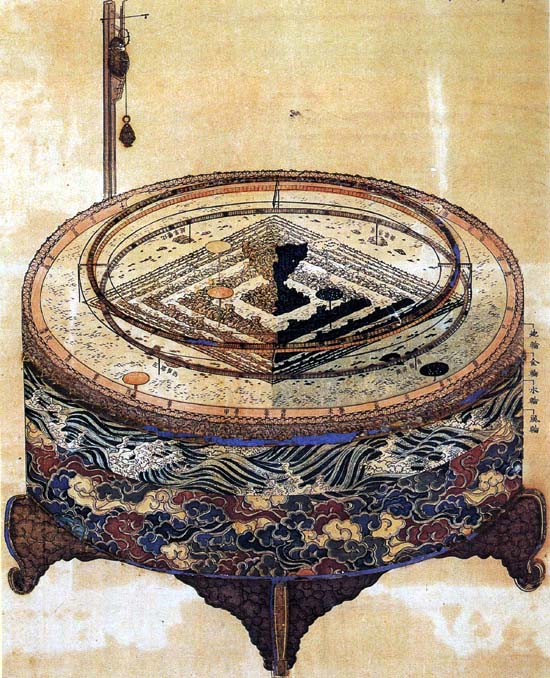
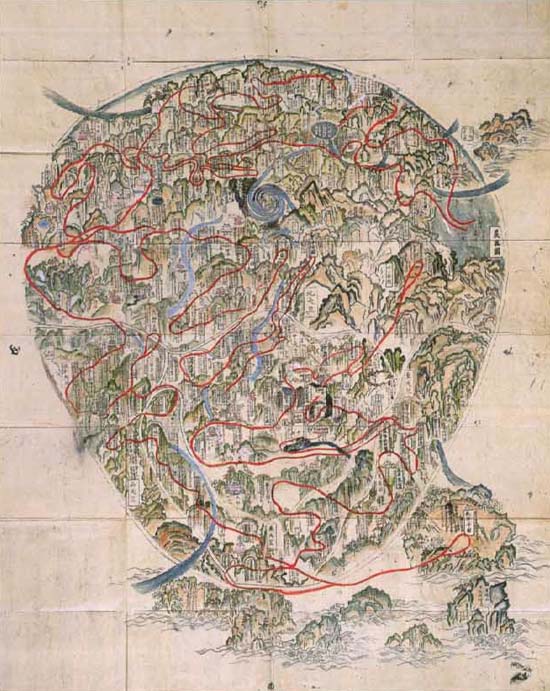
Figure 1 Shumisen-gizu (A Representation of Mount Sumeru), detail, first half of the 19th century. Museum Collection. "In Buddhist philosophy, a giant mountain called Mount Sumeru (Shumisen) was believed to stand at the centre of the world. The map in figure 1 shows a 3-D model (Shumisen-gi) of the Buddhist world organized around Mount Sumeru. The huge mountain of Sumeru towers up in the centre, enclosed by a series of eight concentric oceans and mountain ranges. The outermost of these, called Tecchisen (Cakravada Mountain), is located at the very edge of the world, and in the ocean just inside it (i.e. the outermost ocean) islands are depicted to the north, south, east and west of Mount Sumeru respectively. Of these four islands the one to the south of centre, shaped like an inverted triangle (to the lower right of Mount Sumeru in figure 1), is Nansenbushu (Jambu-dviipa) where human beings reside. Portrayal of Nansenbushu is essential to all Buddhist world maps. The oldest extant example is the 14th century Gotenjiku-zu in the Horyuji collection, but maps in this lineage continued to be produced through the Edo period. The Map of Nansenbushu in figure 2 is one such example. Looking at the inverted triangle shape denoting the Indian Subcontinent we can see the Himalayan Mountains indicated in the central area, and so that tract of land clearly represents India (Tenjiku). In the far northeast corner of this continent we can see China (Shintan) and in the eastern sea at the very edge of the map, the island of Japan."
Figure 2 Map of Nansenbushu (Jambu-dviipa), late Edo period. Museum Collection. Edo period of Japanese history (1603-1867) |
||
| FAIR USE NOTICE: This page contains copyrighted material the use of which has not been specifically authorized by the copyright owner. Pegasus Research Consortium distributes this material without profit to those who have expressed a prior interest in receiving the included information for research and educational purposes. We believe this constitutes a fair use of any such copyrighted material as provided for in 17 U.S.C § 107. If you wish to use copyrighted material from this site for purposes of your own that go beyond fair use, you must obtain permission from the copyright owner. | ||
| ~ MENU ~ |