|
Squaring the Circle |
||
|
..
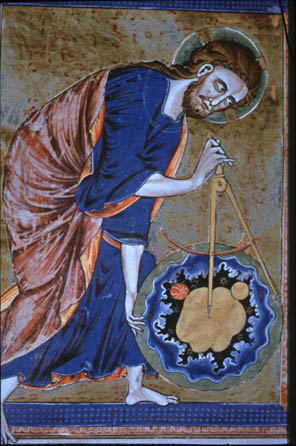
God the Geometer, Manuscript illustration. Clark, Kenneth. Civilization. NY: Harper, 1969. p. 52
According to Cowan, churches had been built on geometric principles since early Christian times. Geometry was the basis of all Gothic cathedrals, everything being created from basic relationships. We've seen that the ground plan was always cruciform, the baptism font always octagonal, and the baptistry itself often was, and the circle was everywhere. This was symbolized in art by God holding a pair of compasses, a common motif in the Middle Ages. The art historian Ernst Gombrich credits a passage from the Old Testament as the inspiration for these portrayals. In Proverbs, Chapter 8 par. 27,
Wisdom put forth her
voice;
|
||
|
The Golden Ratio & Squaring the Circle in the Great Pyramid "Twenty years were
spent in erecting the pyramid itself: of this,
which is square, each face is eight plethra, and
the height is the same;
it is composed of polished stones, and jointed
with the greatest exactness;
none of the stones are less than thirty feet."
-Heroditus, Chap. II,
para. 124.
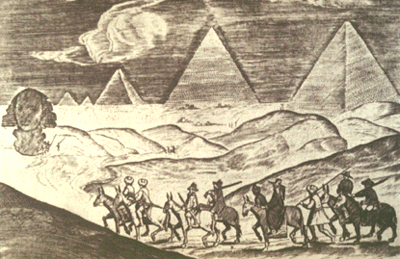
In his History Heroditus says that the pyramids, already ancient, were covered with a mantle of highly polished stones joined with the greatest exactness. Definition of the Golden Ratio The golden ratio is also called extreme and mean ratio. According to Euclid, A straight line is said to have been cut in extreme and mean ratio when, as the whole line is to the greater segment, so is the greater to the less. Rest is here - LESSON 2 |
||
|
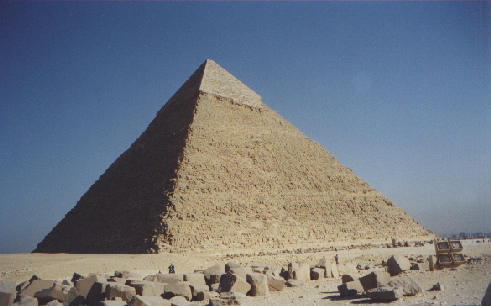
Let's now return to the pyramids. If we take a cross-section through a pyramid we get a triangle. If the pyramid is the Great Pyramid, we get the so-called Egyptian Triangle. It is also called the Triangle of Price, and the Kepler triangle. This triangle is special because it supposedly contains the golden ratio. In particular,the ratio of the slant height s to half the base b is said to be the golden ratio. To verify this we have to find the slant height. Rest is here - LESSON 2 |
||
|
A British railway engineer, Robert Ballard, saw the pyramids on his way to Australia to become chief engineer of the Australian railways. He watched from a moving train how the relative appearance of the three pyramids on the Giza plateau changed. He concluded that they were used as sighting devices, and wrote a book with the grand title of The Solution of the Pyramid Problem in 1882. He also noted that the cross-section of the Great Pyramid is two of what we have called Egyptian triangles. He then constructs what he called a Star Cheops, which, he says, "... is the geometric emblem of extreme and mean ratio and the symbol of the Egyptian Pyramid Cheops." To draw a star Cheops: * Draw vertical
and horizontal axes.
Project Draw a star Cheops. Fold it to quickly make a model pyramid. Rest is here - LESSON 2 |
||
|
..
Now we'll look at his other claim, that the Great Pyramid's dimensions also show squaring of the circle. But just what is that? The problem of squaring the circle is one of constructing, using only compass and straightedge; (a) a square whose perimeter is exactly equal to the perimeter of a given circle, or (b) a square whose area is exactly equal to the area of a given circle. There were many attempts to square the circle over the centuries, and many approximate solutions, some of which we'll cover. However it was proved in the ninteenth century that an exact solution was impossible. Squaring of the Circle in the Great Pyramid The claim is: The perimeter of the base of the Great Pyramid equals the circumference of a circle whose radius equal to the height of the pyramid. Does it? Recall from the last unit
that if we let the
base of the Great pyramid be 2 units in length, then
pyramid height = Then for a circle with radius equal
to pyramid height So the perimeter of the square and the circumference of the circle agree to less than 0.1%. Editors Note: So what was "impossible" in the ninteenth century, the Egytians managed to accomplish on a grand scale to within less than .1% accuracy The Value of Pi in the Pyramid An Approximate
Value for Since the
circumference of the
circle (2 2 Area Squaring of the Circle The claim here is: The area of
that same circle,
with radius equal to the pyramid height equals
that of a rectangle whose
length is twice the pyramid height( Area of
rectangle = 2 ( Area of circle
of radius An agreement within 0.01% |
||
|
We just saw that the circle is the ultimate geometric figure, perfect, infinite, representing the divine, and we had seen that the square often represented mankind. Combining the two figures had special significance, the reconciliation of the heavenly and infinite with the earthly and man-made. Recall from our unit on Egypt we said that the problem of squaring the circle is one of constructing, using only compass and straightedge; (a) a square whose perimeter is exactly equal to the perimeter of a given circle, or (b) a square whose area is exactly equal to the area of a given circle. In that same unit we also saw that a circle whose radius is the pyramid height 1. has the same perimeter of the base of the Great Pyramid 2. and the same area as the rectangle whose width equals the pyramid's base and whose length is twice the pyramid height |
||
| A Note on
Dartmouth University
"Welcome to Dartmouth, a private, four-year liberal arts institution that has been at the forefront of American higher education since 1769. A member of the Ivy League, Dartmouth is a superb undergraduate residential college with the intellectual character of a university, featuring thriving research and first-rate graduate and professional programs." - James Wright, President Editors Note: This is a mainstream Ivy League University studying Ancient Science and Sacred Geometry |
||
| FAIR USE NOTICE: This page contains copyrighted material the use of which has not been specifically authorized by the copyright owner. Pegasus Research Consortium distributes this material without profit to those who have expressed a prior interest in receiving the included information for research and educational purposes. We believe this constitutes a fair use of any such copyrighted material as provided for in 17 U.S.C § 107. If you wish to use copyrighted material from this site for purposes of your own that go beyond fair use, you must obtain permission from the copyright owner. | ||
|
|


 7.992
7.992