|
|
|||||
|
..
Scientists
Now Know: We're Not From Here!
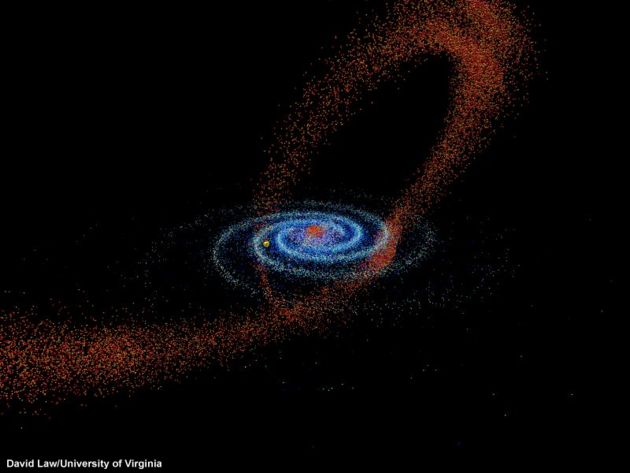
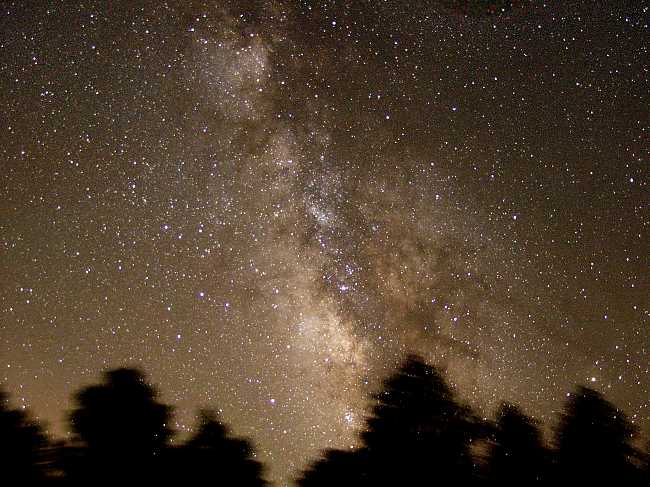
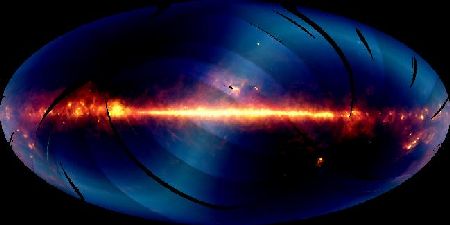
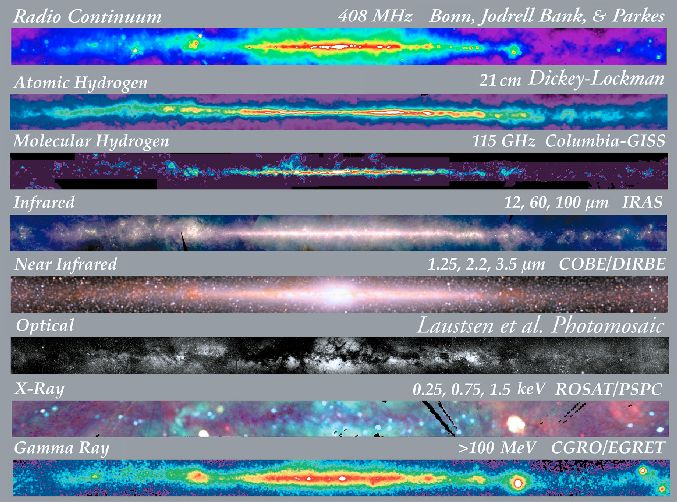
Summary & comments by Dan Eden for Viewzone Viewzone Milky Way Imagine the shock of growing up in a loving family with people you call "Mum" and "Dad" and then, suddenly, learning that you are actually adopted! This same sense of shock came as scientists announced that the Sun, the Moon, our planet and its siblings, were not born into the familiar band of stars known as the Milky Way galaxy, but we actually belong to a strange formation with the unfamiliar name of the Sagittarius Dwarf galaxy! How can this be? Using volumes of data from the Two-Micron All Sky Survey (2MASS), a major project to survey the sky in infrared light led by the University of Massachusetts, the astronomers are answering questions that have baffled scientists for decades and proving that our own Milky Way is consuming one of its neighbors in a dramatic display of ongoing galactic cannibalism. The study published in the Astrophysical Journal, is the first to map the full extent of the Sagittarius galaxy and show in visually vivid detail how its debris wraps around and passes through our Milky Way. Sagittarius is 10,000 times smaller in mass than the Milky Way, so it is getting stretched out, torn apart and gobbled up by the bigger Milky Way.
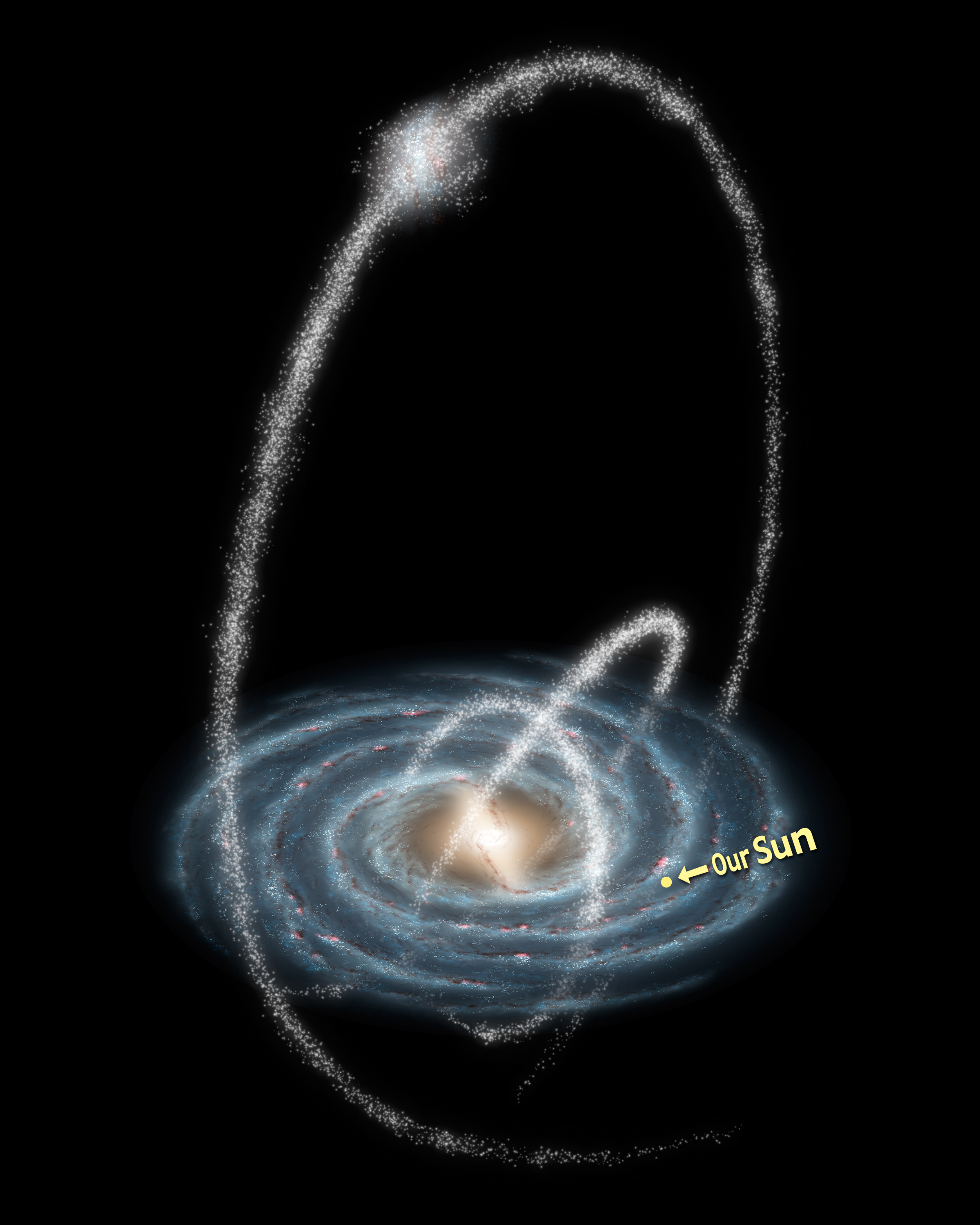
A new infra red digital survey of the entire sky was made in 2003. Teams from the universities of Virginia and Massachusetts used a supercomputer to sort through half a billion stars to create a -- NEW STAR MAP showing our Solar System (yellow circle) to be at the exact nexus crossroads where two galaxies are actually joining. "It's clear who's the bully in the interaction," said Steven Majewski, U.Va. professor of astronomy and lead author on the paper describing the results.Not any more. By using infrared maps, the astronomers filtered away millions of foreground stars to focus on a type of star called an M giant. These large, infrared-bright stars are populous in the Sagittarius galaxy but uncommon in the outer Milky Way. The 2MASS infrared map of M giant stars analyzed by Majewski and collaborators is the first to give a complete view of the Milky Way galaxy's meal of Sagittarius stars, now wrapping like a spaghetti noodle around the Milky Way. Prior to this work, astronomers had detected only a few scattered pieces of the disrupted Sagittarius dwarf. Even the existence of Sagittarius was unknown until the heart of this nearest satellite galaxy of the Milky Way was discovered by a British team of astronomers in 1994. Here's an animation of the "marriage". The fact that the Milky Way is seen in the sky at an angle has always puzzled astronomers. If we originated from the Milky Way, we ought to be oriented to the galaxy's ecliptic, with the planets aligned around our Sun in much the same angle as our Sun aligns with the Milky Way. Instead, as first suggested by researcher Matthew Perkins Erwin, the odd angle suggests that our Sun is influenced by some other system. Together with data from the Two-Micron All Sky Survey we now know what it is. We actually belong to the Sagittarius Dwarf galaxy. "We sifted several thousand interesting stars from a catalog of half a billion," said co-author Michael Skrutskie, U.Va. professor of astronomy and principal investigator for the 2MASS project. "By tuning our maps of the sky to the 'right' kind of star, the Sagittarius system jumped into view."
We are from another galaxy in the process of joining with the Milky Way. The Milky Way is actually not our parent galaxy. The mystery of why the Milky Way has always been sideways in the night sky has never been answered -- until now. "This first full-sky map of Sagittarius shows its extensive interaction with the Milky Way," Majewski said. "Both stars and star clusters now in the outer parts of the Milky Way have been 'stolen' from Sagittarius as the gravitational forces of the Milky Way nibbled away at its dwarf companion. This one vivid example shows that the Milky Way grows by eating its smaller neighbors." The study's map of M giants depicts 2 billion years of Sagittarius stripping by the Milky Way, and suggests that Sagittarius has reached a critical phase in what had been a slow dance of death. "After slow, continuous gnawing by the Milky Way, Sagittarius has been whittled down to the point that it cannot hold itself together much longer," said 2MASS Science Team member and study co-author Martin Weinberg of the University of Massachusetts. "We are seeing Sagittarius at the very end of its life as an intact system." Does this mean we are at a unique moment in the life of our galaxy? Yes and no. "Whenever possible, astronomers appeal to the principle that we are not at a special time or place in the universe," Majewski said. "Because over the 14 billion-year history of the Milky Way it is unlikely that we would just happen to catch a brief event like the death of Sagittarius, we infer that such events must be common in the life of big spiral galaxies like our own. The Milky Way probably dined on a number of dwarf galaxy snacks in the past." On the other hand, Majewski and his colleagues have been surprised by the Earth's proximity to a portion of the Sagittarius debris. "For only a few percent of its 240 million-year orbit around the Milky Way galaxy does our Solar System pass through the path of Sagittarius debris," Majewski said. "Remarkably, stars from Sagittarius are now raining down onto our present position in the Milky Way. Stars from an alien galaxy are relatively near us. We have to re-think our assumptions about the Milky Way galaxy to account for this contamination." The new findings will help astronomers measure the total mass of the Milky Way and Sagittarius galaxies, and probe the quantity and distribution of the invisible dark matter in these systems. "The shape of the Sagittarius debris trail shows us that the Milky Way's unseen dark matter is in a spherical distribution, a result that is quite unexpected," Weinberg said. "The observations provide new insights into the nature of the mysterious dark matter," said Princeton's Spergel. "Either our galaxy is unusual or the dark matter has richer properties than postulated by conventional models." Implications in Global Warming? It has been postulated that this is the real reason for both global warming since higher energy levels of the Milky Way are almost certain to cause our Sun to burn hotter and emit higher energies. Indeed, temperatures have been seen to rise on virtually all the planets in our system. This seems quite apart from any local phenomenon like greenhouse gases etc. This grand turning is possibly the root cause for the discontinuation of the Mayan calendar (the most accurate on the planet) because the 'read-point' of the Pleiades star cluster, which many believe the calendar was based upon, can no longer be a constant as we begin to steer away from the earlier predictable movements.
Other changes happening in our system The "marriage" of our birth galaxy with our new adopted Milky Way galaxy is causing energy shifts that are obvious just about everywhere. Here are some changes being watched by scientists:
We of the overarching Sagittarius Dwarf Elliptical Galaxy have finally come down next to, and even with the massively powerful spiral armed equatorial plane of the Milky Way Galaxy. In our movement through space, our Earth has now fully begun to respond to the more powerful galactic energies and electro-gravitational bias of the massive Milky Way. We have reached the higher energy equatorial disc region of the massive spiral arm. We have now been "adopted" by a new system, a stronger and more powerful system, and we can expect changes on almost every level of energy. Whatever these changes are, they are all part of the natural birth, death, rebirth and transformation of the cosmos. As our knowledge of the universe grows, we cannot but understand how much we do not understand. Such is life. [For further reading we suggest you go to Matthew Perkins Erwin's blog; abc.net.au which was the basis of this summary.] Readers may also be interested to read about Doomsday: The Mayan Prophecy. Comments: From Dan Eden: Back when the telescope was first invented, those who observed the movement of the planets postulated that the Earth was not the center of "God's creation" and were criticized, imprisoned and even put to death as heretics. The criticism was usually vague and simply stated that things were not that way because... everyone should know they it's just not that way... A paradigm is always difficult to change and seldom yields to a newer idea without much dialog and discussion.UPDATE: MARCH 2010 New 'Alien Invader' Star Clusters Found in Milky Way ScienceDaily (Feb. 26, 2010) As many as one quarter of the star clusters in our Milky Way -- many more than previously thought -- are invaders from other galaxies, according to a new study. The report also suggests there may be as many as six dwarf galaxies yet to be discovered within the Milky Way rather than the two that were previously confirmed. "Some of the stars and star clusters you see when you look into space at night are aliens from another galaxy, just not the green-skinned type you find in a Hollywood movie. These 'alien' star clusters that have made their way into our galaxy over the last few billion years," says Terry Bridges, an astronomer at Queen's University in Kingston, Canada. The study (co-authored by Duncan Forbes of Swinburne University of Technology in Australia) has been accepted for publication in the Monthly Notices of the Royal Astronomical Society. Previously, astronomers had suspected that some star clusters, which contain from 100,000 to a million stars each, were foreign to our galaxy, but it was difficult to identify which ones. Using mostly Hubble Space Telescope data, Mr. Bridges and Mr. Forbes examined old star clusters within the Milky Way galaxy. From the research they compiled the largest ever high-quality database to record the age and chemical properties of each of these clusters. "We looked at all the data we could find. The best data are from the Hubble Telescope because it has the best imaging," Bridges says. "We looked at the ages and the amounts of heavy elements in these clusters, which can be measured from their stars." The researchers' work also suggests that the Milky Way may have swallowed-up more dwarf galaxies than was previously thought. They found that many of the foreign clusters originally existed within dwarf galaxies -- 'mini' galaxies of up to 100 million stars that sit within our larger Milky Way. The study suggests that there are more of these accreted dwarf galaxies in our Milky Way than was thought. Dan Eden SOURCE: Viewzone Milky Way
Editor's Notes: #5. This statement about the gases from IO to Jupiter came from here, The Millenium Group. It is copied all over the web. The article is written by Alexei N. Dmitriev who also is involved in SETI. (See Towards Lunar Archaeology- SETI). Z.I.Vselennaya is not the name of an author as it seems on looking at the references. "Zemlya i Vselennaya" is the phonetic translation of the Russian "Земля и Вселенная" which is the name of the Magazine "Earth and Universe" printed in Russian. The only reference found so far about this IO/Jupiter gas event is in this repeated article. We have not yet traced the original Data to the Russian periodical so far. The issue is Vol No. 3 1997. However... using different search parameters we did get the story. See Below |
|||||
Related Links:
|
|||||
| Sagittarius
Dwarf Elliptical
Galaxy
The Sagittarius Dwarf Elliptical Galaxy (SagDEG) is an elliptical loop-shaped satellite galaxy of the Milky Way Galaxy. The main cluster which, in 1994, was the first to be discovered, is roughly 10,000 light-years in diameter, and is currently about 70,000 light-years from Earth and travelling in a polar orbit at a distance of about 50,000 light-years from the core of the Milky Way (about 1/3 the distance of the Large Magellanic Cloud). Sag DEG should not be confused with Sag DIG, the Sagittarius Dwarf Irregular Galaxy, a small galaxy 3.4 million light-years distant. Geometry and dynamics Based on its current trajectory, the Sag DEG main cluster is about to pass through the galactic disc of the Milky Way within the next hundred million years, while the extended loop-shaped ellipse is already extended around and through our local space and on through the Milky Way galactic disc, and in the process of slowly being absorbed into the larger galaxy, calculated at 10,000 times the mass of Sag DEG. SOURCE: Sagittarius Dwarf Elliptical Galaxy
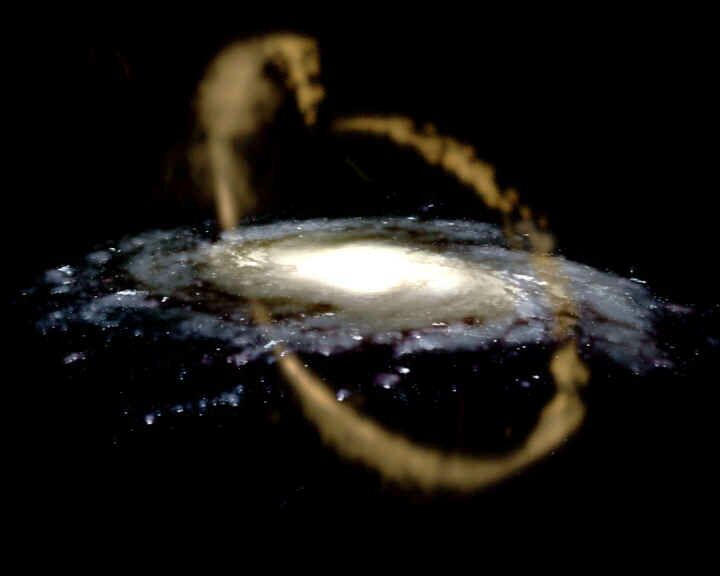
Explanation: Is our Milky Way Galaxy out to lunch? Recent wide field images and analyses now indicate that our home galaxy is actually still in the process of devouring its closest satellite neighbor. This unfortunate neighbor, the Sagittarius Dwarf galaxy, is now seen to be part of a larger Sagittarius Tidal Stream, a loose filament of stars, gas, and possibly dark matter that entangles the Milky Way. An artist's depiction of the stream is shown above. Speculation also holds that the Sagittarius Dwarf was once pulled through the Milky Way disk very close to our Sun's current location. An important resulting realization is that galaxies contain a jumble of clumps and filaments of both dim and dark matter. SOURCE: NASA APOD |
|||||
|
..
Rings Around
the Galaxy
Three newly-discovered streams arcing high over the Milky Way Galaxy are remnants of cannibalized galaxies and star clusters. The streams are between 13,000 and 130,000 light-years distant from Earth and extend over much of the northern sky. Two of the newly discovered streams are almost certainly the remains of ancient star clusters. Known to astronomers as globular clusters, these giant stellar cities contain between tens of thousands and millions of stars. Though only about 150 globular clusters orbit the Milky Way today, they may once have numbered in the thousands. Over billions of years, the relentless gravitational stresses inflicted on them by our galaxy have slowly torn them apart, leaving behind long, thin streams of stars. Once crowded so closely together that they could sometimes actually collide, these stars are now separated by many light-years, trailing one another at half a million miles an hour through the dark and lonely reaches of the galactic halo. The third stream is spread over a much larger region of the sky, and is most likely the scattered remains of a dwarf galaxy. Such dwarf galaxies may contain up to 100 million stars, along with sometimes substantial amounts of mysterious "dark matter." While the Milky Way galaxy currently hosts a family of 20 or so known dwarf galaxies, scientists who study the growth of galaxies in the early universe have long been puzzled as to why we don't see hundreds of them. SOURCE: Rings Around the Galaxy - Spitzer Space Telescope - NASA |
|||||
| The Following
Posts are relevant
Excerpts from our discussion thread at
AboveTopSecret.com...
The Milky Way - Welcome to your New Home Galaxy! Originally posted by poet1b ATS Post ID 10091256 Great stuff Zorgon. Thanks for posting this thread. Here is a link that gives an idea of how this information is obtained, and how much scientist really know about what they are discovering as their ability to gaze out into space improves. At the very end there are some pictures that put more perspective on the situation. This is some heavy stuff, but those scientifically minded should be able to glean a better perspective of what is being said. Maximum Likelihood Fitting of Tidal Streams With Application to the Sagittarius Dwarf Tidal Tails - [PDF][Archived] What fascinates me is the huge spiraling ring that has been named the Sagittarius Tidal Stream. While this system might not be as dense as the Milky Way Galaxy, it seems to occupy a far greater amount of space. Could the STS extend far deeper into space than we are aware? I don't see how this could have been some kind of spiral galaxy ripped apart by the Milky way. It doesn't fit any pattern to suggest such a thing, from what I am reading. Could this stream link us to other galaxies? There is a story out on the web that has been discussed here on ATS on some threads which claims that the Earth, and our solar system is very important territory for some galactic empire, because we are situated in an important trade route. With the STS intersecting at our location in space, it sure makes that crazy story more plausible. Originally
posted by poet1b ATS
Post
ID 10091420
Actually our solar system is moving across the solar plane, not necessarily around it. It is ( or was ) believed that we orbit the center of our galaxy in a sinusoidal pattern, but that is only a theory that at a certain point the direction our solar system is moving will change. The Sun and planets move in a quasi-elliptical orbit between about 8.4 and 9.7 kpc from the galactic center, with a period of revolution of about 240 million years. The solar system Is currently close to and moving inward toward "perigalacticon," the point in the orbit closest to the galactic center. In addition, the solar system moves perpendicular to the galactic plane in a harmonic fashion, with a period of 52 to 74 million years and an amplitude of ~49 to 93 pc out of the galactic plane. (The uncertainties in the estimates of the period and amplitude of the motion are caused by the uncertainty in the amount of dark matter in the galactic disk.) The Sun and planets passed through the galactic plane about 2-3 million years ago, moving "northward."It is pure theory that we moving in an orbit around the center of the Milky Way galaxy, as I pointed out in my previous post. Currently we are moving across the galactic plane at a pretty steep angle. And the plane of our solar system is at about a 90 degree angle from our galactic plane. [Ed Note: About the same angle of the Sagittarius Streamer] Originally
posted by poet1b ATS
Post
ID 10091775
Read the article in my first post on this thread, and you will get an idea of how little we know about space. The article you linked to does not support your claims, and asks more questions than it gives answers. The tilt of the Earth's axis of rotation has nothing to do with it, we are talking planetary orbit. The orbit of the Moon, which is in line with our orbit around the sun does prove my point. Our solar plane is almost 90 degrees different from the galactic plane, and that does puzzle scientists. Originally posted by poet1b ATS Post ID 10099666 Once again, it is pure theory that we are orbiting the Milky Way. Our solar system is currently moving almost perpendicular to the plane of the Milky Way. The theory is that we oscillate around the Milky Way galaxy in a sinusoidal pattern, but the length of time for a single cycle is millions of years, and there is no proof that this happens, only a theory. . We might be a part of the Sagittarius Tidal Stream, and remain a part of it. You debunkers need to throw up some links to back up your claims. |
|||||
| Clean up Below | |||||
| Originally posted by ZeroGhost ATS
Post
ID 10100257
Wonderful topic, and one I wish I had a day to contribute and read comments thoughtfully. Great work by the OP and the recent information, although tenuous in our exact understanding due to SAG Deg being discovered in 1994, is the reality we now see that we are in a relationship with an interloper galaxy. I did a lot of illustration for different astronomy orgs and publications before the discovery was confirmed and accepted, so all my work eventually became obsolete, which is a good thing. It shows our understanding and observational is evolving. Below is an illustration of our local group with delineated distances. We did not see SagDEG behind the Sagittarius stellar density of our galactic core, and still cannot see it clearly due to this, so it is not in this illustration, but would be like the Magellanic clouds, (LMC SMC), but closer, smaller and more diffuse. The arms so diffuse you can only see remnants in star density imaging from our location. 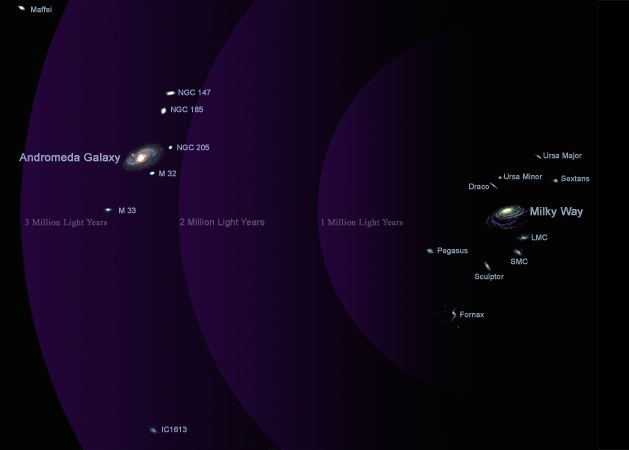 You can see how larger galactic structures attract smaller ones in this. SagDEG has been absorbed mostly, but has been orbiting the Milky Way for many orbits, It's closest at about 50,00 LY from SagA, the center of our galactic Core. It is hard then to speculate on and if our particular stellar cluster was from SagDEG originally. Such an event would be hundreds of millions of years past, and long since become a "naturalized" citizen of the milky way. Ancient Sanskrit texts in India, largely found to be accurate in its numbers, volumes and distances thousands of years before modern astronomy, tell of our solar systems orbit of the core several times. 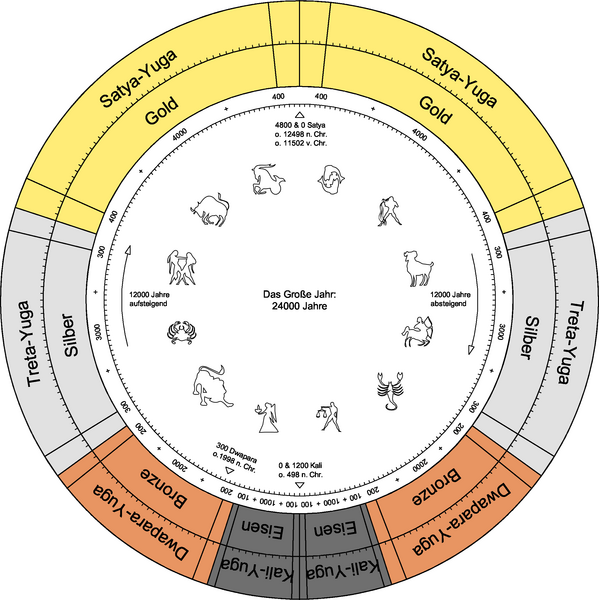 Called the "Yugas", they outline ages of our planetary life in many hundreds of thousands of years, and tell us also of an eccentricity where in our Aphelion and Perihelion, or closest and furthest point to the center, we experience a different awareness. Orbital eccentricity is the off center point of orbit also. 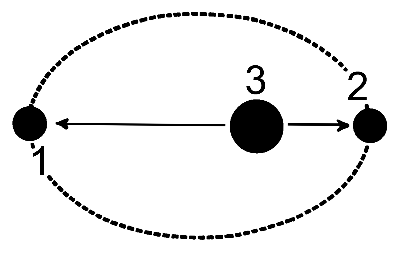 Apsides 1) Apoapsis; 2) Periapsis; 3) Focus We are in the Kali Yuga, the apsis, or the point of greatest distance of the foci of the elliptical orbit. We are moving in to the Dwapara Yuga, inbound and now getting closer. Point being, if the record from ancients predating our current cycle of civilization on this planet is accurate, we might be original, and not from SagDEG. The Hopi say we are 4th world moving to 5th. Maybe they have the records deep in their sacred repository to back this up too? As far as our position on a theoretical plane of the galaxy, we are always moving away and towards and pass up and over, under and up the plain every few thousand years. In this illustration we can see how we would look if our planetary track was lit as we oscillate in our orbit. Notice the very slight curve of the sun? That would be the oscillatory point weaving up and down along the orbit. 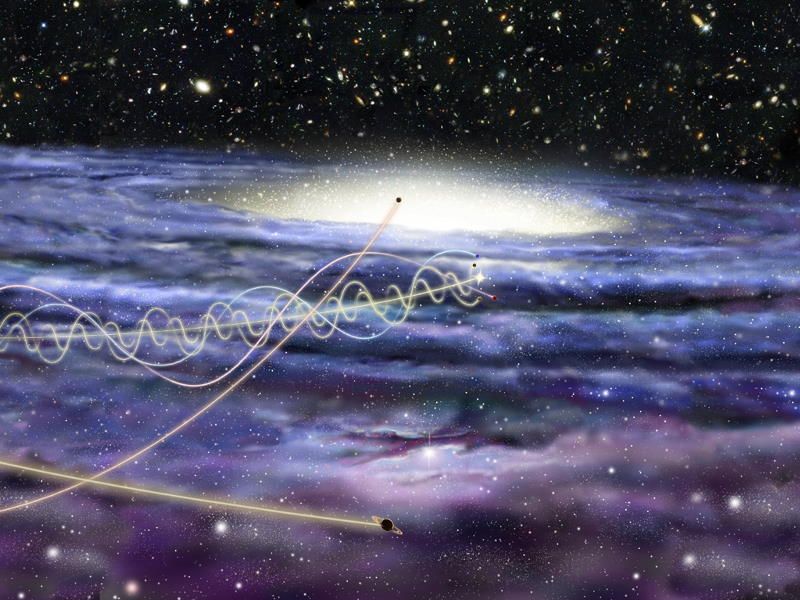 Everything is a sine wave. Amplitude and frequency determining by the mass and speed and relationship to the larger mass. In this case the Milky Way core. This might show in visual terms how all objects move in a stationary relationship to each other while also being influenced by other nearby masses and solar and other particle space winds, gases and forms of space "friction". All effects all. I would like to illustrate and animate in 3D the SagDEG interloping event to current and project forward. I wish someone would give me a grant to do that. You can do that on small systems now. No super Cray is needed. The stretched arms of a galaxy being ripped by larger galaxies when exposed, are called Rat Tail galaxies. In this illustration, you can see some galaxies arms being ripped and stretched, then absorbed into the larger galaxies. Timothy Ferris has a great picture book called Galaxies, that explains and shows how that dynamic effect works. We get very interesting galactic formations from such events. 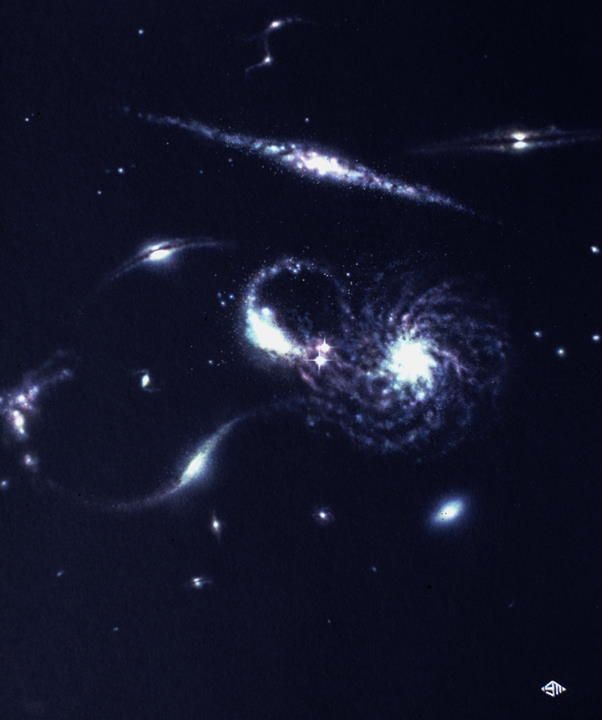 It is a common event in galactic evolution. Galaxies attract, then absorb, or can actually decimate one another completely, like a car wreck, throwing fractions and gravitationally cohesive strings of debris millions of light years from an event. Flung into the intergalactic abyss. The LMC and SMC might be stabilized crumbs left over from other impacts or just smaller attracted entities to the Milky Way. The Andromeda Galaxy, thought to have been the biggest in our local group, is now thought to be smaller than our Milky Way, and is moving towards us and will impact us in 3-4 billion years. Science has waffled about such events, saying that component distribution of one galaxy and another are so far apart that nothing will touch as they pass through one another. Others then said otherwise, and again back to the dispersion being too great. OK in theory, but it is misleading because there are gravitational and other fields that will impact as well. Collisions of stars and planets are not out of the realm of possibility. We have observed as much in other galactic events. Even core impacts. THAT would be a show of shows. Remote view that however if you know whats good for you. :lol: Thanks again to the OP. I eat this stuff for lunch :) ZG |
|||||
| ADD MORE FROM FORUM |
|||||
| FAIR USE NOTICE: This page contains copyrighted material the use of which has not been specifically authorized by the copyright owner. Pegasus Research Consortium distributes this material without profit to those who have expressed a prior interest in receiving the included information for research and educational purposes. We believe this constitutes a fair use of any such copyrighted material as provided for in 17 U.S.C § 107. If you wish to use copyrighted material from this site for purposes of your own that go beyond fair use, you must obtain permission from the copyright owner. | |||||
|
|