Muhammad
ibn Zakariya al-Razi
August 26, 865
- 925
..
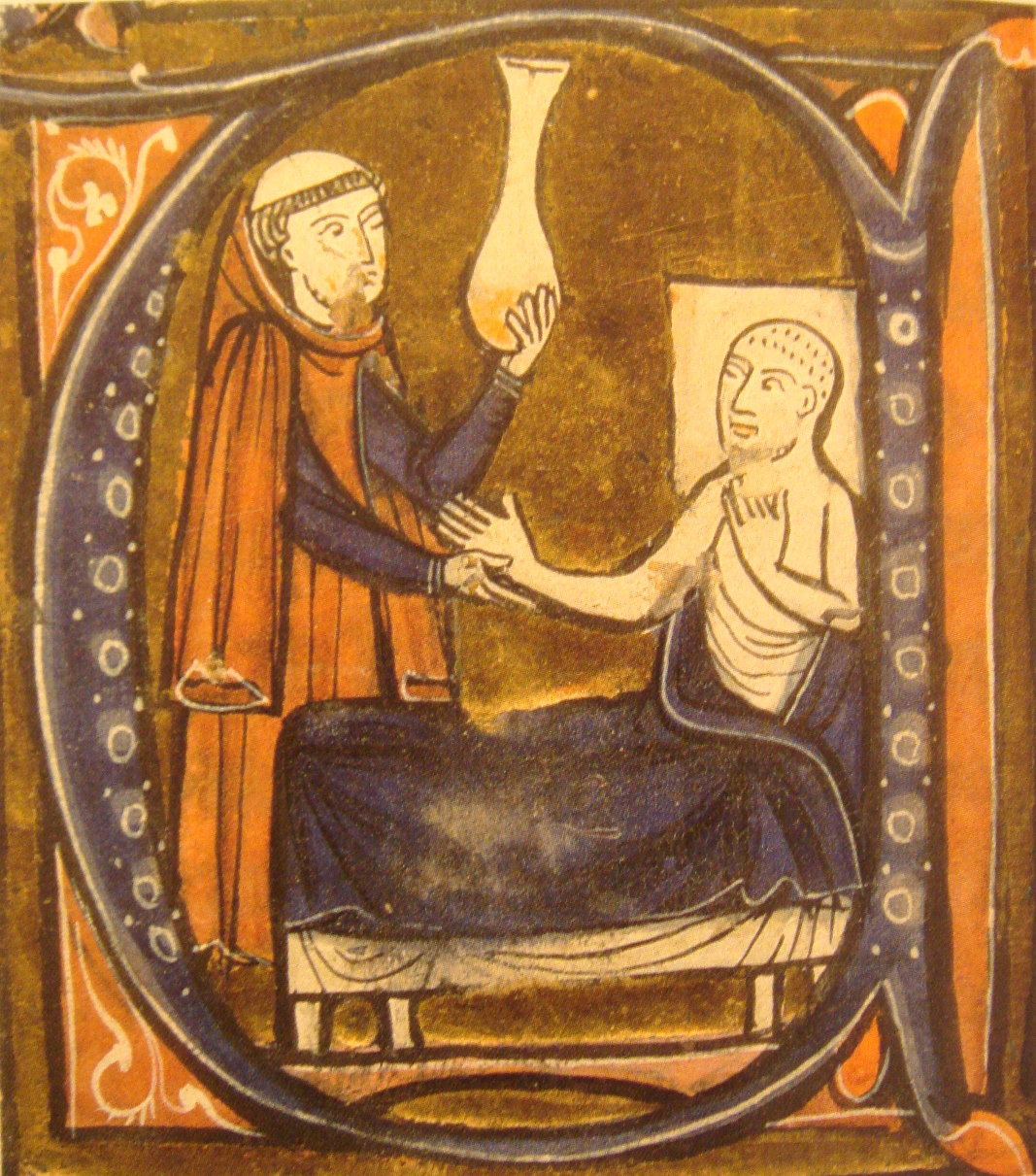
European
depiction of the Persian
(Iranian) doctor Al-Razi, in Gerardus Cremonensis
"Recueil des traités
de médecine" 1250-1260. Gerardus
Cremonensis
"Recueil des traités de médecine" 1250-1260.
Reproduction
in "Inventions et découvertes au Moyen-Âge",
Samuel Sadaune. Author
Gerardus Cremonensis
Muhammad ibn
Zakariya al-Razi
Persian scholar
Medieval era
Full Name: Abū Bakr Muhammad ibn
Zakariyā Rāzī
Notable ideas: The discovery of
alcohol, first to produce
acids such as sulfuric acid, writing up limited or
extensive notes on diseases
such as smallpox and chickenpox, a pioneer in
neurosurgery and ophthalmology,
making leading contributions in inorganic and
organic chemistry, also the
author of several philosophical works.
Abū Bakr Muhammad ibn Zakariyā
Rāzī (Zakariā-ye
Rāzi: Persian: زكريای رازی), known as Rhazes
or Rasis after
medieval Latinists, (August 26 865, Rayy - 925,
Rayy) was a Persian alchemist,
chemist, physician, philosopher and scholar. He is
recognised as a polymath
and often referred as "probably the greatest and
most original of all the
Muslim physicians, and one of the most prolific as
an author
He made fundamental and enduring
contributions to the
fields of medicine, alchemy, music, and
philosophy, recorded in over 184
books and articles in various fields of science.
He was well-versed in
Persian, Greek and Indian medical knowledge and
made numerous advances
in medicine through own observations and
discoveries.
Well educated in music,
mathematics, philosophy, and
metaphysics, he finally chose medicine as his
professional field. As a
physician, he was an early proponent of
experimental medicine and is considered
the father of pediatrics. He was also a pioneer of
neurosurgery and ophthalmology.
He was among the first to use Humoralism to
distinguish one contagious
disease from another. In particular, Razi was the
first physician to distinguish
smallpox and measles through his clinical
characterization of the two diseases.
And as an alchemist, Rhazes is known for his study
of sulfuric acid and
for his discovery of ethanol and its refinement to
use in medicine. He
became chief physician of Rayy and Baghdad
hospitals.
Rhazes was a rationalist and very
confident in the
power of ratiocination; he was widely regarded by
his contemporaries and
biographers as liberal and free from any kind of
prejudice and very bold
and daring in expressing his ideas without a
qualm.
He traveled extensively but mostly
in Persia. As a
teacher in medicine, he attracted students of all
disciplines and was said
to be compassionate and devoted to the service of
his patients, whether
rich or poor.
Contents
-
Biography
-
Razi's
masters
and opponents
-
Contributions
to
medicine
-
Smallpox
vs. measle
-
Allergies
and fever
-
Pharmacy
-
Ethics
of medicine
-
Books
and articles
on medicine
-
Books
on medicine
-
Translations
-
Alchemy
-
The
Transmutation
of Metals
-
Chemical
instruments
and substances
-
Major works
on alchemy
-
Books
on alchemy
-
Philosophy
-
On
existence
-
Metaphysics
-
Excerpt
from
The Philosophical Approach
-
Books
on philosophy
-
On
Religion
-
Criticism
-
Quotes
from Rhazes
-
Quotes
on Rhazes
-
Legacy
-
Notes
-
References
and
further reading
-
Bibliography
-
Ancient
sources
-
Modern
studies
-
Editions
of
philosophical works
-
See also
-
External
links
Biography
..
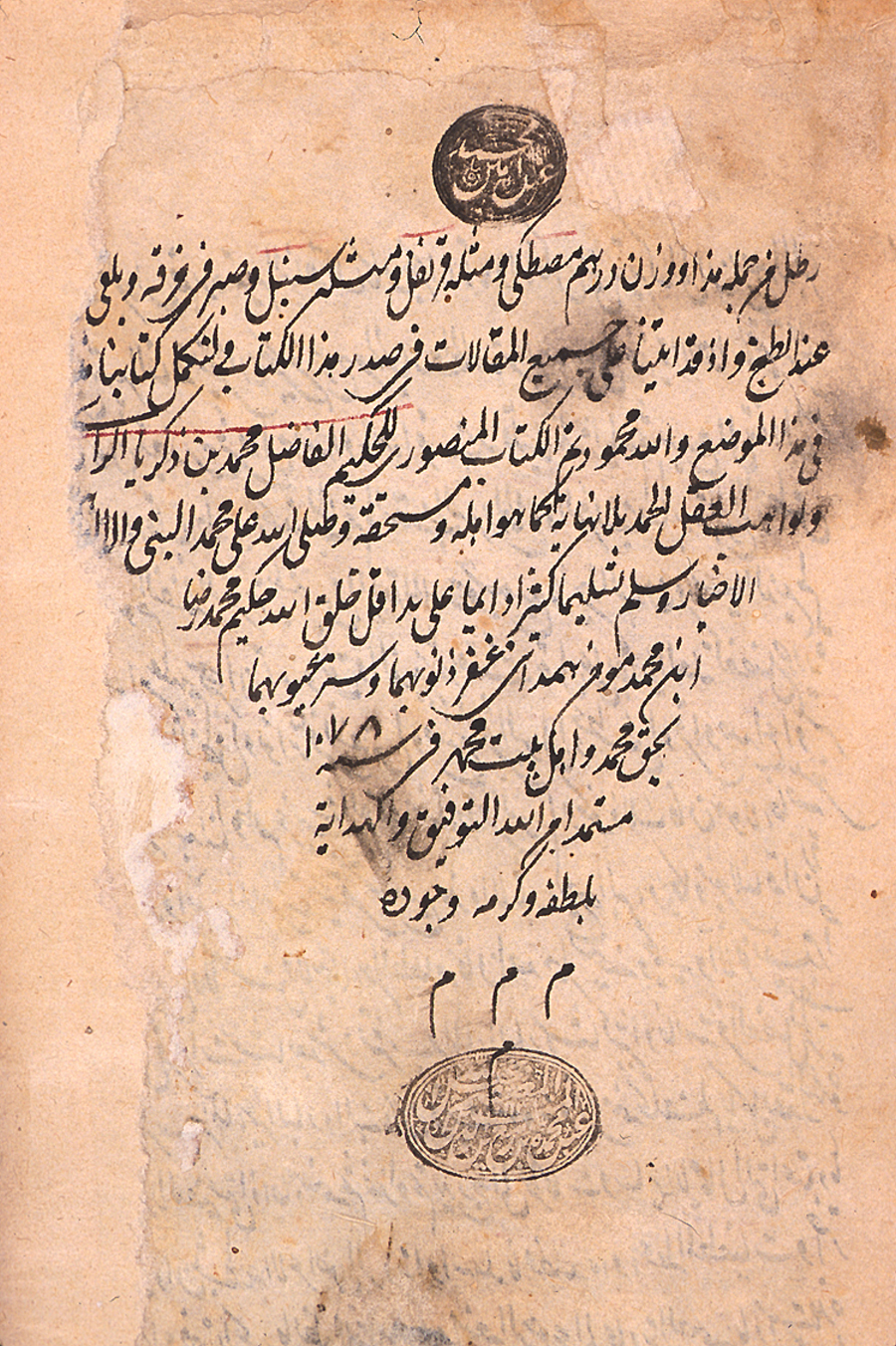
Colophon
of Razi's Book
of Medicine in Arabic
Rhazes was born on 28 August 865
AH and died on 6 October
925AH. His name Razi in Persian means from
the city of Rayy, an
ancient town called Ragha in old Persian and Ragâ
in Avestan. It is located
on the southern slopes of the Elburz Range
situated near Tehran, Iran.
In this city (like Ibn Sina) he accomplished most
of his work.
In his early life he could have
been a musician or
singer (see Ibn abi Usaibi'ah) but more likely a
lute-player who shifted
his interest from music to alchemy (cf. ibn
Juljul, Sa'id, ibn Khallikan,
Usaibi'ah, al-Safadi). At the age of 30 (Safadi
says after 40) he stopped
his study of alchemy because his experimentation
had caused an eye-disease
(Cf. al-Biruni), obliging him to search for
physicians and medicine to
cure it. al-Biruni, Beyhaqi and others, say this
was the reason why he
began his medical studies.
He studied medicine under Ali ibn
Sahl Rabban al-Tabari,
known as Ali ibn Rabban al-Tabari or Ali ibn Sahl,
(Cf. al-Qifti,
Usaibi'ah), a physician and philosopher born in
Merv about 192 AH (808
C.E.) (d. approx. 240 AH (855 C.E.)). Ali ibn Sahl
belonged to the famous
medical school of Tabaristan or Hyrcania). This
teacher was a Jew who had
converted to Islam in conjunction with taking an
appointment to the court
of the Abbassid caliph Al-Mu'tasim (833-842 C.E.).
Razi became famous in his native
city as a physician.
He became Director of the hospital of Rayy (Cf.
ibn Juljul, al-Qifti,
ibn abi Usaibi'ah), during the reign of Mansur ibn
Ishaq ibn Ahmad ibn
Asad who was Governor of Rayy from 290-296 AH
(902-908 C.E.) on behalf
of his cousin Ahmad ibn Isma'il ibn Ahmad, second
Samanian ruler. Razi
dedicated his al-Tibb al-'Mansurito Mansur
ibn Ishaq ibn Ahmad,
which was verified in a handwritten manuscript of
his book. This was refuted
by ibn al-Nadim', but al-Qifti and ibn abi
Usaibi'ah confirmed that the
named Mansur was indeed Mansur ibn Isma'il who
died in 365 AH (975 C.E.).
Razi moved from Rayy to Baghdad during Caliph
Muktafi's reign (approx.
289-295 AH (901-907 C.E.)) where he again held a
position as Chief Director
of a hospital.
After al-Muktafi's death in 295 AH
(907 C.E.) Razi
allegedly returned to Rayy where he gathered many
students around him.
As Ibn al-Nadim relates in Fihrist, Razi
was then a Shaikh
(title given to one entitled to teach), surrounded
by several circles of
students. When someone arrived with a scientific
question, this question
was passed on to students of the 'first circle'.
if they did not know the
answer, it was passed on to those of the 'second
circle'... and so on and
on, until at last, when all others had failed to
supply an answer, it came
to Razi himself. We know of at least one of these
students who became a
physician. Razi was a very generous man, with a
humane behavior towards
his patients, and acting charitable to the poor.
He used to give them full
treatment without charging any fee, nor demanding
any other payment.[citation
needed]
Some say the cause of his
blindness was that he used
to eat too many broad beans (baqilah). His
eye affliction started
with cataracts and ended in total blindness. The
rumor goes that he refused
to be treated for cataract, declaring that he "had
seen so much of the
world that he was tired of it." However, this
seems to be an anecdote more
than a historical fact. One of his pupils from
Tabaristan came to look
after him, but, according to al-Biruni, he refused
to be treated proclaiming
it was useless as his hour of death was
approaching. Some days later he
died in Rayy, on the 5th of Sha'ban 313 AH (27th
of October, 925 C.E.).
Razi's
masters and opponents
Razi studied medicine under Ali
ibn Rabban al-Tabari, however, Ibn
al-Nadim indicates that he studied
philosophy under al-Balkhi, who
had travelled much and possessed great knowledge
of philosophy and ancient
sciences. Some even say that Razi attributed some
of al-Balkhi's books
on philosophy to himself. We know nothing about
this man called al-Balkhi,
not even his full name.
Razi's opponents, on the contrary,
are well-known.
They are the following:
-
Abu al-Qasim al-Balki, chief of
the Mu'tazilah
of Baghdad (d. 319 AH/931 CE), a contemporary of
Razi who wrote many refutations
about Razi's books, especially in his Ilm
al-Ilahi. His disagreements
with Razi entailed his thoughts on the concept
of 'Time'.
-
Shuhaid ibn al-Husain al-Balkhi,
with whom Razi had many
controversies; one of these was on the concept
of 'Pleasure', expounded
in his Tafdll Ladhdhat al-Nafs which abu
Sulaiman al-Mantiqi al-Sijistani quotes in
his work Siwan al-Hikmah.
Al-Balkhi died prior to 329 AH/940 CE.
-
Abu Hatim al-Razi (Ahmad ibn
Hamdan). an Isma'ili missionary,
was one of his most influential opponents (d.
322 AH/933-934 CE). He published
his controversies with Razi in his book A'lam
al-Nubuwwah. Because
of this book, Razi's thoughts on Prophets and
Religion are preserved to
the present time.
-
Ibn al-Tammar (seemingly being
abu Bakr Husain al-Tammar,
according to Kraus) was a physician who had some
disputes with Razi, as
documented by Abu Hatim al-Razi in A'lam
al-Nubuwwah. Ibn al-Tammar
disagreed with Razi's book al-Tibb al-Ruhani
but Razi rebutted him
in two antitheses:
-
First refutation of al-Tammar's
disagreement with
Misma'i
concerning 'Matter'.
-
Second refutation of
al-Tammar's opinion of 'the Atmosphere
of subterranean habitations'.
-
Following are authors as
described by al-Razi in his writings:
-
al-Misma'i, a Mutakallim,
who opposed 'materialists',
counteracted byan al-Razi's treatise.
-
Jarir, a physician who had a
theory about 'The eating
of black mulberries after consuming
water-melon'.
-
al-Hasan ibn Mubarik al-Ummi,
to whom al-Razi wrote two
epistles with commentaries.
-
al-Kayyal, a Mutakallim:
al-Razi wrote a book on
about his Theory of the Imam.
-
Mansur ibn Talhah, being the
author of the book "Being",
which was criticized by al-Razi.
-
Muhammad ibn al-Laith
al-Rasa'ili whose opposition against
alchemists was disputed by al-Razi.
-
Ahmad ibn al-Tayyib al-Sarakhasi
(d. 286 AH/899 CE), was
an older contemporary of al-Razi. Al-Razi
disagreed with him on the question
of 'bitter taste'. He moreover opposed his
teacher Ya'qub ibn Ishaq al-Kindi,
regarding his writings, in which he discredited
alchemists.
-
More names could be added to this
list of all people opposed
by al-Razi, specifically the Mu'tazilah
and different Mutakallimin.
Contributions
to medicine
Smallpox vs.
measles
..
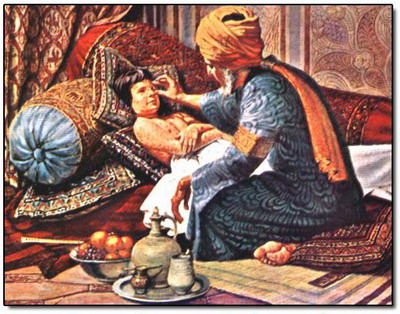
Razi,
treating a patient.
Muhammad
ibn Zakariya ar-Razi
before 1970 Iranian 2nd year of Rahnamai
textbook
As chief physician of the Baghdad
hospital, Razi formulated
the first known description of smallpox:
"Smallpox appears when blood
'boils' and is infected,
resulting in vapours being expelled. Thus juvenile
blood (which looks like
wet extracts appearing on the skin) is being
transformed into richer blood,
having the color of mature wine. At this stage,
smallpox shows up essentially
as 'bubbles found in wine' - (as blisters) - ...
this disease can also
occur at other times - (meaning: not only during
childhood) -. The best
thing to do during this first stage is to keep
away from it, otherwise
this disease might turn into an epidemic."
This diagnosis is acknowledged by the
Encyclopaedia
Britannica (1911), which states: "The most
trustworthy statements as
to the early existence of the disease are found in
an account by the 9th-century
Persian physician Rhazes, by whom its symptoms were
clearly described,
its pathology explained by a humoral or fermentation
theory, and directions
given for its treatment."
Razi's book: al-Judari wa
al-Hasbah (On Smallpox
and Measles) was the first book describing
smallpox and measles as distinct
diseases. It was translated more than a dozen
times into Latin and other
European languages. Its lack of dogmatism and its
Hippocratic reliance
on clinical observation show Razi's medical
methods. For example:
"The eruption of smallpox is
preceded by a continued
fever, pain in the back, itching in the nose and
nightmares during sleep.
These are the more acute symptoms of its approach
together with a noticeable
pain in the back accompanied by fever and an
itching felt by the patient
all over his body. A swelling of the face appears,
which comes and goes,
and one notices an overall inflammatory color
noticeable as a strong redness
on both cheeks and around both eyes. One
experiences a heaviness of the
whole body and great restlessness, which expresses
itself as a lot of stretching
and yawning. There is a pain in the throat and
chest and one finds it difficult
to breath and cough. Additional symtomps are:
dryness of breath, thick
spittle, hoarseness of the voice, pain and
heaviness of the head, restlessness,
nausea and anxiety. (Note the difference:
restlessness, nausea and anxiety
occur more frequently with 'measles' than with
smallpox. At the other hand,
pain in the back is more apparent with smallpox
than with measles). Altogether
one experiences heat over the whole body, one has
an inflamed colon and
one shows an overall shining redness, with a very
pronounced redness of
the gums."
Allergies and
fever
..
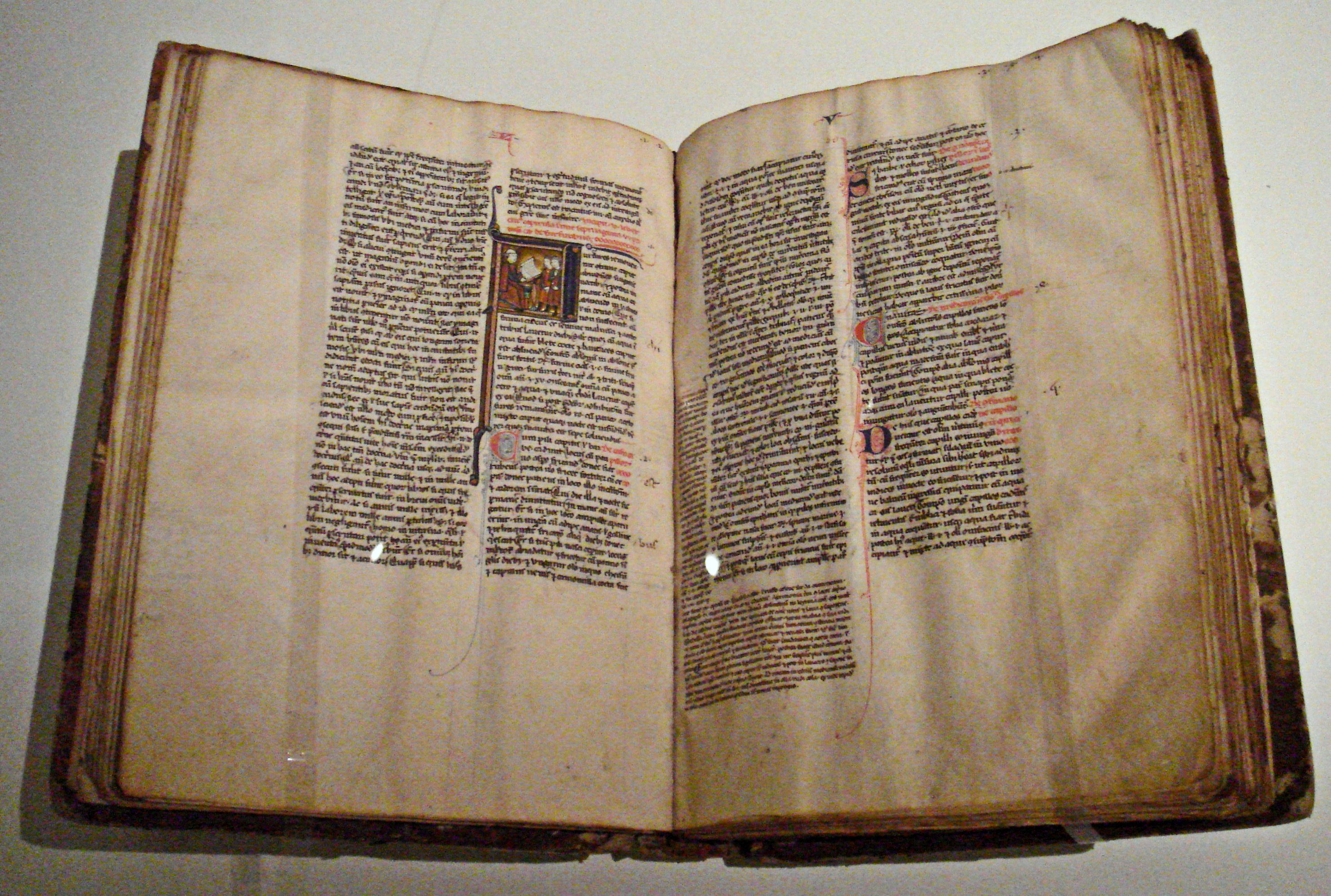
Al-Razi's
Recueil des
traités de médecine translated by Gerard
of Cremona, second
half of 13th century.
Photographed
at Musee de
Cluny
Razi is also known for having
discovered "allergic
asthma," and was the first physician ever to write
articles on allergy
and immunology. In the Sense of Smelling
he explains the occurrence
of 'rhinitis' after smelling a rose during the
Spring: Article on the
Reason Why Abou Zayd Balkhi Suffers from
Rhinitis When Smelling Roses in
Spring. In this article he discusses
seasonal 'rhinitis', which is
the same as allergic asthma or hay fever. Razi was
the first to realize
that fever is a natural defense mechanism, the
body's way of fighting disease.
Pharmacy
R
hazes contributed in many ways to
the early practice
of pharmacy by compiling texts, in which he
introduces the use of 'mercurial
ointments' and his development of apparatus such
as mortars, flasks, spatulas
and phials, which were used in pharmacies until
the early twentieth century.
Ethics of
medicine
On a professional level, Razi
introduced many practical,
progressive, medical and psychological ideas. He
attacked charlatans and
fake doctors who roamed the cities and countryside
selling their nostrums
and 'cures'. At the same time, he warned that even
highly educated doctors
did not have the answers to all medical problems
and could not cure all
sicknesses or heal every disease, which was
humanly speaking impossible.
To become more useful in their services and truer
to their calling, Razi
advised practitioners to keep up with advanced
knowledge by continually
studying medical books and exposing themselves to
new information. He made
a distinction between curable and incurable
diseases. Pertaining to the
latter, he commented that in the case of advanced
cases of cancer and leprosy
the physician should not be blamed when he could
not cure them. To add
a humorous note, Razi felt great pity for
physicians who took care for
the well being of princes, nobility, and women,
because they did not obey
the doctor's orders to restrict their diet or get
medical treatment, thus
making it most difficult being their physician.
He also wrote the following on
medical ethics:
"The doctor's aim is to
do good, even to our
enemies, so much more to our friends, and my
profession forbids us to do
harm to our kindred, as it is instituted for the
benefit and welfare of
the human race, and God imposed on physicians the
oath not to compose mortiferous
remedies."
Books and
articles on medicine
The Virtuous Life (al-Hawi
Arabic الحاوي).
This monumental medical
encyclopedia in nine volumes
— known in Europe also as The Large
Comprehensive or Continens
Liber (Arabic جامع الكبير) —
contains considerations
and criticism on the Greek philosophers
Aristotle and Plato, and expresses
innovative views on many subjects. Because of
this book alone, many scholars
consider Razi the greatest medical doctor of the
Middle Ages.
The al-Hawi is not a
formal medical encyclopedia,
but a posthumous compilation of Razi's working
notebooks, which included
knowledge gathered from other books as well as
original observations on
diseases and therapies, based on his own
clinical experience. It is significant
since it contains a celebrated monograph on
smallpox, the earliest one
known. It was translated into Latin in 1279 by
Faraj ben Salim, a physician
of Sicilian-Jewish origin employed by Charles of
Anjou, and after which
it had a considerable influence in Europe.
The al-Hawi also
criticized the views of Galen,
after Razi had observed many clinical cases
which did not follow Galen's
descriptions of fevers. For example, he stated
that Galen's descriptions
of urinaryailments were inaccurate as he had
only seen three cases, while
Razi had studied hundreds of such cases in
Muslim hospitals of Baghdad
and Rayy.
A medical adviser for the
general public (Man
la Yahduruhu Al-Tabib) (Arabic من لا
يحضره الطبيب)
Razi was possibly the first
Persian doctor to deliberately
write a home Medical Manual (remedial)
directed at the general public. He dedicated it
to the poor, the traveler,
and the ordinary citizen who could consult it
for treatment of common ailments
when a doctor was not available. This book, of
course, is of special interest
to the history of pharmacy since similar books
were very popular until
the 20th century. Razi described in its 36
chapters, diets and drug components
that can be found in either an apothecary, a
market place, in well-equipped
kitchens, or and in military camps. Thus, every
intelligent person could
follow its instructions and prepare the proper
recipes with good results.
Some of the illnesses treated
were headaches, colds,
coughing, melancholy and diseases of the eye,
ear, and stomach. For example,
he prescribed for a feverish headache: " 2 parts
of duhn (oily extract)
of rose, to be mixed with 1 part of vinegar, in
which a piece of linen
cloth is dipped and compressed on the forehead".
He recommended as a laxative,
" 7 drams of dried violet flowers with 20 pears,
macerated and well mixed,
then strained. Add to this filtrate, 20 drams of
sugar for a drink. In
cases of melancholy, he invariably recommended
prescriptions, which included
either poppies or its juice (opium), clover
dodder (Cuscuta epithymum)
or both. For an eye-remedy, he advised myrrh,
saffron, and frankincense,
2 drams each, to be mixed with 1 dram of yellow
arsenic formed into tablets.
Each tablet was to be dissolved in a sufficient
quantity of coriander water
and used as eye drops.
Doubts About Galen (Shukuk
'ala alinusor)
Razi's independent mind is
revealed in this book and
G. Stolyarov II quotes:
"In the manner of numerous
Greek thinkers, including
Socrates and Aristotle, Razi rejected the
mind-body dichotomy and pioneered
the concept of mental health and self-esteem
as being essential to a patient's
welfare. This "sound mind, healthy body"
connection prompted him to frequently
communicate with his patients on a friendly
level, encouraging them to
heed his advice as a path to their recovery
and bolstering their fortitude
and determination to resist the illness and
resulting in a speedy convalescence."
In his book Doubts about
Galen, Razi rejects
several claims made by the Greek physician, as
far as the alleged superiority
of the Greek language and many of his
cosmological and medical views. He
links medicine with philosophy, and states that
sound practice demands
independent thinking. He reports that Galen's
descriptions do not agree
with his own clinical observations regarding the
run of a fever. And in
some cases he finds that his clinical experience
exceeds Galen's.
He criticized moreover Galen's
theory that the body
possessed four separate "humors" (liquid
substances), whose balance are
the key to health and a natural
body-temperature. A sure way to upset such
a system was to insert a liquid with a different
temperature into the body
resulting in an increase or decrease of bodily
heat, which resembled the
temperature of that particular fluid. Razi noted
that a warm drink would
heat up the body to a degree much higher than
its own natural temperature.
Thus the drink would trigger a response from the
body, rather than transferring
only its own warmth or coldness to it. (Cf.
I. E. Goodman)
This line of criticism
essentially had the potentiality
to destroy completely Galen's Theory of Humours
including Aristotle's theory
of the Four Elements, on which it was grounded.
Razi's own alchemical experiments
suggested other qualities of matter, such as
"oiliness" and "sulphurousness",
or inflammability and salinity, which were not
readily explained by the
traditional fire, water, earth, and air division
of elements.
Razi's challenge to the current
fundamentals of medical
theory were quite controversial. Many accused
him of ignorance and arrogance,
even though he repeatedly expressed his praise
and gratitude to Galen for
his commendable contributions and labors.
saying:
"I prayed to God to direct and
lead me to the truth
in writing this book. It grieves me to oppose
and criticize the man Galen
from whose sea of knowledge I have drawn much.
Indeed, he is the Master
and I am the disciple. Although this reverence
and appreciation will and
should not prevent me from doubting, as I did,
what is erroneous in his
theories. I imagine and feel deeply in my
heart that Galen has chosen me
to undertake this task, and if he were alive,
he would have congratulated
me on what I am doing. I say this because
Galen's aim was to seek and find
the truth and bring light out of darkness. I
wish indeed he were alive
to read what I have published."
Crystallization of ancient
knowledge, and the refusal
to accept the fact that new data and ideas
indicate that present day knowledge
ultimately might surpass that of previous
generations.
Razi believed that contemporary
scientists and scholars
are by far better equipped, more knowledgeable,
and more competent than
the ancient ones, due to the accumulated
knowledge at their disposal. Razi's
attempt to overthrow blind acceptance of the
unchallenged authority of
ancient Sages, encouraged and stimulated
research and advances in the arts,
technology, and sciences.
Al-Razi is considered the father
of pediatrics for
writing The Diseases of Children, the
first book to deal with pediatrics
as an independent field of medicine.
Books on
medicine
This is a partial list of Razi's
books and articles
in medicine, according to Ibn Abi Usaybi'ah. Some
books may have been copied
or printed under different names.
al-Hawi
(Arabic الحاوي), al-Hawi al-Kabir (Arabic
الحاوي الكبير).
Also known as The Virtuous Life, Continens
Liber. The large
medical Encyclopedia containing mostly recipes and
Razi's notebooks.
Isbateh Elmeh Pezeshki
(Persian اثبات
علم پزشكى), An Introduction to Medical Science.
Dar Amadi bar Elmeh Pezeshki
(Persian درآمدى
بر علم پزشكى)
Rade Manaategha 'tibb jahez
Rade Naghzotibbeh Nashi
The Experimentation of Medical
Science and its
Application
Guidance
Kenash
The Classification of Diseases
Royal Medicine
For One Without a Doctor
(Arabic من لايحضره
الطبيب)
The Book of Simple Medicine
The Great Book of Krabadin
The Little Book of Krabadin
The Book of Taj or The
Book of the Crown
The Book of Disasters
Food and its Harmfulness
al-Judari wa al-Hasbah,
Translation: A treatise
on the Small-pox and Measles
Ketab dar Padid Amadaneh
Sangrizeh (Persian
كتاب در پديدآمدن سنگريزه) (Stones in the Kidney
and
Bladder)
Ketabeh Dardeh Roodeha
(Persian كتاب درد
رودهها)
Ketab dar Dard Paay va Dardeh
Peyvandhayyeh Andam
(Persian كتاب در درد پاى و درد پيوندهاى اندام)
Ketab dar Falej
The Book of Tooth Aches
Dar Hey'ateh Kabed (Persian
در هيأت
كبد)
Dar Hey'ateh Ghalb (About
Heart Ache)
About the Nature of Doctors
About the Earwhole
Dar Rag Zadan (Persian در رگ
زدن)
Seydeh neh/sidneh
Ketabeh Ibdal
Food For Patients
Soodhayeh Serkangabin
(Persian سودهاى
سركنگبين) or Benefits of Honey and Vinegar
Mixture
Darmanhayeh Abneh
The Book of Surgical Instruments
The Book on Oil
Fruits Before and After Lunch
Book on Medical Discussion
(with Jarir Tabib)
Book on Medical Discussion II
(with Abu Feiz)
About the Menstrual Cycle
Ghi Kardan or vomiting
(Persian قى
كردن)
Snow and Medicine
Snow and Thirst
The Foot
Fatal Diseases
About Poisoning
Hunger
Soil in Medicine
The Thirst of Fish
Sleep Sweating
Warmth in Clothing
Spring and Disease
Misconceptions of a Doctors
Capabilities
The Social Role of Doctors
Translations
Razi's notable books and articles
on medicine (in English)
include:
Mofid al Khavas, The Book
for the Elite.
The Book of Experiences
The Cause of the Death of Most
Animals because
of Poisonous Winds
The Physicians' Experiments
The Person Who Has No Access to
Physicians
The Big Pharmacology
The Small Pharmacology
Gout
Al Shakook ala Jalinoos, The
Doubt on Galen
Kidney and Bladder Stones
Ketab tibb ar-Ruhani,The
Spiritual Physik
of Rhazes.
Alchemy
The
Transmutation of Metals
Razi's interest in alchemy and his
strong belief in
the possibility of transmutation of lesser metals
to silver and gold was
attested half a century after his death by Ibn
an-Nadim's book (The Philosophers Stone-Lapis
Philosophorum
in Latin). Nadim attributed a series of twelve
books to Razi, plus an additional
seven, including his refutation to al-Kindi's
denial of the validity of alchemy. Al-Kindi
(801-873 CE) had been appointed
by the Abbasid Caliph Ma'mum founder of Baghdad,
to 'the House
of Wisdom' in that city, he was a
philosopher and an opponent of alchemy.
Finally we will mention Razi's two
best-known alchemical
texts, which largely superseded his earlier ones:
al-Asrar ("The
Secrets"), and Sirr al-Asrar ("The Secret
of Secrets"), which incorporates
much of the previous work.
Apparently Razi's contemporaries
believed that he had
obtained the secret of turning iron and copper
into gold. Biographer Khosro
Moetazed reports in Mohammad Zakaria Razi
that a certain General
Simjur confronted Razi in public, and asked
whether that was the underlying
reason for his willingness to treat patients
without a fee. "It appeared
to those present that Razi was reluctant to
answer; he looked sideways
at the general and replied":
"I understand alchemy and I have
been working on the
characteristic properties of metals for an
extended time. However, it still
has not turned out to be evident to me, how one
can transmute gold from
copper. Despite the research from the ancient
scientists done over the
past centuries, there has been no answer. I very
much doubt if it is possible..."
Chemical
instruments and substances
Razi developed several chemical
instruments that remain
in use to this day. He is known to have perfected
methods of distillation
and extraction, which have led to his discovery of
sulfuric acid, by dry
distillation of vitriol (al-zajat), and
alcohol. These discoveries
paved the way for other Islamic alchemists, as did
the discovery of various
other mineral acids by Jabir Ibn Hayyan (known as
Geber in Europe). As
a pioneer of Alchemy and chemistry in medieval
Islam, Razi was the first
to distill kerosene and petroleum.
Razi dismissed the idea of potions
and dispensed with
magic, meaning the reliance on symbols as causes.
Although Razi does not
reject the idea that miracles exist, in the sense
of unexplained phenomena
in nature, his alchemical stockroom was enriched
with products of Persian
mining and manufacturing, even with sal ammoniac a
Chinese discovery. He
relied predominantly on the concept of 'dominant'
forms or essences, which
is the Neoplatonic conception of causality rather
than an intellectual
approach or a mechanical one. Razi's alchemy
brings forward such empiric
qualities as salinity and inflammability -the
latter associated to 'oiliness'
and 'sulphurousness'. These properties are not
readily explained by the
traditional composition of the elements such as:
fire, water, earth and
air, as al-óhazali and others after him were quick
to note, influenced
by critical thoughts such as Razi had.
Major works
on alchemy
Razi's achievements are of
exceptional importance in
the history of chemistry, since in his books we
find for the first time
a systematic classification of carefully observed
and verified facts regarding
chemical substances, reactions and apparatus,
described in a language almost
entirely free from mysticism and ambiguity. Razi's
scheme of classification
of the substances used in chemistry shows sound
research on his part.
This book was written in response
to a request from
Razi's close friend, colleague, and former
student, Abu Mohammed b. Yunis
of Bukhara, a Muslim mathematician, philosopher,
a highly reputable natural
scientist.
In his book Sirr al-Asrar,
Razi divides the
subject of "Matter' into three categories as he
did in his previous book
al-Asrar.
Knowledge and identification of
drug components of
plant-, animal- and mineral-origin and the
description of the best type
of each for utilization in treatment.
Knowledge of equipment and
tools of interest to and
used by either alchemist or apothecary.
Knowledge of seven alchemical
procedures and techniques:
sublimation and condensation of mercury,
precipitation of sulfur and arsenic
calcination of minerals (gold, silver, copper,
lead, and iron), salts,
glass, talc, shells, and waxing.
This last category contains
additionally a description
of other methods and applications used in
transmutation:
* The added mixture and use of
solvent vehicles.
* The amount of heat (fire) used,
'bodies and stones',
('al-ajsad'
and 'al-ahjar) that can or cannot be
transmuted into corporal substances
such of metals and Id salts ('al-amlah').
* The use of a liquid mordant
which quickly and permanently
colors lesser metals for more lucrative sale and
profit.
Similar to the commentary on the
8th century text
on amalgams ascribed to Al- Hayan (Jabir), Razi
gives methods and procedures
of coloring a silver object to imitate gold
(gold leafing) and the reverse
technique of removing its color back to silver.
Gilding and silvering of
other metals (alum, calcium salts, iron, copper,
and tutty) are also described,
as well as how colors will last for years
without tarnishing or changing.
Behind these procedures one does not find a
deceptive motive rather a technical
and economic deliberation. This becomes evident
from the author's quotation
of market prices and the expressed triumph of
artisan, craftsman or alchemist
declaring the results of their efforts "to make
it look exactly like gold!".
However, another motive was involved, namely, to
manufacture something
resembling gold to be sold quickly so to help a
good friend who happened
to be in need of money fast. Could it be Razi's
alchemical technique of
silvering and gilding metals which convinced
many Muslim biographers that
he was first a jeweler before he turned to the
study of alchemy?
Of great interest in the text is
Razi's classification
of minerals into six divisions, showing his
discussion a modern chemical
connotation:
Four SPIRITS (AL-ARWAH)
: mercury, sal ammoniac,
sulfur, and arsenic sulphate (orpiment and
realgar).
Seven BODIES (AL-AJSAD)
: silver, gold, copper,
iron, black lead (plumbago), zinc (Kharsind),
and tin.
Thirteen STONES : (AL-AHJAR)
Pyrites marcasite
(marqashita), magnesia, malachite,
tutty Zinc oxide (tutiya),
talcum, lapis lazuli, gypsum, azurite,
magnesia , haematite (iron oxide),
arsenic oxide, mica and asbestos and glass
(then identified as made of
sand and alkali of which the transparent
crystal Damascene is considered
the best),
Seven VITRIOLS (AL-ZAJAT) :
alum(ak-shubub),
and white (qalqadzs), black , red, and
yellow
(qulqutar)vitriols
(the impure sulfates of iron, copper, etc.),
green (qalqand).
Seven BORATES : tinkar, natron,
and impure sodium
borate.
Eleven SALTS (AL-AMLAH):
including brine, common
(table) salt, ashes, naphtha, live lime, and
urine, rock, and sea salts.
Then he separately defines and describes each
of these substances and their
top choice, best colors and various
adulterations.
Razi gives also a list of
apparatus used in alchemy.
This consists of 2 classes:
Instruments used for the
dissolving and melting of
metals such as the Blacksmith's hearth,
bellows, crucible, thongs (tongue
or ladle), macerator, stirring rod, cutter,
grinder (pestle), file, shears,
descensory and semi-cylindrical iron mould.
Utensils used to carry out the
process of transmutation
and various parts of the distilling apparatus:
the retort, alembic, shallow
iron pan, potters kiln and blowers, large
oven, cylindrical stove, glass
cups, flasks, phials, beakers, glass funnel,
crucible, alundel, heating
lamps, mortar, cauldron, hair-cloth, sand- and
water-bath, sieve, flat
stone mortar and chafing-dish.
Secret of Secrets (Sirr
Al-asrar)
This is Razi's most famous book
which has gained a
lot of recognition in the West. Here he gives
systematic attention to basic
chemical operations important to the history of
pharmacy.
Books on
alchemy
Here is a list of Razi's known
books on alchemy, mostly
in Persian:
Modkhele Taalimi
Elaleh Ma'aaden
Isbaate Sanaa'at
Ketabeh Sang
Ketabe Tadbir
Ketabe Aksir
Ketabe Sharafe Sanaa'at
Ketabe Tartib, Ketabe
Rahat, The
Simple Book
Ketabe Tadabir
Ketabe Shavahed
Ketabe Azmayeshe Zar va Sim
(Experimentation
on Gold)
Ketabe Serre Hakimaan
Ketabe Serr (The Book of
Secrets)
Ketabe Serre Serr (The
Secret of Secrets)
The First Book on Experiments
The Second Book on Experiments
Resaale'ei Be Faan
Arezooyeh Arezookhah
A letter to Vazir Ghasem ben
Abidellah
Ketabe Tabvib
Philosophy
On existence
Razi believed that a competent
physician must also
be a philosopher well versed in the fundamental
questions regarding existence:
"He proclaimed the absolutism of
Euclideanspace and
mechanical time as the natural foundation of the
world in which men lived,
but resolved the dilemma of existent infinities by
synthesizing this outlook
with the atomic theory of Democritus, which
recognized that matter existed
in the form of indivisible and fathomable quanta.
The continuity of space,
however, holds due to the existence of void, or a
region lacking matter...
This is remarkably close to the systems yielded by
the discoveries of such
later European scientists as John Dalton and Max
Planck, as well as the
observational and theoretical works of modern
astronomer Halton Arp and
Objectivist philosopher Michael Miller. Progress,
in the view of all these
men, is not to be obstructed by a jumble of
haphazard and contradictory
relativistic assertions which result in
metaphysical hodge-podge instead
of a sturdy intellectual base. Even in regard to
the task of the philosopher,
Rhazes considered it to be progressing beyond the
level of one's teachers,
expanding the accuracy and scope of one's
doctrine, and individually elevating
oneself onto a higher intellectual plane." (G.
Stolyarov II)
Razi is known to have been a
free-thinking philosopher,
since he was well-trained in ancient Greek science
and philosophy although
his approach to chemistry was rather naturalistic.
Moreover, he was well
versed in the theory of music, as so many other
Islamic scientists of that
time.
Metaphysics
His ideas on metaphysics were also
based on the works
of the ancient Greeks:
"The metaphysical doctrine of Razi,
insofar as it
can be reconstructed, derives from his concept of
the five eternal principles.
God, for him, does not 'create' the world from
nothing but rather arranges
a universe out of pre-existing principles. His
account of the soul features
a mythic origin of the world in which God out of
pity fashions a physical
playground for the soul in response to its own
desires; the soul, once
fallen into the new realm God has made for it,
requires God's further gift
of intellect in order to find its way once more to
salvation and freedom.
In this scheme, intellect does not appear as a
separate principle but is
rather a later grace of God to the soul; the soul
becomes intelligent,
possessed of reason and therefore able to discern
the relative value of
the other four principles. Whereas the five
principles are eternal, intellect
as such is apparently not. Such a doctrine of
intellect is sharply at odds
with that of all of Razi's philosophical
contemporaries, who are in general
either adherents of some form of Neoplatonism or
of Aristotelianism. The
remaining three principles, space, matter and
time, serve as the non-animate
components of the natural world. Space is defined
by the relationship between
the individual particles of matter, or atoms, and
the void that surrounds
them. The greater the density of material atoms,
the heavier and more solid
the resulting object; conversely, the larger the
portion of void, the lighter
and less solid. Time and matter have both an
absolute, unqualified form
and a limited form. Thus there is an absolute
matter - pure extent - that
does not depend in any way on place, just as there
is a time, in this sense,
that is not defined or limited by motion. The
absolute time of al-Razi
is, like matter, infinite; it thus transcends the
time which Aristotle
confined to the measurement of motion. Razi, in
the cases of both time
and matter, knew well how he differed from
Aristotle and also fully accepted
and intended the consequences inherent in his
anti-Peripatetic positions."
(Paul E. Walker)
Excerpt
from The Philosophical Approach
"(...) In short, while I am writing
the present book,
I have written so far around 200 books and
articles on different aspects
of science, philosophy, theology, and [[hekmat]]
(wisdom). (...)
I never entered the service of any king as a
military man or a man of office,
and if I ever did have a conversation with a king,
it never went beyond
my medical responsibility and advice. (...) Those
who have seen me know,
that I did not into excess with eating, drinking
or acting the wrong way.
As to my interest in science, people know
perfectly well and must have
witnessed how I have devoted all my life to
science since my youth. My
patience and diligence in the pursuit of science
has been such that on
one special issue specifically I have written
20,000 pages (in small print),
moreover I spent fifteen years of my life -night
and day- writing the big
collection entitled Al Hawi. It was during this
time that I lost my eyesight,
my hand became paralyzed, with the result that I
am now deprived of reading
and writing. Nonetheless, I've never given up, but
kept on reading and
writing with the help of others. I could make
concessions with my opponents
and admit some shortcomings, but I am most curious
what they have to say
about my scientific achievement. If they consider
my approach incorrect,
they could present their views and state their
points clearly, so that
I may study them, and if I determined their views
to be right, I would
admit it. However, if I disagreed, I would discuss
the matter to prove
my standpoint. If this is not the case, and they
merely disagree with my
approach and way of life, I would appreciate they
only use my written knowledge
and stop interfering with my behaviour."
"In the "Philosophical Biography",
as seen
above, he defended his personal and philosophical
life style. In this work
he laid out a framework based on the idea that
there is life after death
full of happiness, not suffering. Rather than
being self-indulgent, man
should pursue knowledge, utilise his intellect and
apply justice in his
life.
According to Al-Razi: "This is what
our merciful Creator
wants. The One to whom we pray for reward and
whose punishment we fear."
In brief, man should be kind,
gentle and just. Al-Razi
believed that there is a close relationship
between spiritual integrity
and physical health. He did not implicate that
the soul could avoid distress
due to his fear of death. He simply states that
this psychological state
cannot be avoided completely unless the
individual is convinced that, after
death, the soul will lead a better life. This
requires a thorough study
of esoteric doctrines and/or religions. He
focuses on the opinion of some
people who think that the soul perishes when the
body dies. Death is inevitable,
therefore one should not pre-occupy the mind
with it, because any person
who continuously thinks about death will become
distressed and think as
if he is dying when he continuously ponders on
that subject. Therefore,
he should forget about it in order to avoid
upsetting himself. When contemplating
his destiny after death, a benevolent and good
man who acts according to
the ordinances of the Islamic Shari`ah,
has after all nothing to
fear because it indicates that he will have
comfort and permanent bliss
in the Hereafter. The one who doubts the Shari`ah,
may contemplate
it, and if he diligently does this, he will not
deviate from the right
path. If he falls short, Allah will excuse him
and forgive his sins because
it is not demanded of him to do something which
he cannot achieve." (Dr.
Muhammad Abdul-Hadi Abu Reidah)
Books on
philosophy
This is a partial list of Razi's
books on philosophy.
Some books may have been copied or published under
different titles.
The Small Book on Theism
Response to Abu'al'Qasem Braw
The Greater Book on Theism
Modern Philosophy
Dar Roshan Sakhtane Eshtebaah
Dar Enteghaade Mo'tazlian
Delsoozi Bar Motekaleman
Meydaneh Kherad
Khasel
Resaaleyeh Rahnamayeh Fehrest
Ghasideyeh Ilaahi
Dar Alet Afarineshe Darandegan
Shakkook
Naghseh Ketabe Tadbir
Naghsnamehyeh Ferforius
Do name be Hasanebne Moharebe
Ghomi
Notable books in English are:
Spiritual Medicine
The Philosophical Approach (Al
Syrat al
Falsafiah)
The Metaphysics
On Religion
Razi wrote three books dealing
with religion; they
were: The Prophets' Fraudulent Tricks
(Arabic مخارق الانبياء),
The
Stratagems of Those Who Claim to Be Prophets
(Arabic حيل المتنبيين),
and On the Refutation of Revealed Religions
(Arabic نقض الادیان).
He offered harsh criticism concerning religions,
in particular those religions
that claim to have been revealed by prophetic
experiences. Razi asserted
that "[God] should not set some individuals over
others, and there should
be between them neither rivalry nor disagreement
which would bring them
to perdition." He argued,
On what ground do you
deem it necessary
that God should single out certain individuals
[by giving them prophecy],
that he should set them up above other people,
that he should appoint them
to be the people's guides, and make people
dependent upon them?
Concerning the link between violence
and religion, Razi
expressed that God must have known, considering the
many disagreements
between different religions, that "there would be a
universal disaster
and they would perish in the mutual hostilities and
fighting. Indeed, many
people have perished in this way, as we can see."
He was also critical of the lack
of interest among
religious adherents in the rational analysis of
their beliefs, and the
violent reaction which takes its place:
If the people of this
religion are asked
about the proof for the soundness of their
religion, they flare up, get
angry and spill the blood of whoever confronts
them with this question.
They forbid rational speculation, and strive to
kill their adversaries.
This is why truth became thoroughly silenced and
concealed.
Al-Razi believed that common people
had originally been
duped into belief by religious authority figures and
by the status quo.
He believed that these authority figures were able
to continually deceive
the common people "as a result of [religious people]
being long accustomed
to their religious denomination, as days passed and
it became a habit.
Because they were deluded by the beards of the
goats, who sit in ranks
in their councils, straining their throats in
recounting lies, senseless
myths and "so-and-so told us in the name of
so-and-so..."
He believed that the existence of
a large variety of
religions was, in itself, evidence that they were
all man made, saying,
"Jesus claimed that he is the son of God, while
Moses claimed that He had
no son, and Muhammad claimed that he [Jesus] was
created like the rest
of humanity." and "Mani and Zoroaster contradicted
Moses, Jesus and Muhammad
regarding the Eternal One, the coming into being
of the world, and the
reasons for the [existence] of good and evil." In
relation to the Hebrew's
God asking of sacrifices, he said that "This
sounds like the words of the
needy rather than of the Laudable Self-sufficient
One."
On the Quran, al-Razi said:
You claim that the
evidentiary miracle
is present and available, namely, the Koran. You
say: "Whoever denies it,
let him produce a similar one." Indeed, we shall
produce a thousand similar,
from the works of rhetoricians, eloquent
speakers and valiant poets, which
are more appropriately phrased and state the
issues more succinctly. They
convey the meaning better and their rhymed prose
is in better meter. ...
By God what you say astonishes us! You are
talking about a work which recounts
ancient myths, and which at the same time is
full of contradictions and
does not contain any useful information or
explanation. Then you say: "Produce
something like it"?!
From the beginning of the human
history, all of those
who claimed to be prophets were, in his worst
assumption tortuous and devious
and with his best assumption had psychological
problems.
Criticism
Al-Razi's philosophical and
religious views were later
criticized by prominent Persian philosophers such
as Avicenna
and Abū
Rayhān
al-Bīrūnī in the early 11th century. The Hermetical
writings and religious views of al-Razi were
criticized by al-Biruni, and
during a debate between Avicenna and al-Biruni,
Avicenna wrote the following
criticism on al-Razi:
Or
from Muhammad
ibn Zakariyyab al-Razi, who meddles in
metaphysics and exceeds his competence.
He should have remained confined to surgery and
to urine and stool testing—indeed
he exposed himself and showed his ignorance in
these matters.
Quotes from
Rhazes
Let your first thought
be to strengthen
your natural vitality.
Truth in medicine is an
unattainable goal, and
the art as described in books is far beneath
the knowledge of an experienced
and thoughtful physician.
Asked if a philosopher can follow a
prophetically revealed
religion, al-Razi frankly replies:
How can anyone think
philosophically while listening
to old wives' tales founded on contradictions,
which obdurate ignorance,
and dogmatism?
Gentility of character,
friendliness and purity
of mind, are found in those who are capable of
thinking profoundly on abstruse
matters and scientific minutiae.
Man should hasten to protect
himself from love
before succumbing to it and cleanse his soul
from it when he falls.
The self-admirer, generally,
should not glorify
himself nor be so conceited that he elevates
himself above his counterparts.
Neither should he belittle himself to such an
extent that he becomes inferior
to his own peers or to those who are inferior
both to him and to his fellowmen
in the eyes of others. If he follows this
advice, he will be freed from
self-admiration and feelings of inferiority,
and people will call him one
who truly knows himself.
When questioned on the subject of
'envy', Razi answers:
It results from an
accumulation of stinginess and
avarice in the soul, being one of the diseases
that cause serious harm
to the soul.
Wikiquote
has a collection of quotations related to: Muhammad
ibn Zakariya al-Razi
Quotes on
Rhazes
"Rhazes was the greatest
physician of Islam and
the Medieval Ages." – George
Sarton
"Rhazes remained up to the
17th century the indisputable
authority of medicine." – The Encyclopaedia
of Islam
"His writings on smallpox and
measles show originality
and accuracy, and his essay on infectious
diseases was the first scientific
treatise on the subject." – The Bulletin
of the World
Health Organization (May 1970)
"In today's world we tend to
see scientific advance
as the product of great movements, massive
grant-funded projects, and larger-than-life
socio-economic forces. It is easy to forget,
therefore, that many contributions
stemmed from the individual efforts of
scholars like Rhazes. Indeed, pharmacy
can trace much of its historical foundations
to the singular achievements
of this ninth-century Persian scholar." —
Michael
E. Flannery
Legacy
The modern-day Razi Institute in
Tehran, and Razi University
in Kermanshah were named after him, and 'Razi Day'
('Pharmacy Day') is
commemorated in Iran every August 27.
Notes
-
Inventions et decouvertes au
Moyen-Age, Samuel Sadaune,
p.44
-
Robinson, Victor (1944), The
story of medicine, New
York: New Home Library
-
Porter, Dorothy (2005),
written at New York, Health,
civilization, and the state : a history of
public health from ancient to
modern times, Routledge (published 1999), p.
25, ISBN 0415200369
-
History of civilizations of
Central Asia, Motilal Banarsidass
Publ., ISBN 8120815963, vol. IV, part two, p.
228.
-
Browne (2001, p. 44)
-
Hakeem Abdul Hameed, Exchanges
between India and Central Asia in the field of
Medicine
-
David W. Tschanz, PhD (2003),
"Arab Roots of European
Medicine", Heart Views 4 (2).
-
S Safavi-Abbasi, LBC Brasiliense,
RK Workman (2007), "The
fate of medical knowledge and the neurosciences
during the time of Genghis
Khan and the Mongolian Empire",
Neurosurg Focus 23 (1), E13, p.
3.
-
Richter-Bernburg
-
Boyce, Mary; Frantz, Grenet
(1982). History of Zoroastrianism:
Under The Achaemenians. Leiden: Brill. ISBN
9004065067. p. 8. See also
( Gnoli, Gerardo. "AVESTAN
GEOGRAPHY". Encyclopaedia Iranica. 3.
ISBN 0710091214 excerpt:
"the question of the identification of Avestan
Raya with the Raga in the
inscription of Darius I at Bīsotūn [...] with
Ray[...] has by no means
been settled.")
-
Abu
Bakr Mohammad Ibn Zakariya al-Razi (c. 864-c.
930) - Crystalinks,
2008
-
Abu
Bakr Muhammad ibn Zakariya ar- Razi Biography
(c. 850-c. 932) -
Free Health Encyclopedia, 2006
-
Al-Razi,
the Clinician - U.S. National
Library of Medicine, 1998
-
ABU
BAKR MUHAMMAD BIN ZAKARIYA AR-RAZI (Rhazes)
- Dr. A. Zahoor, 1997
-
Islamic
Science, the Scholar and Ethics -
Foundation for Science Technology
and Civilisation.
-
Emilie Savage-Smith (1996),
"Medicine", in Roshdi Rashed,
ed., Encyclopedia
of the History of Arabic Science, Vol.
3, p. 903-962 [917]. Routledge,
London and New York.
-
A Treatise on the Small-pox and
Measles, Translated by
William
Alexander Greenhill, Published by Printed
for the Sydenham Society
[by C and J. Adlrd], 1848, pp. 252, URL
-
Jennifer Michael Hecht, "Doubt: A
History: The Great Doubters
and Their Legacy of Innovation from Socrates and
Jesus to Thomas Jefferson
and Emily Dickinson", pg. 227-230
-
Seyyed
Hossein
Nasr (1993), An Introduction to
Islamic Cosmological Doctrines,
p. 166. State
University
of New York Press, ISBN 0791415163.
-
Rafik Berjak and Muzaffar Iqbal,
"Ibn Sina—Al-Biruni
correspondence", Islam & Science,
December 2003.
-
Razi
Vaccine
& Serum Research Institute
-
Razi
day commemoration.
References and
further reading
-
Browne,
Edward Granville (2001). Islamic
Medicine. Goodword Books Pvt. Ltd..
ISBN 8187570199.
-
Richter-Bernburg, Lutz. "AL-ḤĀWI".
Encyclopaedia Iranica. 1. ISBN 0933273541
-
M. M. Sharif, A History of
Muslim Philosophy
-
Paul Kraus, Opera
Philosophica: this is the only
edition of Razi's philosophical books and
fragments still extant. Abi Bakr
Mohammadi Filii Zachariae Raghensis or Opera
Philosophica, fragmentaque
quae superssunt. Collegit et edidit Paulus
Kraus. Pars Prior. Cahirae MCMXXXIX.
Only the first volume was published since
Kraus's suicide prevented the
publication of the second volume for which he
already had gathered a great
amount of material. This material was
transferred, after his death, to
the Institut Francais d'Archeologie Orientale,
in Cairo; it still remains
to be published.
-
Walker, P. "The Political
Implications of al-Razi's Philosophy",
in C. Butterworth (ed.) The Political
Aspects of Islamic Philosophy,
Cambridge, MA: Harvard University Press,
61-94.(1992)
-
Motazed, K. Mohammad Zakaria
Razi
-
Stolyarov II, H. "Rhazes: The
Thinking Western Physician",
in: The Rational Argumentator, Issue
VI.(2002)
Bibliography
Ancient sources
-
Ibn al-Nadim, Fihrist,
(ed. Flugel), pp. 299 et
sqq.
-
Sa'id
al-Andalusi, Tabaqat al-Umam, p.
33
-
ibn Juljul, Tabaqat al-Atibba
w-al-Hukama, (ed.
Fu'ad Sayyid), Cairo, 1355/1936, pp. 77–78
-
al-Biruni, Epitre de Beruni,
contenant le repertoire
des ouvres de Muhammad ibn Zakariya
ar-Razi, publiee par P.
Kraus, Paris, 1936
-
al-Baihaqi, Tatimmah Siwan
al-Hikma, (ed. M. Ghafi),
Lahore, 1351/1932
-
al-Qifti,Tarikh al-Hukama,
(ed. Lippert), pp. 27–177
-
ibn abi Usaibi'ah,Uyun al-Anba
fi Tabaqat al-Atibba,
Vol. I, pp. 309–21
-
abu al-Faraj ibn al-'Ibri
(Bar-Hebraeus),Mukhtasar
Tarikh al-Duwal, (ed. A. Salhani), p. 291
-
Ibn
Khallikan, Wafayat al-A'yan, (ed.
Muhyi al-Din 'Abd al-Hamid),
Cairo, 1948, No. 678, pp. 244–47
-
al-Safadi, Nakt al-Himyan,
pp. 249–50
-
Ibn al-'Imad, Shadharat
al-Dhahab, Vol. II, p.
263
-
al-'Umari, Masalik al-Absar,
Vol. V, Part 2, ff.
301-03 (photostat copy in Dar al-Kutub
al-Misriyyah).
Modern studies
-
G. S. A. Ranking, The Life
and Works of Rhazes,
in Proceedings of the Seventeenth International
Congress of Medicine, London,
1913, pp. 237–68.
-
J. Ruska, Al-Biruni als
Quelle fur das Leben und die
Schriften al-Razi's, Isis, Vol. V, 1924,
pp. 26–50.
-
Al-Razi als Bahnbrecher einer
neuer Chemie, Deutsche
Literaturzeitung, 1923, pp. 118–24.
-
Die Alchemie al-Razi's der
Islam, Vol. XXII,pp.
283–319.
-
Uber den gegenwartigen Stand
der Razi-Forschung,
Archivio di stori della scienza, 1924, Vol. V,
pp. 335–47
-
H. H. Shader, ZDMG, 79, pp.
228–35 (see translation
into Arabic by Abdurrahman
Badawi in al-Insan al-Kamil,Islamica,
Vol. XI, Cairo, 1950,
pp. 37–44).
-
E. O. von Lippmann, Entstehung
und Ausbreitung der
Alchemie, Vol. II, p. 181.
-
S. Pines, Die Atomenlehre
ar-Razi's in Beitrage zur
islamischen Atomenlehre, Berlin, 1936, pp.
34–93.
-
Dr. Mahmud al-Najmabadi, Shah Hal
Muhammad ibn Zakariya,
(1318/1900) *Encyclopaedie des Islams, s.
v. (by Ruska).
-
Gamil Bek, Uqud al-Jauliar,
Vol. I, pp. 118–27.
-
Izmirli Haqqi, Ilahiyat,
Fak. Macm., Vol. I, p.
151; Vol. II, p. 36, Vol. III, pp. 177 et seq.
-
Abdurrahman
Badawi, Min Tarlkh al-Ilhad fi
al-Islam Islamica, Vol. II, Cairo,
1945, pp. 198–228.
-
Hirschberg,Geschichte der
Augenheilkunde, p. 101.
-
E. G.Browne, Arabian Medicine,
Cambridge, 1921,
pp. 44–53.
-
M. Meyerhof, Legacy of Islam,
pp. 323 et seq.
-
F.
Wüstenfeld, Geschichte der Arabischen
Arzte und Naturforscher,
ftn. 98.
-
L. Leelerc, Histoire de la
medicine arabe, Paris,
1876, Vol. I, pp. 337–54.
-
H. P. J. Renaud, A propos du
millenaire de Razes,
in bulletin de la Societe Irancaise d'Histoire
de la medicine, Mars-avril,
1931, pp. 203 et seq.
-
A. Eisen, Kimiya al-Razi,
RAAD, DIB, 62/4.
-
Aldo Mieli, La science arabe,
Leiden, 1938, pp.
8, 16.
-
Nasr, Science and
Civilization in Islam, see. Razes:
The
Secret of Secrets, p. 273, also pp.
197–200, and Anawati:
L'Alchemie
arabe in Rased.
-
A.J. Arberry (transl.), The
spiritual Physik of Rhazes
(London, John Murray 1950).
Editions of
philosophical works
See C.
Brockelmann for the manuscript of Razi's
extant books in general, see
Brockelmann, GAL, I, pp. 268–71 (second edition),
Suppl., Vol. I, pp.
418–21. Cf. Paul Kraus: Abi Bakr
Mohammadi Filii Zachariae
Raghensis, Opera Philosophica, fragmentaque
quae superssunt. Collegit
et edidit Paulus Kraus. Pars Prior. Cahirae
MCMXXXIX.
See also
External links
|