|
Alchemy
|
Heinrich
Khunrath
The Emerald
Tablet
..
Alchemy and Mysticism from The
Hermetic Museum
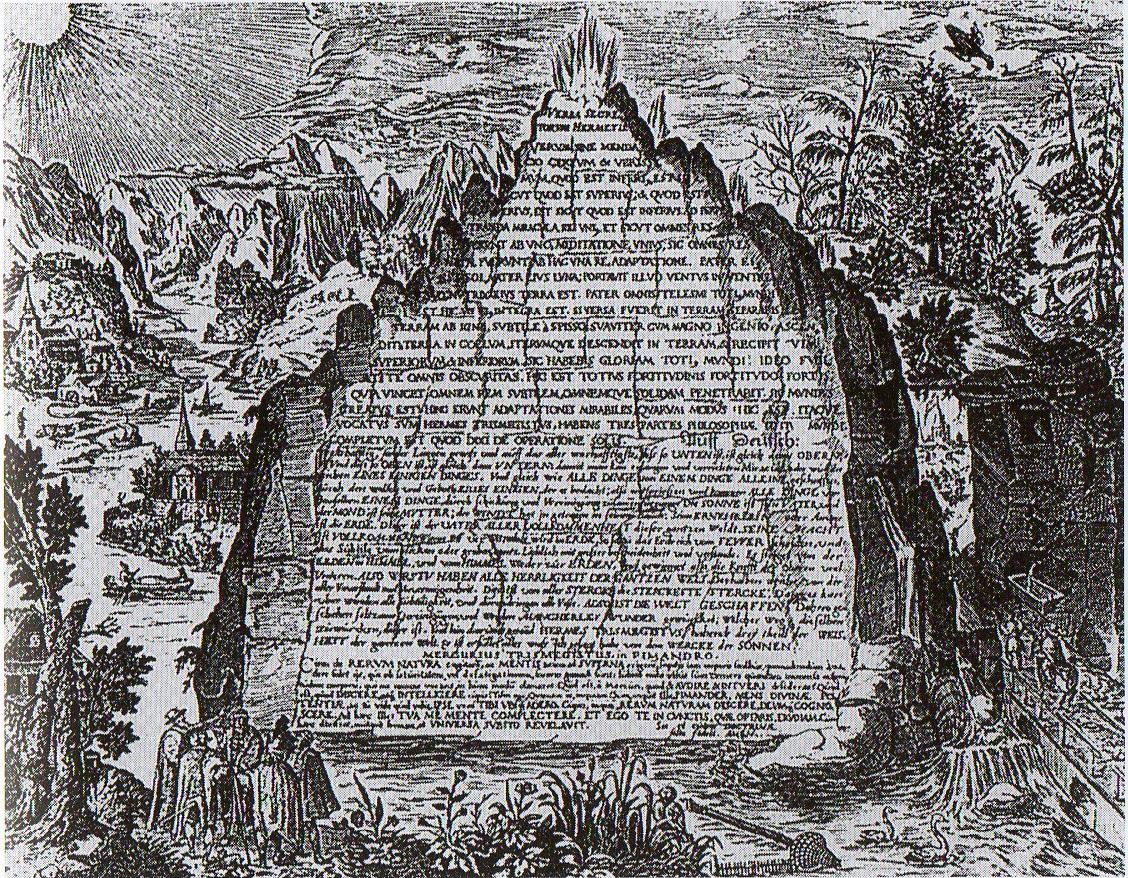
A 17th century depiction of the
Tablet by Heinrich
Khunrath, 1606
Author: Heinrich Khunrath Work:
Amhitheatrum sapientae
aeternae Date: 1606
This work is over 400 years old, in
the public domain.
(Click image
for full size)
The Emerald
Tablet, also known
as Smaragdine Table, Tabula Smaragdina, or The
Secret of Hermes, is a text
purporting to reveal the secret of the primordial
substance and its transmutations.
It claims to be the work of Hermes Trismegistus
("Hermes the Thrice-Great"),
a legendary Egyptian sage or god, variously
identified with the Egyptian
god Thoth and/or the Greek god Hermes.
This short and
cryptic text was
highly regarded by European alchemists as the
foundation of their art,
in particular of its Hermetic tradition.
|
| The Tablet Text
Arabic
translation
A new translation bypassing the
Latin has just been
published by Nineveh Shadrach from the original
Arabic of Book of Causes
attributed to Apollonius of Tyana.[1]
1. It contains an accurate
commentary that can't be
doubted.
2. It states: What is the above is
from the below
and the below is from the above. The work of wonders
is from one.
3. And all things sprang from this
essence through
a single projection. How marvelous is its work! It
is the principle [sic]
part of the world and its custodian.
4. Its father is the sun and its
mother is the moon.
Thus the wind bore it within it and the earth
nourished it.
5. Father of talismans and keeper of
wonders.
6. Perfect in power that reveals the
lights.
7. It is a fire that became our
earth. Separate the
earth from the fire and you shall adhere more to
that which is subtle than
that which is coarse, through care and wisdom.
8. It ascends from the earth to the
heaven. It extracts
the lights from the heights and descends to the
earth containing the power
of the above and the below for it is with the light
of the lights. Therefore
the darkness flees from it.
9. The greatest power overcomes
everything that is
subtle and it penetrates all that is coarse.
10. The formation of the microcosm is
in accordance
with the formation of the macrocosm.
11. The scholars made this their
path.
12. This is why Thrice Hermes was
exalted with wisdom.
13. This is his last book that he hid
in the catacomb.
|
| Newton's
translation
A 17th century depiction of the
Tablet by Heinrich
Khunrath, 1606
One translation, by Isaac Newton,
found among his alchemical
papers as reported by B. J. Dobbs[2] in modern
spelling:
1. Tis true without lying, certain
most true.
2. That which is below is like that
which is above
that
which
is above is like that which is below to do the
miracles of one
only thing.
3. And as all things have been arose
from one by the
meditation of one: so all things have their birth
from this one thing by
adaptation.
4. The Sun is its father, the moon
its mother,
5. the wind hath carried it in its
belly, the earth
its nurse.
6. The father of all perfection in
the whole world
is here.
7. Its force or power is entire if it
be converted
into earth.
7a. Separate thou the earth from the
fire, the subtle
from the gross sweetly with great industry.
8. It ascends from the earth to the
heaven again it
descends to the earth and receives the force of
things superior and inferior.
9. By this means ye shall have the
glory of the whole
world thereby all obscurity shall fly from you.
10. Its force is above all force. for
it vanquishes
every subtle thing and penetrates every solid thing.
11a. So was the world created.
12. From this are and do come
admirable adaptations
whereof the means (Or process) is here in this.
13. Hence I am called Hermes
Trismegist, having the
three parts of the philosophy of the whole world.
14. That which I have said of the
operation of the
Sun is accomplished and ended
|
| Beato
translation
Another translation from Aurelium
Occultae Philosophorum
by Georgio Beato:
1) This is true and remote from all
cover of falsehood.
2) Whatever is below is similar to
that which is above.
Through this the marvels of the work of one thing
are procured and perfected.
3) Also, as all things are made from
one, by the consideration
of one, so all things were made from this one, by
conjunction.
4) The father of it is the sun, the
mother the moon.
5) The wind bore it in the womb. Its
nurse is the
earth, the mother of all perfection.
6) Its power is perfected.
7) If it is turned into earth,
7) Separate the earth from the fire,
the subtle and
thin from the crude and coarse, prudently, with
modesty and wisdom.
8) This ascends from the earth into
the sky and again
descends from the sky to the earth, and receives the
power and efficacy
of things above and of things below.
9) By this means you will acquire the
glory of the
whole world, and so you will drive away all shadows
and blindness.
10) For this by its fortitude
snatches the palm from
all other fortitude and power. For it is able to
penetrate and subdue everything
subtle and everything crude and hard.
11) By this means the world was
founded
12) And hence the marvelous
cojunctions of it and
admirable effects, since this is the way by which
these marvels may be
brought about.
13) And because of this they have
called me Hermes
Tristmegistus since I have the three parts of the
wisdom and Philosophy
of the whole universe.
14) My speech is finished which I
have spoken concerning
the solar work.
|
| Latin text
Original edition of the Latin text.
(Chrysogonus Polydorus,
Nuremberg 1541): Verum, sine mendacio, certum et
verissimum: Quod est inferius
est sicut quod est superius, et quod est superius
est sicut quod est inferius,
ad perpetranda miracula rei unius. Et sicut res
omnes fuerunt ab uno, meditatione
unius, sic omnes res natae ab hac una re,
adaptatione. Pater eius est Sol.
Mater eius est Luna. Portavit illud Ventus in ventre
suo. Nutrix eius terra
est. Pater omnis telesmi[3] totius mundi est hic.
Virtus eius integra est
si versa fuerit in terram. Separabis terram ab igne,
subtile ab spisso,
suaviter, magno cum ingenio. Ascendit a terra in
coelum, iterumque descendit
in terram, et recipit vim superiorum et inferiorum.
Sic habebis Gloriam
totius mundi. Ideo fugiet a te omnis obscuritas.
Haec est totius fortitudinis
fortitudo fortis, quia vincet omnem rem subtilem,
omnemque solidam penetrabit.
Sic mundus creatus est. Hinc erunt adaptationes
mirabiles, quarum modus
est hic. Itaque vocatus sum Hermes Trismegistus,
habens tres partes philosophiae
totius mundi. Completum est quod dixi de operatione
Solis.
Contemporary
rendering of Latin
text
1. True, without error, certain and
most true
2. That which is below is as that
which is above,
and that which is above is as that which is below,
to perform the miracles
of the one thing.
3. And as all things were from [the]
one, by [means
of] the meditation of [the] one, thus all things of
the daughter from [the]
one, by [means of] adaptation.
4. Its father is the sun, its
mother[,]the moon, the
wind carried it in its belly, its nurse is the
earth.
5. The father of all the initiates of
the whole world
is here.
6. Its power is integrating if it be
turned into earth.
7. Separate the earth from the fire,
the fine from
the dense, delicately, by [means of/to] the great
[together] with capacity.
8. It ascends by [means of] earth
into heaven and
again it descends into the earth, and retakes the
power of the superior[s]
and of the inferior[s].
9. Thus[,] you have the glory of the
whole world.
10. Therefore[,] may it drive-out by
[means of] you
of all the obscurity.
11. This is the whole of the strength
of the strong
force, because it overcomes all fine things, and
penetrates all the complete.
12. Thus[,] the world has been
created.
13. Hence they were wonderful
adaptations, of which
this is the manner.
14. Therefore[,] I am Hermes the
Thrice Great, having
the three parts of the philosophy of the whole
world.
15. What I have said concerning the
operation of the
Sun has been completed.
|
| Textual history
The oldest documentable source for
the text is the
Kitab
Sirr al-Asrar,
a compendium of advice for rulers in Arabic which
purports to be a letter
from Aristotle to Alexander the Great. This work was
translated into Latin
as Secretum Secretorum (The Secret of Secrets) by
Johannes "Hispalensis"
or Hispaniensis (John of Seville) ca. 1140 and by
Philip of Tripoli c.
1243.
In the 14th century, the alchemist
Ortolanus wrote
a substantial exegesis on "The Secret of Hermes,"
which was influential
on the subsequent development of alchemy. Many
manuscripts of this copy
of the Emerald Tablet and the commentary of
Ortolanus survive, dating at
least as far back as the 15th century.
The Tablet has also been found
appended to manuscripts
of the Kitab Ustuqus al-Uss al-Thani (Second Book of
the Elements of Foundation)
attributed to Jabir ibn Hayyan, and the Kitab Sirr
al-Khaliqa wa San`at
al-Tabi`a ("Book of the Secret of Creation and the
Art of Nature"), dated
between 650 and 830 AD.
Influence
In its several Western recensions,
the Tablet became
a mainstay of medieval and Renaissance alchemy.
Commentaries and/or translations
were published by, among others, Trithemius, Roger
Bacon, Michael Maier,
Aleister Crowley, Albertus Magnus, and Isaac Newton.
C.G. Jung identified "The Emerald
Tablet" with a table
made of green stone which he encountered in the
first of a set of his dreams
and visions beginning at the end of 1912, and
climaxing in his writing
The Seven Sermons to the Dead in 1916.
Because of its longstanding
popularity, the Emerald
Tablet is the only piece of non-Greek Hermetica
to attract widespread attention in the West. The
reason that the Emerald
Tablet was so valuable is because it contained the
instructions for the
goals of alchemists. It hinted at the recipe for
alchemical gold, as well
as how to set one's level of consciousness to a new
degree.
|
Related Links:
-
Secretum
Secretorum - or Kitab
Sirr al-Asrar is a medieval treatise also
known as Secret of Secrets,
or The Book of the Secret of Secrets, or in
Arabic Kitab sirr al-asrar,
or the Book of the science of government: on the
good ordering of statecraft.
It is a mid-12th century Latin translation of a
10th century Arabic encyclopedic
treatise on a wide range of topics including
statecraft, ethics, physiognomy,
astrology, alchemy, magic, and medicine. It was
influential in Europe during
the High Middle Ages.
-
Arabic of Book
of Causes attributed to Apollonius
of Tyana
-
Aurelium
Occultae Philosophorum by Georgio
Beato
-
Kitab
Ustuqus al-Uss al-Thani (Second Book of
the Elements of Foundation)
attributed to Jabir
ibn
Hayyan
-
Kitab
Sirr al-Khaliqa wa San`at al-Tabi`a
("Book of the Secret of Creation
and the Art of Nature"), dated between 650 and
830 AD.
-
The
Seven Sermons to the Dead - C.G. Jung
identified "The Emerald Tablet"
with a table made of green stone which he
encountered in the first of a
set of his dreams and visions beginning at the
end of 1912, and climaxing
in his writing The Seven Sermons to the Dead in
1916.
-
Translation
from
the original Arabic of Book of Causes attributed
to Apollonius of
Tyana
Key Names:
|
References:
-
Translation
from
the original Arabic of Book of Causes attributed
to Apollonius of
Tyana
-
"Newton's Commentary on the Emerald
Tablet of Hermes Trismegistus"
in Merkel, I. and Debus,
A. G., Hermeticism and the Renaissance.
Folger, Washington 1988.
-
Sometimes written Thelesmi.
This indicates a Greek
origin. The Latin word "Tela" (ae,fem.) roughly
means "loom" or "incomplete
cloth". The true meaning of the word is somewhat
obscure.
-
Holmyard,
E.J. "The Emerald Table" Nature, No. 2814,
Vol. 112, October 6 1923,
pp 525–6.
-
Holmyard, E.J. Alchemy, Pelican,
Harmondsworth, 1957.
pp95–8.
-
Needham, J. Science and
Civilisation in China, vol. 5,
part 4: Spagyrical discovery and invention:
Apparatus, Theories and gifts.
CUP, 1980.
-
Ruska,
Julius. Die Alchimie ar-Razi's. n.p., 1935.
-
Ruska, Julius. Quelques problemes
de literature alchimiste.
n.p., 1931.
-
Stapleton, H.E., Lewis, G.L,
Sherwood Taylor, F. "The
sayings of Hermes quoted in the Ma Al-Waraqi of
Ibn Umail. " Ambix, vol.
3, 1949, pp 69–90.
-
M.Robinson. "The History and Myths
surrounding Johannes
Hispalensis," in
Bulletin of Hispanic Studies vol. 80, no.
4, October
2003, pp. 443–470, abstract.
External links
Retrieved from "Wikipedia
Emerald Tablet" |
| FAIR USE NOTICE: This page
contains copyrighted
material the use of which has not been specifically
authorized by the copyright
owner. Pegasus Research Consortium distributes this
material without profit
to those who have expressed a prior interest in
receiving the included
information for research and educational purposes. We
believe this constitutes
a fair use of any such copyrighted material as
provided for in 17 U.S.C
§ 107. If you wish to use copyrighted material from
this site for
purposes of your own that go beyond fair use, you must
obtain permission
from the copyright owner. |
|
~ MENU
~
|