|
Ancient Electricity Part Two |
|||||||
|
|||||||
|
.
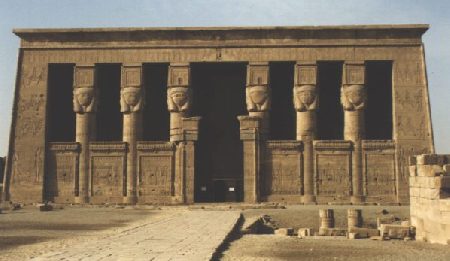
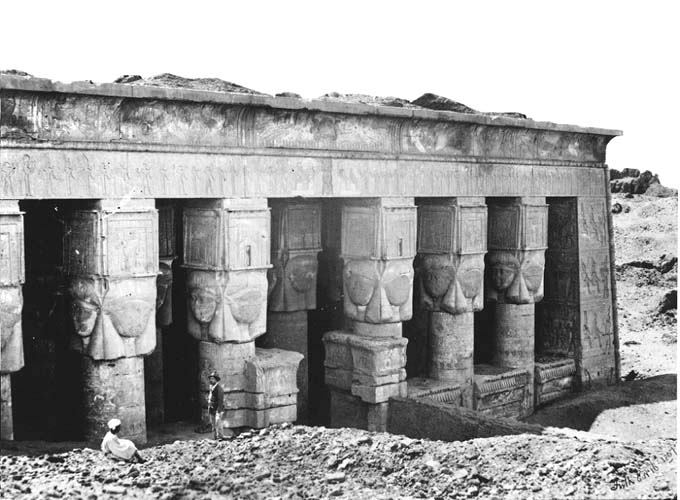
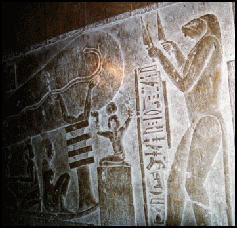
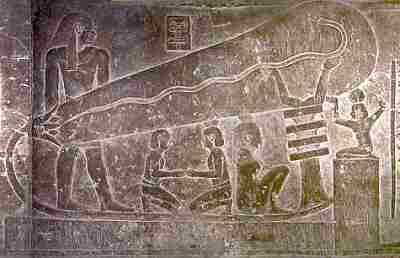
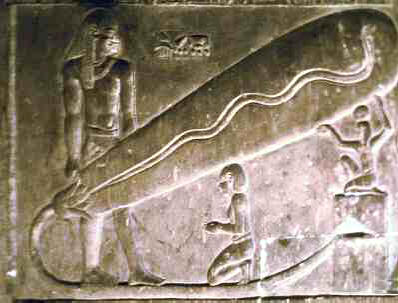
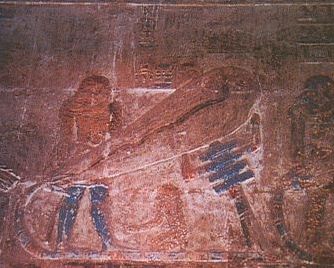
Excerpt The Temple of Hathor at Dendera contains a number of small crypts along the eastern, southern, and western sides. These crypts are thought to have served as warehouses or treasuries for ritual furnishings, sacred and ceremonial equipment, and divine images used in celebrating various feasts and holidays. The crypts are small and it is likely that few served as locations for formal rituals. Many have plain, undecorated walls, but some have walls of limestone, rather than the sandstone of the temple itself, that are covered with carefully carved reliefs At the southern end of the temple there are five subterranean crypts aligned along a straight hallway. It was in these small rooms that the most valuable of the temple statues and objects were kept, including two gilt statues of Hathor decorated with precious stones. The statues have long since vanished, but they are described in the text: one was "the height of one cubit, three palms and two fingers." François Daumas wrote: But most prestigious of the statues was that of the ba of Hathor. According to the texts written on the walls, we know that the kiosk consisted of a gold base surmounted by a gold roof supported by four gold posts, covered on all four sides by linen curtains hung from copper rods. Inside was placed the gold statuette representing a bird with a human head capped with a horned disc. This was Hathor, Lady of Dendara, residing in her house... It was certainly this statuette that was carried in the kiosk on the evening of the New Year. [Dendara et le Temple d'Hathor, 1969, p. 60; my own translation.]It is in the easternmost of these five crypts that the strange reliefs are found... Editors Note: Its interesting
that the above
description calls the building a storeroom, yet
still calls the actual
rooms crypts.
|
|||||||
|
.
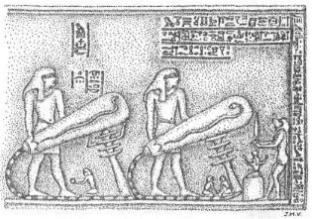
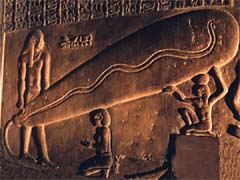
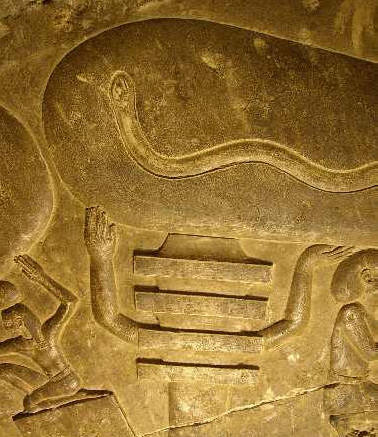
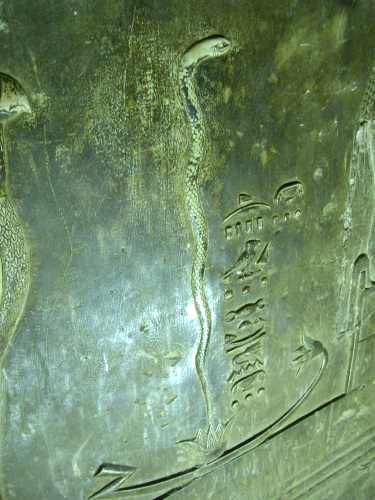
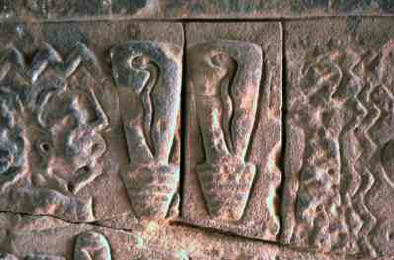
The walls are decorated with human figures next to bulb-like objects reminiscent of oversized light bulbs. Inside these "bulbs" there are snakes in wavy lines. The snakes' pointed tails issue from a lotus flower, which, without much imagination, can be interpreted as the socket of the bulb. Something similar to a wire leads to a small box on which the air god is kneeling. Adjacent to it stands a two-armed djed pillar as a symbol of power, which is connected to the snake. Also remarkable is the baboon-like demon holding two knives in his hands, which are interpreted as a protective and defensive power. |
|||||||
|
Electric Lights in Egypt?
It is a widespread belief in alternative science
that our forefathers
possessed a much greater technological knowledge
than our schoolbook science
is willing to accept. Many of those theories are
lacking serious foundation
and are often based on overdrawn speculations, like
the Manna machine I
discussed before.
The key to the whole theory lies a few hundred
kilometers east
of Egypt, in today's Iraq. There some strange pots
were found. Some contained
watertight copper cylinders, glued into the opening
with asphalt. In the
middle of the cylinder was an iron rod, held in
place also with asphalt.
The excavator who found the first of these pots in
1936 was sure: this
is a galvanic element, a primitive battery.
Reconstructions did indeed
show that it was possible to create electricity with
it. {See
Baghdad Battery}
Hathor-Temple in Dendera In this temple in Dendera, several dozens of
kilometers north
of Luxor, some experts found the light. A Norwegian
electrical engineer
noticed that the object shown on the relief on top
of this page coud work
as a lamp. An Austrian colleague was able to
construct a working model,
and two well known authors in the AAS, Peter Krassa
and Rainer Habeck,
could even work out a real theory based on it.
Editors Note: Frank Dörnenburg does not believe that the images portrayed are actually light bulbs, however his article is extremely well written and provides actual details of someone who visited the site. He makes several interesting points for consideration, especially about the "absence of soot argument". Take the time to read his articles as well and decide for yourself. Our view is that the presence or absence of soot is
irrelevant. That
oil lamps can burn soot free is true, as we have used
such lamps ourselves
in recreation of Medieval times...That there are signs
of soot in some
buildings simply means that later generations of
looters and explorers
used torches to find their way...In either case the
fact that Egyptians
had smokeless oil lamps does not deter from the
"alternate tech" theory
at all. It only assumes that "lightbulbs" is
what they were intended
for. Erik von Danekin proved that they can work, yet
give off very little
light. Perhaps the purpose was something else
entirely. This is the theory
we are working on.
|
|||||||
|
Complete text of the south wall: Bandeau de la frise:
|
|||||||
|
"The splendid but enigmatic
reliefs of the crypt
are cosmogonical and depict the serpent (dualizing
principle underlying
all creation: In Genesis the separation of heaven
and earth) borne aloft
by the lotus, the symbol of creation as a
manifestation of consciousness."
{From West's The Traveler's Key to
Ancient Egypt, page
402.}
{From "The Gods of the Egyptians:
Studies in Egyptian
Mythology, Vol. 1."
by EA Wallis Budge, Ernest A. Budge, Page 473}
Coincidence?
|
|||||||
|
|
|||||||
| FAIR USE NOTICE: This page contains copyrighted material the use of which has not been specifically authorized by the copyright owner. Pegasus Research Consortium distributes this material without profit to those who have expressed a prior interest in receiving the included information for research and educational purposes. We believe this constitutes a fair use of any such copyrighted material as provided for in 17 U.S.C § 107. If you wish to use copyrighted material from this site for purposes of your own that go beyond fair use, you must obtain permission from the copyright owner. | |||||||
| ~ MENU ~ |