|
The India ~ Hindu Connection |
||
| Ramesh S. Balsekar
"In the eye
of creation's
electrical storm, this body, the eye of
the mind circles itself
motionless, centered, seeing."
|
||
"Beyond that he is exposed to the procreation, which he experiences in quasi-Buddhist terms as "the Void," the "Eye of Creation." There he feels he is "touching the Face of God." The Void is not void: "it is full of energy." When he reverses the process, returning back home, "I was given lessons in the mechanics of reincarnation. I was given answers to all those little questions I had: How does this work? How does that work?" "What is the best religion on the planet?" Benedict proceeds to ask God. "And Godhead said, with great love: 'I don't care.' That was an incredible grace," Benedict says. "What that meant was that we are the caring beings here. The ultimate Godhead of all the stars tells us: 'It doesn't matter what religion you are'." 38
|
||
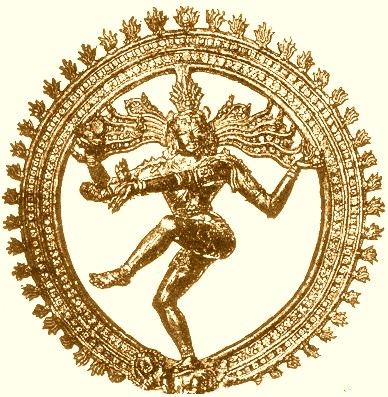
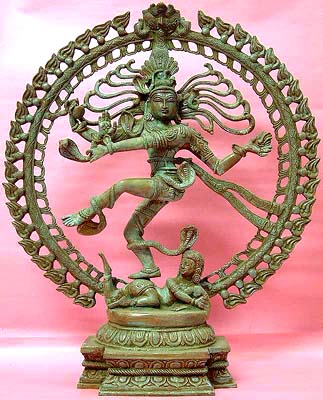
| Nataraja
These iconographic details of
Nataraja are to be read,
according to the Hindu tradition, in terms of a
complex pictorial allegory:
The most common figures depict a four-armed Shiva. These multiple arms represent the four cardinal directions. Each hand either holds an object or makes a specific mudra (gesture). The upper right hand holds an hour-glass drum which is a symbol of creation. It is beating the pulse of the universe. The drum also provides the music that accompanies Shiva’s dance. It represents sound as the first element in an unfolding universe, for sound is the first and most pervasive of the elements. The story goes that when Shiva granted the boon of wisdom to the ignorant Panini (the great Sanskrit grammarian), the sound of the drum encapsulated the whole of Sanskrit grammar. The first verse of Panini’s grammar is in fact called Shiva sutra. The hour-glass drum also represents the male and female vital principles; two triangles penetrate each other to form a hexagon. When they part, the universe also dissolves. The opposite hand, the upper left, bears on its palm a tongue of flames. Fire is the element of destruction of the world. According to Hindu mythology at the end of the world, it will be fire that will be the instrument of annihilation. Thus in the balance of these two hands is illustrated a counterpoise of creation and destruction. Sound against flames, ceaselessness of production against an insatiate appetite of extermination. The second right hand is held in the abhaya pose (literally without fear) and so a gesture of protection, as an open palm is most likely to be interpreted. It depicts the god as a protector. Batik Paintings of Lord ShivaThe left leg is raised towards the right leg and reaches across it; the lower left hand is stretched across the body and points to the upraised left foot which represents release from the cycle of birth and death. Interestingly, the hand pointing to the uplifted foot is held in a pose imitative of the outstretched trunk of an elephant. In Sanskrit this is known as the ’gaja-hasta-mudra’ (the posture of the elephant trunk), and is symbolic of Ganesha, Shiva’s son, the Remover of obstacles. Shiva dances on the body of a dwarf apasmara-purusha (the man of forgetfulness) who embodies indifference, ignorance and laziness. Creation, indeed all creative energy is possible only when the weight of inertia (the tamasic darkness of the universe) is overcome and suppressed. The Nataraja image thus addresses each individual to overcome complacency and get his or her own act together. The ring of fire and light, which circumscribes the entire image, identifies the field of the dance with the entire universe. The lotus pedestal on which the image rests locates this universe in the heart or consciousness of each person. |
||
|
||
| See Also Kundalini | ||
| FAIR USE NOTICE: This page contains copyrighted material the use of which has not been specifically authorized by the copyright owner. Pegasus Research Consortium distributes this material without profit to those who have expressed a prior interest in receiving the included information for research and educational purposes. We believe this constitutes a fair use of any such copyrighted material as provided for in 17 U.S.C § 107. If you wish to use copyrighted material from this site for purposes of your own that go beyond fair use, you must obtain permission from the copyright owner. | ||
| ~ MENU ~ |