|
The Christian Connection Part One Artwork that Indicates Gates |
|||
|
...
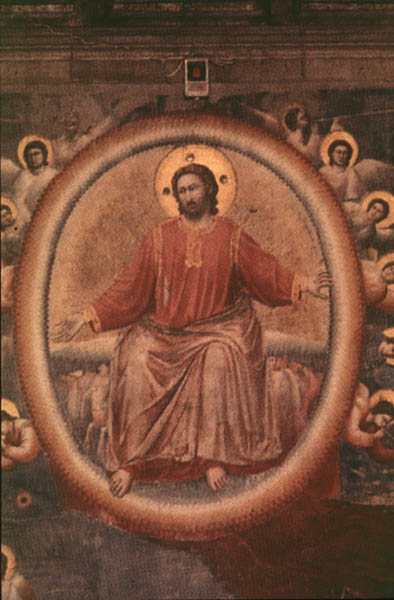
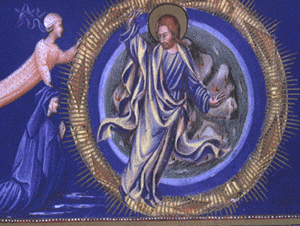
At the Second Coming Christ will appear in the heavens, seated on a cloud and surrounded by the angelic hosts (Matthew 16:27; 24:30; 25:31) The above picture very clearly shows
Jesus stepping
out of a portal with the "Host of Angels" still to
come through.
Mathew 16:27. For the Son of man shall come in the glory of his Father with his angels: and then will he render to every man according to his works.*NOTES VERSE 27. The coming of Christ shall be sudden, and manifest to all the world, like lightning: VERSE 29. The stars... Or flaming meteors resembling stars. VERSE 30. The sign, etc... The cross of Christ. Source: Catholic
Encyclopedia
Angels
(Latin angelus; Greek aggelos; from the Hebrew for "one going" or "one sent"; messenger). The word is used in Hebrew to denote indifferently either a divine or human messenger. The Septuagint renders it by aggelos which also has both significations. The Latin version, however, distinguishes the divine or spirit-messenger from the human, rendering the original in the one case by angelus and in the other by legatus or more generally by nuntius. In a few passages the Latin version is misleading, the word angelus being used where nuntius would have better expressed the meaning, e.g. Isaiah 18:2; 33:3, 6. The angels are represented throughout the Bible as a body of spiritual beings intermediate between God and men: "You have made him (man) a little less than the angels" (Psalm 8:6). They, equally with man, are created beings; "praise ye Him, all His angels: praise ye Him, all His hosts . . . for He spoke and they were made. Sabaoth
(In Hebrew, plural form of "host" or "army"). The word is used almost exclusively in conjunction with the Divine name as a title of majesty: "the Lord of Hosts", or "the Lord God of Hosts". The origins and precise signification of the title are matters of more or less plausible conjecture. According to some scholars the "hosts" represent, at least primitively, the armies of Israel over whom Jehovah exercised a protecting influence. Others opine that the word refers to the hosts of heaven, the angels, and by metaphor to the stars and entire universe (cf. Genesis 2:1). In favour of the latter view is the fact that the title does not occur in the Pentateuch or Josue though the armies of Israel are often mentioned, while it is quite common in the prophetic writings where it would naturally have the more exalted and universal meaning.
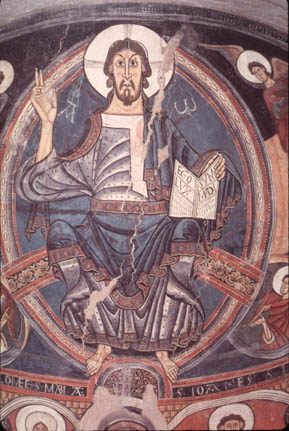
The Greek cross within a circle
(cruciform nimbus)
is used only when portraying Christ. In the San
Giovanni ceiling, notice
that the figure of God is also in the shape of a
Greek cross, within a
circle. Both can be taken as an examples of squaring
the circle. - Source
- Dartmouth
University
Fisher, Sally. The Square Halo. NY: Abrams, 1995. p. 91 The Middle Ages saw numerous appearances of the vesica used as an aureole, a field of radiance surrounding the entire body, a sort of body halo surrounding holy figures. This use continued into the Renaissance. It is the most common use of the vesica as an art motif. Interpreting the aureole as a Venn diagram, it could represent the uniting of God and man or the intersection (crossroads [ed.]) of two realms, earthly and divine. - Source - Dartmouth University Editors Note: The depiction of the Halo around divine figures can be traced back to Buddhist traditions of the Aura that surrounds all beings. The more "spiritual" or divine the being, the larger and more golden is the aura. In Christian paintings and illuminations, this was known and depicted by the halo all around a deity. Later this was reduced to just around the head, and now in present day we see the halo as a mere circle above the head. This detracts from the real significance of the Halo/Aura. We will cover this topic in another paper. |
|||
|
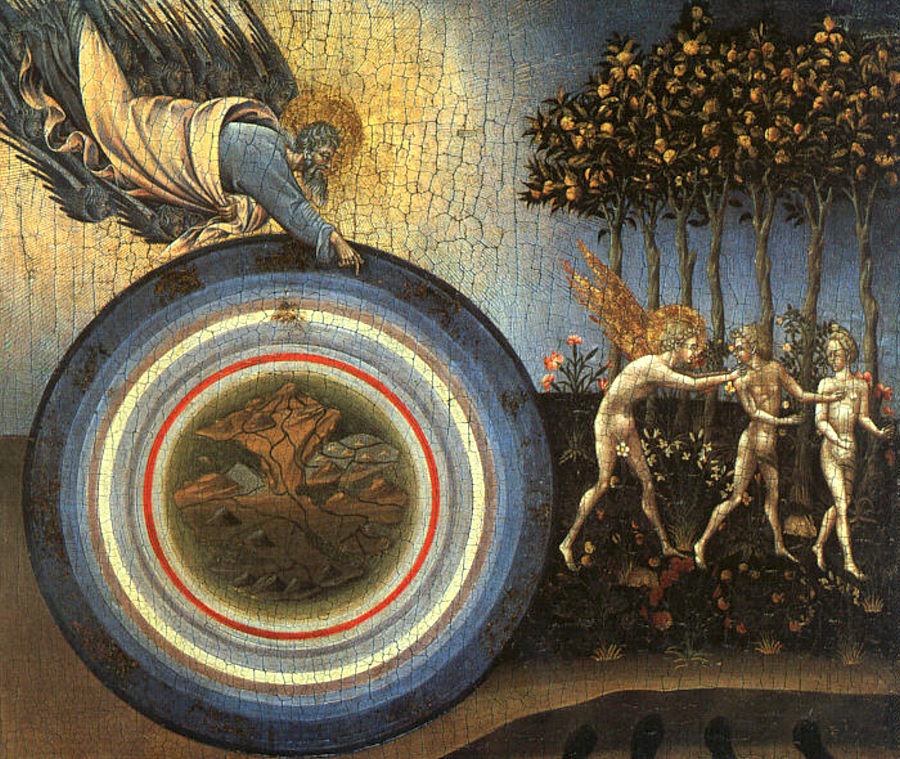
Expulsion from Paradise Author Beth Vegh, in her series of
E-books expressing
her theory of Ancient
Star
Gates she mentions the possible location of
Eden being through a gateway
in another realm. Looking at the picture below
painted in 1445, it seems
she is not the first to reach this startling
conclusion.
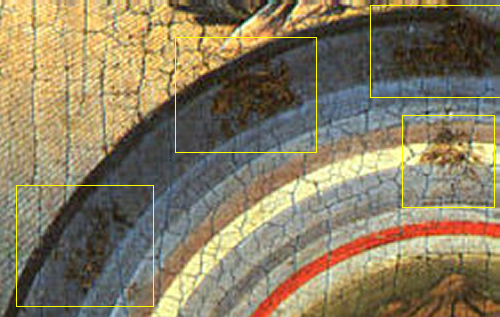
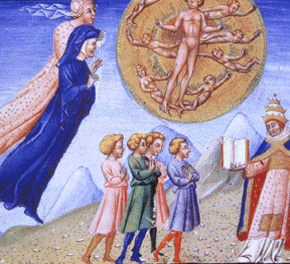
Creation of the World & Expulsion from Paradise The Earth (brown) at center, shown as a Mappamondo, or world map, surrounded by the three other elements, water, air, and fire, its bright red clearly marks the boundary between the sublunary and translunary realms. Then comes the moon and planets, all blue, except for the Sun, yellow-white, with gilded sunburst, and Mars, in pink, for the red planet. Then the fixed stars with signs of the zodiac, the Primum mobile (the first moved) which regulated the motion of all the spheres beneath it, and the Empyrean heaven, the home of God and the angels. - Source - Dartmouth University In this painting the concept of passing through a portal to the Barren land of sand and rock where Adam and Eve were sent is very clearly portrayed. A closer look
around the edge
shows that there are symbols around the 'gate'.
There is one triangle marking
top center on the inner ring but this may be a
smudge of dirt, though I
would wonder why they left it.
|
|||
|
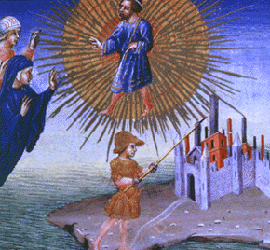
Old Paintings showing circles or portals around deities... Mercury
|
|||
Archangels
|
|||
|
|||
|
|
|||
| FAIR USE NOTICE: This page contains copyrighted material the use of which has not been specifically authorized by the copyright owner. Pegasus Research Consortium distributes this material without profit to those who have expressed a prior interest in receiving the included information for research and educational purposes. We believe this constitutes a fair use of any such copyrighted material as provided for in 17 U.S.C § 107. If you wish to use copyrighted material from this site for purposes of your own that go beyond fair use, you must obtain permission from the copyright owner. | |||
|
|