|
Nazca Lines Nazca, Peru |
||||||
|
Plains of Nazca, Peru
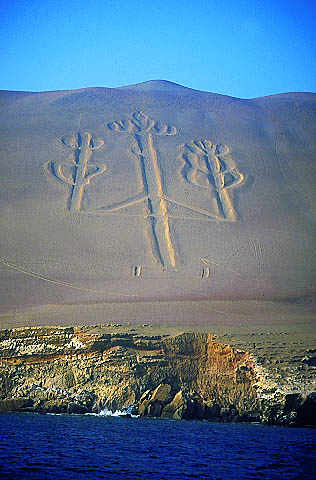
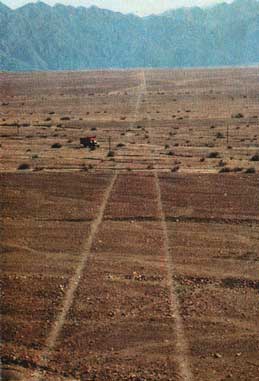
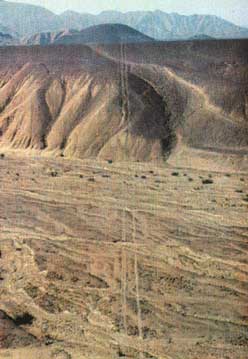
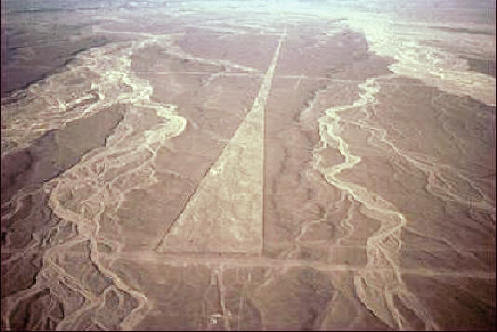
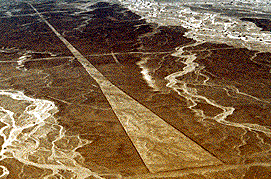
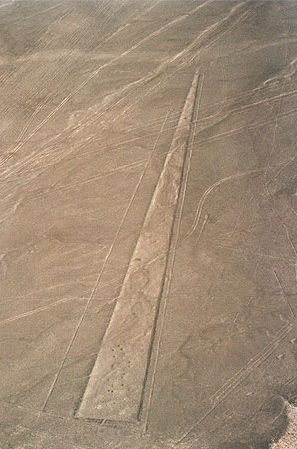
A trident, carved on a mountain side in Peru, pointing the way to the Plains of Nazca. |
||||||
|
.
Nazca on the dry, southern
coast of Peru, is one
of the most famous archaeological sites in the
world. The desert drawings
there were already known to Peruvian archaeologists
and the Peruvian Air
Force by the early twentieth century, but
archaeologists Alfred Kroeber
and Toribio Mejia Xesspe the first scholars to
highlight their significance
(in the 1930s). As at Sajama, the lines appear to
have been carved into
the earth by removing rocks and topsoil from the
surface to reveal lighter
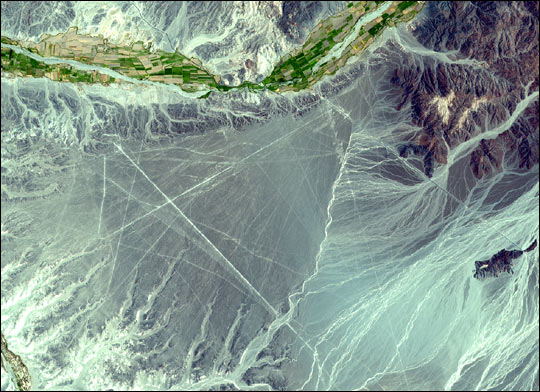
soils below. The Nazca lines cover some 550 square
miles and, according
to Aveni, if “laid end to end would run nearly 1,000
miles” (Aveni 2000:29).
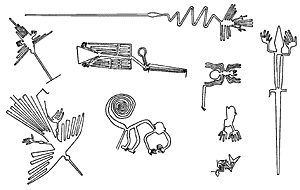
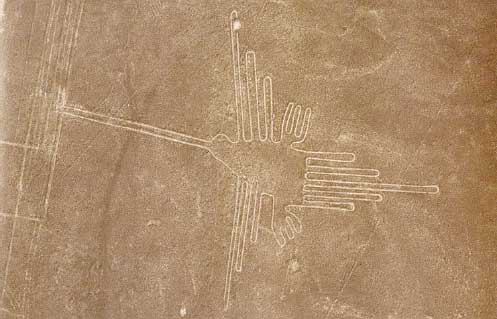
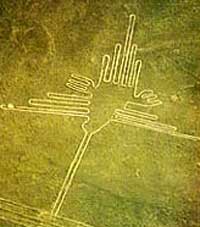
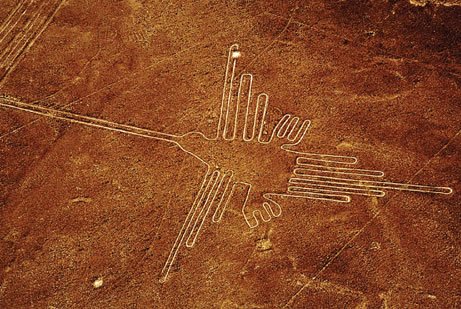
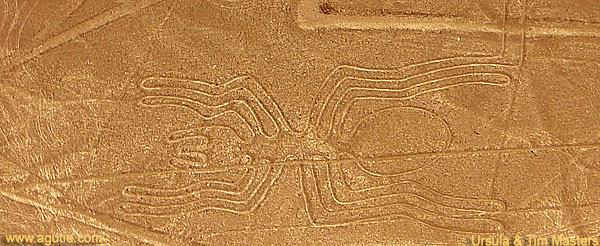
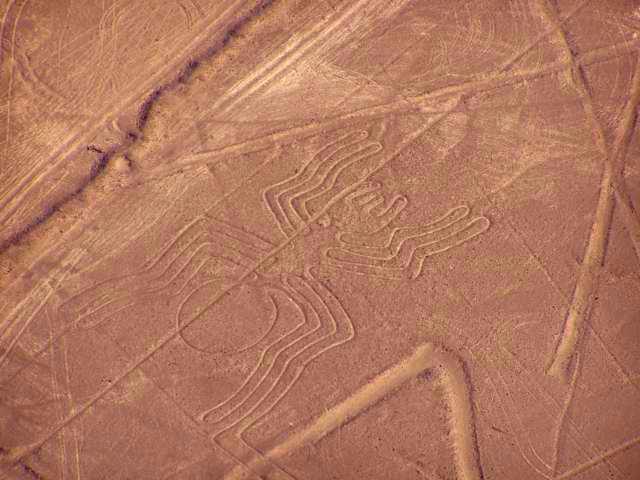
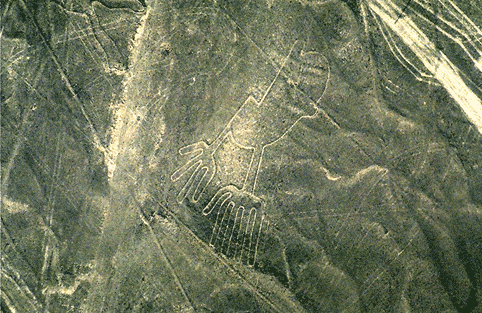
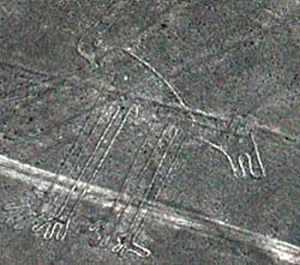
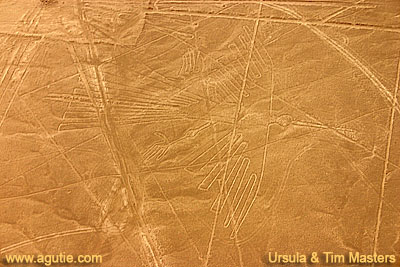
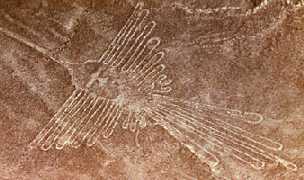
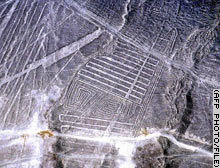
The desert plains of Nazca also have large,
elaborate ground drawings –
such as figures of a monkey, a fish, and a
hummingbird – each constructed
from a single, unbroken path.
- SOURCE |
||||||
|
.
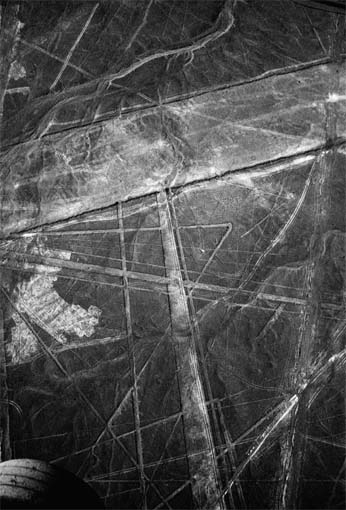
The Nazca Lines provide one of the enduring images of Peru. These colossal geometric and artistic patterns etched in the desert south of Nazca have also engraved themselves on our collective memory. The Lines were re-discovered in the 1920s and were first thought to have been created by the Incas, but it now seems clear that they are the legacy of a much older culture that developed over 2,300 years ago. Today, frustratingly little is known about the Nazca culture despite finds of mummies, huge irrigation systems and some highly-decorated ceramics. We can still only wonder at what they were trying to accomplish by making these enormous shapes in the desert, and we can only begin to guess at how they created their greatest legacy, the Nazca Lines themselves. -
Source
and over the mountain, maintaining a straght line |
||||||
|
.
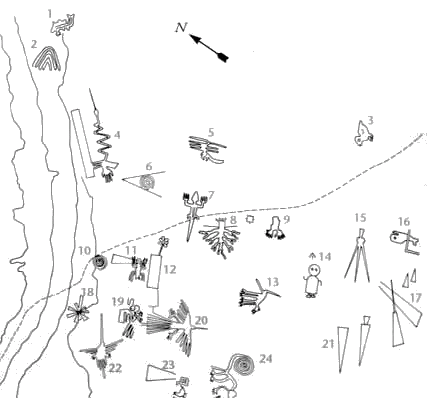
"All over the thirty miles and more
of desert where
ground-drawings can be found, these show always the
same basic forms. The
same kind of quadrangles, triangles, zigzag- and
oscillating lines on large
and small scales, the same starlike centres can be
found everywhere, on
vast plains. They are one single creation and are,
together with the animal
figures, quantitatively and qualitatively the most
outstanding of all works
by ancient Peruvians."
|
||||||
|
.
On the pampa, south of the Nasca
Lines, archaeologists
have now uncovered the lost city of the
line-builders, Cahuachi. It was
built nearly two thousand years ago and was
mysteriously abandoned 500
years later. New discoveries at Cahuachi are at last
beginning to give
us insight into the Nasca people and to unravel the
mystery of the Nasca
Lines. - SOURCE
|
||||||
|
.
The Nazca Lines are the most
outstanding group of geoglyphs
in the world. There are also huge geoglyphs in
Egypt, Malta, United States
(Mississippi and California), Chile, Bolivia and in
other countries. But
the Nasca geoglyphs, because of their numbers,
characteristics, dimensions
and cultural continuity as they were made and remade
through out the whole
prehispanic period, form the most impressive as well
as enigmatic archeological
group.
|
||||||
|
.
|
||||||
|
.
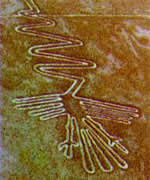
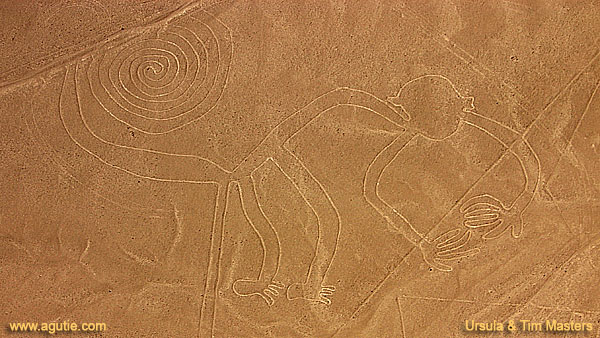
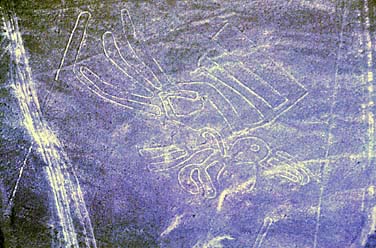
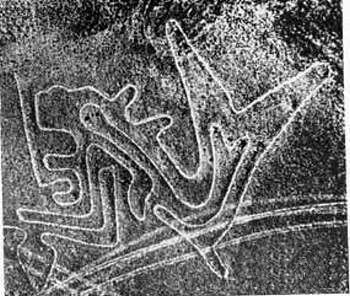
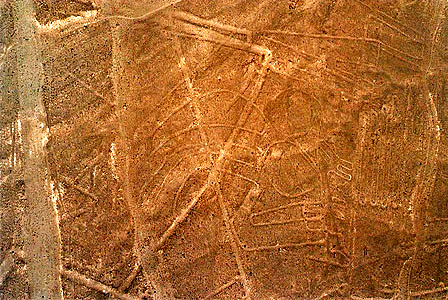
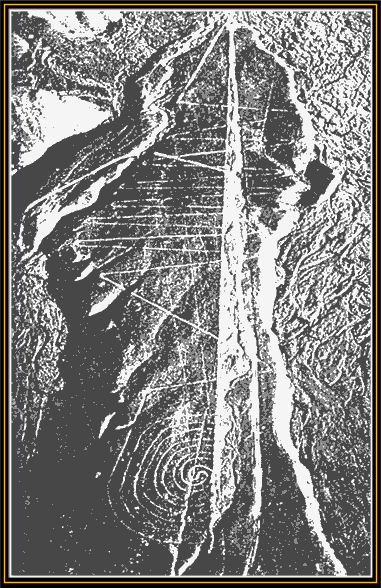
"This drawing consists of no more
than two elements.
One is a wide line with a stem which, almost a mile
long, leads into the
maze of lines at the edge of the pampa. The other is
one single uninterrupted
line, that starts from one side of the long surface
and after describing
the contours of the monkey, consisting only of
curves, runs through two
different zig-zag shapes and crosses sixteen times
over the geometric surface
at whose top it finally ends."
|
||||||
|
.
"This drawing consists of no more
than two elements.
One is a wide line with a stem which, almost a mile
long, leads into the
maze of lines at the edge of the pampa. The other is
one single uninterrupted
line, that starts from one side of the long surface
and after describing
the contours of the monkey, consisting only of
curves, runs through two
different zig-zag shapes and crosses sixteen times
over the geometric surface
at whose top it finally ends."
|
||||||
|
.
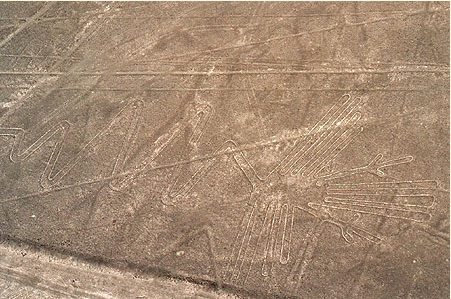
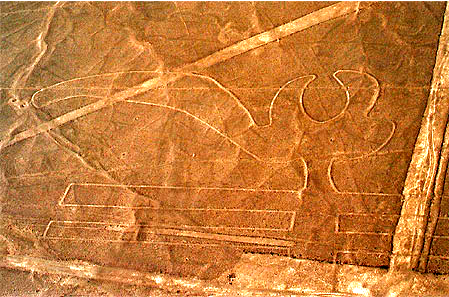
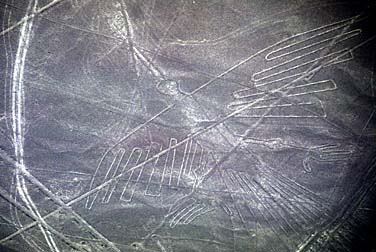
"The head of the largest bird is
made of segments of
circles, whose radii vary between 32 and 66 feet.
The figure is much stylized,
showing in profile, while two circles of equal
diameter could represent
two eyes. The two curves continuing from the end of
the neck have exactly
the same radius, being both concentrical to the
eyes."
|
||||||
|
.
"The head of the largest bird is
made of segments of
circles, whose radii vary between 32 and 66 feet.
The figure is much stylized,
showing in profile, while two circles of equal
diameter could represent
two eyes. The two curves continuing from the end of
the neck have exactly
the same radius, being both concentrical to the
eyes."
|
||||||
|
.
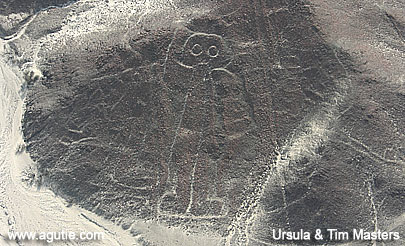
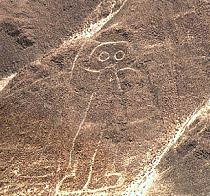
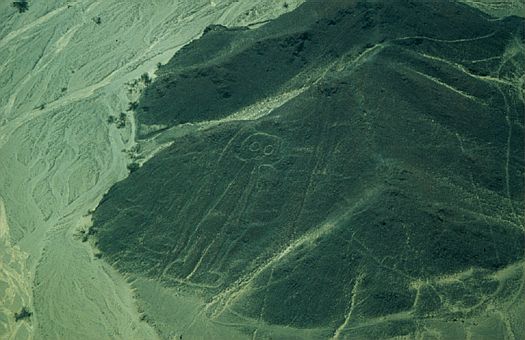
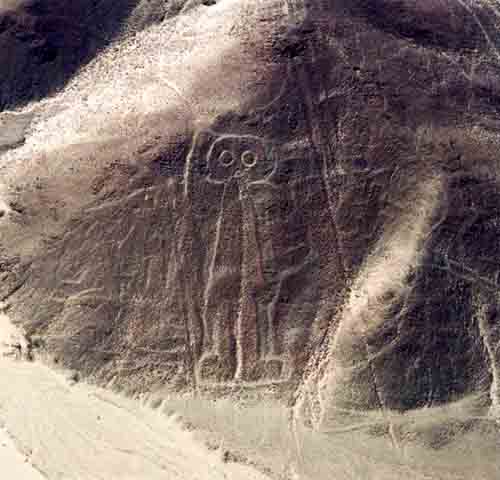
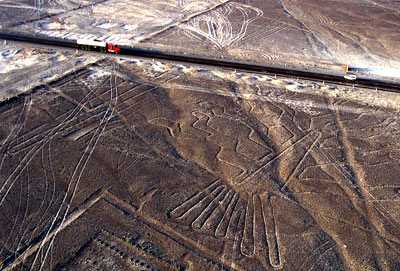
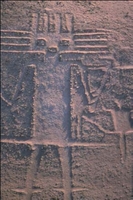
"Another kind of figures is found on
steep slopes (see
the owl-man figure). From the ground they are
practically unrecognizable."
In the owl-man "The study of the straight lines
beside it could perhaps
throw light on its significance. The owl-man appears
also in Peruvian pottery.
Figures on slopes may be more primitive because of
the steepness of the
incline, or else they could belong to an earlier
cultural level."
|
||||||
|
.
|
||||||
|
||||||
|
.
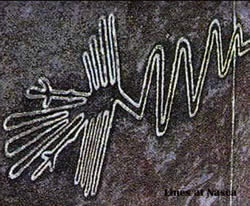
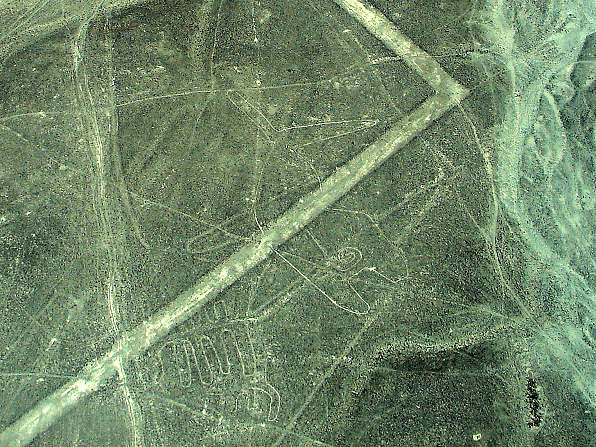
"It is represented as in a
turn in its flight."
|
||||||
This one is becoming difficult to see and the highway runs trough the center of it. |
||||||
|
.
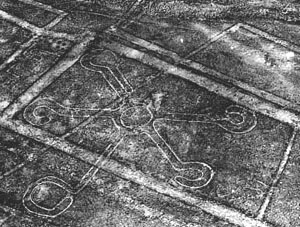
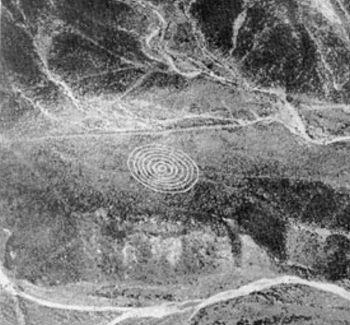
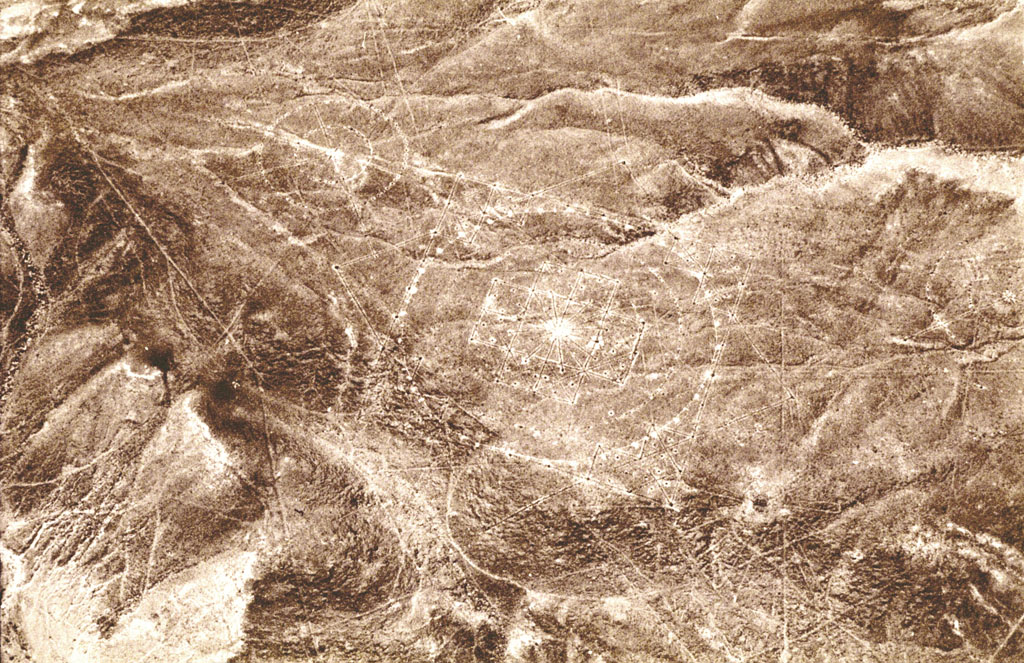
Many of the lines form geometric
figures: angles, triangles,
bunches, spirals, rectangles, wavy lines, etc. Other
lines form concentric
circles converging with or emanating from a
promontory.
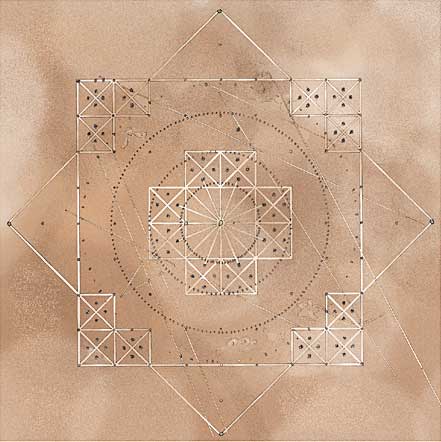
A large and complex Nasca "Geoglyph"
|
||||||
|
Gilbert de Jong .
Gilbert de Jong was himself in Nazca and measured the GGF by GPS. He obtained a length of the square side of about 54,7 Meter. In the formation he recognized a Zodiac. You can find out more about at his theory at his website.
|
||||||
|
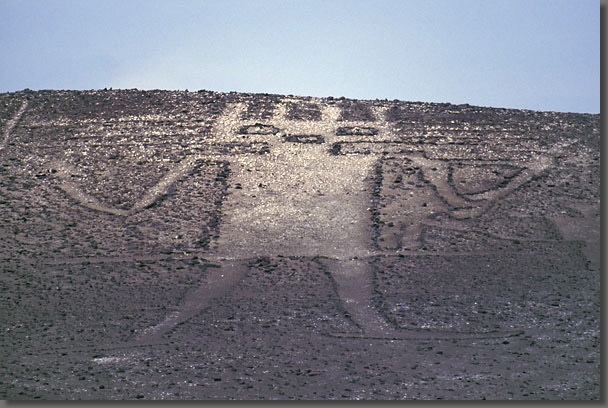
THE GIANT OF ATACAMA Exhibit 101 Cerro Unitas, Chile
This huge geoglyph on Cerro Unitas in the Chilean Atacama desert was created 900 B.C. and measures 86 meters. "The Chilean glyphs in the Atacama
Desert are far more
numerous and varied in style, cover a much larger
region (150,000 km2 versus
the 250 km2 of the Nazca lines), and were built
between 600 and 1500 AD."
-
K.
Kris
Hirst
|
||||||
|
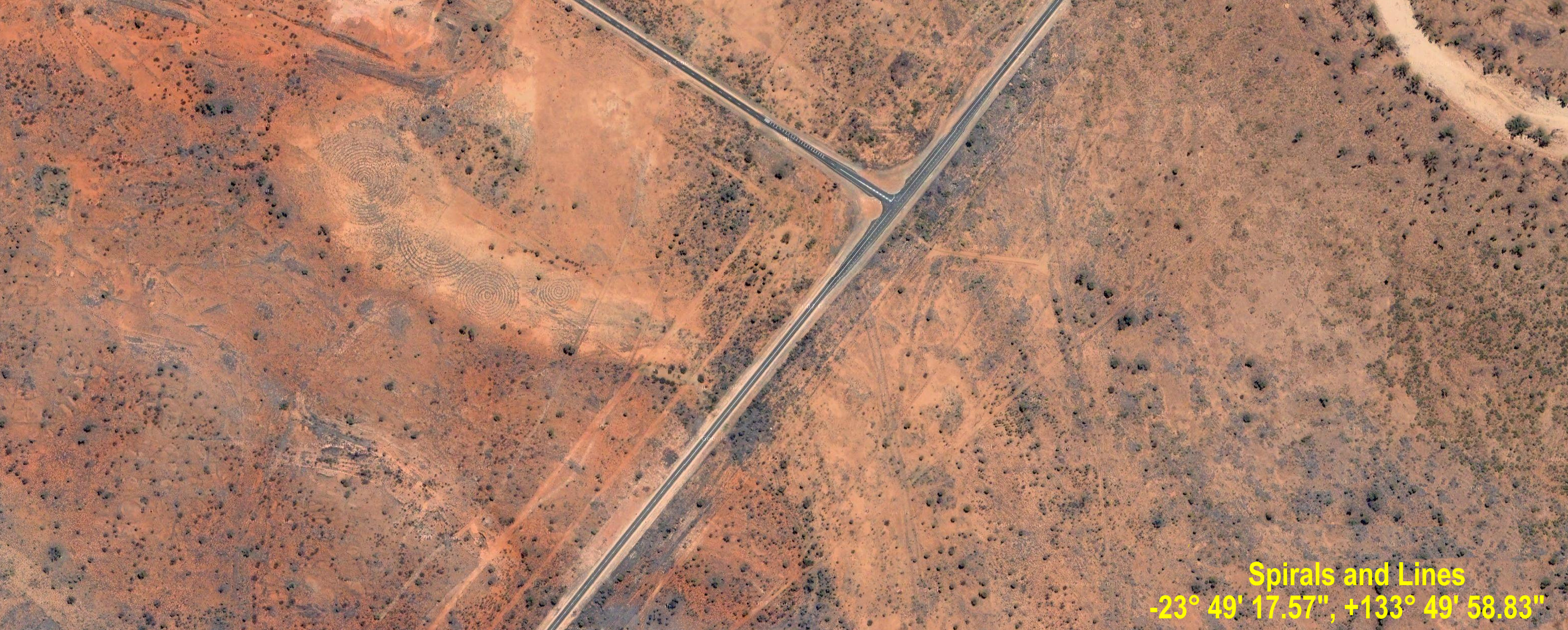
Spirals of Pine Gap Exhibit 102 Alice Springs, Western Australia Near Pine Gap Echelon Station
Spirals and Lines at the intersection of Hatt Rd (entrance to Pine Gap) and Stuart Hwy, Western Australia. Click on the image to zoom in for the full details. The Spirals are in the sandy area, the lines to the right of the highway. For
more
information and comparisons see here
|
||||||
|
|
Webpages © 2001-2017 Blue Knight Productions |