Vimanas -
Vaimanika Shastra
..
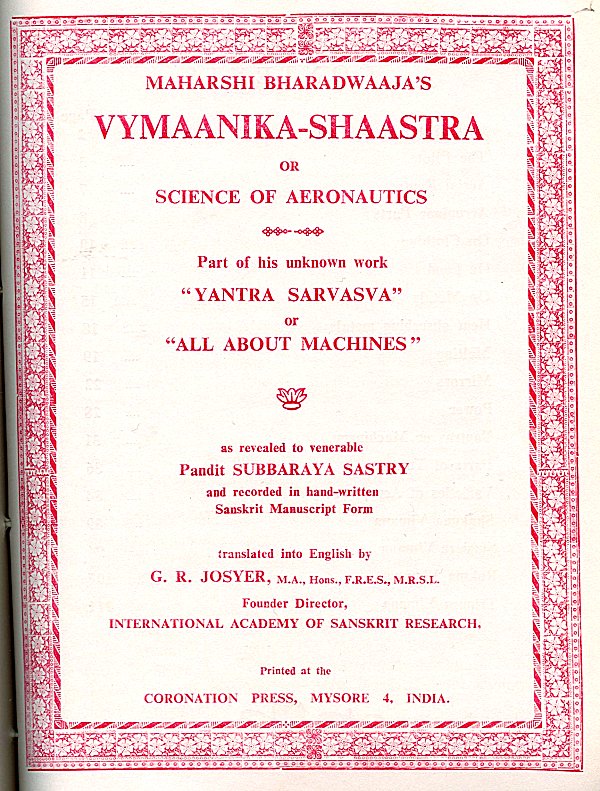
Title
page of the English
translation of Vyamanika Shastra published in
1973
Vaimanika
Shastra
The Vaimānika Shāstra वैमानिक
शास्त्र
("Science of Aeronautics" [1]; also Vimanika,
Vymanika) is an early
20th century Sanskrit text on aeronautics, claimed
to be obtained by mental
channeling, about construction of vimānas,
the "chariots of the
Gods", self-moving aerial cars mentioned in the
Sanskrit epics.
The existence of the text was
revealed in 1952 by G.
R. Josyer, according to whom it is due to one
Pandit Subbaraya Shastry,
who dictated it in 1918-1923. A Hindi
translation was published in 1959,
the Sanskrit text with an English translation in
1973. It has 3000 shlokas
in 8 chapters and was attributed by Shastry to Maharishi
Bharadvaja, [2] which makes it of
purportedly "ancient" origin,
and hence it has a certain notability in ancient
astronaut theories.
A study by aeronautical and
mechanical engineering
at Indian Institute of Science, Bangalore in
1974 concluded that the aircraft
described in the text were "poor concoctions"
and that the author showed
a complete lack of understanding of aeronautics.
[3]
Origin and
publication
Subbaraya Shastry was a mystic
from Anekal, who was
reputed to speak out verses (slokas)
whenever he got inspiration,
described by Josyer as "a walking lexicon gifted
with occult perception".
According to Josyer, he dictated the text to G.
Venkatachala Sharma in
the early 1900s (completing it in 1923).
Subbaraya Shastry died in 1941,
and Venkatachala took
his manuscripts into keeping. The Vaimanika
Shastra manuscript appeared
at Rajakiya Sanskrit Library, Baroda by 1944.[4]
The text was published
in Hindi in 1959 [5] and later in English by
G.R. Josyer, titled Vymanika
Shastra. Josyer's edition, also added
illustrations drawn by T. K.
Ellappa, a draughtsman at a local engineering
college in Bangalore, under
the direction of Shastry, which had been missed
in the 1959 edition. [6]
Its existence was first
announced publicly in a 1952
press release by G.R. Josyer, who had founded
his "International Academy
of Sanskrit Research" in Mysore the year before.
In the foreword to the
1973 publication that contained the full
Sanskrit text with English translation,
Josyer quotes a 1952 press release of his which
was "published in all the
leading dailies of India, and was taken up by
Reuter and other World Press
News Services":[7]
Mr. G. R. Josyer,
Director of the International
Academy of Sanskrit Research in Mysore, in the
course of an interview recently,
showed some very ancient manuscripts which the
Academy had collected. He
claimed that the manuscripts were several
thousands of years old, compiled
by ancient rishis, Bharadwaja, Narada and
others, dealing, not with the
mysticism of ancient Hindu philosophy of Atman
or Brahman, but with more
mundane things vital for the existence of man
and progress of nations both
in times of peace and war. [...] One manuscript
dealt with Aeronautics,
construction of various types of aircraft for
civil aviation and for warfare.
[...] Mr. Josyer showed some types of designs
and drawing of a helicopter-type
cargo-loading plane, specially meant for
carrying combustibles and ammunition,
passenger aircraft carrying 400 to 500 persons,
double and treble-decked
aircraft. Each of these types had been fully
described.
Josyer then tells how he was
visited by "Miss Jean Lyon,
journalist of Toronto and New York" for an
interview, and how Lyon in her
Just Half a World Away (1954) concluded
that he was "guilty of a
rabid nationalism, seeking to wipe out everything
since the Vedas".
A critical review pronounced
Josyer's introduction
to be "least scholarly by any standards." and
said that "the people connected
with publication – directly or indirectly – are
solely to blame either
for distorting or hiding the history of the
manuscripts." perhaps in an
attempt to "eulogise and glorify whatever they
can find about our past,
even without valid evidence". By tracing the
provenance of the manuscript,
interviewing associates of S. Shastry (including
G. V. Sharma to whom the
text was originally dictated), and based on the
linguistic analysis of
the text, the review concluded that it came into
existence sometime between
1900 and 1922.[6]
Structure
and content
..
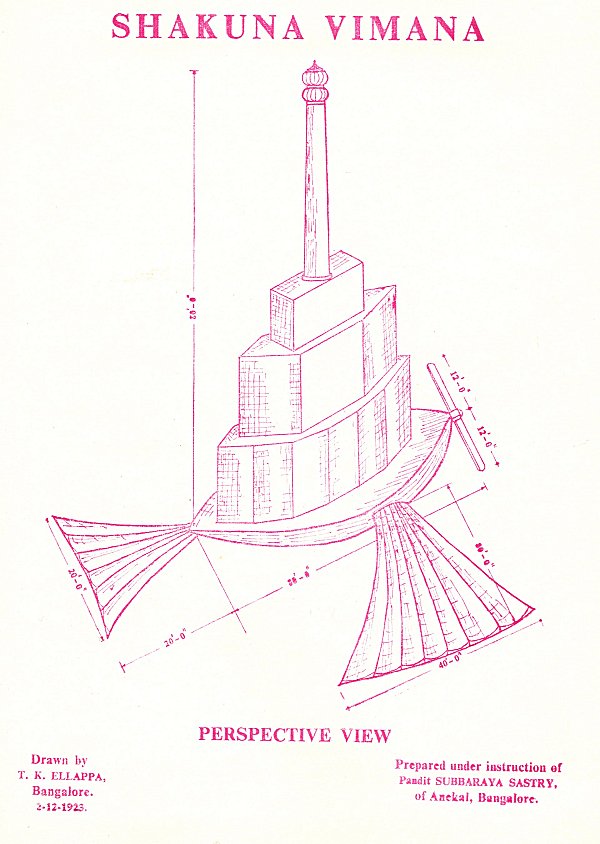
An
illustration of the
Shakuna Vimana that is supposed to fly
like a bird with hinged wings and
tail.[6]
Unlike modern treatises on
aeronautics that begin by discussing
the general principles of flight before detailing
concepts of aircraft
design, the Vaimanika Shastra straightaway
gets into quantitative
description, as though a particular aircraft is
being described. The topics
covered include, "definition of an airplane, a
pilot, aerial routes, food,
clothing, metals, metal production, mirrors and
their uses in wars, varieties
of machinery and yantras, planes like ‘mantrik’,
‘tantrik’, and
‘kritak’" and four planes called Shakuna,
Sundara, Rukma,
and Tripura are described in greater
detail. The extant text is
claimed to be only a small (one-fortieth) part of
a larger work Yantra
Sarvaswa ("All about machines[7]) composed
by Maharishi
Bharadwaj and other sages for the
"benefit of all mankind".[6]
In 1991, the English portion and
the illustrations
from the Josyer book were reprinted by David Hatcher
Childress in Vimana Aircraft of
Ancient India & Atlantis
as part of the Lost Science Series.
According to Childress, the
8 chapters treat the following:
-
The secrets of constructing
aeroplanes, which will not
break, which cannot be cut, will not catch
fire, and cannot be destroyed.
-
The secret of making planes
motionless.
-
The secret of making planes
invisible.
-
The secret of hearing
conversations and other sounds in
enemy places.
-
The secret of retrieving
photographs of the interior of
enemy planes
-
The secret of ascertaining the
direction of enemy planes
approach.
-
The secret of making persons in
enemy planes lose consciousness.
-
The secret of destroying enemy
planes.
The propulsion of the Vimanas
according to Kanjilal (1985)
is by a "Mercury Vortex Engines"[8], apparently a
concept similar to electric
propulsion. Childress finds evidence for this
"mercury vortex engine" in
the Samarangana
Sutradhara, an 11th century treatise
on architecture.
J. B. Hare of the Internet
Sacred Text Archive in 2005 compiled an
online edition of Josyer's
1973 book, in the site's "UFOs" section. In his
introduction, Hare writes
The Vymanika
Shastra was first committed
to writing between 1918 and 1923, and nobody is
claiming that it came from
some mysterious antique manuscript. The fact is,
there are no manuscripts
of this text prior to 1918, and nobody is
claiming that there are.
So on one level, this is not a hoax. You just
have to buy into the assumption
that 'channeling' works. ... there is no
exposition of the theory of aviation
(let alone antigravity). In plain terms, the VS
never directly explains
how Vimanas get up in the air. The text is
top-heavy with long lists of
often bizarre ingredients used to construct
various subsystems. ... There
is nothing here which Jules Verne couldn't have
dreamed up, no mention
of exotic elements or advanced construction
techniques. The 1923 technical
illustration based on the text ... are absurdly
un-aerodynamic. They look
like brutalist wedding cakes, with minarets,
huge ornithopter wings and
dinky propellers. In other words, they look like
typical early 20th century
fantasy flying machines with an Indian twist.
A 1974 study by researchers at the
Indian
Institute of Science, Bangalore found that
the heavier-than-air aircraft
that the Vaimanika Shastra described were
aeronautically unfeasible.
The authors remarked that the discussion of the
principles of flight in
the text were largely perfunctory and incorrect,
in some cases violating
Newton's
laws of motion. The study concluded:[9]
Any reader by now would
have concluded the
obvious – that the planes described above are
the best poor concoctions,
rather than expressions of something real. None
of the planes has properties
or capabilities of being flown; the geometries
are unimaginably horrendous
from the point of view of flying; and the
principles of propulsion make
then resist rather than assist flying. The text
and the drawings do not
correlate with each other even thematically. The
drawings definitely point
to a knowledge of modern machinery. This can be
explained on the basis
of the fact that Shri Ellappa who made the
drawings was in a local engineering
college and was thus familiar with names and
details of some machinery.
Of course the text retains a structure in
language and content from which
its 'recent nature' cannot be asserted. We must
hasten to point out that
this does not imply an oriental nature of the
text at all. All that may
be said is that thematically the drawings ought
to be ruled out of discussion.
And the text, as it stands, is incomplete and
ambiguous by itself and incorrect
at many places.
The authors expressed puzzlement at
the contradiction
and errors in the Vaimanika Shastra text,
especially since its compilers
supposedly had access to publications that did not
make such errors (such
as, Dayanand Saraswati's
commentary on the
Rigveda published in 1878 or earlier).[10]
Related
Links:
Notes:
-
lit. "shastra
on the topic of Vimanas";
Shastry
& Josyer 1973
-
Childress (1991), p. 109
-
"Flights
of
fancy? (Part X of XII)". The
Week. 2001-06-24
-
Mukunda
1974, p. 2.
-
Swami Brahmamuni Parivrajaka, Brihad
Vimana Shastra,
Sarvadeshik Arya Pratinidhi Sabha. Dayanand
Bhavan, New Delhi, 1959.
-
Mukunda
1974
-
Shastry
& Josyer
1973
-
Childress (1991), p. 249
-
Mukunda
1974, p. 11
-
Mukunda
1974, p. 12
References:
-
Mukunda, H.S.; Deshpande, S.M.,
Nagendra, H.R., Prabhu,
A. and Govindraju, S.P. (1974). "A
critical study of the work "Vyamanika
Shastra"". Scientific Opinion:
5–12
-
A.S. Shastry, G.R. Josyer, Vymanika
Shastra - Pronouncements
of Maharshi Bhradwaja (1973) [1][2]
-
Dileep Kumar Kanjilal, Vimana
in Ancient India : Aeroplanes
Or Flying Machines in Ancient India,
Sanskrit Pustak Bhandar (1985).
-
David
Hatcher Childress, Vimana Aircraft
of Ancient India, Adventures
Unlimited Press (1991), ISBN
0932813127
|
Ancient Indian
Vimanas
and Modern
Mercury Vortex Technology
Vimanas
This article deals with vimanas that
are running on
a mercury vortex propulsion system. This system is
developed by, created
by Bill Clendenon, an inventor of the mercury vortex
propulsion system.
Clendenon explains that the vimana was an ancient
Indian aircraft, mention
in variuous Vedic scriptures. This was a machine
driven by a now unconventional
manner. The mercury vortex propulsion engine.
The workings
of the mercury vortex
technology
David hatcher Childress has
explained a bit further,
the theory of the mercury vortex technology. I will
quote it here in full:
-
The electromagnetic field coil,
which consists of the
closed circuit exchanger / condenser coil circuit
containing the liquid
metal mercury and / or its hot vapor, is placed
with its core axis vertical
to the craft.
-
A ring conductor (directional
gyro-armature) is placed
around the field coil (heat exchanger) windings so
that the core of the
vertical heat exchanger coils protrudes through
the center of the ring
conductor.
-
When the electromagnet (heat
exchanger coils) is energized,
the ring conductor is instantly shot into the air,
taking the craft as
a complete unit along with it.
-
If the current is controlled by a
computerized resistance,
(rheostat), the ring conductor armature and craft
can be made to hover
or float in the Earth's atmosphere.
-
The electromagnet hums and the
armature ring (or torus)
becomes quite hot. In fact, if the electrical
current is high enough, the
ring will glow dull red or rust orange with heat.
-
The phenomenon (outward sign of a
working law of nature)
is brought about by an induced current effect
identical with an ordinary
transformer.
-
As the repulsion between the
electromagnet and the ring
conductor is mutual, one can imagine the craft
being affected and responding
to the repulsion phenomenon as a complete unit.
-
Lift or repulsion is generated
because of close proximity
of the field magnet to the ring conductor.
Clendenon says that lift would
always be opposed to the gravitational pull of the
planet Earth, but repulsion
can also be employed to cause fore and aft
propulsion.'(David hatcher Childress
(2000), p.180)
The basic turbo-pump engine has four
main sections: compressor,
combustion, or heating chambers, turbo-pump and
exhaust. Burning gases
are exhausted through the turbo-pump wheel to generate
power to turn the
electric generator:
-
Propellant tanks will be filled
with liquid air (obtained
directly from the atmosphere by on-board reduction
equipment).
-
Liquid air may be injected into
expansion chambers and
heated by the metal working-fluid mercury confined
in a boiler coupled
to a heat exchanger.
-
The super heated M.H.D. plasma (or
air) will expand through
propellant cooled nozzles.
-
The ship may recharge its
propellant tanks with liquid
air and condensate water collected directly from
the upper atmosphere by
the on-board reducing plant.
Important is that this mercury vortex
propulsion model
is intented for terrestrial flight only. The strange
ball of light that
is often seen by UFO like craft, is the ball of light
that surrounds a
craft is: the magneto-hydrodynamic plasma, a hot
continuously recirculating
air flow through the ship's gas turbine which is
ionized (electrically
conducting). Magnetohydrodynamics (MHD) is described
by Childress as an
ionized gas that is passed through a magnetic field to
generate electricity.
(Childress (2000), p.182)
This effect of the ball of
light makes the craft
to appear alive and breathing. The reason why ships
disappear from view
is according to Clendenon: The ionized bubble of air
surrounding the UFO
may be controlled by a computerized rheostat so the
ionization of the air
may shift through every color of the spectrum,
obscuring the aircraft from
view. (Childress (2000), p. 181)
Here is a scientific view on the
socalled invisiblility
of aerial craft. All these ideas are taken from an
ancient manuscript the
Vimaana Shaastra. In this manuscript there are many
detailed characteristists
about what could very possible have been mercury
vortex generators. These
mercury vortex generators could have been used in
various types of vimanas.
Dangers of
mercury vortex propulsion
Clendenon points out the danger of
this mercury vortex
propulsion system. When the liquid metal mercury is
heated, it gives forth
a hot vapor. This hot vapour is deadly poisonous,
because; '... if the
liquid metal mercury is made radioactive and heated
sufficiently to emit
radiation, any leaks in the mercury would,
therefore, be a double danger
to the crew and maintenance personnel of any vehicle
powered by a mercury
vapor turbine.'(Quoted from the book by Bill
Clendenon and David Hatcher
Childress, Mercury: UFO Messengers of the Gods,
1990, p. 85)
SOURCE: http://illuminanet.tripod.com/id4.html
|
UFOs and Vimanas
By Stephen Knapp
In supplying information about the
advancements of
Vedic science, the subject of Vedic airplanes,
vimanas, is almost in a
classification of its own. Some of this information
is so amazing that
for some people it may border science fiction.
Nonetheless, as we uncover
and explain it, it provides serious food for
thought.
First of all we need to understand
that the Vedic conception
of universal time is divided into different periods.
For example, a period
called one day of Brahma is equivalent to
4,320,000,000 of our years on
earth. Brahma's night is equally as long and there
are 360 of such days
and nights in one year of Brahma. Each day of Brahma
is divided into one
thousand cycles of four yugas, namely Satya-yuga,
Treta-yuga, Dvapara-yuga,
and finally the Kali-yuga, which is the yuga we are
presently experiencing.
Satya-yuga lasts 1,728,000 years, and is an age of
purity when all residents
live very long lives and can be fully developed in
spiritual understanding
and mystical abilities and remarkable powers. Some
of these abilities,
or mystic siddhis, include changing one's shape,
becoming very large or
microscopically small, becoming very heavy or even
weightless, securing
any desirable thing, becoming free of all desires,
or even flying through
the sky to wherever one wanted to go on one's own
volition. So at that
time, the need for mechanical flying machines was
not necessary.
As the yugas continued, the purity
of the people, along
with their mystical abilities, decreased by 25% in
each age. The age of
Treta-yuga lasts 1,296,000 years. During that age,
the minds of humanity
became more dense, and the ability for understanding
the higher spiritual
principles of the Vedic path was also more
difficult. Naturally, the ability
to fly through the sky by one's own power was lost.
After Treta-yuga, Dvapara-yuga
lasts 864,000 years, and Kali-yuga lasts 432,000
years, of which 5,000
have now already passed. At the end of Kali-yuga,
the age of Satya-yuga
starts again and the yugas continue through another
cycle. One thousand
such cycles is one day of Brahma. Now that we are in
Kali-yuga, almost
all spiritual understanding disappears, and whatever
mystical abilities
that remain are almost insignificant.
It is explained that it was not
until the beginning
of Treta-yuga that the development of vimanas took
place. In fact, Lord
Brahma, the chief demigod and engineer of the
universe, is said to have
developed several vimanas for some of the other
demigods. These were in
various natural shapes that incorporated the use of
wings, such as peacocks,
eagles, swans, etc. Other vimanas were developed for
the wiser human beings
by great seers of Vedic knowledge.
In the course of time, there were
three basic types
of vimanas. In Treta-yuga, men were adept in mantras
or potent hymns. Thus,
the vimanas of that age were powered by means of
knowledge of mantras.
In Dvapara-yuga, men had developed considerable
knowledge of tantra, or
ritual. Thus, the vimanas of Dvapara-yuga were
powered by the use of tantric
knowledge. In Kali-yuga, knowledge of both mantra
and tantra are deficient.
Thus, the vimanas of this age are known as kritaka,
artificial or mechanical.
In this way, there are three main types of vimanas,
Vedic airplanes, according
to the characteristics of each yuga.
Of these three types, there is
listed 25 variations
of the mantrika vimanas, 56 variations of the
tantrica vimanas, and 25
varieties of the kritakaah vimanas as we find today
in Kali-yuga. However,
in regard to the shape and construction, there is no
difference between
any of these vimanas, but only in how they were
powered or propelled, which
would be by mantras, tantras, or mechanical engines.
The controversial text known as
Vimaanika Shastra,
said to be by Maharshi Bharadwaja, also describes in
detail the construction
of what is called the mercury vortex engine. This is
no doubt of the same
nature as the Vedic Ion engine that is propelled by
the use of mercury.
Such an engine was built by Shivkar Bapuji Talpade,
based on descriptions
in the Rig-veda, which he demonstrated in Mumbai
(Bombay), India in 1895.
I more fully explained this in Chapter Three of this
volume. Additional
information on the mercury engines used in the
vimanas can be found in
the ancient Vedic text called the Samarangana
Sutradhara. This text also
devotes 230 verses to the use of these machines in
peace and war. We will
not provide the whole description of the mercury
vortex engine here, but
we will include a short part of William Clendenon's
translation of the
Samarangana Sutradhara from his 1990 book, Mercury,
UFO Messenger of the
Gods:
"Inside the circular air frame,
place the mercury-engine
with its electric/ultrasonic mercury boiler at the
bottom center. By means
of the power latent in the mercury which sets the
driving whirlwind in
motion, a man sitting inside may travel a great
distance in the sky in
a most marvelous manner. Four strong mercury
containers must be built into
the interior structure. When those have been heated
by controlled fire
from iron containers, the vimana develops
thunder-power through the mercury.
At once it becomes like a pearl in the sky."
This provides a most simplistic idea
of the potential
of the mercury engines. This is one kind of a
propulsion mechanism that
the vimanas of Kali-yuga may use. Other variations
are also described.
Not only do these texts contain directions on how to
make such engines,
but they also have been found to contain flight
manuals, aerial routes,
procedures for normal and forced landings,
instructions regarding the condition
of the pilots, clothes to wear while flying, the
food to bring and eat,
spare parts to have, metals of which the craft needs
to be made, power
supplies, and so on. Other texts also provide
instructions on avoiding
enemy craft, how to see and hear what occupants are
saying in enemy craft,
how to become invisible, and even what tactics to
use in case of collisions
with birds. Some of these vimanas not only fly in
the sky, but can also
maneuver on land and fly into the sea and travel
under water.
There are many ancient Vedic texts
that describe or
contain references to these vimanas, including the
Ramayana, Mahabharata,
Rig-veda, Yajur-veda, Atharva-veda, the
Yuktilkalpataru of Bhoja (12th
century A.D.), the Mayamatam (attributed to the
architect Maya), plus other
classic Vedic texts like the Satapathya Brahmana,
Markandeya Purana, Vishnu
Purana, Bhagavata Purana, the Harivamsa, the
Uttararamcarita, the Harsacarita,
the Tamil text Jivakacintamani, and others. From the
various descriptions
in these writings, we find vimanas in many different
shapes, including
that of long cigars, blimp-like, saucer-shapes,
triangular, and even double-decked
with portholes and a dome on top of a circular
craft. Some are silent,
some belch fire and make noise, some have a humming
noise, and some disappear
completely.
These various descriptions are not
unlike the reports
of UFOs that are seen today. In fact, David
Childress, in his book Vimana
Aircraft of Ancient India & Atlantis, provides
many reports, both recent
and from the last few hundred years, that describe
eye witness accounts
of encounters with UFOs that are no different in
size and shape than those
described in these ancient Vedic texts. Plus, when
the pilots are seen
close up, either fixing their craft or stepping
outside to look around,
they are human-like, sometimes with a Oriental
appearance, in clothes that
are relatively modern in style. In other reports, we
have read where the
craft may have alien type beings on board along with
ordinary humans navigating
the craft.
Does this mean that these are
ancient vimanas that
still exist today? Are they stored in some
underground caverns somewhere?
Or are they simply modern-built, using the ancient
designs as described
in the Vedic texts? The UFOs that have been seen
around the world may not
be from some distant galaxy, but may be from a
secret human society, or
even military installation. However, many of the
Vedic texts do describe
interplanetary travel. So even if these space
machines are from some other
planet, they may be using the same principles of
propulsion that have already
been described in the universal Vedic literature.
The answer awaits us.
SOURCE: http://www.stephen-knapp.com/ufos_and_vimanas.htm
|
Vedic Vimanas - 8
Years Before
the Wright Brothers
Shivkar Bapuji
Talpade
Orville Wright demonstrated on
December 17th 1903 that
it was possible for a ‘manned heavier than air
machine to fly’. But,
in 1895, eight years earlier, the Sanskrit scholar
Shivkar Bapuji Talpade
had designed a basic aircraft called Marutsakthi
(meaning Power of Air)
based on Vedic technology and had it take off
unmanned before a large audience
in the Chowpathy beach of Bombay. The importance of
the Wright brothers
lies in the fact, that it was a manned flight for a
distance of 120 feet
and Orville Wright became the first man to fly. But
Talpade’s unmanned
aircraft flew to a height of 1500 feet before
crashing down and the historian
Evan Koshtka, has described Talpade as the ‘first
creator of an aircraft’.
As the world observes the one
hundredth anniversary
of the first manned flight, it is interesting to
consider the saga of India’s
19th century first aircraft inventor for his design
was entirely based
on the rich treasury of India’s Vedas. Shivkar
Bapuji Talpade was born
in 1864 in the locality of Chirabazar at Dukkarwadi
in Bombay.
He was a scholar of Sanskrit and
from his young age
was attracted by the Vaimanika Sastra (Aeronautical
Science) expounded
by the great Indian sage Maharishi Bhardwaja. One
western scholar of Indology
Stephen-Knapp has put in simple words or rather has
tried to explain what
Talpade did and succeeded!
According to Knapp, the Vaimanika
Shastra describes
in detail, the construction of what is called, the
mercury vortex engine
the forerunner of the ion engines being made today
by NASA. Knapp adds
that additional information on the mercury engines
can be found in the
ancient Vedic text called Samaranga Sutradhara. This
text also devotes
230 verses, to the use of these machines in peace
and war. The Indologist
William Clarendon, who has written down a detailed
description of the mercury
vortex engine in his translation of Samaranga
Sutradhara quotes thus ‘Inside
the circular air frame, place the mercury-engine
with its solar mercury
boiler at the aircraft center. By means of the power
latent in the heated
mercury which sets the driving whirlwind in motion a
man sitting inside
may travel a great distance in a most marvellous
manner. Four strong mercury
containers must be built into the interior
structure. When these have been
heated by fire through solar or other sources the
vimana (aircraft) develops
thunder-power through the mercury.
NASA (National Aeronau-tical and
Space Administra-tion)
world’s richest/ most powerful scientific
organisation is trying to create
an ion engine that is a device that uses a stream of
high velocity electrified
particles instead of a blast of hot gases like in
present day modern jet
engines. Surprisingly according to the bi-monthly
Ancient Skies published
in USA, the aircraft engines being developed for
future use by NASA by
some strange coincidence also uses mercury
bombardment units powered by
Solar cells! Interestingly, the impulse is generated
in seven stages. The
mercury propellant is first vapourised fed into the
thruster discharge
chamber ionised converted into plasma by a
combination with electrons broke
down electrically and then accelerated through small
openings in a screen
to pass out of the engine at velocities between 1200
to 3000 kilometres
per minute! But so far NASA has been able to produce
an experimental basis
only a one pound of thrust by its scientists a power
derivation virtually
useless. But 108 years ago Talpade was able to use
his knowledge of Vaimanika
Shastra to produce sufficient thrust to lift his
aircraft 1500 feet into
the air!
According to Indian scholar Acharya,
‘Vaimanika Shastra
deals about aeronautics including the design of
aircraft the way they can
be used for transportation and other applications in
detail. The knowledge
of aeronautics is described in Sanskrit in 100
sections, eight chapters,
500 principles and 3000 slokas including 32
techniques to fly an aircraft.
In fact, depending on the classifications of eras or
Yugas in modern Kaliyuga
aircraft used are called Krithakavimana flown by the
power of engines by
absorbing solar energies!’ It is feared that only
portions of Bharadwaja’s
masterpiece Vaimanika Shas-tra survive today.
The question that comes to one’s
mind is, what happened
to this wonderful encyclopaedia of aeronautical
knowledge accumulated by
the Indian savants of yore, and why was it not used?
But in those days,
such knowledge was the preserve of sages, who would
not allow it to be
misused, just like the knowledge of atomic bombs is
being used by terrorists
today!
According to scholar Ratnakar
Mahajan who wrote a brochure
on Talpade. ‘Being a Sanskrit scholar interested in
aeronautics, Talpade
studied and consulted a number of Vedic treatises
like Brihad Vaimanika
Shastra of Maharishi Bharadwaja Vimanachandrika of
Acharya Narayan Muni
Viman yantra of Maharish Shownik Yantra Kalp by
Maharishi Garg Muni Viman
Bindu of Acharya Vachaspati and Vimana Gyanarka
Prakashika of Maharishi
Dhundiraj’. This gave him confidence that he can
build an aircraft with
mercury engines. One essential factor in the
creation of these Vedic aircraft
was the timing of the Suns Rays or Solar energy (as
being now utilised
by NASA) when they were most effective to activate
the mercury ions of
the engine. Happily for Talpade Maharaja Sayaji Rao
Gaekwad of Baroda a
great supporter of the Sciences in India, was
willing to help him and Talpade
went ahead with his aircraft construction with
mercury engines. One day
in 1895 (unfortunately the actual date is not
mentioned in the Kesari newspaper
of Pune which covered the event) before an curious
scholarly audience headed
by the famous Indian judge/ nationalist/ Mahadeva
Govin-da Ranade and H
H Sayaji Rao Gaekwad Talpade had the good fortune to
see his un manned
aircraft named as ‘Marutsakthi’ take off, fly to a
height of 1500 feet
and then fall down to earth.
But this success of an Indian
scientist was not liked
by the Imperial rulers. Warned by the British
Government the Maharaja of
Baroda stopped helping Talpade. It is said that the
remains of the Marutsakthi
were sold to ‘foreign parties’ by the relatives of
Talpade in order
to salvage whatever they can out of their loans to
him. Talpade’s wife
died at this critical juncture and he was not in a
mental frame to continue
with his researches. But his efforts to make known
the greatness of Vedic
Shastras was recognised by Indian scholars, who gave
him the title of Vidya
Prakash Pra-deep.
Talpade passed away in 1916
un-honoured, in his own
country.
As the world rightly honours the
Wright Brothers for
their achievements, we should think of Talpade, who
utilised the ancient
knowledge of Sanskrit texts, to fly an aircraft,
eight years before his
foreign counterparts.
Original from: http://www.deccanherald.com/deccanherald/dec16/snt2.asp
SOURCE: Hindu
Answers
|