|
by Brian Allan The Dark Side of Magic Oi sonuf vaoresaja, gohu IAD Balta,
elanusaha caelazod: sobrazod-ol Roray I ta nazodapesad [The
|
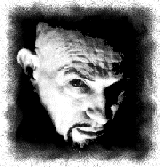 Anton
Szandor La Vey (1933–1997) sometimes referred to as the ‘Black Pope’, author
of ‘The Satanic Bible’ and ‘The Satanic Rituals’ and founder of the ‘Church
of Satan,’ was very much in this mould. At first sight he appears to have
been a ‘grandstander’ who, like some other high profile mages, relished
his notoriety and was more interested in creating an image and lifestyle
based upon his own particular credo. However, on closer inspection this
is not the case, an interesting aspect of The Satanic Bible is the inclusion
of a number of conjurations in ‘Enochian’, a language transcribed by the
16th century magician and alchemist Dr John Dee. The specific purpose of
this enigmatic ‘language’ is to summon and communicate with demons and
lesser entities to carry out the will of whoever invokes them. Dee claimed
to have learned this language during his encounters with entities from,
presumably, the abyss; he claimed that it was the language of angels. One
interesting aspect of Dee’s alleged encounters with ‘angels’ may be the
result of mistranslation. When Dee encountered these entities it was as
a result of scrying (clairvoyance) conducted by his assistant, Edward Kelley.
When Kelley did this he used, not a conventional crystal ball, but instead
a multifaceted artefact called a ‘Trapezohedron’. It is thought
that what they saw reflected in the facets (or angles) of the crystal were
entities inhabiting dimensions alongside our own, certainly not divine
beings and the use of the term ‘angels’ was a either misunderstanding that
derived from the word ‘angles’, or simply the lack of any better description
for they saw. Anton
Szandor La Vey (1933–1997) sometimes referred to as the ‘Black Pope’, author
of ‘The Satanic Bible’ and ‘The Satanic Rituals’ and founder of the ‘Church
of Satan,’ was very much in this mould. At first sight he appears to have
been a ‘grandstander’ who, like some other high profile mages, relished
his notoriety and was more interested in creating an image and lifestyle
based upon his own particular credo. However, on closer inspection this
is not the case, an interesting aspect of The Satanic Bible is the inclusion
of a number of conjurations in ‘Enochian’, a language transcribed by the
16th century magician and alchemist Dr John Dee. The specific purpose of
this enigmatic ‘language’ is to summon and communicate with demons and
lesser entities to carry out the will of whoever invokes them. Dee claimed
to have learned this language during his encounters with entities from,
presumably, the abyss; he claimed that it was the language of angels. One
interesting aspect of Dee’s alleged encounters with ‘angels’ may be the
result of mistranslation. When Dee encountered these entities it was as
a result of scrying (clairvoyance) conducted by his assistant, Edward Kelley.
When Kelley did this he used, not a conventional crystal ball, but instead
a multifaceted artefact called a ‘Trapezohedron’. It is thought
that what they saw reflected in the facets (or angles) of the crystal were
entities inhabiting dimensions alongside our own, certainly not divine
beings and the use of the term ‘angels’ was a either misunderstanding that
derived from the word ‘angles’, or simply the lack of any better description
for they saw.
At its root, LaVey’s satanic philosophy considers Christianity as inherently defeatist, limp and hypocritical, while Satanism reflects the realities, needs, desires (and failings) of humanity. Superficially this has a certain attraction, those who promote a supposedly idealised ‘good’ life can only ultimately fail (as can be regularly seen in lurid tabloid headlines concerning priests and ministers), while those following a pragmatic path that glorifies and accepts the human condition may find it more acceptable. This is perhaps where many incorrect assumptions are made; this creed does not suggest that someone embarks on a life of crime and perversion, but instead it does not automatically categorise the pleasures of the flesh as sinful. Perhaps this can be summarised as, you do not necessarily have to be a bad or immoral person to be a Satanist. Before leaving this section; on a particularly sinister note, copies of La Vey’s Satanic Bible have often been found among the personal belongings of convicted killers and rapists, particularly young ones. This more than anything else illustrates the latent power and influence contained in works like this, they are most definitely not for the inexperienced or uninitiated. However, it can also be argued that ultimately, the hedonistic philosophy preached by La Vey is only an enhanced variation on the crass materialism fostered by the ‘me first’ generation of the 1980’s, perhaps he even saw it coming. Into the Abyss
© Brian Allan 2004 |
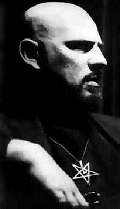 Although
La Vey set up his ‘church’ in direct opposition to the Christian church,
in a strange manner he was legitimising the very organisation and deity
that he railed against. Originally, the existence of Satan was necessary
to serve as a logical counterpoint to Christ or God; where there is good,
to demonstrate the difference, of necessity you must have the opposite,
evil. Therefore when La Vey created his satanic church it was actually
perpetuating and contributing to a natural law of balance. Was this perhaps
an unintentional demonstration of the Gnostic tenet, ‘as above, so below’?
Neither did he originally set himself up as a magician; rather, in spite
of all the magical trappings and ceremonies, his role seems to have been
that of an evangelising, ‘anti-messiah’ figure promoting the works and
values of Satan, his master. One quote of La Vey’s sums up his views of
traditional magic and magicians quite well; “With very few exceptions,
every tract and paper, every ‘secret grimoire’, all of the ‘great works’
on the subject of magic are nothing more than sanctimonious fraud’, guilt-ridden
ramblings and esoteric gibberish by chroniclers of esoteric lore unable
or unwilling to present an objective view on the subject’. [Ibid p
21]
Although
La Vey set up his ‘church’ in direct opposition to the Christian church,
in a strange manner he was legitimising the very organisation and deity
that he railed against. Originally, the existence of Satan was necessary
to serve as a logical counterpoint to Christ or God; where there is good,
to demonstrate the difference, of necessity you must have the opposite,
evil. Therefore when La Vey created his satanic church it was actually
perpetuating and contributing to a natural law of balance. Was this perhaps
an unintentional demonstration of the Gnostic tenet, ‘as above, so below’?
Neither did he originally set himself up as a magician; rather, in spite
of all the magical trappings and ceremonies, his role seems to have been
that of an evangelising, ‘anti-messiah’ figure promoting the works and
values of Satan, his master. One quote of La Vey’s sums up his views of
traditional magic and magicians quite well; “With very few exceptions,
every tract and paper, every ‘secret grimoire’, all of the ‘great works’
on the subject of magic are nothing more than sanctimonious fraud’, guilt-ridden
ramblings and esoteric gibberish by chroniclers of esoteric lore unable
or unwilling to present an objective view on the subject’. [Ibid p
21]
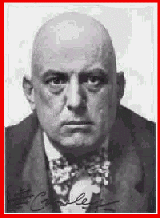 Of
the other practitioners, only one or two may have actually experienced
success in performing effective magical rituals, and in relatively recent
times of those fitting this description there is only one man who really
lived up to and fed the publics expectations, and that was Aleister Crowley.
Although the available information suggests that Crowley was a self-centred
and profoundly selfish man there is no doubt that he exercised considerable
charisma and he certainly had no doubts about his abilities as a magician.
Crowley’s interest in the occult blossomed shortly after he went to university
and from there he quickly became involved with a series of esoteric organisations
including the ‘Golden Dawn’ and the ‘Ordo Templi Orientis’
(OTO). Such was his dynamism that he soon vied for leadership of both organisations
and perhaps predictably fell foul of the existing masters of both of them.
Eventually, Crowley and a group of his followers left for Sicily where
they founded the ‘Abbey of Thelma’ dedicated to the practise of
‘Magick’ rituals designed or adapted by Crowley. However, it is fair to
say that by this time Crowley, who by now was using of a variety of powerful
drugs, was not quite the man he once was, but he still exerted considerable
influence over his disciples.
Of
the other practitioners, only one or two may have actually experienced
success in performing effective magical rituals, and in relatively recent
times of those fitting this description there is only one man who really
lived up to and fed the publics expectations, and that was Aleister Crowley.
Although the available information suggests that Crowley was a self-centred
and profoundly selfish man there is no doubt that he exercised considerable
charisma and he certainly had no doubts about his abilities as a magician.
Crowley’s interest in the occult blossomed shortly after he went to university
and from there he quickly became involved with a series of esoteric organisations
including the ‘Golden Dawn’ and the ‘Ordo Templi Orientis’
(OTO). Such was his dynamism that he soon vied for leadership of both organisations
and perhaps predictably fell foul of the existing masters of both of them.
Eventually, Crowley and a group of his followers left for Sicily where
they founded the ‘Abbey of Thelma’ dedicated to the practise of
‘Magick’ rituals designed or adapted by Crowley. However, it is fair to
say that by this time Crowley, who by now was using of a variety of powerful
drugs, was not quite the man he once was, but he still exerted considerable
influence over his disciples.