|
Sinkholes |
|||
|
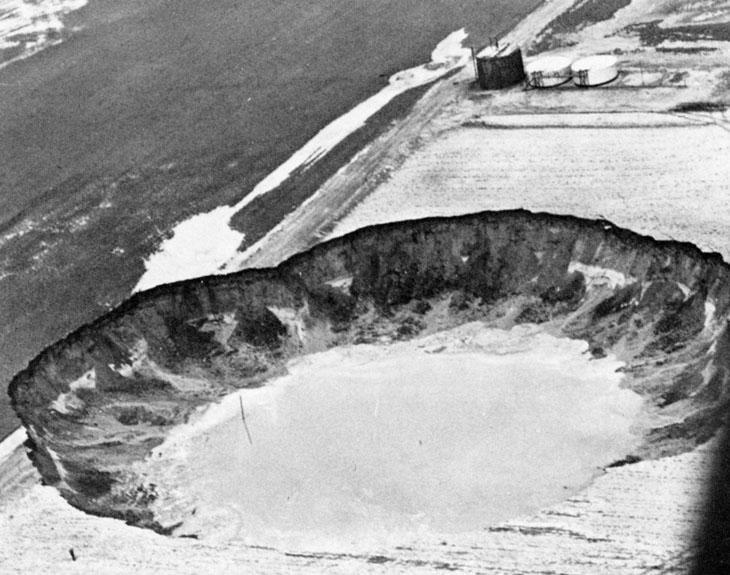
Hutchinson, Kansas October 21, 1974 ..
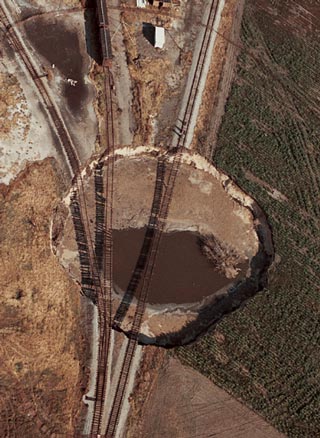
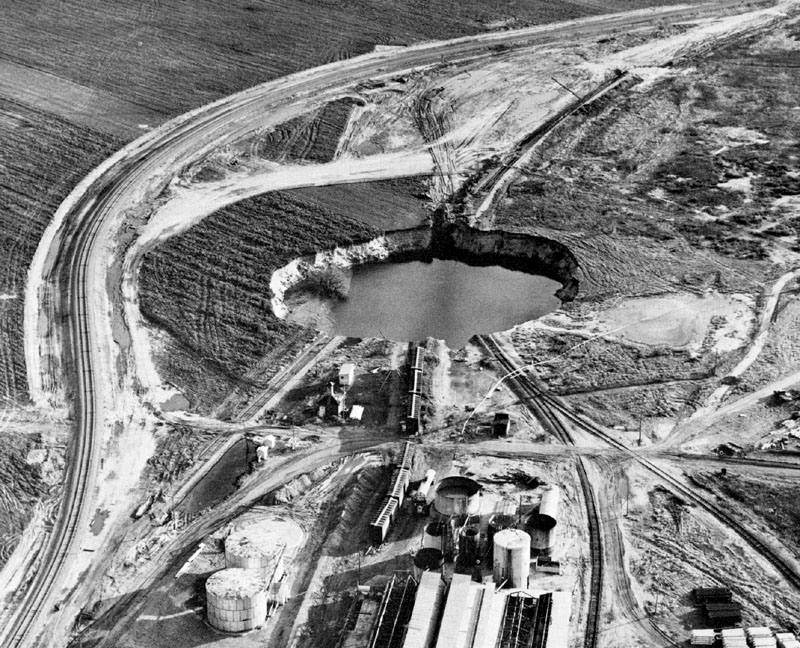
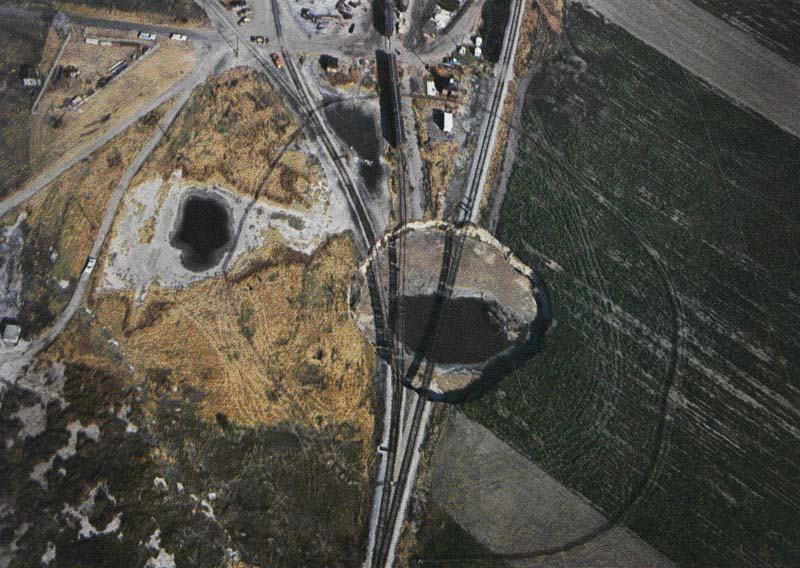
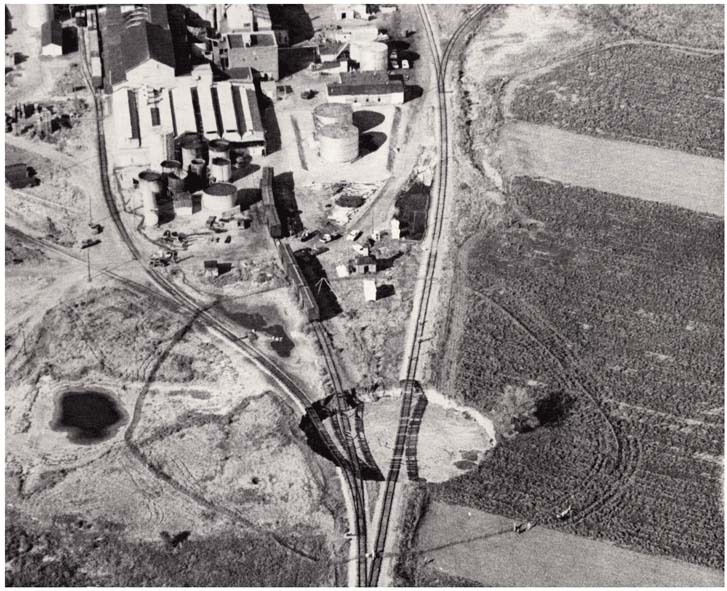
Cargill sink formed as a result of solution mining of salt near Hutchinson, Kansas. The sudden collapse of bedrock and near-surface, water-saturated sands into the underground brine-filled cavity created the sinkhole and left the Missouri-Pacific railroad tracks suspended 6 meters in the air. The volume of the crater was estimated at 70,000 cubic meters.
Susan Ward Aber - The Many Uses of Salt from the Earth |
|||
..
Kansas Geological Survey - Hutchinson Response Project |
|||
|
April 24, 1959 ..
|
|||
|
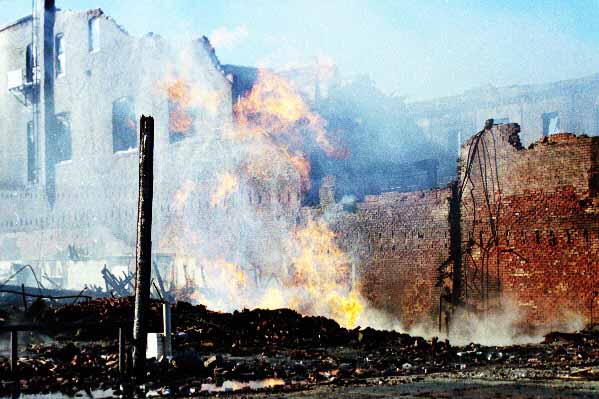
January 17, 2001 ..
Hutchinson was
rocked by an explosion and subsequent persistent
fire destroying two downtown businesses and injuring
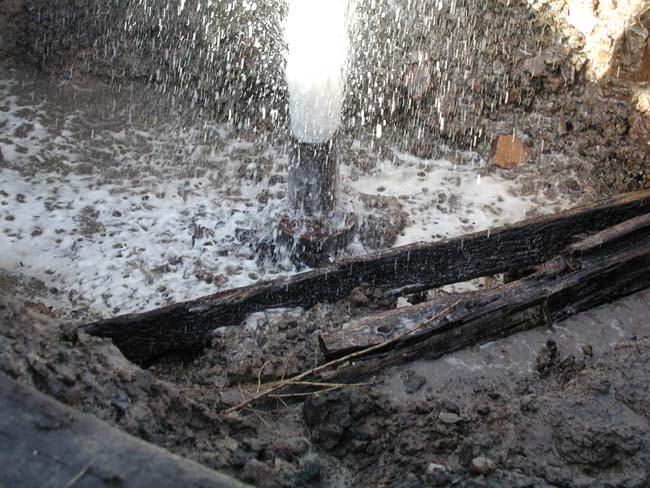
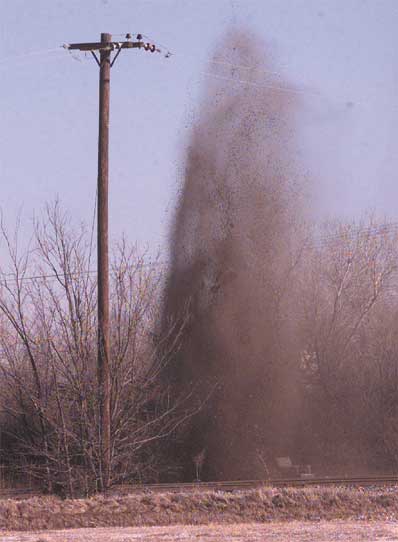
several people. Over the next 24 hours geysers of
salt water and gas erupted in the eastern part of
the community. An explosion and fire at the Big
Chief Mobile Home Park resulted in the death of two
citizens. The situation was terrifying and the cause
unknown. Local government personnel were all working
around the clock to insure public safety, fight the
fires, and trying to figure out what was occurring.
The City Fire
Department and Police were the front lines in
responding to the incident. As the nature of the
event unfoldedthe Local Emergency Preparedness
Department becamethe focal pointin coordinating
efforts. Literally all city personnel from Fire,
Police, Public Works, Emergency Response were
involved. Responses included fire fighting and
keeping citizens away from dangerous areas, all the
while trying to determine what was happening.
As it became
apparent natural gas was involved, contacts were
made with federal and state agencies and the gas
company, Kansas Gas Service. A pipeline leak was
initially suspected, but company and agency reviews
of the operations showed no evidence of pipeline
problems. Kansas Gas was reviewing pipeline and distribution operations and also
operations at the Yaggy underground gas storage
facility. Pressure anomalies were notedat storage well S-1 prompting
further investigation including video logging of the
well. The video logging revealed a hole in the well
casing at a depth of 600 feet. This is thought to be
the source of the gas causing the eruptions in
Hutchinson. Kansas Gas Service took steps to reduce
leakage by removing gas from the well and setting
special plugs to seal the leak. All gas was removed
from storage well S-1 and the storage cavern was filled with brine. The state
required no more gas be placed in the Yaggy facility
as a safety precaution. Kansas Gas Service brought
in nearly 200 employees to search for leaks in the
community. Public buildings, such as schools, were
surveyed with detection equipment. Additionally
special sniffer trucks cris- crossed the town and
geo-probe units were used to monitor suspect areas.
These surveys continue today as a precaution.
Local and state
officials and Kansas Gas Service officials agreed it
was in the best interest to attempt to drill special
wells designed to vent gas from under Hutchinson.
The gas was apparently traveling up to seven miles
under ground and rising to the surface through old
salt solution mining wells. The location or
potential danger of these old, unplugged brine wells
was not known. The geysers in east Hutchinson and
the source of the downtown explosion were all from
old brine wells. Location and completion of the vent
wells required considerable geologic research and
expertise. The first 4 wells did not hit gas, but
eventually 13 of the 57 (8 of first 30) vent wells
drilled were successful in venting gas, thus
relieving the danger of further releases. The vent
wells also dropped the pressure and volume of gas
under the community. Only 3 of these vent wells
still show small amounts of natural gas. Plugging of
the dry vent wells, i.e., those not hitting gas, has
been initiated with two wells being recently
plugged. Plugging will continue through the summer.
Certain wells are being logged in an effort to learn
more about the travel pathways of the gas. Several
of the vent wells might remain in place as sentinels
or safety relief wells allowing gas to escape
without harm to the public. Kansas Gas Service paid
the expenses for the installation and operation of
the vent wells. Kansas Gas Service paid for the
plugging of these two vent wells and will pay for
the plugging of the remaining vent wells.
Approved: March 12, 2002 Minutes of the House Commitee - PDF Natural Gas Explosions in Hutchinson, Kansas Kansas Geological Survey, Hutchinson Response Project
Kansas Supreme
Court Strikes
Down Jury Award
TOPEKA, Kansas (AP) - The Kansas Supreme Court strikes down a jury verdict awarding $7.7 million for the 2001 natural gas explosions in which two Hutchinson residents died. The award had been against Tulsa, Oklahoma-based ONEOK and two of its subsidiaries - Kansas Gas Service and Mid-Continent Market Center. ONEOK owned and operated a natural gas storage facility northwest of Hutchinson. Experts testified a series of explosions were caused by the escape of 143 million cubic feet of gas from the facility. In reversing the award in the class-action lawsuit, the court said property owners did not show there was physical damage to their individual properties. Instead, they contended the stigma of danger lowered property values throughout the area.
Eyewitness
Report
This is too weird. This whole town is on pins and needles. It started yesterday morning with a huge explosion downtown. The fire still has not gone out. I went there last night and talked to a police officer and he told me that they shut off all possible gas lines and it still won't go out. They do not know what is feeding it. This morning there was another explosion about six blocks from where I live. There is at least 8 natural gas leaks all around the city. I grabbed some things and am waiting this out at my shop right now. They have evacuated by my house. I sent my family to the north side of the city. This is too weird. Has anyone else ever heard of anything like this? Hutchinson is built on salt mines. Makes you wonder if natural gas has built up in them. The National Guard is getting ready to be called out. They are not sure if they need to evacuate the whole town. There is somewhere around 30,000+ people here. Dan I will keep you all posted as I can. SOURCE: Chiefsplanet.com |
|||
|
January 17, 2001 ..
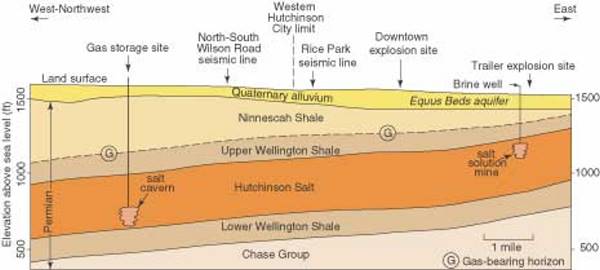
In January 2001, natural gas exploded in the central Kansas town of Hutchinson, killing two people, destroying two downtown businesses, and creating a series of geyser-like spouts of water and gas. For weeks, Hutchinson residents wondered what had happened and worried about what was coming next. Today, some of the most heavily examined geology in Kansas lies beneath western Hutchinson, along the probable path that the gas took into town. The Kansas Geological Survey used a variety of techniques to study the area. While the gas’s movement isn’t completely understood, Survey geologists know a great deal. Here’s the Survey’s working hypothesis. The source of the natural gas, or methane, appears to be a storage facility west of Hutchinson (near a railroad-siding town named Yaggy). In the 1980’s, salt caverns were created for storing propane in a layer of rock called the Hutchinson Salt Member of the Wellington Formation, about 500 to 600 feet below ground. These same salt beds are mined in Hutchinson and throughout central Kansas. Salt caverns are effective for gas storage because gas can be quickly introduced, and later removed. That’s especially useful during times of peak demand, like cold winters. At Yaggy, the salt didn’t fail. But a pipe (one used to put gas in and take gas out) did fail. For at least three days, highly pressurized methane escaped through a hole in the pipe and moved up until it reached a permeable zone near the contact between the Wellington Formation and the overlying Ninnescah Shale. These rocks dip (or are angled) very slightly to the west, and the pressurized gas moved up that dip until it found a way to the surface. In Hutchinson,
a town with a
century’s history of salt mining, that didn’t take
long. Gas first exploded
after it moved up an old well that was used to
produce mineralized water
for a spa. The second explosion occurred at the
site of an abandoned well
that was used to dissolve and mine salt.
..
Kansas Geological Survey - Survey Responds to Hutchinson Natural Gas Explosion |
|||
| Sinkhole
Testing In Reno
June 11, 2008 01:44 PM
Sinkholes in one Kansas County are getting larger. A research group in the county says it can't control the sinkholes. It can only help people prepare. Brandy Lake is something of a misleading name. The lake east of Hutchinson along US-50 Highway is actually a sinkhole that developed thousands of years ago. The sinkhole is actively, if only gradually, growing. Salt about 400 feet below the county dissolves when groundwater gets to it causing the ground to sink. Researchers use special vehicles to send sound waves underground. Microphones then pick up echoes and tell them what's happening with the salt. "We have no control over the natural process," says Rick Miller with the Kansas Geological Survey. "All we can do is respond to it. What we hope to do is acquire this data, interpret this data, and get an edge on Mother Nature, if you will." Knowing what's in the future can be critical in predicting problems for highways and buildings. "(We want to) be able to tell our engineers and other folks we may have a problem in this location and get it fixed ahead of time," says Bob Henthorne with KDOT. "We don't want to come out here and have a hole already developed and have it be a surprise." Testing will continue in Reno County through then end of the month meaning parts of US-50 will be down to one lane. Researchers hope to present their findings in four to six months. NOTE: NO PHOTOS; NO GOOGLE EARTH IMAGE AVAILABLE |
|||
|
Underground Secrets ..
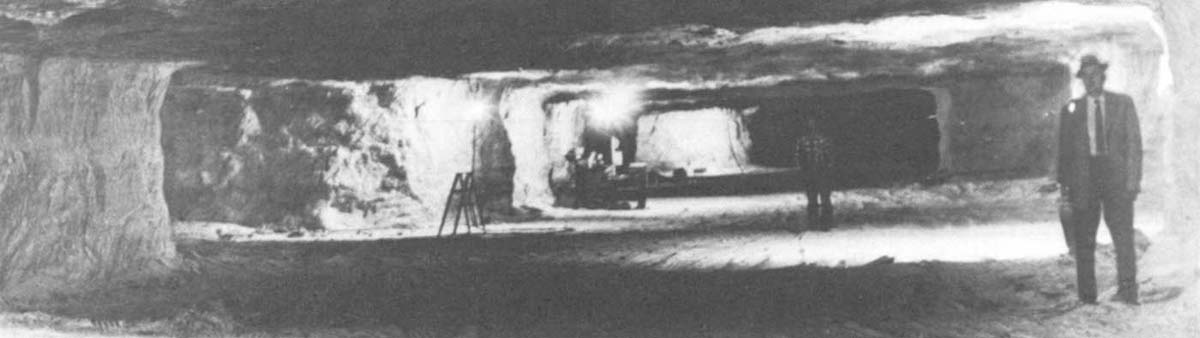
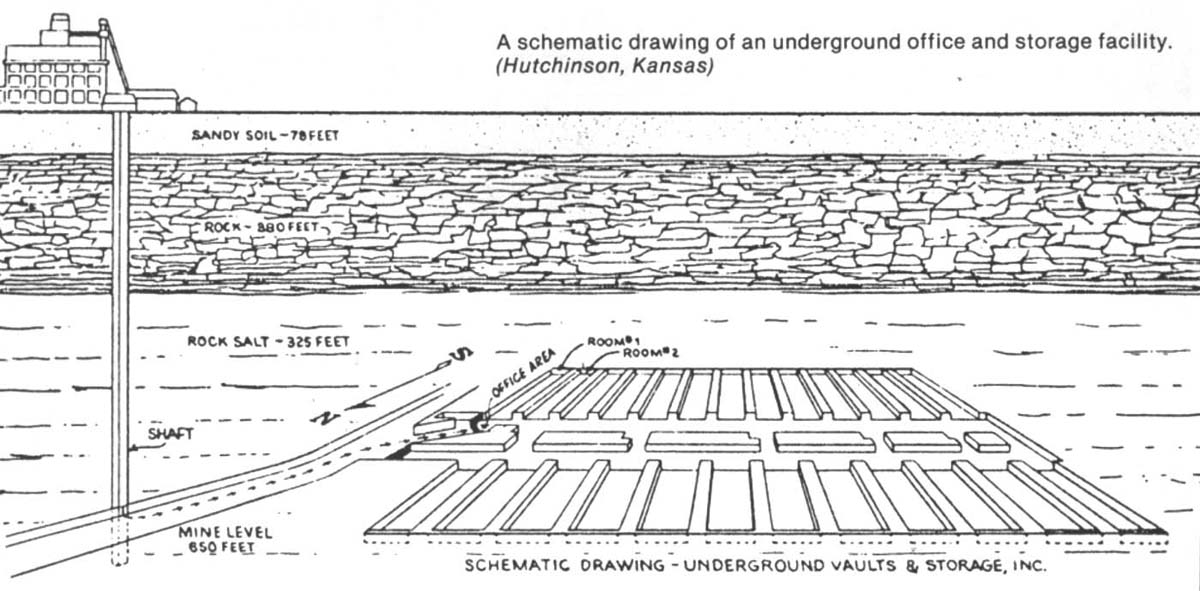
HUTCHINSON, Kan.–Six hundred and fifty feet beneath the Kansas prairie, in a mined-out section of a working salt mine, a man in a gray plaid suit sits at a telex machine typing out and receiving messages. This is only a test-the man comes to the salt mine two times a year for a communications drill. But if a nuclear attack had been launched against the United States, the messages he is sending and receiving would be devoted to re-establishing the services of the Federal Reserve Bank in the devastated country.
SOURCE and Rest of Story: Corporate Civil Defense |
|||
| FAIR USE NOTICE: This page contains copyrighted material the use of which has not been specifically authorized by the copyright owner. Pegasus Research Consortium distributes this material without profit to those who have expressed a prior interest in receiving the included information for research and educational purposes. We believe this constitutes a fair use of any such copyrighted material as provided for in 17 U.S.C § 107. If you wish to use copyrighted material from this site for purposes of your own that go beyond fair use, you must obtain permission from the copyright owner. | |||
|
|