|
The Enigmas on Venus |
|||||
|
.
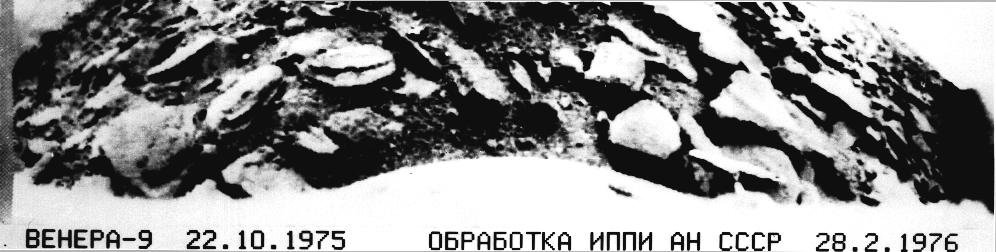
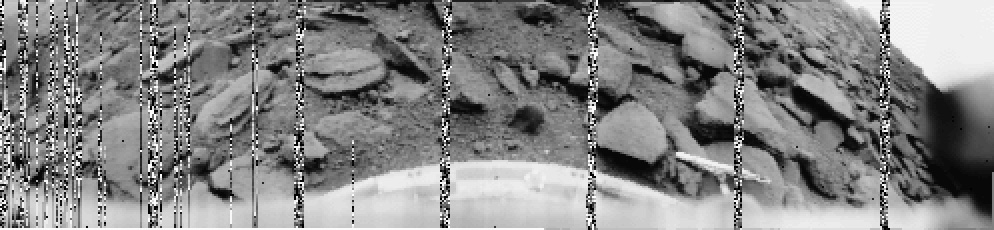
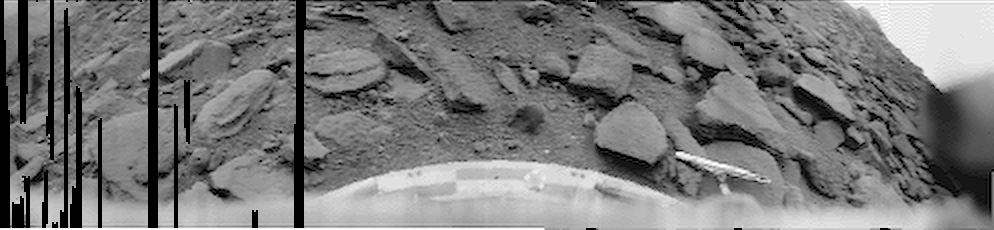
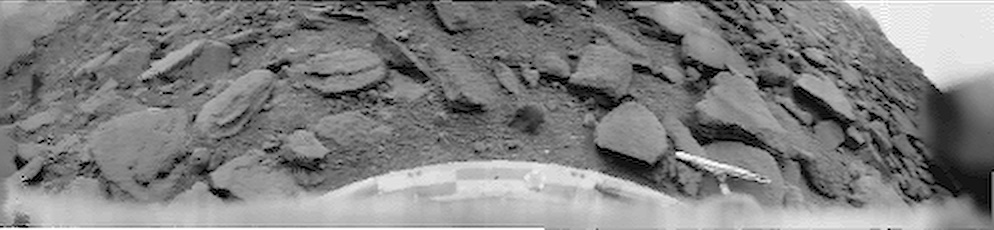
5:13 UT with the sun near zenith on 22 October 1975 {Click on image to enlarge More Info) On October 20, 1975, this spacecraft was separated from the Orbiter, and landing was made with the sun near zenith at 0513 UT on October 22. A system of circulating fluid was used to distribute the heat load. This system, plus precooling prior to entry, permitted operation of the spacecraft for 53 min after landing. During descent, heat dissipation and deceleration were accomplished sequentially by protective hemispheric shells, three parachutes, a disk-shaped drag brake, and a compressible, metal, doughnut-shaped, landing cushion. The landing was about 2,200 km from the Venera 10 landing site. Preliminary results indicated: (A) clouds 30-40 km thick with bases at 30-35 km altitude, (B) atmospheric constituents including HCl, HF, Br, and I, (C) surface pressure about 90 (earth) atmospheres, (D) surface temperature 485 deg C, (E) light levels comparable to those at earth midlatitudes on a cloudy summer day, and (F) successful TV photography showing shadows, no apparent dust in the air, and a variety of 30-40 cm rocks which were not eroded. Image Credits... All
images on this page posted
with permission, copyright 2003 Don P. Mitchell. All
rights reserved.
Authors/Curators: Dave Williams,
dave.williams@gsfc.nasa.gov, (301) 286-1258
|
|||||
|
.
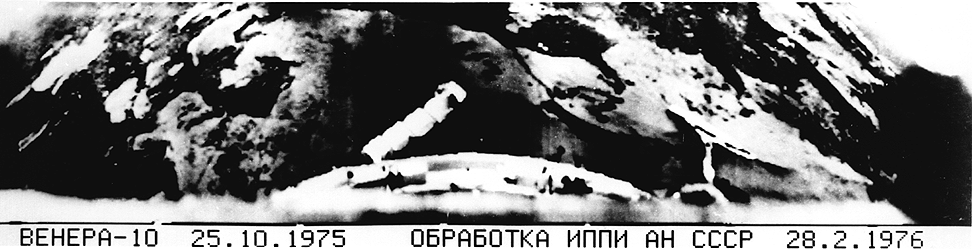
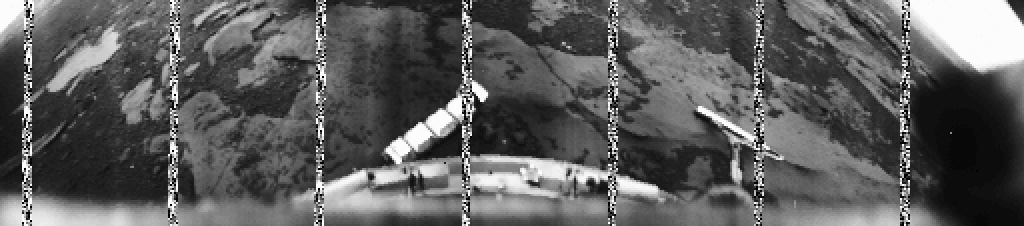
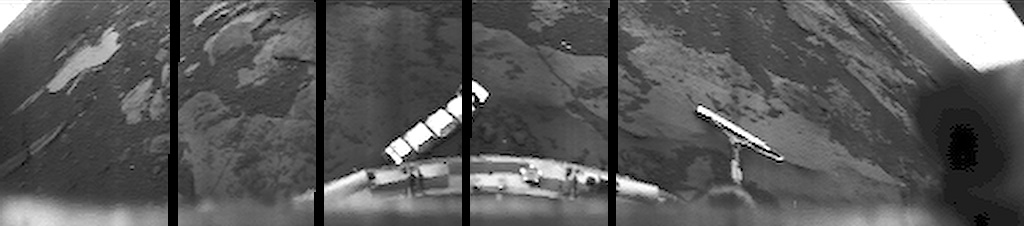
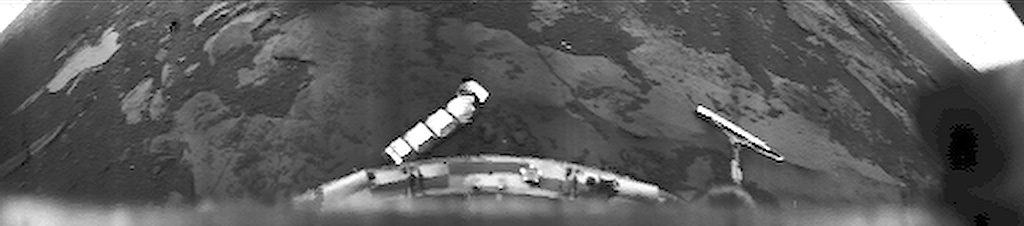
5:17 UT on 25 October 1975 {Click on image to enlarge More Info) Soviet space images are sometimes printed in astonishingly degraded forms. This is partially the result of generation loss, and partly an effect of cold-war-era propaganda. Sometimes the only available glimpse of a device or an image from space is a photocopy from a Russian journal. The image above is the version released to the American public via NASA. This image is STILL on the NASA website about the Venera 10 Mission at NSSD On October 23, 1975, this spacecraft
was separated
from the Orbiter, and landing was made with the sun
near zenith, at 0517
UT, on October 25. A system of circulating fluid was
used to distribute
the heat load. This system, plus precooling prior to
entry, permitted operation
of the spacecraft for 65 min after landing. During
descent, heat dissipation
and deceleration were accomplished sequentially by
protective hemispheric
shells, three parachutes, a disk-shaped drag brake,
and a compressible,
metal, doughnut-shaped, landing cushion. The landing
was about 2,200 km
distant from Venera 9. Preliminary results provided:
(A) profile of altitude
(km)/pressure (earth atmospheres)/temperature (deg
C) of 42/3.3/158, 15/37/363,
and 0/92/465, (B) successful TV photography showing
large pancake rocks
with lava or other weathered rocks in between, and
(C) surface wind speed
of 3.5 m/s.
|
|||||
|
.
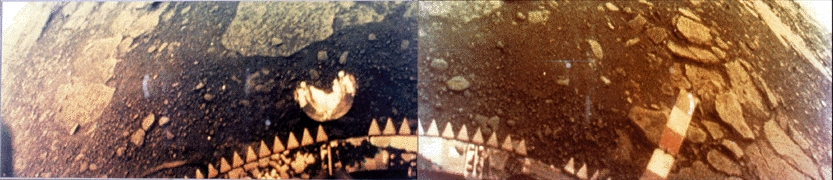
Venera 13 survived on the surface for 2 hours, 7 minutes, long enough to obtain 14 images on 1 March, 1982 {Click on image to enlarge More Info) So Far we have only been able to find 2 of the 14 images... Venera 13 and 14
were identical spacecraft built to
take advantage of the 1981 Venus launch opportunity
and launched 5 days
apart. The Venera 13 mission consisted of a bus
(81-106A) and an attached
descent craft (81-106D). The Venera 13 descent
craft/lander was a hermetically
sealed pressure vessel, which contained most of the
instrumentation and
electronics, mounted on a ring-shaped landing
platform and topped by an
antenna. The design was similar to the earlier
Venera 9-12 landers. It
carried instruments to take chemical and isotopic
measurements, monitor
the spectrum of scattered sunlight, and record
electric discharges during
its descent phase through the Venusian atmosphere.
The spacecraft utilized
a camera system, an X-ray fluorescence spectrometer,
a screw drill and
surface sampler, a dynamic penetrometer, and a
seismometer to conduct investigations
on the surface. After launch and a four month cruise to Venus, the descent vehicle separated from the bus and plunged into the Venus atmosphere on 1 March 1982. After entering the atmosphere a parachute was deployed. At an altitude of 47 km the parachute was released and simple airbraking was used the rest of the way to the surface. Venera 13 landed about 950 km northeast of Venera 14 at 7 deg 30 min S, 303 E, just east of the eastern extension of an elevated region known as Phoebe Regio. The area was composed of bedrock outcrops surrounded by dark, fine-grained soil. After landing an imaging panorama was started and a mechanical drilling arm reached to the surface and obtained a sample, which was deposited in a hermetically sealed chamber, maintained at 30 degrees C and a pressure of about .05 atmospheres. The composition of the sample determined by the X-ray flourescence spectrometer put it in the class of weakly differentiated melanocratic alkaline gabbroids. The lander survived for 127 minutes (the planned design life was 32 minutes) in an environment with a temperature of 457 degrees C and a pressure of 84 Earth atmospheres. The descent vehicle transmitted data to the bus, which acted as a data relay as it flew by Venus.
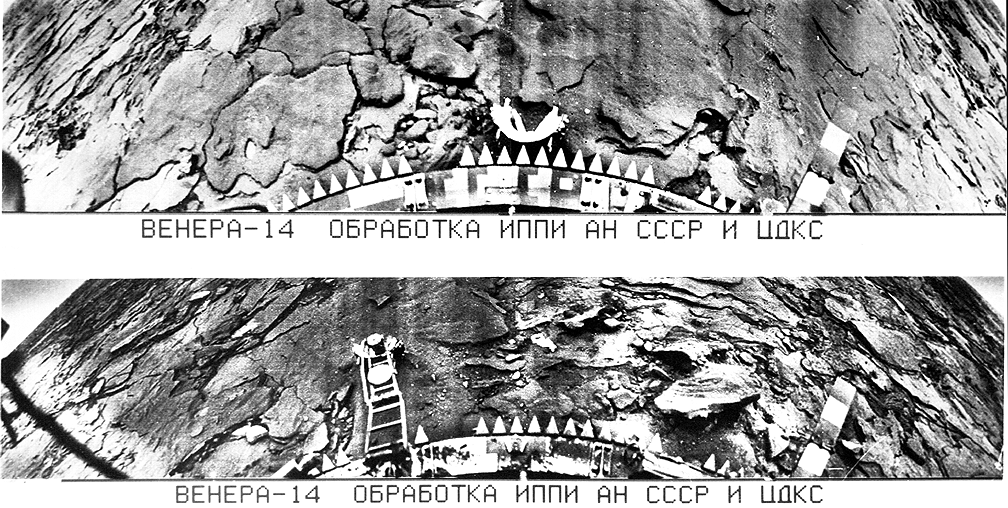
The top image is a black and white frame of the color image vg261_262 {Click on image to enlarge More Info)
|
|||||
|
.
Venera 14 Lander, YG06848 {Click on image to enlarge More Info) |
|||||
| FAIR USE NOTICE: This page contains copyrighted material the use of which has not been specifically authorized by the copyright owner. Pegasus Research Consortium distributes this material without profit to those who have expressed a prior interest in receiving the included information for research and educational purposes. We believe this constitutes a fair use of any such copyrighted material as provided for in 17 U.S.C § 107. If you wish to use copyrighted material from this site for purposes of your own that go beyond fair use, you must obtain permission from the copyright owner. | |||||
|
|