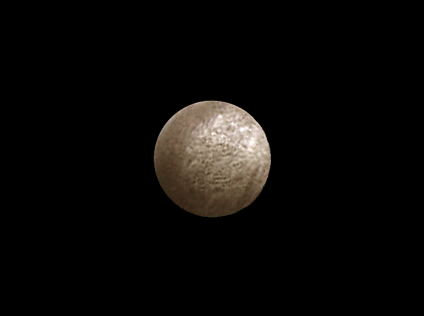
Varuna -
20000
.
Artist's
conception of
Varuna - TNO (20000) Varuna
20000 Varuna is a
large classical Kuiper Belt object
(KBO). It previously had the provisional designation
2000 WR106 and has
been precovered in plates dating back to 1953. Under
the International
Astronomical Union's 2006 draft proposal for the
definition of a planet,
Varuna would be labelled a dwarf planet if it were
proven to be spherical.
Size
The size of the
large KBOs can be determined by simultaneous
observations of thermal emission and reflected
sunlight. Unfortunately,
thermal measures, intrinsically weak for distant
objects are further hampered
by the absorption of the Earth atmosphere as only
the weak ‘tail’ of the
emissions is accessible to Earth-based observations.
In addition, the estimates
are model-dependent with the unknown parameters
(e.g. pole orientation
and thermal inertia) to be assumed. Consequently,
the estimates of the
albedo vary resulting in sometimes substantial
differences in the inferred
size.
A recent thermal
model estimates the size at 936 +238/-324
km. This estimate is based on earlier results (900
+129/-145) and (1060
+180/-220).
|
Orbit
..
Orbits
of Varuna (blue)
and Pluto (red)
Credit
Varuna is classified
as a classical trans-Neptunian
object and follows a near-circular orbit with a
semi-major axis of ~43
AU, similar to that of Quaoar but more inclined. Its
orbital period is
similar to Quaoar at 283 Earth years. The graph
shows the polar view (top;
Varuna’s orbit in blue, Pluto’s in red, Neptune in
grey). The spheres illustrate
the current (April 2006) positions, relative sizes
and colours. The perihelia
(q), aphelia (Q) and the dates of passage are also
marked. Interestingly,
the orbits of Varuna and Pluto have similar
inclination and are similarly
oriented (the nodes of both orbits are quite close).
At 43 AU and on a
near-circular orbit, unlike Pluto
which is in 2:3 orbital resonance with Neptune,
Varuna is free from any
significant perturbation from Neptune. The ecliptic
view illustrates the
comparison of Varuna's near-circular orbit with that
of Pluto (highly eccentric,
e=0.25), both similarly inclined.
Physical characteristics
Varuna has a
rotational period of approximately 3.17
hours (or 6.34 hours, depending on whether the light
curve is single or
double-peaked). Given the rapid rotation, rare for
objects so large, Varuna
is thought to be an elongated spheroid (ratio of
axis 2:3), with a mean
density around 1g/cm³ (roughly the density of water
ice). Examination
of Varuna's light curve has found that the best-fit
model for Varuna is
a triaxial ellipsoid with the axes a,b,c in
relations: b/a = 0.63 ? 0.80,
c/a = 0.45 ? 0.52 and a bulk density of 0.992
g/cm³.[2] Since the
discovery of Varuna, another, even larger, rapidly
rotating (3.9 h) object
(136108) 2003 EL61 has been discovered, also thought
to have an elongated
shape.
The surface of Varuna is moderately
red (similar to
Quaoar) but exceptionally dark (albedo<0.04)
compared with other large
classical Kuiper Belt objects, suggesting that the
surface is largely devoid
of ice, although small amounts of water ice have
been detected on its surface
[9].
SOURCE: Wikipedia
-
20000 Varuna
|
References
-
Stansberry (2005).
TNO/Centaur
diameters and albedos. Retrieved on
2006-11-08.
-
Lightcurves Lacerda P.,
Jewitt D. Dentisities Of Solar
System Objects From Their Rotational
Lightcurves", accepted to AJ Dec.
2006 Preprint
-
TNO
and Centaur Colors. Retrieved on 2006-11-08.
-
Grundy, W. M.; Noll, K.
S.; Stephens, D. C. (2005).
"Diverse albedos of small
trans-neptunian objects". Icarus, 176:
184-191.Preprint
on arXiv.
-
Jewitt D, Aussel H,
Evans A (2001). "The size and albedo
of the Kuiper-belt object (20000)
Varuna". Nature411
(6836): 446-7.PMID
11373669. Reprint
on the Author's site.
-
E. Lellouch, R. Moreno,
J. L. Ortiz, G. Paubert, A.
Doressoundiram and N. Peixinho (2002).
"Coordinated thermal and optical
observations of Trans-Neptunian object
(20 000)Varuna from Sierra Nevada".
Astronomy & Astrophysics 391:
1133-1139.Preprint
on arXiv.
-
Jewitt D, Sheppard S
(2002). "Physical
Properties Of Trans-Neptunian Object
(20000) Varuna". Astronomical
Journal 123 (April): 2110–2120.Preprint
on arXiv.
-
D.
L. Rabinowitz, K. M. Barkume, M.
E. Brown, H. G. Roe, M. Schwartz, S.
W. Tourtellotte, C.
A. Trujillo (2005), Photometric
Observations Constraining the Size,
Shape, and Albedo of 2003 EL61,
a Rapidly Rotating, Pluto-Sized
Object in the Kuiper Belt, The
Astrophysical Journal (2006), 639, Issue
2, pp. 1238-1251 Preprint
on arXiv (pdf)
-
Licandro J, Oliva E, Di
Martino M (2001). "NICS-TNG
infrared spectroscopy of trans-neptunian
objects 2000 EB173 and 2000 WR106".
Astronomy
& Astrophysics 373 (July):
29-32L.
External
links
More Wikipedia Pages
..
|