Can
you describe the main architectural
characteristics of Göbekli Tepe?
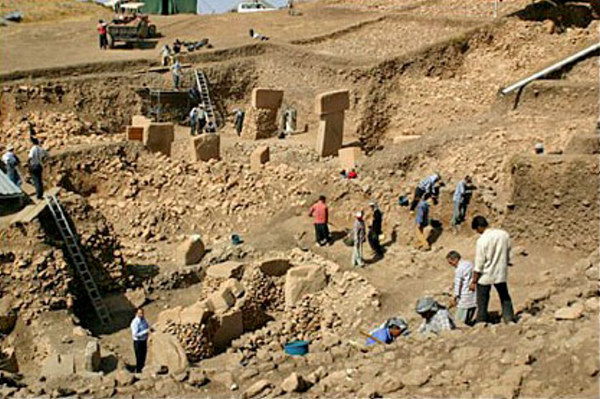
It is made up
of a series of three
main sub-surface rectilinear structures defined by
dry-stone walls, and
containing many decorated T-shaped pillars. These
stones served primarily
as roof supports, although a symbolic purpose can
not be ruled out. In
one 'cult building', as these structures are
known, is a ring of free standing
pillars, their edges radiating out from a central
point, like the spokes
of a wheel.
Could you
explain to our readers
why Göbekli Tepe was a "sacerdotal" site?
Göbekli
Tepe can be described
as sacerdotal, in that it was clearly utilized
as a place of veneration
and perhaps communication with supernatural
entities and domains. This
is accepted by the main excavator Dr Klaus
Schmidt of the German
Aarchaeological Institute of Istanbul.
Curiously, in the Turkish language
Göbekli
Tepe means 'hill of the naval', suggestive
of the site's former role
as an important religious centre serving a large
catchment region.

Göbekli
Tepe looking south
How
is it possible that a hunter/gatherer society
suddenly transforms itself
to be able to build such a magnificent
megalithic site with no equals in
the world?
I strongly
suspect that the transition
was engineered by an extremely powerful and very
cunning shamanic or priestly-based
ruling elite, who knew how to easily manipulate
and motivate the local
population. It would have required a
considerable work force of hundreds
of people to have constructed sites such as Göbekli
Tepe, and this
has to have been controlled by a ruling body of
immense persuasiveness.
The
question remains as to where this elite might
have come from, and whether
independent evidence of their existence can be
found anywhere. The main
indication would be sites of proto-agriculture
experimentation that predate
the PPN sites of Upper Mesopotamia (northern
Syria, northern Iraq and southeast
Turkey), c.11,500-11, 000 BP (before present).
I suspect
the original homeland
of the incoming shamanic elite was on the Upper
Nile in Egypt and the Sudan,
where some indication of proto-agriculture was
found during the excavation
of sites belonging to the Isnan and Qadan
peoples of 15,000 to 11,500 years
ago. However, today this evidence has been
seriously called into question,
making a migration route for these people more
difficult to establish.
I
still suspect that the individuals responsible
for Göbekli Tepe
came out of Africa, and migrated into Upper
Mersopotamia via what is today
the foothills and mountains of northern Israel,
southern Lebanon. However,
there might also be a link with the Cro-Magnon
cave artists of Western
Europe, or even incoming peoples from China and
South-east Asia (after
the work of Stephen Oppenheimer in his book EDEN
IN THE EAST - 1998).
We should keep an open mind at this time, for
evidence of proto-agriculture
is emerging earlier and earlier all over the
world.
The
antiquity of the site
is amazing considering the complexity of the
advanced culture shown by
the site. How do you explain such an advanced
culture 11,000 years ago?
There is no
obvious explanation
for a high culture existing in Upper Mesopotamia
at the end of the last
Ice Age, when the rest of the world was still
populated by hunter-gathering
communities concerned with day-to-day survival,
and little more. However,
these faceless individuals, known to
archaeologists as the Pre-Pottery
Neolithic (PPN) peoples, created some of the
most mesmeric art in the ancient
world, which would not be bettered for thousands
of years.
I suspect
that the proposed priestly
or shamanic-based ruling elite entered the
region and came across a basic
hunter-gathering society ripe for change at the
end of the last Ice Age,
and so they simply engineered their transition
into settled farming communities.
Elevated sites such as Göbekli Tepe and
Nevali Çori became
their civil and ceremonial nerve centers, all as
part of the so-called
Neolithic revolution or explosion which
eventually began here, before spreading
out across the Eurasian continent.
It
is my belief that the trafficking between the
suspected ruling elite and
the peoples of Upper Mesopotamia is the story
found in the
Book of Enoch, where beings called Watchers
are said to have gone amongst mortal kind giving
them the forbidden arts
and sciences of heaven. These were said to have
included the use of herbs
and plants, metallurgy, the fashioning of
weapons, female beautification,
and astronomy, many of the firsts accredited to
the Early Neolithic world
in Upper Mesopotamia.
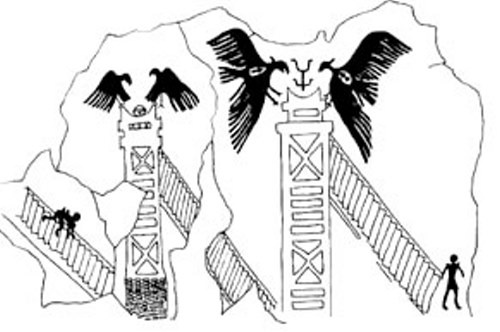
The
excarnation frescoe as
seen on a wall at Çatal Hüyük.
On the
left, the vultures
protect the head, representing the seat of
the soul.
Similar
stories exist in the
myths and legends of Sumeria,
which speak of gods called Anunnaki
coming among mortal kind and providing them with
the rudiments of civilization.
I believe there is strong evidence to suggest
that the Watchers, and
their offspring the Nephilim, were indeed
the shamanic elite that founded
the early Neolithic cult centers of Upper
Mesopotamia.
They
are repeatedly referred to in pseudepigraphical
literature as birdmen,
and we know that the Neolithic period's highly
prominent cult of the dead
was focused around excarnation, and the
use of the vulture as a symbol of both
astral flight and the transmigration
of the soul in death. Clear carvings and
depictions of vultures, as well
as representations of birdmen, have been
found at Göbekli Tepe
and other PPN sites in SE Turkey and North
Syria.
At
Göbekli Tepe was found
the first temples with totemic symbols. Could
you explain us which kind
of cult was celebrated there and which is the
meaning of those animals?
Among the
carved forms in high
relieves to be seen on stone pillars at Göbekli
Tepe are anthropomorphs,
felines, raptor birds, sperm-like snakes,
arachnids, insects, foxes, boars
and ostriches. There are so many different types
of zoomorphic images that
it has so far proved impossible for anyone to
interpret or bracket all
their intended symbolism, if indeed this is was
it is meant to be.
However,
there seems to be a
clear preference of interest in snakes and
birds, like the vulture. Whereas
the vulture is associated with death and
rebirth, as it is at Çatal
Hüyük - the oldest Neolithic city anywhere
in the world, situated
in southern-central Turkey and dating to 8500 BP
- I suspect the snake
played a slightly different role among the PPN
communities.
The
snake
is universally a symbol of birth, new life,
transformation, cosmic creation
and divine knowledge and wisdom. I also suspect
that Upper Mesopotamia's
cult of the dead featured the use of
hallucinogenic substances, most obviously
mycetes,
since serpents are a universal symbol seen
during mind-altered states,
and examples to be seen as Göbekli Tepe
and Nevali Çori
sport heads that closely resemble
highly-psychotropic mushrooms
of the psilocybin family.
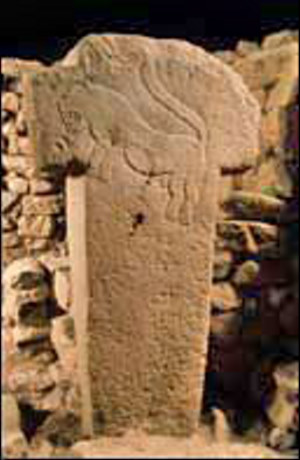
Leonine
pillar discovered
at Göbekli Tepe
Do
you really believe that through the correct
study of Göbekli Tepe we will
be able to understand the origins of the
biblical narration?
Göbekli
Tepe is the oldest
stone temple anywhere in the world, and has to
be a key to understanding
the
symbolism of the story of the Garden of Eden.
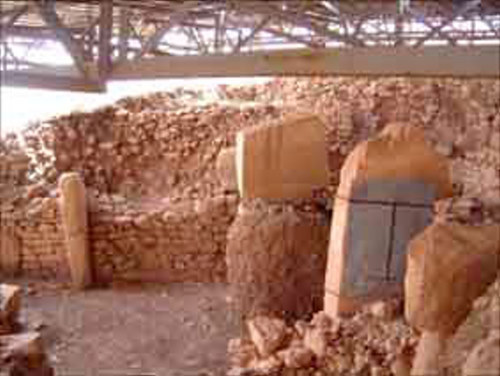
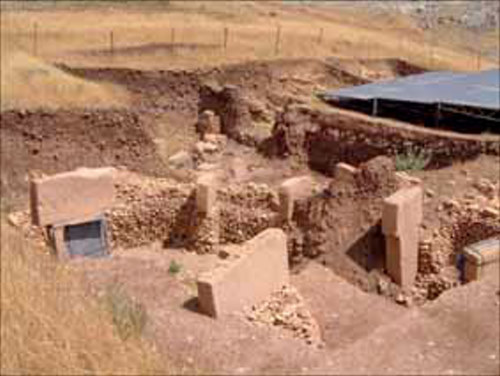
Most
southerly cult building
at Göbekli Tepe
It is
strange that the snake
appears as an important symbol in the Book
of Genesis's story of Adam
and Eve. Here in the Old Testament it
symbolizes the knowledge of
awareness that Adam and Eve are naked, and
that they should cover themselves.
I feel it is a metaphor for the manner in which
the incoming ruling elite
of Upper Mesopotamia, the suspected Watchers
of the Book of Enoch, gave mortal kind
forbidden knowledge, which forever
changed the way they thought about life.
However,
it was a case of too much knowledge too soon,
and so Adam and Eve were
cast out of Eden, which we know to have been a
real kingdom focused on
Lake
Van, a huge inland sea in Eastern Turkey.
From here the Euphrates and
Tigris, two of the rivers of paradise, take
their course before flowing
down into Iraq's Fertile Crescent.
Indeed,
author and archaeologist
David Rohl - a colleague of yours - is
convinced that Göbekli Tepe is
the biblical Eden. Do you agree with him? If
so, how could you explain
this relationship?
David is
very familiar with the
themes outlined in my previous books FROM
THE ASHES OF ANGELS (1996) and GODS
OF EDEN (1998), which cite the original
Garden of Eden as an area encompassing
mainly Upper Mesopotamia (Southeast Turkey,
Northern Syria and Northern
Iraq).
In
his own book LEGEND (1998) David saw the
land of Eden as a much
bigger region covering not only the whole of
Upper Mesopotamia, but also
large parts of Western and Northern Iran and
Armenia as well. He was adamant
that I was wrong about my choice of area, since
it contradicted his own
theories on the four rivers of paradise, said to
flow out of the land of
Eden.
If
David now believes that Göbekli Tepe is
the Garden of Eden, then
he has changed his position somewhat. Yet I
suspect he is correct, for
I say more-or-less the same thing in THE
CYGNUS MYSTERY, which opens
with my own visit to Göbekli Tepe in 2004.
What was
the relationship
between the centers of Göbekli Tepe, Nevali
Çori and Çatal Huyuk?
The main
relationship between
key PPN sites such as Göbekli Tepe and Nevali
Çori is the fact that their
layout, design and art are the same. They were
constructed by the same
unique race of people. They connect with Çatal
Hüyük because
this was a latter development of the same high
culture, and so this city
- excavated first in the early 1960s by British
archaeologist James Mellaart
- can tell us much about the earlier cults at
places such as Göbekli
Tepe and Nevali Çori.
Like,
for example, the Neolithic cult of the dead. At
Çatal Hüyük we find
frescoes
of vultures accompanying the soul of the
deceased into the next world,
and also of shamans taking the form of vultures
for presumed shamanic practices,
such as contacting or journeying into the other
world. Since statues of
birdmen,
as well as those of vultures, have been found at
both Göbekli Tepe and
Nevali Çori, we can be pretty sure that the same
cult existed here as
far back as 11,500-10,000 BP.
Could you
tell me about the
stone Karibu that guards the tree of life?
This reminds me a lot of the
cherub that guards the Ark of the Covenant and
a similar image found also
among the Babylonians. Is Göbekli Tepe really
the origin of those biblical
symbols?
Karibu
and Cherubim
are the same - angelic beings, and
ultimately their roots can be
traced back to memories of the priestly or
ruling elite at places such
as Göbekli Tepe. Clearly, there is more to the
story of the cherub that
guards the Tree of Life in the Garden of Eden,
for it might also relate
to either archaeoastronomy or a global
catastrophe around the end of the
last Ice Age.
Much
more knowledge about this epoch is contained in
the Book
of Enoch and Book
of Giants, both found among the Dead
Sea Scrolls and probably
first recorded down in the region of Southeast
Turkey, where Abraham, the
ancestor of the Hebrew race is said to have come
from. A cave shrine marking
his alleged place of birth can be visited in Sanliurfa
(Urfa,
the ancient city of ancient Edessa), where
various PPN sites have been
discovered.
There
is powerful evidence, supported by David Rohl,
to demonstrate that
Sanliurfa,
ancient
Urfa, was the original Ur of the
Chaldees, where Abraham is
said to have been born. It is very possible that
the
story of the Watchers, as found in the Book of
Enoch, was carried out
of Upper Mesopotamia, the true site of Chaldea,
when Abraham and his family,
the ancestors of the Israelites and Jews, set
out from the city of Harran
on their epic journey to Canaan, the future land
of Israel.
I read
also that at Göbekli
Tepe has been found one of the first
representations of an angel. Could
you tell me about it? Do you think that this
site could be connected with
the WATCHERS?
I can only
repeat what I have
said above. We are talking about a cult of
birdmen, vulture shamans,
who would eventually be remembered as the
Watchers of the Book of Enoch
and the angels of biblical tradition. No
'angel' has been found
at Göbekli Tepe, simply carved statues of men
with wings on their backs.
These hybrids are likely to be shamans
wearing wings, not supernatural beings.
It
is worth noting that originally angels never had
wings - these were added
to existing stories by the early Christians
during the fourth century AD.
In fact, there are some accounts of Watchers wearing
cloaks of feathers,
which in one case was altered in Christian times
to read 'wings' instead
of feathers. The adaptation is clumsy, and
obvious in its intent.
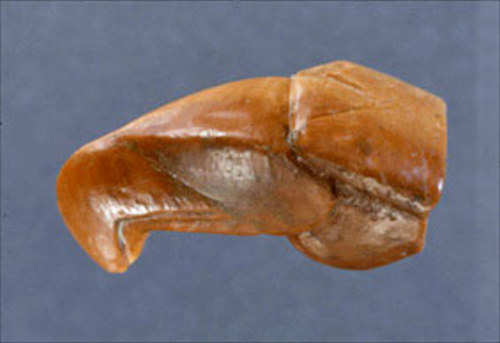
Carved
stone vulture head
found at Göbekli Tepe
I
also read about the discovery of similar
temples of the same age at Karahantepe,
Sefertepe and Hamzantepe. It was a truly
widespread society for the time,
and it could antedate the birth of the
Neolithic Age in the area, according
also to the discovery of the Balikligöl
statue. What do you think about
it?
There are
several new PPN sites
being investigated at the moment in Eastern and
Southeast Turkey, and hopefully
much new evidence will emerge in due course. Two
PPN sites were recently
unearthed actually inside the city limits of
Sanliurfa. Sadly, these examples
were destroyed, with only a few items being
preserved for posterity. One
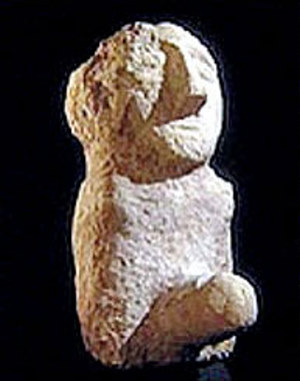
site was Balikligöl, where the idol was
discovered. It is a giant
ithyphallic male (image left). What it
represents is anyone's guess, although
it has to be connected with fertility and
fecundity of the land.
 Much more
important is Karahan
Tepe, a site only discovered in the late
1990s and still awaiting full
excavation. This is located near Sogmatar on the
Harran Plain, and dates
back 11,000 years at least. Already a large number
of t-shaped pillars
and stone rows have been uncovered here, and it
was their orientation north
and east-north-west that made me realize the
significance of the Pre-Pottery
Neolithic mindset in Upper Mesopotamia.
Much more
important is Karahan
Tepe, a site only discovered in the late
1990s and still awaiting full
excavation. This is located near Sogmatar on the
Harran Plain, and dates
back 11,000 years at least. Already a large number
of t-shaped pillars
and stone rows have been uncovered here, and it
was their orientation north
and east-north-west that made me realize the
significance of the Pre-Pottery
Neolithic mindset in Upper Mesopotamia.
I
began to find that the earliest Neolithic
cult centers, the prototypes
of stone circles and chambered barrows
everywhere, were directed roughly
north-south. Since the north was a direction of
death and rebirth at Çatal
Hüyük, I quickly realized that the focus of
attention at places such
as Karahan Tepe and Göbekli Tepe was the movement
of circumpolar stars
around the northern celestial pole, for
there was no Pole Star in c.
9500-9000 BC.
I
looked closely at the Skyglobe astronomical
program for these dates,
and realized that only one constellation could
have been the object of
their gaze, and this was Cygnus,
which in European starlore is the celestial
swan. However, there
is clear evidence that in Ancient Mesopotamia Cygnus
was seen as a raptor
bird, while in classical myth it was
occasionally seen as a vulture,
the symbol of the transmigration of the soul in
the Neolithic cult of the
dead.
When I also
discovered that the
Sabians
of Harran - a race of people known also as
the Chaldeans who
inhabited Upper Mesopotamia many thousands of
years after the Pre-Pottery
Neolithic peoples vanished from the radar -
venerated the north as the
Primal Cause and also the direction of heaven, I
knew I was on to something.
The
results
of that investigation are to be found in THE
CYGNUS MYSTERY, which forces us to
re-evaluate everything we thought
we know about our early ancestors' understanding
of the cosmos, and our
place in it.