|
The Fossil Evidence |
|
|
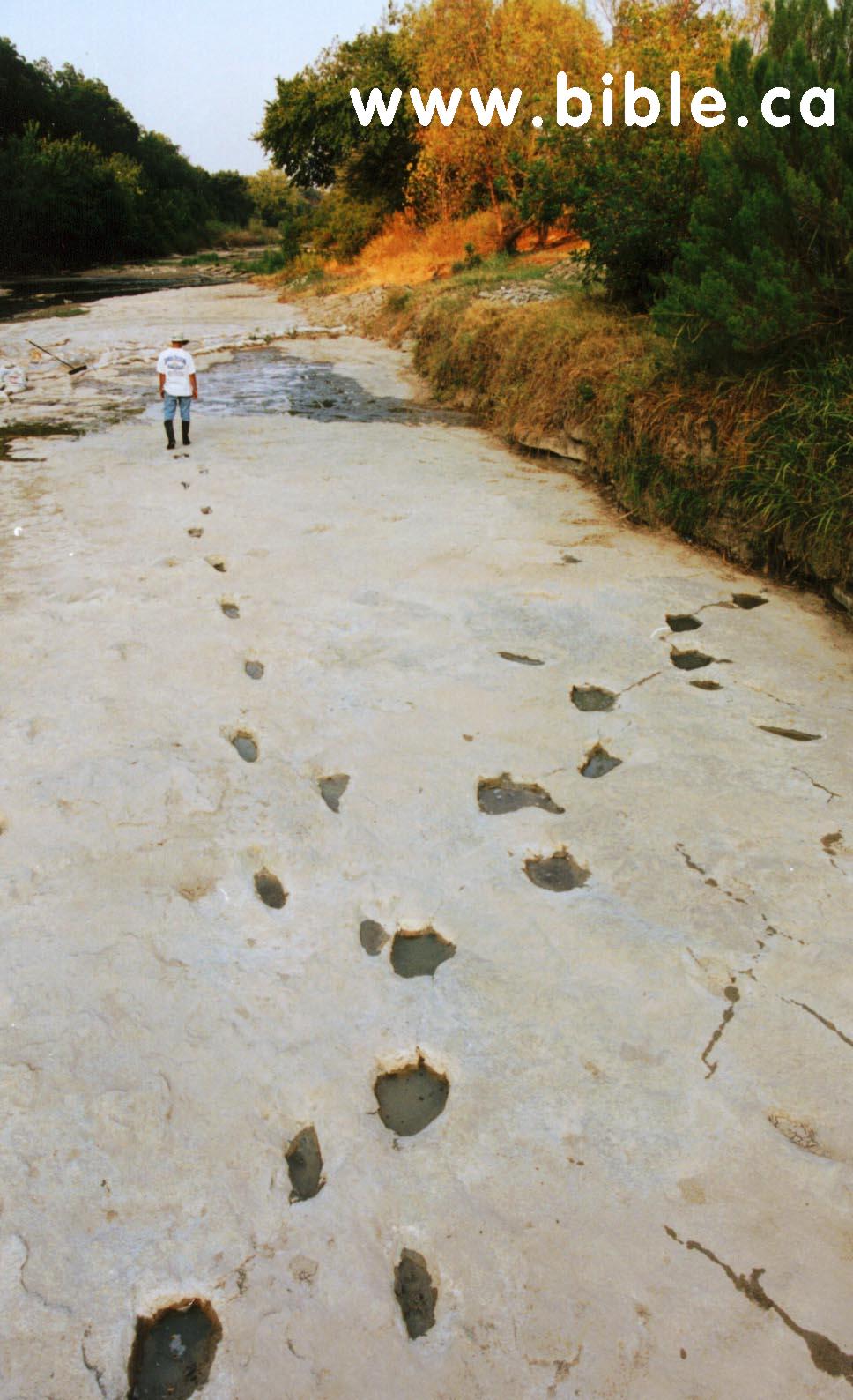
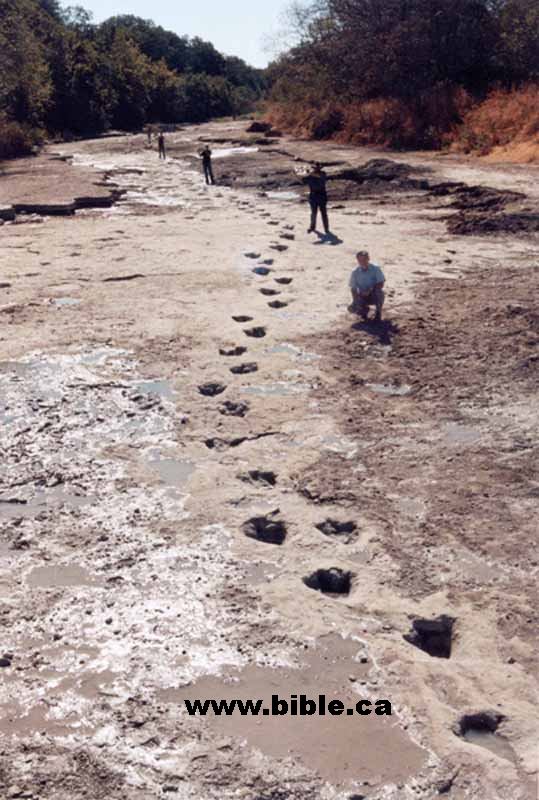
A series of 14 sequential human footprints on the same platformwith at least 134 dinosaur tracks. ---
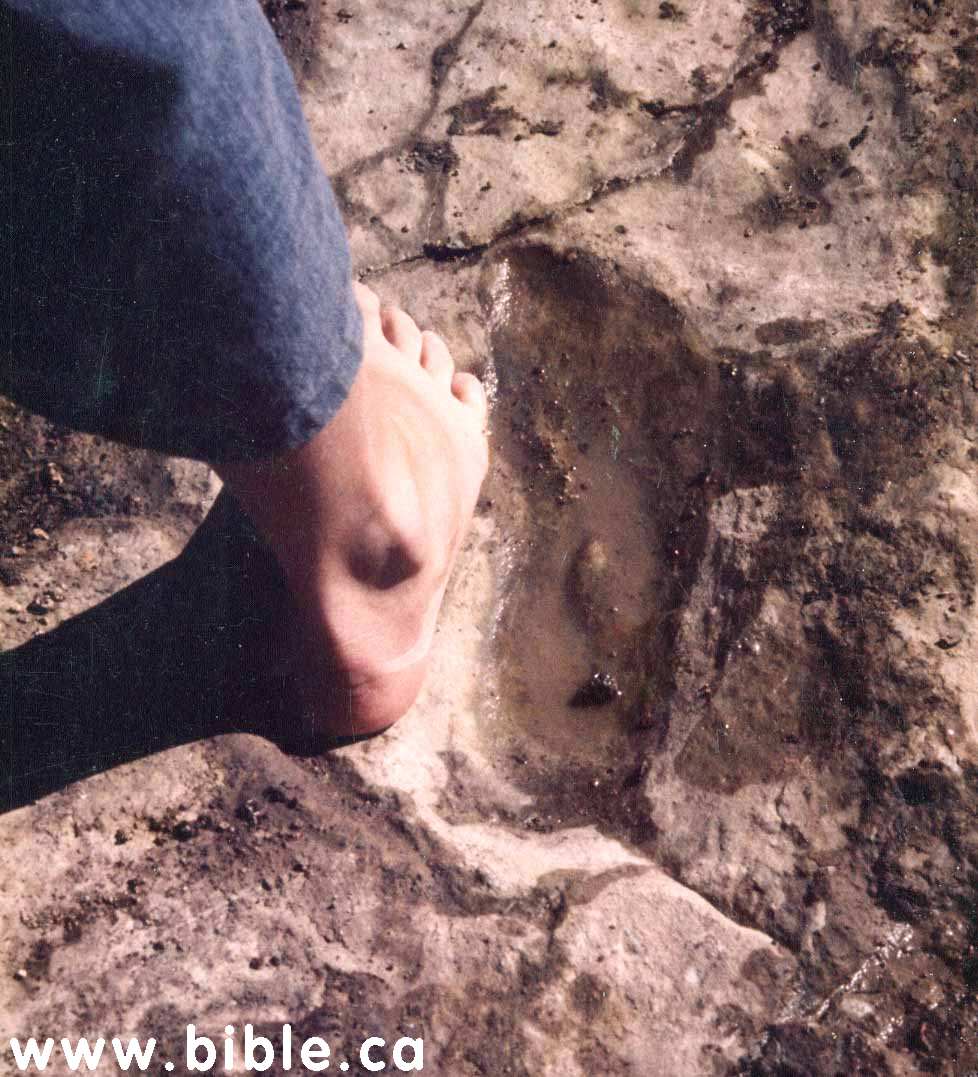
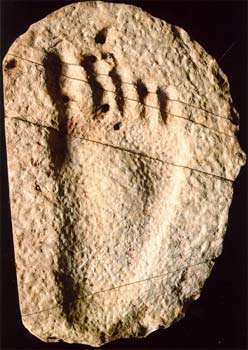
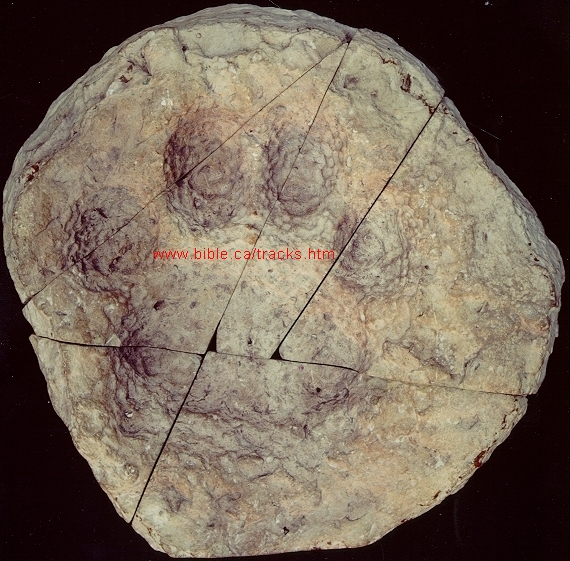
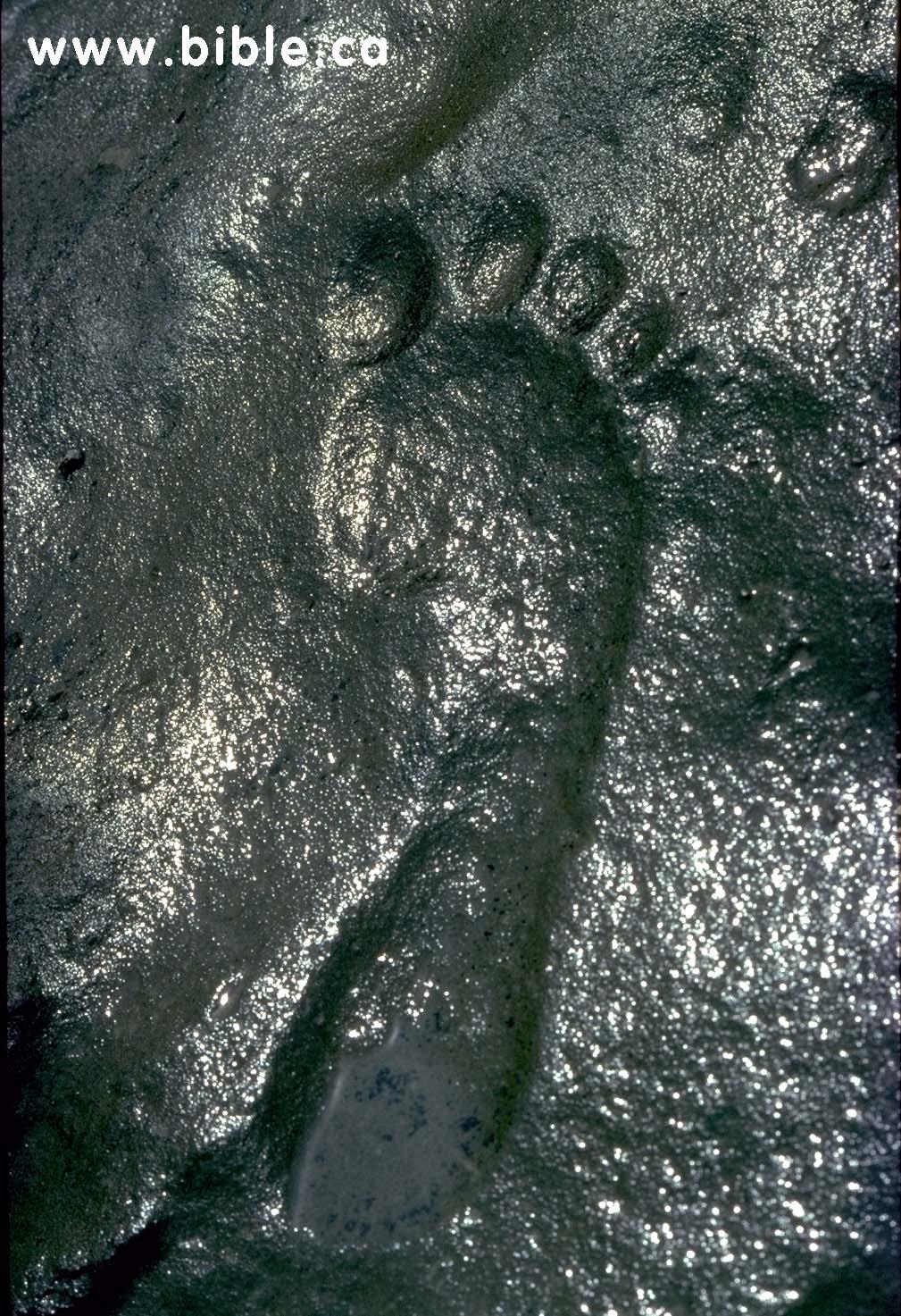
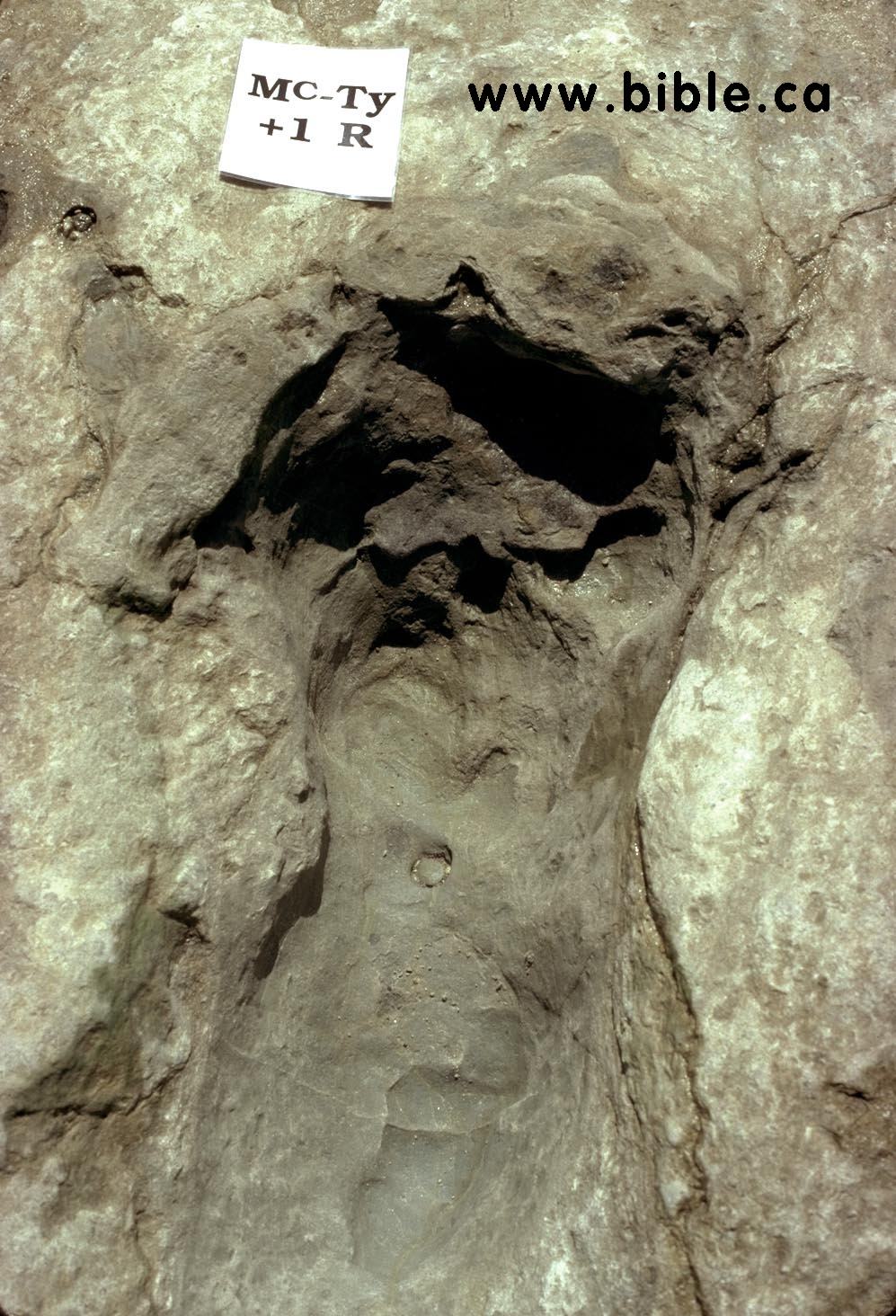
By following the trail back under the river bank, seven more very human like tracks were exposed. The process involved removing tons of limestone overburden, effectively eliminating the possibility that the tracks were carved. Taylor Trail Analysis: Perhaps the strongest feature of the evidence presented by the Taylor Trail is the fact that it is composed of a sequence of fourteen tracks, consistent in length, in a consistent right-left pattern. Each of the 14 tracks demonstrate, at least, a general oblong human-like shape. They are amazingly consistent in length. The largest variance from the average is less than 5%. In the sequence of associated dinosaur tracks, length varies as much as 40%. Of course, some of them are still in the process of being "revealed" by erosion. Individual toes can be discerned in seven of the fourteen tracks. Such detail is unexpected. In Mary Leakey’s Laetoli tracks, one great toe can be distinguished but no individual small toes can be seen. Left-right distinctions can be made in twelve of the fourteen tracks. Two are simply oblong shapes. When such determinations can be made, they are left-right consistent, with lefts where lefts should be and rights where rights should be. Deliberate Vandalism: Prize Track +1 destroyed once for all time! This is one of three tracks featured at the 1989 Dayton, TN creation conference that was destroyed the next day. On August 12, 1989 Dr. Don Patton spoke at a creation conference in Dayton, TN. He presented compelling evidence that both human and dinosaur tracks were present at the Taylor Trail, including the above pictures. Two well known evolutionists were present and at least one was conspicuously disturbed by this presentation. Both flew to Dallas the next morning and went immediately to the Paluxy River. It is reliably reported that they were in the river that afternoon with an "iron bar." Three days before they were in the river the footprint was observed looking like the picture above, right. Three days after they were in the river, it was observed looking like the picture below, right. Source - The Interactive Bible |
|
|
------
Source - The Interactive Bible |
|
|
---
Source - The Interactive Bible |
|
|
---
We have demonstrated that the shape of Burdick Track is within the range of variation documented by the technical literature. However, experiments that reproduced the shape of the Burdick Track show that it conforms perfectly to the features of a footprint made by a running human. When we consider the deformation under the pressure points within the matrix, especially at the heel and great toe as expected, as well as typical load bearing structures where pressure is concentrated, we have demonstrated that the "carved" hypothesis is falsified. We have verified this is a real fossil footprint. The Source? One more objection remained. Where was the track excavated? John Morris described what we knew about where the track was obtained originally. [Clifford] Burdick purchased the man print from a Rev. Beddoe of Arizona. Beddoe had in turn purchased it years ago from the late Peesee Hudson, who had operated a knick-knack type store in Glen Rose. ...Tracing the print proved impossible, but it was purported to have come from a tributary of the Paluxy, south of Glen Rose. TRACKING THOSE INCREDIBLE DINOASURS, p.117. Dr. Carl Baugh and I determined to find the source and conducted an extensive search. The trail was cold but many of the "old timers" were still around Glen Rose. We interviewed them and we were told what John had been told twenty years earlier. The track came from a tributary of the Paluxy, specifically, Cross Branch. It flows into the Paluxy about three mile south of town. Eventually, we found that they were right. We spent several weeks searching and finally found the layer from which this track came. It is a rather unique layer; ivory-tan color; fine grained, virtually non-fossiliferous, somewhat mottled with rounded, marble sized crystalline calcite inclusions. It has the same grape-sized calcite inclusions found in the matrix of the Burdick track. These inclusions get smaller and disappear toward the river. In the opposite direction, they get larger, up to fist sized a mile upstream. We focused our search at the point where the size of these inclusions matched the Burdick Track. Cordell Van Huse produced a thin section from the layer at this point as well as a thin section from the matrix of the Burdick Track. Microscopic examination demonstrated that they were identical. The layer is located about 30 feet above the level of the branch. As erosion eats back into the bank, support for the layer is removed. Angular blocks of the layer break off and fall down to water level. In the picture below, the anterior portion of the Burdick track rests on the layer from which it originated. We now know the source of the Burdick Track. It came from a layer about 30 feet above water level of Cross Branch, a tributary of the Paluxy River. It is a part of the Glen Rose Formation, Middle Cretaceous, supposedly 110 million years old. Source - The Interactive Bible |
|
|
---
Richard Dawkins, Oxford "If a single, well verified mammal skull were to turn up in 500 million year old rocks, our whole modern theory of evolution would be utterly destroyed. (The Blind Watchmaker, 1986, p.225) Source - The Interactive Bible |
|
|
---
Excavated by Dr. Don Patton beginning on 9 September 2000 The Texas drought has made new revelations possible. A platform in the Paluxy River bed near Glen Rose, Texas has been exposed by consulting geologist, Dr. Don Patton and volunteer workers, revealing three dramatic trails of dinosaur tracks. The primary trail pictured below consists of 136 consecutive tracks, extending over 400 feet. The prints are deep and incredibly detailed. The work of uncovering and cleaning the trails began September 9th and continued through October 14. It was conducted under the auspices of the Metroplex Institute Of Origin Science and the Creation Evidence Museum. The leading dinosaur track authorities have acknowledged that they know of no other single consecutive dinosaur trails in North America that are this long. Both the length and the beautifully preserved detail certainly make this one of the finest displays of dinosaur tracks in the world. Source - The Interactive Bible |
|
|
---
Source - The Interactive Bible |
|
| FAIR USE NOTICE: This page contains copyrighted material the use of which has not been specifically authorized by the copyright owner. Pegasus Research Consortium distributes this material without profit to those who have expressed a prior interest in receiving the included information for research and educational purposes. We believe this constitutes a fair use of any such copyrighted material as provided for in 17 U.S.C § 107. If you wish to use copyrighted material from this site for purposes of your own that go beyond fair use, you must obtain permission from the copyright owner. | |
| ~ MENU ~ |