|
The Fossil Evidence |
|||||
|
Article from the Creation Evidence Museum ---
|
|||||
| A.M. Coffee Track
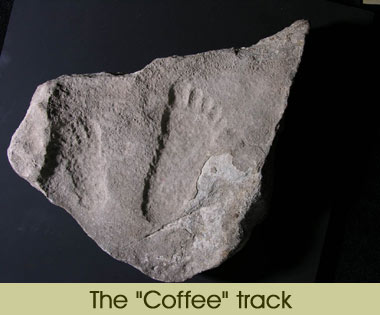
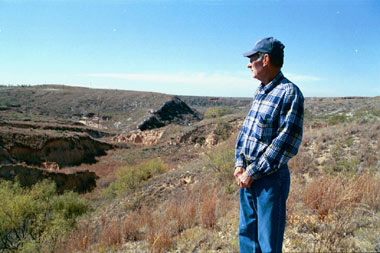
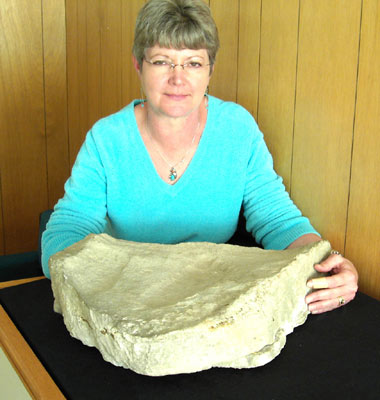
I. Discovery... In 1934 Mr. A.M. Coffee of Stinnett, Texas, a pumper
for the Gulf
Oil Company, discovered a trail
of nine “human-like
footprints” in series on a rock ledge about
four miles out of town.
He worked one of the tracks loose and took it home.
After he showed the
artifact to a few friends including his boss, various
interested persons
took the rest of the tracks from the site. The
discovery created an instant
controversy among archaeologists, geologists and
anthropologists, because
the sedimentary rock system of the entire area is
geologically assigned Permian (assumed to be 225
million years old).
The general consensus was that the print had to be a
carving made by Indians,
or the like. The difficulties involved in drawing such
conclusions were
enhanced by the fact that the print was accompanied by
eight other prints
in the series, along with an adjacent child's print.
Further controversy
ensued when it was pointed out that the tracks were
not “stylized” as other
Indian carvings are.
II. Display... In recent years the original track of the Coffee
discovery has been
kept on public display at the Stinnett City Hall at
Stinnett, Texas. One
of the other tracks in the series was displayed for
years at the Panhandle
A&M College Museum at Goodwell, Oklahoma. It was
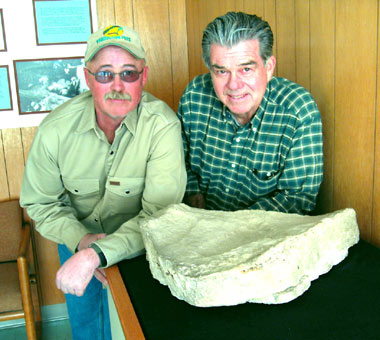
then placed with Mr.
Truman Tucker, a creationist friend of the late Dr.
Walter Lang and the
Creation Evidence Museum. Mr. Tucker placed the
artifact with the Community
Museum in Kenton, Oklahoma near his home. His
companion footprint is not
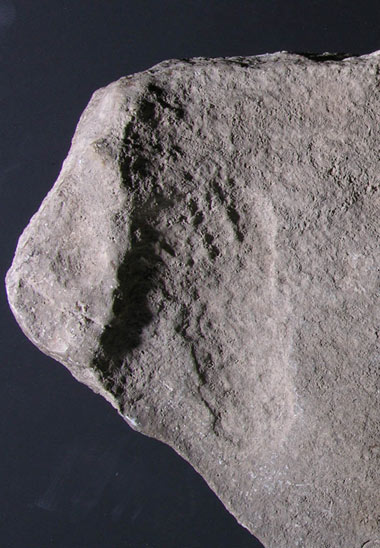
quite as deep nor as distinctive as the Coffee track,
but is discernible
as a human footprint.
III. Description... Both footprints measure 8 ½ inches in length. The
Coffee track
is a “right” footprint, whereas the Tucker track is a
“left” footprint.
On the slab of rock containing the Coffee Footprint is
a 5-inch child's
footprint. The adult print is ¾ inches deep, and the
mud compression
between the toes is evident, along with slight mud
displacement around
the footprint. All five human toes are clearly
displayed.
Definition... The discoverer's grandson, Mr. Fred Coffee, a member of the Stinnett City Council, is the current owner of the artifact. With his gracious cooperation the track was submitted to a nondestructive Spiral CT Scan analysis at a laboratory. While the information was being processed through the computer, the technical staff immediately pointed to the screen and emphasized the compression areas under the track and between the toes. The staff also emphasized the clearly discernible five toes, the three arches (medial, lateral, and metatarsal), and the overall distinctive shape of the human foot. Attention was drawn to the depressions made by the dominant “great toe,” the unique “second toe” that makes a slightly deeper depression, and the distinctive “ball”of the foot. When the analysis was complete the CT Scan had recorded the compression around the complete footprint, clearly indicating that the print was not carved or fabricated. In CT Scan X-rays the lighter areas are more dense, since the X-rays have more difficulty traveling through that medium. As it reaches the ground in forward locomotion the human foot first places pressure in the heel area, gently transfers the weight to the lateral longitudinal arch (creating a slight bulge in the upper outer section of the foot in the process), transfers the weight to the ball and the medial longitudinal arch, then transfers the weight to the metatarsal arch and the toes in a lifting motion. The enclosed documentation verifies this distinctive placement. Of significant importance is the fact that a thin crustal layer of sediment formed over the bulk rock as both layers lithofied. The crustal layer followed the contour of the contour of the depression. This thin layer is clearly seen, since a section of it peeled off as Mr. Coffee was removing the artifact. Any carving activity would have cut through the outer layer, clearly leaving its evidence of fabrication. Decision... With this new technical data in hand we have come to the conclusion that the track is indeed genuine and is a depression left by the placement of a human foot while the matrix of “mud” was still fresh and pliable. All the professional academicians to whom the Director has shown the artifact rate it between 9.5 and 10.0 on a scale of 1 to 10. We offer our congratulations to the Coffee
family,and our commendation
to the man who made this important discovery, the late
A.M. Coffee. He
is worthy of profound honor.
|
|||||
| FAIR USE NOTICE: This page contains copyrighted material the use of which has not been specifically authorized by the copyright owner. Pegasus Research Consortium distributes this material without profit to those who have expressed a prior interest in receiving the included information for research and educational purposes. We believe this constitutes a fair use of any such copyrighted material as provided for in 17 U.S.C § 107. If you wish to use copyrighted material from this site for purposes of your own that go beyond fair use, you must obtain permission from the copyright owner. | |||||
| ~ MENU ~ |