Sedna
.
Image Credit: NASA/JPL-Caltech
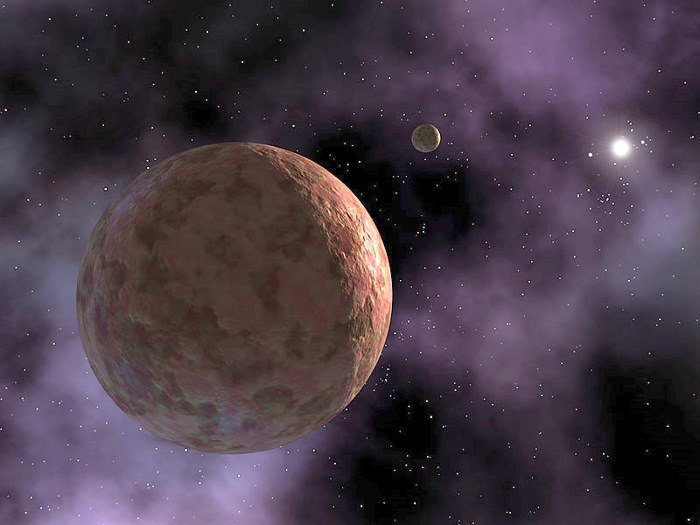
Artist's Conception: Sedna -
Sedna is extremely far from the Sun, in the coldest known region of our
Solar System, where temperatures never rise above minus minus 400 degrees
Fahrenheit (240 degrees Celsius). The planetoid is usually even colder,
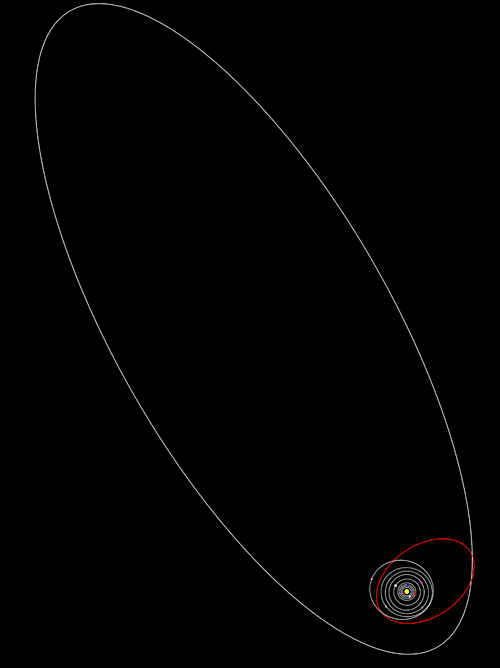
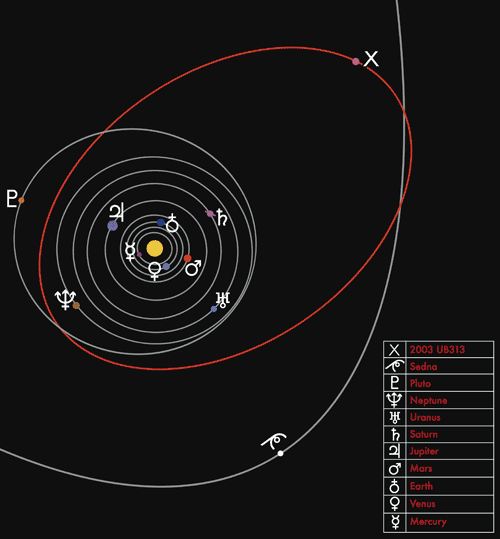
because it approaches the Sun only briefly during its 10,500-year solar
orbit. At its most distant, Sedna is 130 billion kilometers (84 billion
miles) from the Sun, which is 900 times Earth's solar distance.
Sedna was discovered on November 14, 2003 by a CalTech
team, using the 48-inch Samuel Oschin Telescope at Palomar Observatory.
The object lies more than 8 billion miles from the Earth, making it the
most distant object ever observed in the solar system. Its official IAU
provisional designation was minor planet 2003 VB12, but as of September
28, 2004 it officially became known as Sedna after the Inuit goddess of
arctic sea life. |
Sedna Reveals Pristine Surface
in
Gemini Near-infrared Spectra
.
Credit: Gemini artwork
by Jon Lomberg
Recent spectroscopic studies
of infrared light reflected from the surface of Sedna reveal that it is
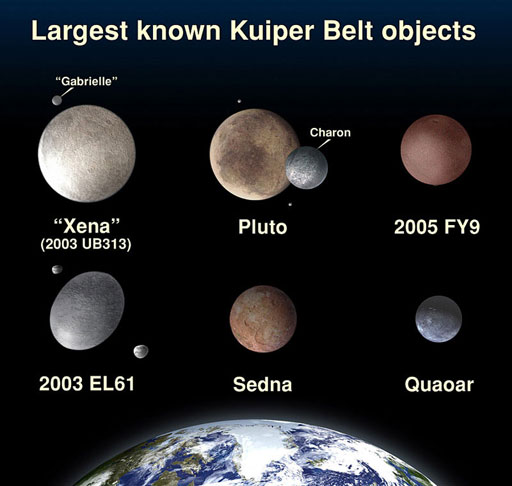
probably unlike Pluto and Charon since Sedna's surface does not display
evidence for a large amount of either water or methane ice. Due to Sedna’s
extreme distance from the Sun, the frigid surface has probably been untouched
for millions of years by anything except cosmic rays and solar ultraviolet
radiation.
Gemini Observatory astronomer
Chad Trujillo led an effort by the same California Institute of Technology
research team responsible for Sedna's original discovery to obtain spectra
of this distant planetoid using the Near Infrared Imager (NIRI) on Gemini
North. Their aim was to better understand the surface of this distant world
and how it has evolved since its formation. “It is likely that Sedna
has experienced an extremely isolated life in the outskirts of our solar
system,” said Trujillo. “Out there beyond what we used to think was
the edge of the solar system, interactions or collisions between bodies
are probably very rare. Our observations confirm what you would expect
from a surface that has been so far out in our solar system for such a
long time and exposed to space weathering.”
SOURCE: Gemini
Observatory |
References:
-
"Discovery
Circumstances: Numbered Minor Planets (90001)-(95000)". IAU: Minor
Planet Center.
-
Buie,
Marc W. (2007-08-13). "Orbit
Fit and Astrometric record for 90377". Deep
Ecliptic Survey.
-
Brown,
Michael E.. "The
largest Kuiper belt objects" (PDF)
-
Stansberry, John; Will Grundy,
Mike Brown, Dale Cruikshank, John Spencer, David Trilling, Jean-Luc Margot
(2007). "Physical
Properties of Kuiper Belt and Centaur Objects: Constraints from Spitzer
Space Telescope". University of Arizona, Lowell Observatory, California
Institute of Technology, NASA Ames Research Center, Southwest Research
Institute, Cornell University
-
Radius of 590 km and density of
0.97
= 8.3 × 10²⁰ kg mass. Radius of 900 km and density of 2.3
= 7.0 × 10²¹ kg mass
-
Tegler, Stephen C. (2006-01-26).
"Kuiper
Belt Object Magnitudes and Surface Colors"
-
"AstDys
(90377) Sedna Ephemerides". Department of Mathematics, University of
Pisa, Italy
-
"Horizons
Output for Sedna 2076/2114" Horizons
-
"JPL
Small-Body Database Browser: 90377 Sedna (2003 VB12)". 2007-11-08 last
obs
-
At present, though, Eris
(dwarf planet) is farther from the Sun than Sedna.
-
Lowell DES Perihelion Epoch
= 2000.0 + (2479283.2278 − 2451545.0)/365.25 = 2075.9431 = (2076-1-1
- 20.7768 days) = 2075-12-11 (Julian
Date Converter)
-
Morbidelli, Alessandro; Harold
F. Levison (2004). "Scenarios for the Origin of the Orbits of the Trans-Neptunian
Objects 2000 CR105 and 2003 VB12 (Sedna)". The Astronomical Journal '128':
2564–2576. doi:10.1086/424617.
(Original
Preprint)
-
"The
Challenge of Sedna". Harvard-Smithsonian Center for Astrophysics
-
Gomes, Rodney S.; John J. Matese,
and Jack J. Lissauer (2006). "A
distant planetary-mass solar companion may have produced distant detached
objects". Icarus 184: 589–601. doi:10.1016/j.icarus.2006.05.026.
http://adsabs.harvard.edu/abs/2006Icar..184..589G
-
Gaudi, B. Scott; Krzysztof Z.
Stanek, Joel D. Hartman, Matthew J. Holman, Brian A. McLeod (CfA) (2005).
"On
the Rotation Period of (90377) Sedna". Astrophys.J. 629: L49–L52.
doi:10.1086/444355.
http://arxiv.org/abs/astro-ph/0503673
-
D.
L. Rabinowitz; K. M. Barkume, M.
E. Brown, H. G. Roe, M. Schwartz, S. W. Tourtellotte, C.
A. Trujillo (2006). "Photometric Observations Constraining the Size,
Shape, and Albedo of 2003 EL61, a Rapidly Rotating, Pluto-Sized
Object in the Kuiper Belt" (preprint
on arXiv). The Astrophysical Journal 639 (2): 1238–1251. doi:10.1086/499575
-
M. Grundy, K. S. Noll, D. C.
Stephens. "Diverse
Albedos of Small Trans-Neptunian Objects". Lowell Observatory, Space
Telescope Science Institute.
-
McKee, Maggie (2005). "Distant
planetoid Sedna gives up more secrets". NewScientist.com news service
-
Alexander, Amir (18 April 2005).
"Sedna:
Mysterious Planetoid Slowly Yielding Up Its Secrets". The Planetary
Society
-
Barucci, M. A.; D. P. Cruikshank,
E. Dotto, F. Merlin, F. Poulet, C. Dalle Ore, S. Fornasier and C. de Bergh
(2005). "Is Sedna another Triton?". Astronomy & Astrophysics 439: L1–L4.
doi:10.1051/0004-6361:200500144
-
Jewitt, David, Morbidelli, Alessandro,
& Rauer, Heike. (2007). Trans-Neptunian Objects and Comets: Saas-Fee
Advanced Course 35. Swiss Society for Astrophysics and Astronomy. Berlin:
Springer. ISBN
3540719571
-
Lykawka, Patryk Sofia & Mukai,
Tadashi. (2007). Dynamical classification of trans-neptunian objects: Probing
their origin, evolution, and interrelation.
Icarus Volume 189, Issue
1, July , Pages 213-232. doi:10.1016/j.icarus.2007.01.001
-
Kenyon, Scott J.; Benjamin C.
Bromley (2 December 2004). "Stellar
encounters as the origin of distant Solar System objects in highly eccentric
orbits". Nature 432: 598–602. doi:10.1038/nature03136
-
Evidence
for an Extended Scattered Disk?
-
Jewitt,
D., A. Delsanti, The Solar System Beyond The Planets in Solar
System Update : Topical and Timely Reviews in Solar System Sciences
, Springer-Praxis Ed., ISBN
3-540-26056-0 (2006) Preprint
of the article (pdf)
-
Elliot, J. L., S. D. Kern, K. B.
Clancy, A. A. S. Gulbis, R. L. Millis, M. W. Buie, L. H. Wasserman, E.
I. Chiang, A. B. Jordan, D. E. Trilling, and K. J. Meech The Deep Ecliptic
Survey: A Search for Kuiper Belt Objects and Centaurs. II. Dynamical Classification,
the Kuiper Belt Plane, and the Core Population. The Astronomical Journal,
129 (2006), pp. preprint
-
Brown,
Michael E.. "The
Dwarf Planets". California Institute of Technology, Department of Geological
Sciences
-
Stern–Levison
parameter (using unlikely highest estimated mass) = ((7 × 10²¹)
/ (5.9736 ×
1024))^2 / 12,059 yr = 1.14 × 10⁻¹⁰ (Sedna
1.14 × 10⁻¹⁰) / (Pluto 1.95 × 10⁻⁸) = 5.8 ×
10−3
Bibliography:
-
Discovery
of a candidate inner Oort cloud planetoid (Brown et al., submitted
to ApJ Letters, March 16, 2004)
-
Hurt, Robert. Artist's
Concept of Sedna. California, USA: Infrared Processing and Analysis
Center. March 15, 2004.
-
Hurt, Robert. Sedna's
Orbit Comparisons. California, USA: Infrared Processing and Analysis
Center. March 15, 2004.
-
JPL. Most
Distant Object in Solar System Discovered. Press release: Jet Propulsion
Laboratory. March 15, 2004.
-
Whitehourse, David. Sedna
has no moon, say astronomers. BBC
News, April 14, 2004.
External links:
|