|
Pyramids Around the World |
|||
| These
pages are temporary storage for new articles on
all pyramids awaiting processing |
|||
|
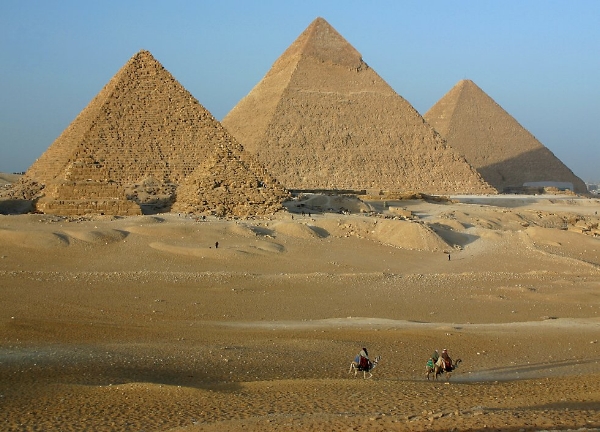
Cairo, Egypt
|
|||
|
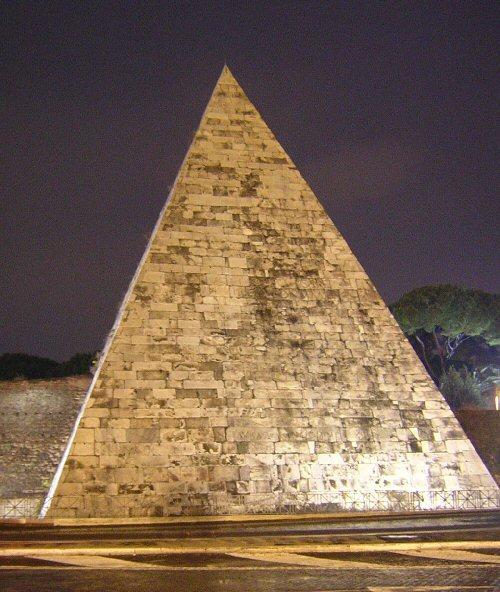
Rome, Italy
The pyramid of Cestius was
built during the reign of the emperor Augustus,
probably between 18 and 12 BCE. It is a remarkable
monument, made of white Carrara marble and exactly
100 Roman feet (30 meters) high.
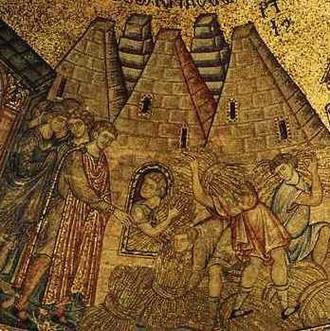
Compared to the real Egyptian pyramids the Pyramid of Cestius is too pointed. This explains why in the Middle Ages and Renaissance, pictures of ancient Egypt also contained too pointed monuments: the only place where European artists could see a pyramid, was at Rome. The picture below shows a mosaic from the San Marco in Venice with a scene from the Biblical story of Joseph in Egypt. The artist has tried to make it look really Egyptian, but his pyramids are clearly based on the Pyramid of Cestius. - Source
|
|||
|
Near Milan, Italy, 2003 Satellite images like the
pictures below are helpful in pointing out the
location of the pyramids of Montevecchia. Mapping
software is used to enhance the detail shown in
satellite images and photography.
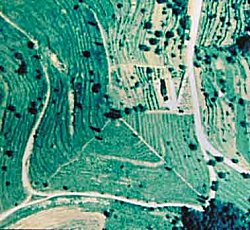
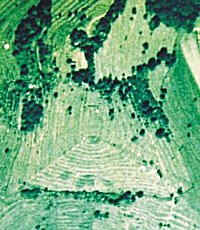 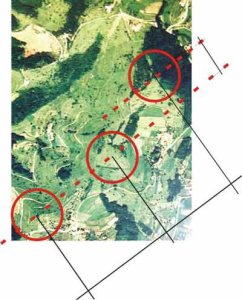 In early
2003, the pyramids of Montevecchia ("Old Mountain"
in English), only about 30 miles from the Italian
city of Milan, were discovered with the use of
satellite and aerial imagery. These pyramids are
completely covered by earth and vegetation and now
appear to be natural hills, but the possibility of
something more was enough for the Czech WM magazine
and its editor-in-chief Georg Wojnar to visit the
area in an effort to locate and survey the site. The
team arrived on 8 May 2003. Finding the location of
the pyramids from the ground proved more difficult
than imagined, the team becoming "impressed" with
the driving abilities required to negotiate their
way towards the hills. After two days, they
succeeded in locating the pyramids and began
carrying out an initial survey. The team's
conclusions appeared in the June 2003 issue of WM.
The first pyramid was estimated to have a base of
100 metres and a height of 50 metres. Three pyramids
in total were surveyed, with one pyramid showing
clear signs of stones worked into the structure,
close to the surface. A platform with an oblong
superstructure of 18 by 9 metres in size was also discovered.
- Source
Editors note: At this time there has been little actual archeology done at the site to reach any conclusions either way... We will be atching this location. More
Articles... |
|||
|
Nice, France
"Nice has a pyramid. Few people know it, but it absolutely exists, near Falicon, to the north of Nice. Speleologues know it as the pyramid that marks the entrance of the Ratapignata cave. Mystics think it is mystic, but it is above all enigmatic." ~ Bert Bos Excert One: The Falicon Pyramid is an ancient monument located at a rural site near the town of Falicon, on the French Riviera, near Nice.It is constructed above a karstic cave known as the Cave of the Bats (Occitan: Bauma des Ratapignata) and is one of the few pyramids in Europe. The pyramid is constructed of small
irregularly-shaped stones, possesses a fairly acute
angle of inclination, and is in a partly ruined
condition. While most of its upper section is
missing, the lower section is reasonably
well-preserved.
The pyramid's purpose and origins are unknown, although it has been suggested that it may have been constructed by Roman legionaries involved in Egyptian cult practices. The number of stairs leading into the cave below the pyramid also supposedly corresponds to the 7-level initiation rituals of the cult of Mithras - an eastern religion that was popular with members of the Roman Army during the later Empire. - Source |
|||
|
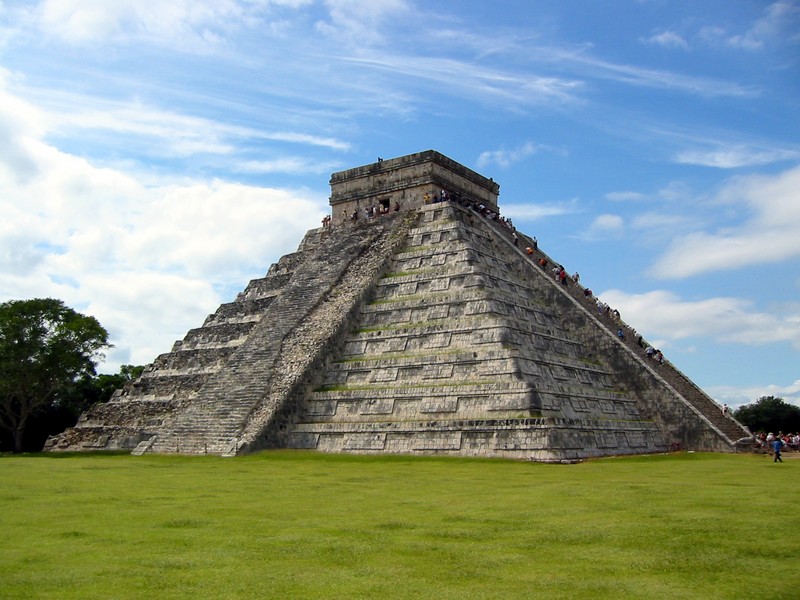
Chichen Itza, Mexico, Mayan
Excerpt The Temple of Kukulkan, the Feathered Serpent God (also known as Quetzalcoatl to the Aztecs) is the largest and most important ceremonial structure at Chichen Itza. This ninety-foot tall pyramid was built during the eleventh to thirteenth centuries directly upon the multiple foundations of previous temples. The architecture of the pyramid encodes precise information regarding the Mayan calendar. Each face of the four-sided structure has a stairway with ninety-one steps, which together with the shared step of the platform at the top, add up to 365, the number of days in a year. These stairways also divide the nine terraces of each side of the pyramid into eighteen segments, representing the eighteen months of the Mayan calendar. The pyramid is also directionally oriented to mark the solstices and equinoxes. The axes that run through the northwest and southwest corners of the pyramid are oriented toward the rising point of the sun at the summer solstice and its setting point at the winter solstice. The northern stairway was the principal sacred path leading to the summit. At sunset on the vernal and autumnal equinoxes, an interplay between the sun's light and the edges of the stepped terraces on the pyramid creates a fascinating - and very brief - shadow display upon the sides of the northern stairway. A serrated line of seven interlocking triangles gives the impression of a long tail leading downward to the stone head of the serpent Kukulkan, at the base of the stairway. Adjacent to the head of Kukulkan, a doorway leads to an interior staircase ending at a small and very mysterious shrine. According to Maya scholars Linda Schele and David Friedel, the massive pyramidal temples found at Chichen Itza, Uxmal, Palenque and many other major Maya sites were symbolic sacred mountains. |
|||
|
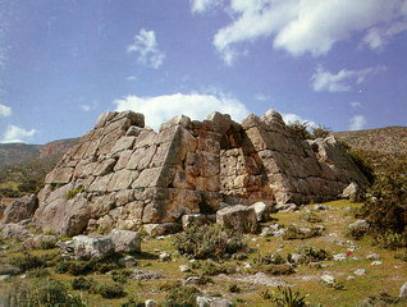
Helleniko, near Argos, Greece
Exerpt One: The three pyramids located in
the Peloponnesus have recently been the center of a
great deal of attention. This sudden interest is
being shown not only by archaeologists and
historians, but by the general public as well, both
Greek and foreign. This is entirely justified
because they concern the distant past of humanity as
a whole. The astonishment one naturally experiences
when seeing the pyramids of Egypt for the first
time, is akin to the reaction of those who are told
that their prototypes are most likely to be found in
an obscure village near Argos in the Peloponnesus.
This assertion -- which contradicts the misguided
belief held by many that civilization
proceeded from the East -- is bolstered by the
concurrence that exists between the chronological
assessment of these pyramids made by the prestigious
Athens Academy, the University of Edinburgh,
Scotland, and the historical information available
to us from ancient sources: All of which have to do
with when these structures were constructed, whether
this architectural know-how was transferred to Egypt
from Greece, and, if so, how. - Source
Exerpt Two: That's right. Greek pyramids! On Greek soil, at Hellenikon and Ligourio west of Athens in the Argolid region, are two limestone pyramids that are stylistically very much like those at Giza near Cairo. The big difference is size; the Greek pyramids are only the size of a large room compared to the Great Pyramid's height (with capstone) of almost 500 feet. When excavations were made around the Greek pyramids in the early 1900s, pottery fragments from the Fourth Century B.C. were found, and it was presumed that the pyramids were also constructed then; that is, about the time of Alexander the Great. Recent dating of crystals from internal surfaces of the limestone blocks using thermoluminescence puts the construction times back two millennia. The Hellenikon pyramid dates to 2730 B.C.; the Ligourio, to 2260 B.C. This means that the Greek pyramids were built in roughly the same time frame as the Egyptian pyramids. Why would the ancient Greeks want to build miniature pyramids? The classical scholar Pausanias wrote in the Second Century A.D. that the Hellenikon pyramid was a cenotaph for the dead fallen in a fratricidal battle 4,000 years ago. Nobody believed his story until now. - Source More Reading: "There are more than 16 pyramids spread all
over the Greece. The oldest one is the pyramid of
Hellinikon... "- Source
|
|||
|
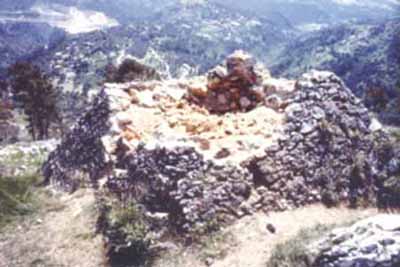
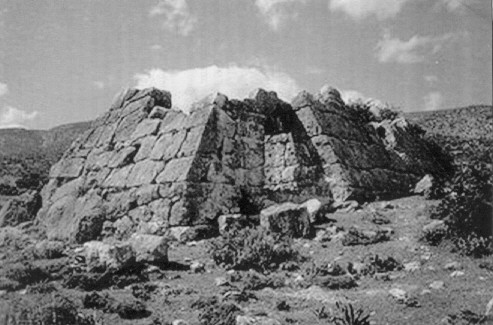
Sparta, Greece
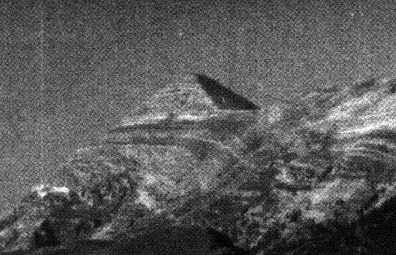
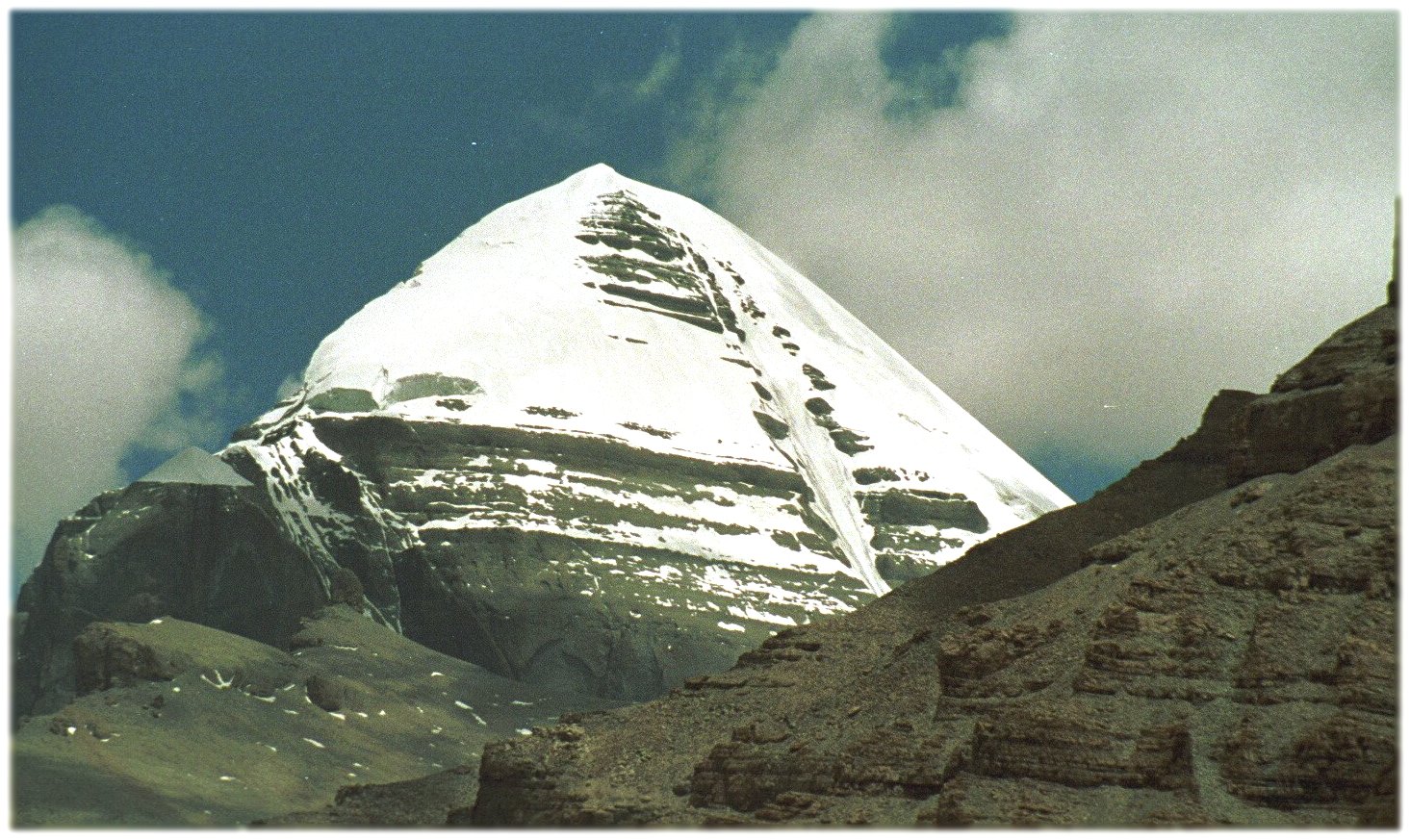
These rock structures are still subject of cotroversy, as to whether they are manmade or natural occurences. Some researchers are convinced that this structure, found on one of the peaks of mount Taygetus, was carved by the hand of man, in remote antiquity, to form this pyramid shape. Others however believe that this is nothing but an natural rock formation. . Visitors to this area, however, are surprised by the abrupt change in the texture of the rock surface near the base of the "pyramid". It is very striking the smooth texture of the rock surface above the base level of the "pyramid" when compared to the surrounding ground below. No erosion mechanism has been suggested (to date) which could create this shape naturally. Particularly curious are the strange shadows cast at dawn and sunset. - Source and Pictures Editors Note: The above picture is the only know image and is "cloned" all over the internet. Until better photos are found no conclusion is possible and this remains unconfirmed. However there is another one that looks similar and it is in the same position related to the big moumtain to its left. This one is on Mount Khailash in Tibet. It is a very strange coincidence that bouth mountains have such a formation beside them. This one though is well documented in many large photos. It is also interesting to note that Mt Kailash is considered by many Tibetans to represent Mt Meru
Mount Kailash Mount Kailash stands prominently in a remote south-west corner of Tibet, an amazingly symmetrical 22,028 foot striated pyramid with a diagonal gash on one of its faces. It has been described as 'a compelling, dome-shaped peak, rising above a desolately beautiful 13,000 ft plateau of rainbow-coloured rocks'. Mt. Kailash is also called Kang Rinpoche, or the Precious Mountain, in Tibetan. It is believed that the eleventh century poet-yogi, Milarepa was the only person to have set foot on its peak, and he accomplished the feat by flying there... The Bön, an aboriginal religious sect of the Tibetan pre-Buddhist era call it Yung-drung Gu-tzeg, or "9-storey Swastika" because on the south face of Kailash can be seen a swastika. The 6,714 metre peak is believed to be the actual home of Lord Shiva, and also the sacred seat of Adinath, the first of the Jains. This peak is the earthly manifestation of Mount Sumeru, or Meru as it is also known. Sumeru is believed to be the axis of the universe. The point about which the entire cosmos spins is Mount Meru. The journey to Mt. Kailash is an important pilgrimage for millions of Buddhists and Hindus, in addition to Jains and also to Bonpos. It is believed that one circuit of the sacred Mt. Kailash(54 km/32 miles) is sufficient to wipe out all the sins of your lifetime. Wiping out the sins of all your lifetimes is a much bigger task; that major sin clean-up requires 108 revolutions. Or bathing in the icy sapphire waters of Lake Manasarovar at the mountain's base is also said to remove the sins of innumerable lifetimes. Since Mt. Kailash is the home of Lord Shiva, for Hindu people it is also the highest blessing to take darshan of the mountain - to be in its presence; to see it and to be seen by it. Tibetan poet and seer of the 11th century Milarepa's comment on Mt. Kailash is worth quoting: "There is no place more powerful for practice, more blessed, or more marvelous than this. May all pilgrims and practitioners be welcome!" |
|||
| FAIR USE NOTICE: This page contains copyrighted material the use of which has not been specifically authorized by the copyright owner. Pegasus Research Consortium distributes this material without profit to those who have expressed a prior interest in receiving the included information for research and educational purposes. We believe this constitutes a fair use of any such copyrighted material as provided for in 17 U.S.C § 107. If you wish to use copyrighted material from this site for purposes of your own that go beyond fair use, you must obtain permission from the copyright owner. | |||
|
|