|
Enigmas in Our Solar System New Planets Discovered |
|
|
.
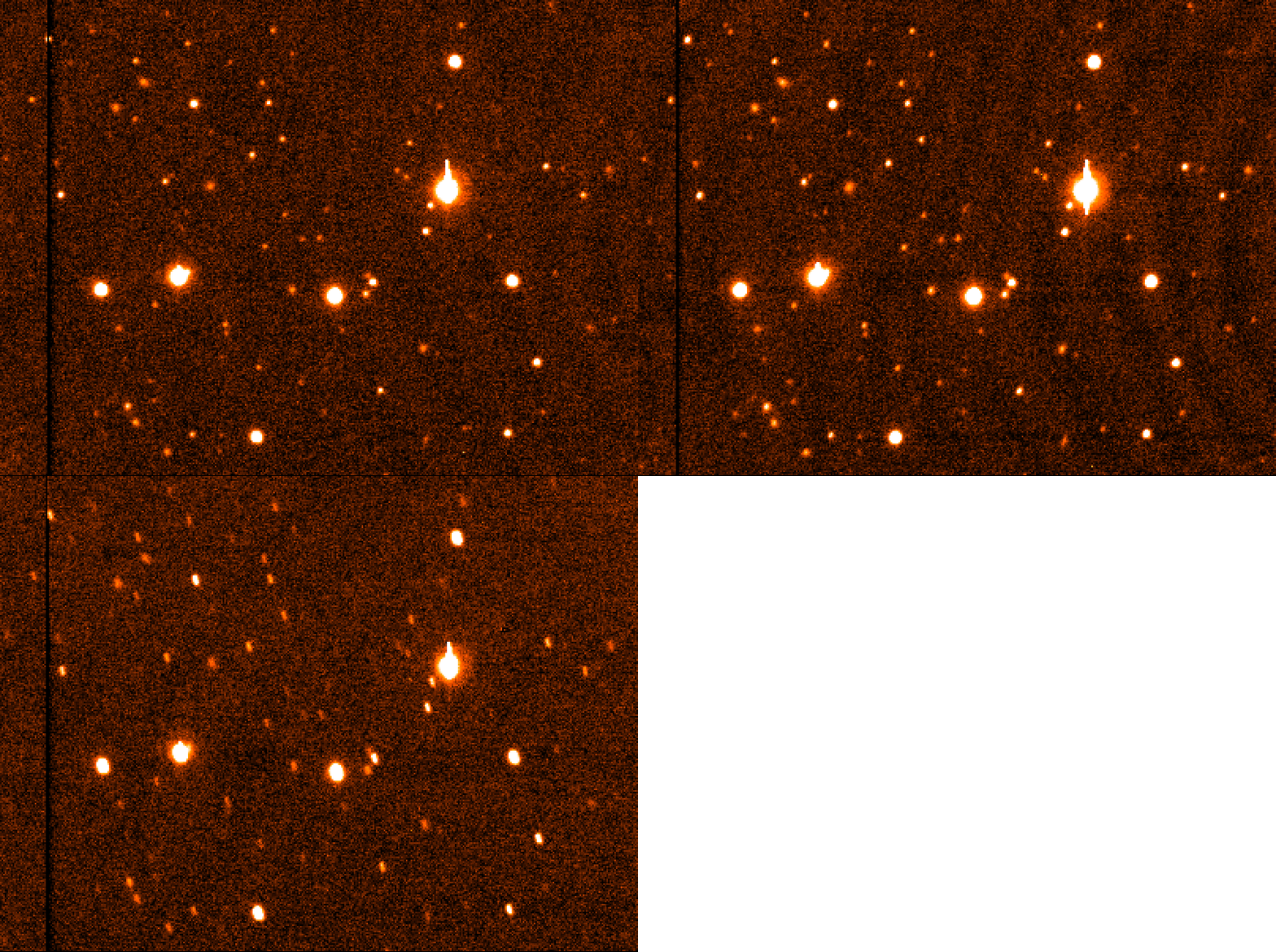
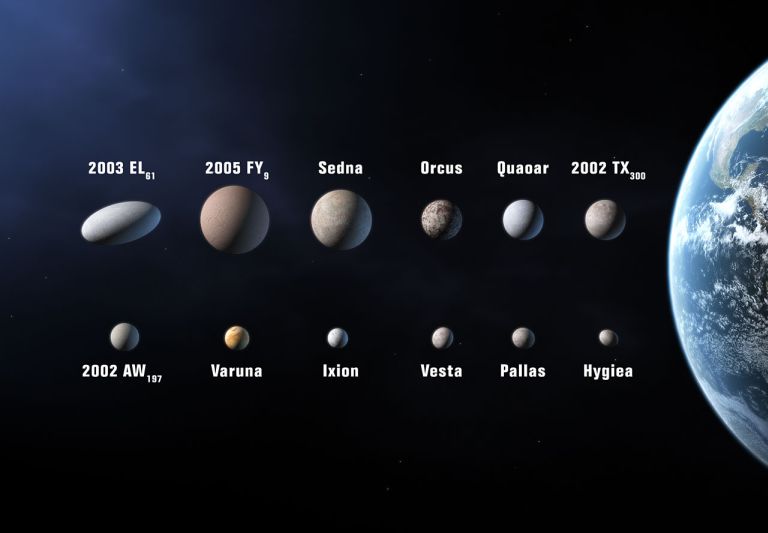
According to astronomer Mike Brown's blog entry for December 31, 2007, Orcus has a tiny moon. Orcus may be a good example of a large planetary body with a lot of ice that did not have a giant collision like Quaoar. Orcus (which is about the same size as Quaoar or around half the size of Pluto) has a moon like Quaoar. Observations with the Hubble Space Telescope in late 2006 have been used to track the orbit of Orcus' satellite and to determine that Orcus is much icier than anticipated. While this moon could have been formed in a giant collision, the satellite is somewhat larger than the recently discovered moons of other large planetary bodies beyond Neptune's orbit, which look like collisional remnants. Hence, it is more probable that Orcus never experienced a giant impact and that its moon is simply another planetary body captured from Solar space. Brown hopes to better determine whether Orcus' moon was created from a collision or captured from space by looking more closely at the composition of its surface to see whether it is very different in surface composition from collisionally formed satellites, by analyzing the spectrum of sunlight after it has reflected off the surface of the satellite with the Keck telescope at the end of March 2008 (more). Orcus On February 17, 2004, a team of astronomers (Chad Trujillo, Mike Brown, and David Rabinowitz, who include discoverers of Quaoar) announced the discovery of an Edgeworth-Kuiper Object (EKO) that is similar to Quaoar in size, which was given the provisional designation of 2004 DW. Based on its current distance of around 48 AUs from Sol, brightness, and presumed albedo or ability to reflect light of nine percent, 2004 DW was initially estimated to have a larger diameter than Quaoar at around 990 miles (1,600 kilometers), but an August 2006 table posted by Mike Brown (a member of the discovery team) now lists a diameter of around 680 miles (1,100 kilometers), or just under half the size of Pluto. On August 24, 2006, the International Astronomical Union (IAU) voted to establish a new category of Solar System objects called "dwarf planets." Orcus (2004 DW) is large enough to have a spherical shape and so is a candidate for IAU designation as a dwarf planet. |
|
|
2004 DW has an orbit similar
to Pluto's. Hence, it has been classified as
"Plutino" -- an EKO in an
orbit that goes around the Sun twice for every
three times that Neptune
orbits around the Sun. As a result, the IAU
approved the permanent name
"Orcus" for this object, which comes a Roman god
of the dead and is another
name for the Greek deity of the dead Hades.
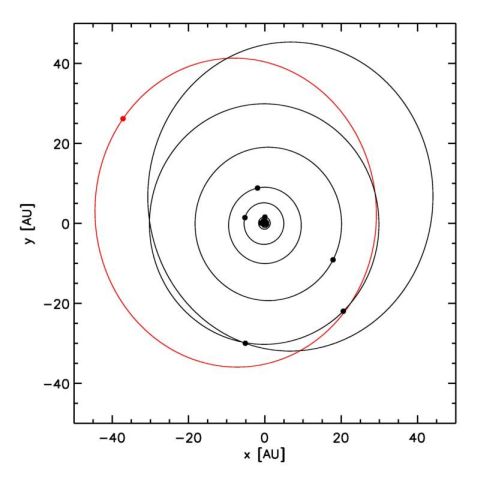
Based on preliminary orbital characteristics determined using images of the object traced back to a First Palomar Sky Survey photograph of November 23, 1954 and to a November 8, 1951 photograph by Australia's Siding Spring Observatory, Orcus' orbital distance from the Sol varies between 30.9 and 48.1 AUs with an orbital inclination of about 20.6°, which is larger even than the orbital inclination of Pluto. It takes 248 years to complete its orbit. Having reached its farthest point from the Sun in 1989, Orcus is now moving inbound towards Sol, reaching perihelion in 2113 (more details, an orbital illustration, and an animated image are available from astronomer Chad Trujillo). |
|
|
..
|
|
| FAIR USE NOTICE: This page contains copyrighted material the use of which has not been specifically authorized by the copyright owner. Pegasus Research Consortium distributes this material without profit to those who have expressed a prior interest in receiving the included information for research and educational purposes. We believe this constitutes a fair use of any such copyrighted material as provided for in 17 U.S.C § 107. If you wish to use copyrighted material from this site for purposes of your own that go beyond fair use, you must obtain permission from the copyright owner. | |
|
|