|
The Enigmas on Mars 04 |
||||||||
|
The Evidence for Water On Mars Part Three: More "Blueberries" & Earth Equivalents “On Earth,
whenever we find water, we find life – in
surface water or underground water, hot water or
cold water – any place there is water on Earth
there are microbes, there is life.” “That’s the
bottom line: hematite is linked to life.”
|
||||||||
|
Another Possibility .
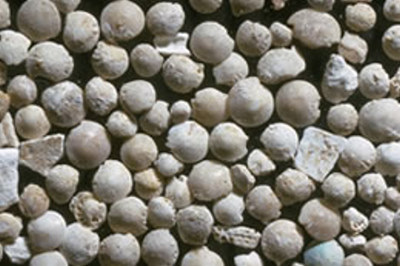
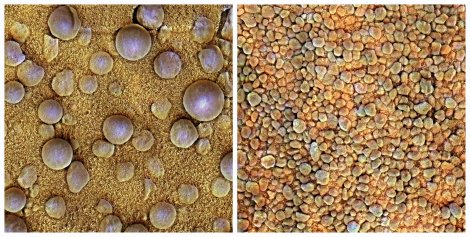
International Sand Collectors Society Sand composed of disc-shaped fossils called forams, Belgium. This sand was formed on an ocean floor, where the shells of dead forams fell to the bottom. |
||||||||
|
Study of Hematite Concretions .
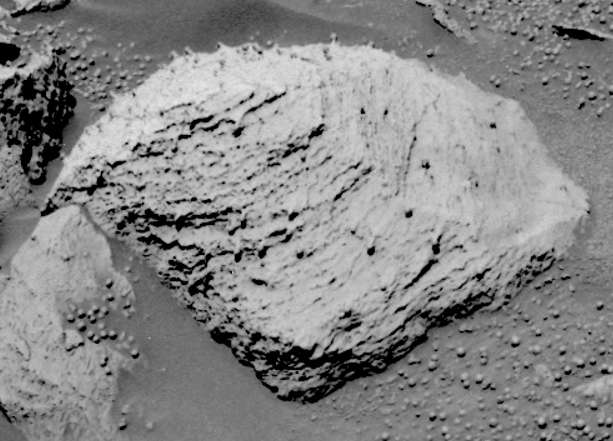
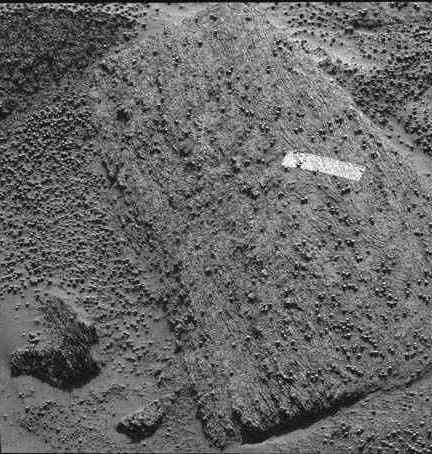
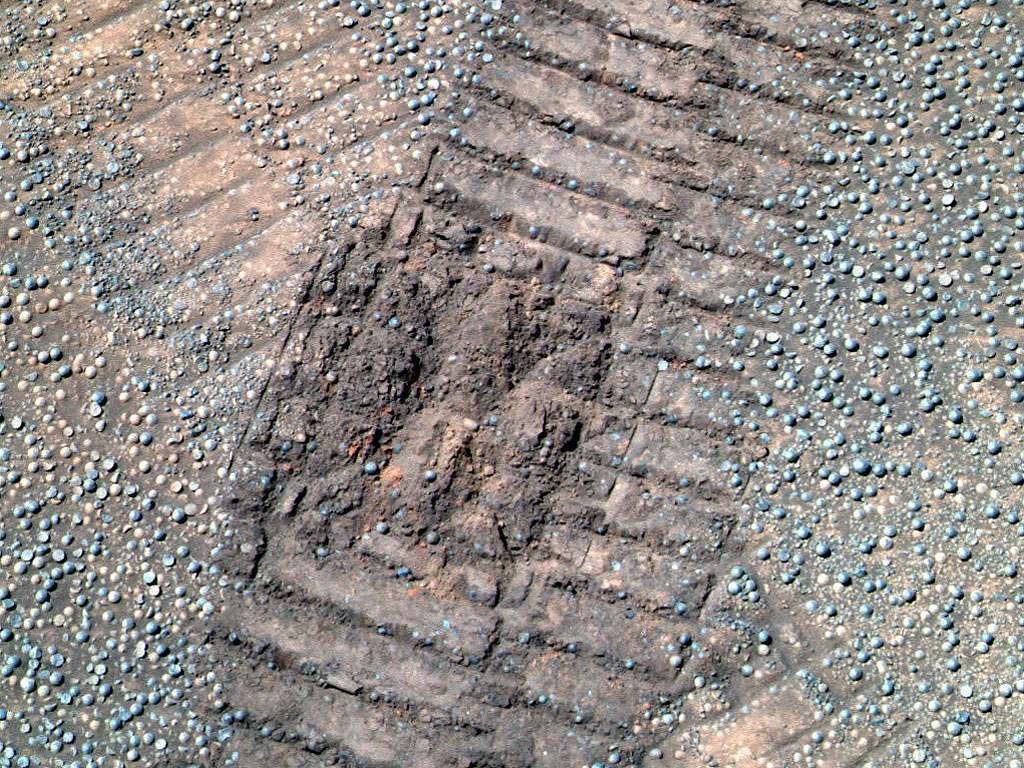
From University of Utah Public Relations ‘Moqui Marbles’ Formed in Groundwater in Utah’s National Parks Even before marble-shaped pebbles nicknamed “blueberries” were discovered on Mars by the Opportunity rover, University of Utah geologists studied similar rocks in Utah’s national parks and predicted such stones would be found on the Red Planet. In a study published in the June 17 issue of the journal Nature, the Utah researchers suggest both the Martian and Utah rocks – known as hematite concretions – formed underground when minerals precipitated from flowing groundwater. “We came up with the ‘recipe’ for blueberries,” says Marjorie Chan, chair and professor of geology and geophysics at the University of Utah. “Before Opportunity landed, we thought there might be hematite concretions on Mars. That was based on our study of hematite-rich regions of southern Utah, where hematite balls are found in national parks and have long been a geological oddity that shows up in many rock shops.” The round rocks are found in southern Utah in Zion and Capitol Reef national parks, Grand Staircase-Escalante National Monument, Snow Canyon State Park and the Moab area. Their diameters range from one-25th of an inch to 8 inches or more. They are known to New Agers as “moqui marbles.” Some are the size of small blueberries like those on Mars. Chan and her
colleagues believe the Utah concretions formed
perhaps 25 million years ago when minerals
precipitated from groundwater flowing through much
older Navajo sandstone, the spectacular red rock
in southern Utah.
In their Nature paper, Chan and colleagues say the Martian “blueberries” may have formed in a similar manner to those in Utah, namely, when significant volumes of groundwater flowed through permeable rock, and chemical reactions triggered minerals to precipitate and start forming a layered, spherical ball. “Given the similarities between the marbles in Utah and on Mars, additional scientific scrutiny of the Utah concretions and how they form will probably shed further light on the similar phenomenon on Mars,” University of Washington scientist David Catling wrote in a Nature commentary accompanying the University of Utah study. The concretions may bear on the search for evidence of past life on Mars because bacteria on Earth can make concretions form more quickly. Chan and colleagues plan to analyze whether there is evidence of past microbial activity in Utah concretions. Chan conducted the new study with
geology graduate student Brenda Beitler and emeritus
professor of geology Bill Parry, both at the
University of Utah; geologist Jens Ormo of the
National Institute of Aerospace Technology in
Madrid, Spain; and planetary scientist Goro Komatsu
of the International Research School of Planetary
Sciences at G. d'Annunzio University in Pescara,
Italy.
The Utah and Mars hematite concretions have similarities and differences. In Utah and likely on Mars, “you have rocks that had iron in them originally,” says Beitler. “Fluids travel through these rocks and leach out the iron. The water moves through cracks, holes, layers or pores until it reaches some place where the chemistry is different and causes the iron to precipitate out of the water as hematite.” A major difference is that the Martian “blueberries” probably are pure hematite – a form of iron oxide that is gray because it has a larger crystal structure than the reddish form of iron oxide, commonly known as rust. The Utah concretions are mostly sandstone, cemented by hematite that makes up a few percent to perhaps one-third of the rock. The Martian concretions likely precipitated from acidic groundwater. Those in Utah precipitated when hydrocarbon-rich, briny fluids encountered oxygen-rich groundwater. After the Utah concretions formed in groundwater, the surrounding Navajo sandstone slowly eroded away over millions of years, so the hard, erosion-resistant concretions accumulated on the ground, often in great numbers. “The loose Utah concretions roll
like marbles into depressions, forming ‘puddles,’
just like their Martian counterparts,” Catling
wrote. “The Hopi Indians have a legend that ‘moqui,’
or spirits of their ancestors, played games of
marbles with the hematite concretions in the
American southwest. Although anthropologists
discourage use of the word ‘moqui’ to be respectful
to Native Americans, New Age gem collectors sell
concretions as ‘moqui marbles’ and claim that they
are endowed with metaphysical powers.”
Chan says her team long suspected concretions like those in Utah might be found on Mars. The idea first was suggested by Ormo and Komatsu in a 2003 scientific abstract that got little if any attention. Ormo contacted Chan in spring 2003 and they started collaborating. The researchers completed a much broader but yet-unpublished study last year indicating that several geological features were seen both in aerial photos of southern Utah’s hematite-rich areas and in images of Mars’ hematite regions taken by orbiting spacecraft. These features include large rocky landforms shaped like knobs, pipes and buttes, and places where bleached-looking rock forms white sediment beds or ring-shapes on the surface. Some of the pipes and other features are tens of yards long or wide. The geologists determined the processes responsible for these large-scale features in Utah involved the flow of briny groundwater saturated with natural gas that bleaches sandstone, and that such groundwater flow, the precipitation of hard hematite-cemented rock and the later erosion of surrounding softer rock also would explain the formation of the erosion-resistant pipes, buttes, knobs and concretions. They concluded a similar process could have formed concretions and larger landforms on Mars. Chan says
studying concretions from Utah and Mars “will help
us learn more about the history of Mars. When we
have something to compare it to, it’s a lot easier
to figure out.”
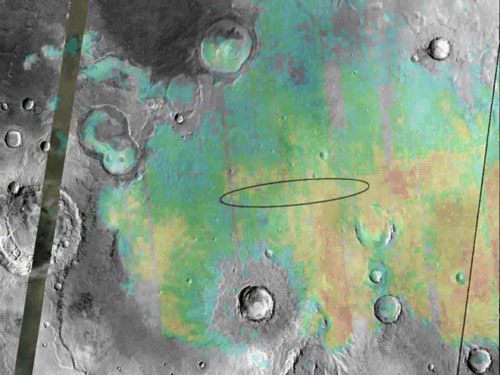
Hematite, Water and Life In 1998, the Mars Global Surveyor orbiting Mars detected what appeared to be a large area of hematite on Meridiani Planum. The broad plain was picked as Opportunity’s landing site because scientists wanted to study the hematite, which almost always forms in water. Scientists are interested in whether water once existed on Mars (or now exists beneath its surface) because water is necessary for life – and the possibility of life beyond Earth is one of the great questions long pondered by humanity. “On Earth, whenever we find water, we find life – in surface water or underground water, hot water or cold water – any place there is water on Earth there are microbes, there is life,” says study co-author Bill Parry. “That’s the bottom line: hematite is linked to life.” While other evidence from Opportunity suggests there once may have been standing water on Meridiani Planum, the Utah team’s study strongly indicates the Martian “blueberries” probably formed in groundwater and not in surface water. “The ‘blueberries’ easily could have formed in groundwater before there was standing water, if that did exist,” Chan says. Other scientists previously offered various explanations for Meridiani Planum’s hematite, including that the mineral precipitated in large lakes or in hot springs when Mars’ ancient volcanoes were active, or that hematite was left when water leached away other minerals, or that it formed when volcanic ash deposits were altered chemically. |
||||||||
| FAIR USE NOTICE: This page contains copyrighted material the use of which has not been specifically authorized by the copyright owner. Pegasus Research Consortium distributes this material without profit to those who have expressed a prior interest in receiving the included information for research and educational purposes. We believe this constitutes a fair use of any such copyrighted material as provided for in 17 U.S.C § 107. If you wish to use copyrighted material from this site for purposes of your own that go beyond fair use, you must obtain permission from the copyright owner. | ||||||||
|
|