|
India |
||||
|
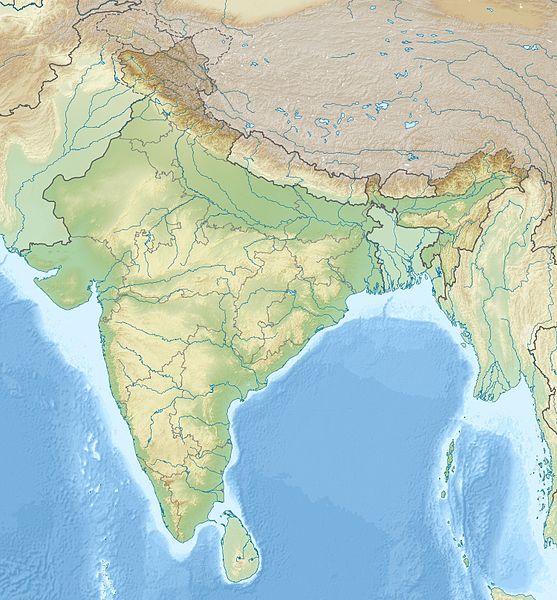
20° 33′ 8.56″ N, 75° 42′ 1.57″ E ..
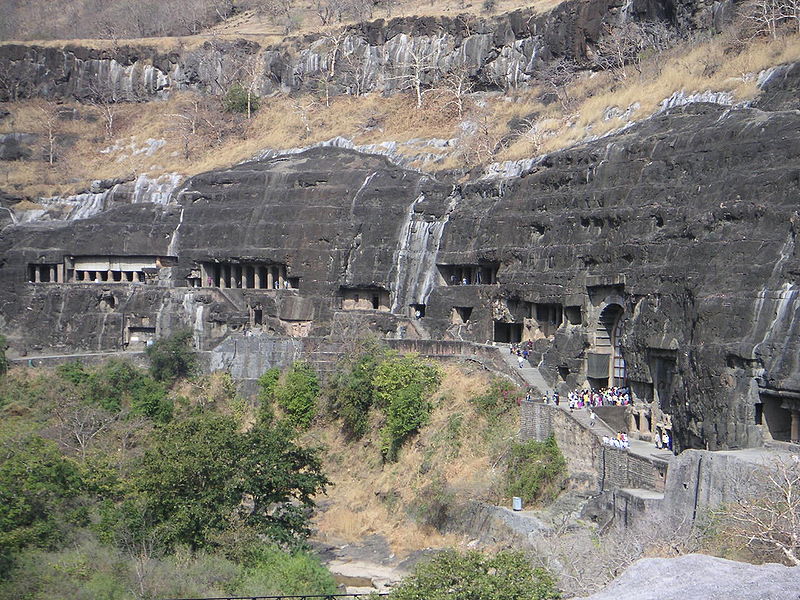
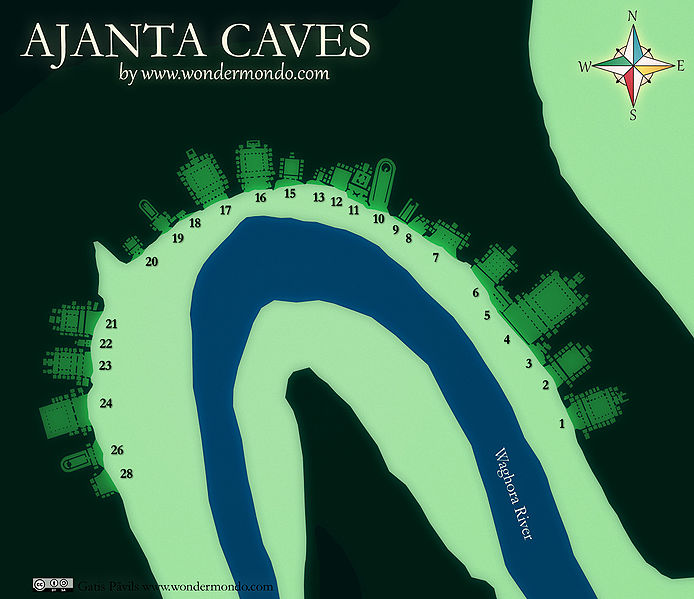
Ajanta Caves The Ajanta Caves (Ajiṇṭhā leni; Marathi: अजिंठा लेणी), Maharashtra, India are 29 rock-cut cave monuments which date from the 2nd century BCE. The caves include paintings and sculptures considered to be masterpieces of both Buddhist religious art (which depict the Jataka tales)[1] as well as frescos which are reminiscent of the Sigiriya paintings in Sri Lanka.[2] The caves were built in two phases starting around 200 BCE, with the second group of caves built around 600 CE.[3] Since 1983, the Ajanta Caves have been a UNESCO World Heritage Site. The caves are located in the Indian state of Maharashtra, near Jalgaon, just outside the village of Ajinṭhā(20°31′56″N 75°44′44″E / 20.53222°N 75.74556°E / 20.53222; 75.74556). Caves are only about 59 kilometers from Jalgaon Railway station (on Delhi - Mumbai, Rail line of the Central railways, India); and 104 kilometers from Aurangabad (From Ellora Caves 100 Kilometers).
Contents: |
||||
| 1. First Period The first sanctuaries (known as chaytia-grihas) were built during the Satavahana dynasty in the canyons of the Waghora River. Murals preserved from this time belong to India
Scholars disagree about the date of the Ajanta Caves' second period. For a time it was thought that the work was done over a long period from the fourth to the 7th century AD, but recently long-time researcher Walter M. Spink declared that most of the work took place over short time period, from 460 to 480 CE, during the reign of Emperor Harishena of the Vakataka dynasty. Some 20 cave temples were simultaneously created, for the most part viharas: monasteries with a sanctuary in the structure's rear centre. Each of cave temples seem to be patronised by influential authority, numerous best available artists have been involved in the work with fruitful rivalry between the neighbouring construction sites. According to Spink, the Ajanta
Caves appear to have been abandoned shortly
after the fall of Harishena c. 480 CE. Since
then, these temples have been abandoned and
gradually forgotten. During the intervening
centuries, the jungle grew back and the caves
were hidden, unvisited and undisturbed. On 28 April 1819, a British officer for the Madras Presidency, John Smith, while hunting tiger, accidentally discovered the entrance to one of the cave temples (Cave No. 9) deep within the tangled undergrowth. Exploring that first cave, long since a home to nothing more than birds and bats and a lair for other, larger, animals, Captain Smith wrote his name in pencil on one of the walls. Still faintly visible, it records his name and the date, April 1819. Shortly after this discovery,
the Ajanta Caves became renowned for their
exotic setting, impressive architecture,
historic artwork, and long-forgotten history.
The first cave was built on the eastern end of the horse-shoe shaped scarp. According to Spink, it is one of the latest caves to have begun on site and brought to near-completion in the Vākāţaka phase. Although there is no epigraphic evidence, it has been proposed that the Vākāţaka king Harisena may have been the benefactor of this better-preserved cave. A dominant reason for this is that Harisena was not involved initially in patronizing Ajanta
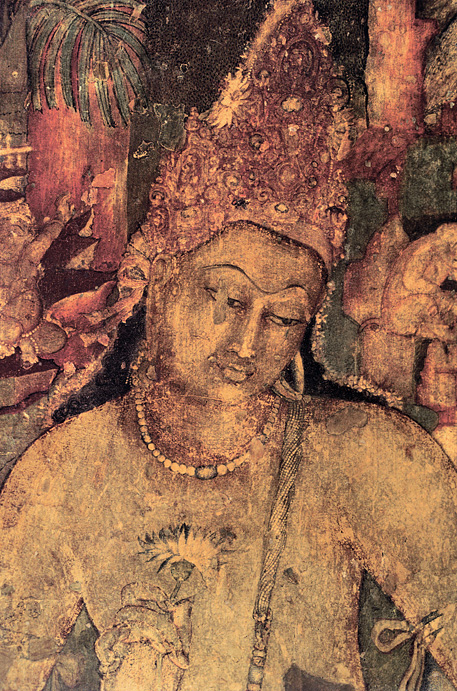
Painting of Vajrapani from Ajanta
Cave No. 1
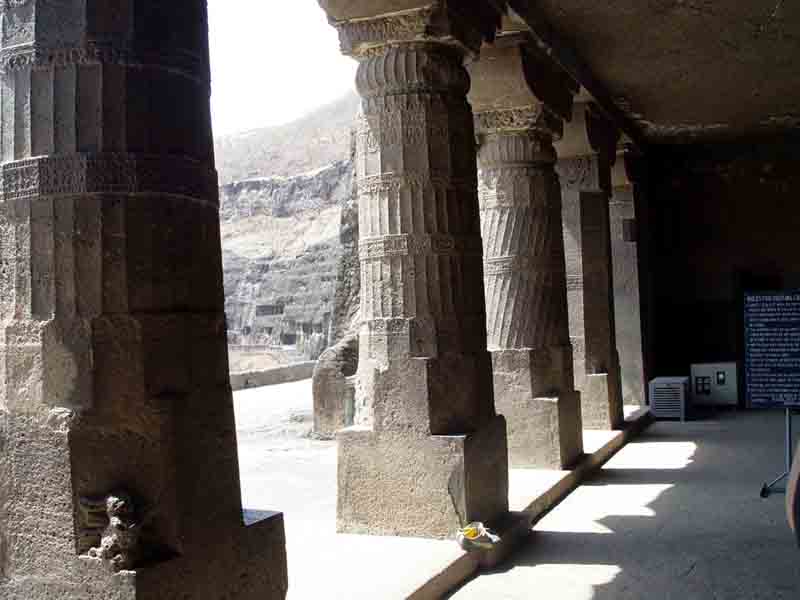
This cave has one of the most elaborate carvings on its facade with relief sculptures on entablature and ridges. There are scenes carved from the life of the Buddha as well as a number of decorative motifs. A two pillared portico, visible in the 19th-century photographs, has since perished. The cave has a front-court with cells fronted by pillared vestibules on either side. These have a high plinth level. The cave has a porch with simple cells on both ends. The absence of pillared vestibules on the ends suggest that the porch was not excavated in the latest phase of Ajanta when pillared vestibules had become a necessity and norm. Most areas of the porch were once covered with murals, of which many fragments remain. There are three doorways: a central doorway and two side doorways. Two square windows were carved between the doorways to brighten the interiors.
Porch of Cave 1 by RK Singh
Each wall of the hall inside is nearly 40 feet (12 m) long and 20 feet (6.1 m) high. Twelve pillars make a square colonnade inside supporting the ceiling, and creating spacious aisles along the walls. There is a shrine carved on the rear wall to house an impressive seated image of the Buddha, his hands being in the dharmachakrapravartana mudra. There are four cells on each of the left, rear, and the right walls. The walls are covered with paintings in a fair state of preservation. The scenes depicted are mostly didactic, devotional, and ornamental. The themes are from the Jataka stories (the stories of the Buddha's former existences as Bodhisattva), the life of the Gautama Buddha, and those of his veneration. |
||||
5. Cave Two
Painting, Cave No. 2 by
Jonathanawhite
Cave 2, adjacent to Cave 1, is known for the paintings that have been preserved on its walls, ceilings, and pillars. It looks similar to Cave 1 and is in a better state of preservation. The Facade Cave 2 has a porch quite different from Cave one. Even the facade carvings seem to be different. The cave is supported by robust pillars, ornamented with designs. The size and ground plan have many things in common with the first cave.
The Porch
The front porch consists of
cells supported by pillared vestibules on both
ends. The cells on the previously "wasted
areas" were needed to meet the greater housing
requirements in later years. Porch-end cells
became a trend in all later Vakataka
excavations. The simple single cells on
porch-ends were converted into CPVs or were
planned to provide more room, symmetry, and
beauty. The paintings on the ceilings
and walls of this porch have been widely
published. They depict the Jataka tales that
are stories of the Buddha's life in former
existences as Bodhisattva. The porch's rear
wall has a doorway in the center, which allows
entrance to the hall. On either side of the
door is a square-shaped window to brighten the
interior. The Hall The hall has four colonnades
which are supporting the ceiling and
surrounding a square in the center of the
hall. Each arm or colonnade of the square is
parallel to the respective walls of the hall,
making an aisle in between. The colonnades
have rock-beams above and below them. The
capitals are carved and painted with various
decorative themes that include ornamental,
human, animal, vegetative, and semi-divine
forms.
The paintings
Paintings appear on almost every surface of the cave except for the floor. At various places the art work has become eroded due to decay and human interference. Therefore, many areas of the painted walls, ceilings, and pillars are fragmentary. The painted narratives of the Jataka tales are depicted only on the walls, which demanded the special attention of the devotee. They are didactic in nature, meant to inform the community about the Buddha's teachings and life through successive births. Their placement on the walls required the devotee to walk through the aisles and 'read' the narratives depicted in various episodes. The narrative episodes are depicted one after another although not in a linear order. Their identification has been a core area of research since the site's rediscovery in 1819. Dieter Schlingloff's identifications have updated our knowledge on the subject. Some believe that the art
work has erroneously been alluded to as
"fresco", rather than mural, and assert
that the technique and process used to
produce this kind of artwork is unlike any
other artwork found in the art history of
other civilizations, including within the
history of South Asian art |
||||
6.
Cave Four
தமிழ்: புத்தர் சிலை , அஜந்தா குகை கோவில்கள் , மகாராஷ்டிரா , இந்தியா Lord buddha in preaching pose flanked by Bodhisattvas, Cave 4, Ajanta |
||||
| 7.
Cave Five, Six & Seven
Cave 5 The T-shaped porched doorway is the only feature because the scooping did not go beyond it. The exuberant carvings are evident here and the jambs and the lintems seem to be of later century. Cave 6 This was the first important cave of the Mahayana phase. The sculptors were probably copying wooden prototypes, or wanted stable supports, so they included one central pillar in their lower story. The simple octagonal pillars are bare, unlike the pillars of other caves, which have capitals and bases. There extensions at the end of the front and the rear aisles to enable pilgrims to circumambulate the Buddha's throne. There is a Buddha image in the lower cave 6. He is sitting with his feet squat on the base, in a rigid pose, only enlivened by the gestures of his hand and the flying couples above him. There could be circumambulation around the Buddha's shrine. This is a late cave, because, instead of attendant bodhisattavas, there are attendants Buddha. The porch doorway is simple with not much carved decoration except attached female figures. There is a medallion in this cave in the colonnade of the shrine vestibule. The couple in the medallion is skillfully carved, but the medallion itself is conventional. Bhikshu with Lotus : The painting of Bhikshu in this cave in the middle, done about 5th century, is almost like a relief. There is the rhythmic vitality in the line and boldness of drawing. The painting is almost like a sculpture. The folds of the garment, the rounded belly, and the calm on the face suggest a devote worshipper. Cave 7 The verandah of this cave must at one time have been elaborate. The ceiling was obviously painted. The carving is simple. |
||||
8. Cave Nine, Ten, Eleven
Cave no. 9 in Ajanta Caves, India.
Date 23 December 2010(2010-12-23) - by Marcin
Białek
Cave 9
This cave has a Chaitya gathering hall. There are two early paintings, which survive. Frieze Of Animals And Herdsmen Naga Worshippers Giant Horseshoe Window There is a Giant Horse-Shoe Window on the façade. The carving of this window suggests that it copied a wooden structure of the same time. The pillars and the slanting eight-sided columns are also copied from wooden structures of earlier times. Cave 10 This is of about the same time as cave 9. It has a similar shape. The large chaitya gathering hall is 28.5m X 12.3m wide and 11m high. It has a stupa shrine at the ambulating passage around the symbolic stupa. King With His Retinue: The paintings in this cave show resemblance with the relief carvings at sanchi in central India of the 2nd century BC. The painting on the left wall shows the King with his Retinue, worshiping the Buddha tree. The royal party stops at the stupa and then passes through a gateway. SHAD-DANTA JATAKA: On the right wall are the series of large wall paintings. One shows the Shada-danta jataka, with the Buddha in his elephant incarnation. This is a crowded scene, but each figure is clearly distinguished from the other. The whole crowd is in movement. ELEPHANTAS IN JUNGLE: In one scene are shown Elephantas in the jungle, with a six-tusked elephant, which is supposed to be a previous incarnation of the Buddha. The animals are beautifully drawn and the large space of the forests, with its thick foliage and trees, is contrasted to the houses on the side. PRINCESS AND TUSK: In the second scene, the princess, seated on a stool, is shown fainting, because the six tusks of the elephant are brought to the king. The queen has wished that the elephant be killed. Now that his tusks are brought before the court, she faints at sight of them. The drama is manifestly painted. THE BUDDHISATTVA ON THE PILLAR: One of the earliest masterpieces of the 1st century BCE. or 1st century CE. has the simplicity, tenderness and grace of the early archaic art of Ajanta. The gracious figure in the pink and buff cloak surrounded by green aureole is emerging to cast blessings on mankind. Two monks kneel by his feet and the flying angels above his black head indicate that they are going to lift him to heaven. The umbrella on the top is symbolic of the protection he offers to all. BUDDHA AND THE ONE-EYED MONK: The painting Buddha and the one-eyed-monk show the devotion of the followers of the Enlightened one. The face and figure of the Buddha here as well as of the monk seem to be echoes of the heavy physical types of Gandhara art of northwest India. Only the flowing draperies have softened their contours. The aureole on the buddha's head and the closed eyes show a dreamy calm. SHYAMA JATAKA: The Shyama-Jataka on a wall in this cave relates the story of where the bodhisattava was born as son of two blind parents, a hunter and his wife. Cave 11 TRANSITION FROM HINAYANA TO MAHAYANA: The Buddha in shrine of cave 11 is one of the earliest images at Ajanta. The important fact about this Buddha is that it is attached to a stupa. This means a compromise between stupa worship and image worship. This cave is interesting, because it shows the transition from the earlier Hinayana to the later Mahayana Buddhist phase of worship. The round stupa has the images of the Buddha to its bare girth. |
||||
| 9.
Cave Sixteen and Seventeen
The porch doorway of cave 16 set a pattern for the later doorway. Of course, the later once are more complex. Here two Goddesses stand on neatly carved pilasters The Buddha figure in the shrine is of about the same time as the Buddha in the shrine of the cave 6 (lower) and cave 11 as the Buddha in cave 16 seated with his heavy feet down the base, it is more than life size and fairly uncommon. Lions and other active animals support the throne. Bodhisattvas stand behind him. This cave gives a good view of the ravine. From the large verandha we enter a hall. There are six cells on each side. GIANT STATUE: There is a Giant Statue of Buddha in the abhayamudra, or teaching gesture, in the inner shrine. DYING PRINCESS: One of the finest paintings in the world art is on left wall. This shows the wife of Gautama's cousin, Nanda. The Dying princess is suffering from the shock of hearing that her husband has become a monk. Some great master paints the sad drama. Notice the bent head of the princess and the tense female attendants. BUDDHA WITH A BEGGING BOWL: On another wall is the Buddha with a begging bowl PRINCE SIDDHARTH STRETCHING THE BOW: Still another painting shows Prince Siddharth Stretching the bow THE DECENT OF THE BUDDHA: The Descent of Buddha from the Tushita heaven is another masterly panel THE SUTASAMA JATAKA: The Sutasama Jataka narrates the story of the previous incarnation of the bodhisattva and the son of the king of indraprastha named sutasama. The prince is trained in all the arts and sciences by a guru at Taxilla. One-day Sutasama was seized by a man-eating dacoit. The prince promised him he would come back and be eaten after he had offered flowers to the Enlightened one. And he did as he promised. The cannibal was surprised to see Sutasama. He who had once been a fellow student of the bodhisattva at Taxilla and then king of Benares was converted, and he became a king of Benares again. Cave Seventeen The porch doorway of cave 17 is similar to that of cave 16, with which it is contemporary. But the seated couples on both the doorjambs and lintels improve on cave 16. Above are the seven Buddha's of the past with maitreya it seems the left side of the door was painted by different artists, using different colors from the apinter of the right half of the door. The T-shape shrine doorway has goddesses, supported by pilasters. This doorway is highly decorative. The plan of this cave is simple and severe. The pillars in both the porch and interior are arranged in a strict order. All the pillars were painted. The pillars near the shrine have intricate carvings. The Buddha in the shrine is seated in the Yogasana. His hands are held in the Dharmachakra mudra, or teaching gesture. There are bodhisattva attendants holding flywhisks. The dwarfs bring garlands. Devotees appear with offerings. The circumambulatory passage around the image shows it is a relatively early cave. The pilasters at the right hand of the porch of this cave are fairly simple. This cave was in transition from Hinayana to Mahayana. So some survivals of symptoms of floral and geometric paintings can be seen on pilasters. APSARAS AND FLYING SPIRITS: This large grotto has many paintings of the mature 5th century. The love of happiness radiates through the pictures. The earth has become heaven. The Apsars and the Flying Spirits float across the sky. Lovers sit in the air houses. INDRA AND THE APSARAS: The famous painting Indra and the Apsaras, in the panel above the doorway of this cave, is a lovely fantasy. All the paintings seem to illustrate the beauty of nature and human love and happiness as described by the poet of Ujjain, Kalidasa at the 4th century CE. ROYAL PROCESSION: There is a magnificent painting showing a king and queen with their attendants going in a royal procession. There are colorful umbrellas over their heads and trees in the background. Some women are looking at them through the window. SHAD-DANTA JATAKA: There is another version of the Shaddanta jataka, which also appears in cave 10. PRINCE SIMHALA: Prince simhala, who conquered Lanka, rides on a white elephant at head of the army. THE BUDDHA RETURNS: The Buddha returns as a beggar and meets the wife and child in a poignant mood |
||||
10. Caves Eighteen and Nineteen
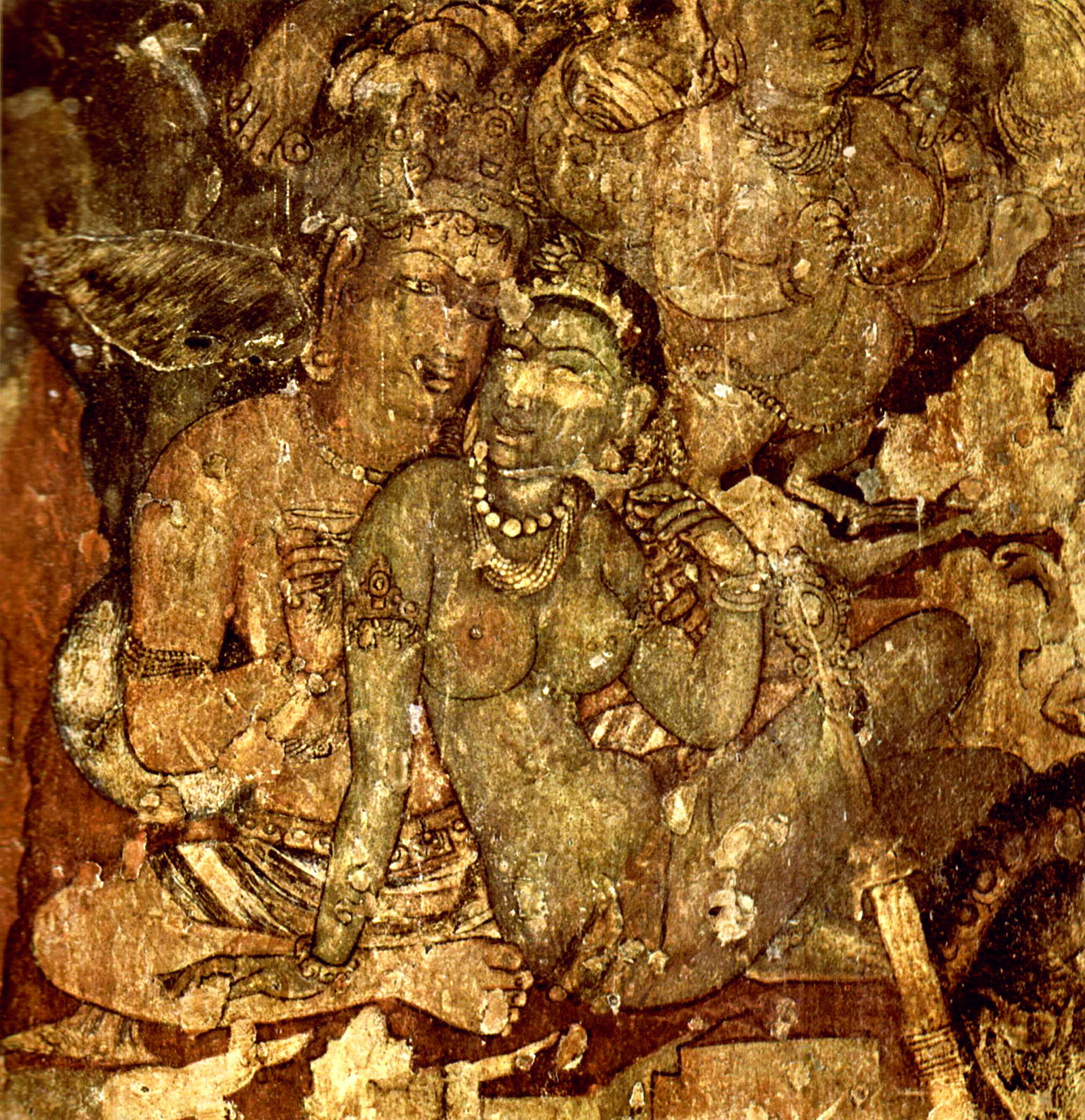
Cave 18 Princess looking in mirror: The Ajanta masters have shown human lives in all its varied colors. One of the scenes, always preferred in Indian painting, has been of sringara, showing the decoration by the women of her body. In one of the most exquisite paintings in this cave, a Princess is looking in her mirror, after she has done her srinagara. One of her female attendants holds a tray of toilette utensils. The other holds a flywhisk in her hand. A little child is looking on from below. Cave 19 Cave 19 is a Chaitya gathering hall, with many paintings and sculptures. They are mostly disfigured. Chaitya Hall: The same donor as of Cave 17 patronized this cave. It was scooped at the same time. It is the chaitya gathering hall for worship. The carving is intricate. The facade is elaborate, with pilasters, which were to be copied in other caves later. There are heavy bodied, strong, somewhat squat yakshagana guardians, flanking the right and the left side of the main arch. The wrinkles of their hair fall like fountains while they are profusely garlanded and bejeweled. On the base of the big stupa at the center of the chaitya hall are dancing dwarfs. Buddha: The solemn Buddha standing above is contrasted with the moving urchins below. Under the arched Chaitya window are sculptured images of the Buddha in the niches. The forecourt has fallen. There is a second aisle towards the nave. The columns have square bases, round shafts, and rich bands of carvings on bracket capitals. Standing Buddha: There is a Standing Buddha on the tall stupa. The stupa itself is crowned with an umbrella that nearly touches the roof. Naga king: There is a Naga king with his queen and attendants, with highly finishing carvings. The aboriginals and the lower caste people, who became Buddhist, brought snake worship with them. The nagas, or snakes, were given human from, except for the hood of snakeheads, which was put round their heads. There was a superstition that the worship of nagas brings rain. Even nowadays peasants consider snakes auspicious. |
||||
| 11.
Cave Twenty one, Twenty four, Twenty six &
Twenty seven
Cave 21 The interior view towards left aisle shows mature sense of the use of space. The pillars are well carved and the remains of plaster show that there were paintings on the ceiling. Chaitya Hall: This is also a Chaitya gathering hall of the 5th-6th century AD. The verandha opens in to a court. There is a colonnade inside, composed of 26 pillars. This forms the aisles. One can go round the cylindrical stupa in circumambulation. The walls have relief carvings. Also, the round stupa is decorated. Buddha in Parinirvana: On the left wall, by the verandah, is the large statue of dead Buddha. The Buddhist calls this sleeping figure the Buddha in parinirvana. Temptation of Buddha: On the same wall, further ahead is a relief sculpture of Temptation of Buddha by the Demon Mara. Cave 24 Pillar style: Unfinished pillars of the front aisle are worth noting for the evolution of the pillar style. The earliest pillars are simple, roughly shaped on four sides. Post Mahayana period they were tapered into octagonal form. Pilaster: The pilaster at right end of porch elaborates piece of work, even though the cave 24 remained unfinished. There are small groups in the medallion. Porched Doorway Upper right corner: The splendid T-shaped doorway came very late in the 7th century. The interior of the cave was left unfinished because patronage at Ajanta had ceased by that time. Cave 26 Chaitya Horseshoe Arch: The Chaitya horseshoe arch of this 5th century cave is imposing. There are various fine images of the Buddha sculpted with rare skill. Sravasti Miracle: The circumambulatory passage is full of them. Mostly they represent the sravasti miracle. This miracle was based on the legend when the Buddha revealed himself in all his various forms on the skies above the village of Sravasti. Nagas, Nanda, Anupananda: At the bottom of the relief, the Nagas, Nanda and Anupananda are shown holding the stem of the lotus. This lotus is the cosmic axis on which the Buddha is seated. Goddess: There is a goddess on the bracket of the first pillar on left in the interior. She is standing under a fully blossomed tree. Underneath is a lunette of a family group. Buddha Head: There is a vital Buddha head with curly hair and large ear lobes in this cave. Family group:There is a family group with profuse floral decoration around it, which shows the ideal human family of that time. Cave 27 Naga Dwarpala: There is a Naga Dwarpala on the outer flank of the shrine. This cave follows many elements from cave 20. For instance, the Naga here is similar to a Naga Dwarpala in cave 20. This is a late 6th century work; the carvings being not as firm as in cave 20. Porched Doorway: The porched doorway of cave 27 is also derived from the shrine doorway of cave 2. The decorations show the new fashion for splendor of the later centuries.Ajanta Caves, Ellora Caves, Aurangabad Caves SOURCE: Wikipedia Ajanta Caves |
||||
References:
|
||||
| FAIR USE NOTICE: This page contains copyrighted material the use of which has not been specifically authorized by the copyright owner. Pegasus Research Consortium distributes this material without profit to those who have expressed a prior interest in receiving the included information for research and educational purposes. We believe this constitutes a fair use of any such copyrighted material as provided for in 17 U.S.C § 107. If you wish to use copyrighted material from this site for purposes of your own that go beyond fair use, you must obtain permission from the copyright owner. | ||||
|
|