|
Hellenistic Judaism |
|
B. HELLENISTIC
JUDAISM [[93]] Chapter IV HELLENISM\1/ The centuries going from the rule of Alexander the Great (336-323 B.C.) to that of Octavian Augustus (27 B.C.-A.D. 14) are commonly called the Hellenistic period. The culture of this period, since Droysen gave vogue to the term, is incorrectly called “Hellenism”2 (properly, classical Greek 1 The brilliant book of Paul Wendland, Die hellenistisc mische Kultur in ihrm Beziehungen zu Judentum und Christentum (Handbuch zum Neum Testament, Vol. I, Part 11). Tubingen, 1907; 2nd and 3rd ed., 1912, is still standard and should have been long since translated into English. The following works me the best histories of Hellenism: J. C. Droysen, Geschichte des Helkninnus, 2 vols., Gotha, 1836, 1843; 2nd ed., 3 vols. Gotha, 1877. B. Niese, Geschichte des grechischen und makedonischen Staten seit der Schlacht bei Chaeronea (Handbucher der alten Geschichte), 3 vols. Gotha, 1893-1903. E. R. Bevan, The House of Seleucus. London, 1902; A History of Egypt under the Ptolemaic Dynasty. London, 1927. A. Bouche-Leclercq, Histoire des Lagides, 2 vols. Paris, 1903 and 1907; Histoire des Seleucides, Parts, 1913. W. S. Ferguson, Hellenistic Athens. London, 1911; Greek Imperialism. London and New York, 1913. F. Baumgarten, F. Poland, R. Wagner, Die hellenistich-romische Kultur. Leipzig and Berlin 1913. W. Schubart, Aegypten van Alexander dem grossen bis auf Mohammed. Berlin, 1922. U. von WilamowitzMoellendorf, Staat und Gesellschaft der Griechen, 2nd ed. Leipzig and Berlin, 1923. J. B. Bury (and others), The Hellenistic Age. Cambridge, 1923. W. Otto, Kulturgeschichte des Altertums. Munich, 1925. K. J. Beloch, Griechische Geschichte, Vol. 4, in two parts. Berlin and Leipzig, 1925 and 1927. E. Meyer, Blute und Niedergang des Hellenismus in Asien. Berlin, 1925. P. Jouget, Limperalisme macedonien et I'helldnisation de l’Orient. Paris, 1926 (English translation: Macedonian Imperialism. London, 1928). J. Kaerst, Geschichte des Hellenismus, 2nd ed. Vol. 1, Leipzig, 1917; Vol ' 2, 1926. Cambridge Ancient History, Vols. VI and following. Cambridge, 1927 ff. .W. W.Tam, Hellenistic Ci@liwtion, 2nd ed. London, 1930. M. 1. Rostovtzeff, The Social and economic History of the Hellenistic World. 3 vols. Oxford and New York, 1941. M. Cary and T.J. Haarrhoff, Life andThought in the Greek and Roman World. New York, 1942. C. A. Robinson, Alexander the Great. New York, 1947. W. W. Tarn. Alexamder the Great, 2 vols. Cambridge University Press, 1948. H. I. Bell, Egypt from the Alexander the Great to the Arab Conquest. Oxford and New York, 1948. On Ptolemaic and Roman-Egypt see also the list in Ida A. Pratt, Ancient Egypt (1925-1941), pp. 132-137. The New York Public Library, 1942. 2The word "Hellenism" occurs in
ancient literature (hellenim6s), meaning the correct
use of the Greek language and, in II Macc. 4:13, the
adoption of Greek manners (being a synonym of
allophylism6s, the adoption of foreign
customs). Similarly, the verb hellenizein and
the noun hellenistes, which originally referred to
the use of the Greek language, came to mean the
adoption of Greek culture; on "Hellenist" in Acts
6:1; 9:29, etc., see Jackson and Lake, Beginnings of
Christianity, vol. 5, pp. 59-74. For the
connotations of "Hellenism,' in ancient and modem
times, see R. Laquem, Hellenismus Giessen,
1925.culture), thus avoiding the correct-but
dreadful-word "Hellenisticism." in view of the fact
that art, science, literature, and philosophy in the
early centuries of the Roman Empire were essentially
Hellenistic (even Rome's greatest creation,
jurisprudence, did not escape Greek influence), we
may be allowed in this chapter to call the culture
from 300 B.C. to A.D. 200 "Hellenism." 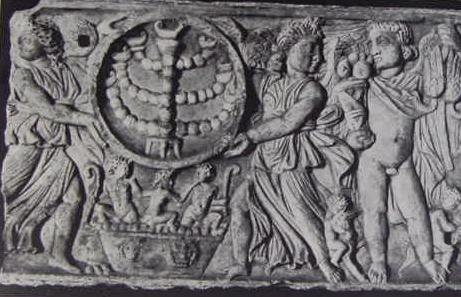 4th-5th century A.D., showing two winged Victories holding a ring in which lies a Jewish candelabra called a Menorah. 1. Historical Sketch Philip II, king of Macedon (356-336 B.C.), defeated the Greek states at Cbaeronea (338) and settled the perennial "Balkan Problem' by forcing them, with the exception of Sparta, to form a Hellenic League. A year later he received from it the mandate to attack Persia. Philip sent Parmenio to Asia Minor with an army in 336, but was assassinated in the same year. His son Alexander the Great was then twenty years of age: faced by a general revolt, he destroyed Thebes and restored order (335). In 334 he crossed over to Asia with an army of 32,000 infantry and 5,000 cavalry, supported by 160 ships. Through the victories-at the river Granicus (334) and at Issus (333), through the conquest of Tyre and Gaza (332), through the expedition into Egypt (332-331), and through the victory at Gaugarnela Dear Arbela (331), Alexander became the master of the Persian Empire. Alexander's great plan was to unite the peoples of Greece and Asia into one nation having a common culture. He symbolized this fusion through marriages of Macedonians with Persians. In Bactria he married Roxana; upon his return from India he married Statira, the daughter of the last Persian king, Darius 111, and Parysatis, the youngest daughter of Artaxerxes III Ochus. He induced eighty of his highest officers to marry Persian ladies; 10,000 of his men married native women and during this feast of "fraternization' (in the spring of 324) Alexander paid all the debts of his men, at a cost of almost 10,000 talents (about fifteen million dollars). When Alexander died in 323, his empire fell apart. After the battle of Ipsus (301), Ptolemy I added Coele-Syria to Egypt, Seleucus I received Syria in addition to Mesopotamia, Asia Minor was divided between Lysimacbus and Pleistarcbus, and Cassander retained control of Macedon. The conquests of Alexander and the rule of his successors are less significant politically than culturally in the history of Egypt and Western Asia. The transition from the Persian to the Macedonian rule did not affect the life of populations long used to foreign rule; some of the Persian satraps were even left in office by Alexander until he found it expedient to substitute Macedonian ones. But the Macedonians (notably their upper classes, who had been Hellenized) and the Greeks felt themselves charged with the diffusion of Greek civilization3, which even their military success per se confirmed as superior. Alexander, who bad been a pupil of Aristotle (384-322), attached to his general staff Greek scholars and scientists, mostly trained by Aristotle: geographers, called Bematists or surveyors (Baeton, Diogenes, Amyntas), Whose observations were utilized by Dicaearchus; botanists, notably Theophrastus, whose geography and physiology of plants laid the foundations of scientific botany; historians, both professional (Callisthenes) and amateur (Nearchus described his sea voyage from India; Androsthenes reported his exploration of the Persian Gulf; Ptolemy and Aristobulus reported military campaigns); etbriographers, zoologists, mineralogists, bydrographers, and others. Unfortunately this mass of important scientific material, with the exception of the botanical works of Theophrastus, has been lost, althougb much of it was preserved indirectly and partially in the works of later Hellenistic and Roman scientists. It is primarily in the scientific field that the Greeks surpassed all other ancient nations. Egypt, Babylonia, and, at a much later date, China had in very early times reacbed a relatively high level of civilization, but, owing perhaps to the brilliance of the initial achievement, they soon became fixed and crystallized, never fulfilling their early promises: the Egyptian art of 2800 B.C. is superior to that of 280 B.c. Their achievements are primarily in the field of plastic arts, practical devices, and measures contributing to human comfort. But in the intellectual field there is little to be said: no great literature (aside from Israel and India) was produced in ancient Egypt and Asia; their science remained practical; philosophy (i.e., the feeling that there is a problem of the universe) is unknown outside of India; mathematics as a science of abstract intangibles was inaugurated by the Greeks. It was thus inevitable that the civilization of Greece should make a great impression on all peoples reached by the armies of Alexander. The Greeks had of course long been aware of their superior culture,4 and cailed those who did not speak Greek "barbarians" (literally "babblers, stammerers"): they regarded it as their mission to spread their civilization and regarded language as a primary factor in culture-both entirely new notions. Nevertheless, they found much to admire in Egypt and in the Near East, particularly the great works of art and the mysterious 3 In modem times this education of the "natives" is quaintly called "the white man's burden," although it usually proves to be quite lucrative. The Bantu in equstorial and Southern Africa say, "At first we had the land and the white man had-the Bible. Now we have the Bible and the white man has the land." 4 As early as 380 B.c., Isocrates could say that as a result of the spread of Athenian culture, "the name 'Hellene' now no longer means racial origin, but Indicates spiritual character, mentality; and those called 'Hellenes' are not so much blood relations as those who partake of our education" (Panegyric 50). wisdom of the East (notably in India), which has always fascinated the West (especially when it was idealized and misunderstood). Strangely, however, no Greek scholar ever learned to read hieroglyphs and cuneiforms. On the other hand, it was inevitable that the peoples of Egypt and Western Asia-notably the upper classes-sbould be impressed by Greek culture, especially when civilian Greeks, following the annies, settled in their midst. Accordingly, many of the Orientals hastened to talk broken Greek, wear Greek attire (Greek bats, worn by the noblest young Jews in Jerusalem, scandalized the orthodox; see 11 Macc. 4:12), take part in Greek sports, erect gymnasia, baths, and theaters, being fascinated by Greek customs and fashions and eager for Greek luxuries. These imitators of the Greeks became known as "Hellenists," from the verb hellemizien, which Plato used in the sense of "to speak good Greek," but which came to mean "to imitate the ways of the Greeks" (cf. above, note 2). Thus Hellenism spread from Cyrene to the Indus and the Caspian, most conspicuously in the kingdom of the Seleucids; and in the West it conquered Rome. The chief agent for the Hellenization of these far-reaching countries was the Greek city. The flourishing Greek centers of commerce and culture founded by Alexander and his successors became the standard-bearers of the new civilizations According to Plutarch (De Alexandri Magni foltuna 1, 5), Alexander founded more than seventy cities-a figure which may not be far from the mark. The most important and famous among them is of course Alexandria in Egypt; Samaria was destroyed by Perdiccas and rebuilt as a Greek city. The greatest of all builders of cities are, however, Seleucus I Nicator (305-280) and Antiochus I Soter (280-261), whose new towns are scattered through Syria (Antioch), Mesopotamia (Edessa; Dura-Europos; Seleucia, the greatest city of the time, which soon eclipsed ancient Babylon), Cilicia, Caria, Lydia, Phrygia, Media, and Iran. These centers of Greek life proved to be at the same time the strength and the weakness of Hellenism in Asia. The greatest among them-capitals of kingdoms such as Alexandria, Pergamum, Antioch, Seleucia-attracted the best minds, not only for government service but also for the development of the arts and sciences, and thus became centers of learning to which pupils flocked and from which they eventually spread Greek culture elsewhere. But, as a result of these conditions, Hellenism prevailed only in the cities and chiefly among the upper classes of the native populations. The countryside, where rural folk retained their old languages and customs, was scarcely affected by Hellenism. 5 On the cities founded by Alexander and his successors see K. J. Beloch, Geschichte, 2nd ed., Vol. 4, Pt. 1, pp. 251-262. Some of these new Hellenistic cities are mentioned in the New Testament. An observer in 200 B.C. would never have doubted the permanence of Hellenism in Western Asia; but a century later the signs of its decay were obvious: it was on the defensive against the Oriental reaction. The rejection of Hellenism in Judea through the victories of Judas Maccabeus was the dramatic forerunner of a general trend which eventually wiped out all traces of Greek culture in Western Asia and Egypt-aside from some archaeological ruins. Like the Philistines before and the Crusaders later, the Macedonians were eventually absorbed in Western Asia, following a striking initial success. Livy (38, 17) already observed this assimilation with the natives when he wrote: "The Macedonians who have colonies at Alexandria in Egypt, at Selencia and Babylon, and at other places scattered over the world, have degenerated into Syrians, Parthians, and Egyptians.” While the Romanization of the West was thorough and bequeathed to modern times the languages derived from vulgar Latin (the Romance languages still spoken in Portugal, Spain, France, Italy, Rumania, and parts of Switzerland) and the solid unity of the Roman Church before the Reformation, the Hellenization of the Near East was only superficial: the Greek language, spoken chiefly in the cities, did not survive the triumph of the old languages (Aramaic or Syriac, Persian, the languages of Asia Minor, Coptic) and later of Arabic; and the Greek Church could not prevent the rise of national churches using Coptic, Ethiopic, Syriac, Armenian, and Georgian in their liturgies-not to speak of the growth of Zoroastrianism and the irresistible spread of Islam. The decline of the Seleucid dynasty, which began with Antiocbus IV Epiphanes (175-163), the rise of the Parthian Empire (founded by Mithridates I [171-138]), and the Roman conquests (following the victory over Antiocbus III the Great at Magnesia in 190 B.c.) mark the beginning of Hellenism's decadence: when the Romans burned Seleucia to the ground in A.D. 164, they extinguished the torch of Greek culture cast of the Euphrates. After the rise of Christianity, only the study of Greek philosophy, especially the works of Plato and (notably in the Syriac Church and in Islam) Aristotle, as also some elements of Hellenistic art, survived the end of Hellenism in the Near East. 2. General Charact It remains now to characterize the Hellenistic culture, the vicissitudes of which have been briefly sketched. The far-reaching changes in the civilization of Greece resulting from the policies of Philip and the conquests of Alexander may be roughly compared to those brought about in Germany by Bismarck, when in 1870, after the victory over France, he founded the German Empire. The culture that was the product of the abiding creations of the genius of Kant, Goethe, Beethoven, and others, came to an end with the final convulsion marked by the works of Nietzsche and Wagner. After 1870 the mental energy of Germany was directed mainly to research in the realm of the physical and natural sciences, as also in philology-if not to industrial production and preparation for war. The Greek classical culture, Teaching its apex at Athens in the age of Pericles, has no rivals. The originality, depth of thought, and perfection of the works of Phidias, Plato, Sophocles, and others are unsurpassed to the present day. It would seem that such genius could best flourish within the confines of a city-state (like Weimar, Florence, Venice), being greatly diluted in an empire. Yet it is only such dilution that makes the highest cultures accessible to the masses: thus they become factors in mankidd's progress, which is accordingly nil in the realm of the spirit. just as the gospel of Jesus had to be transplanted by Paul into the great centers of the Roman world before it became one of the pillars of modern civilization, so the spread of Greek culture through the conquests of Alexander made of Hellenism the other pillar of our civilization. Both the gospel and Hellenism passed through Rome before reaching us, losing thereby the sublime purity and beauty of their beginnings but, by being popularized (or, as they would now say in Europe, "Americanized") almost beyond recognition and made to serve practical purposes in daily life, they gained universal acceptance and produced our modem civilization. The immediate effect of the end of the polis, the independent Greek city-state, and the rise of great kingdoms and empires through the conquests of Alexander was paradoxically to give to human life both a cosmopolitan and an individualistic aspect. Even though, as has been noted,
Hellenism did not take root in the Near East as
deeply as Romanism in the West, the conquests of
Alexander did contribute to the education of the
"barbarians," to the spread of the Greek language
(in the form called koin,6 Ididlektos], or common
[speech]), and thus, to some extent, to the
obliteration of the distinction between Greek and
"barbarians ' " inasmuch as they attained the same
cultural level (cf. Aristotle's remark in 348,
reported by josephus, Against Apion I:22,
§§176-182). Besides this creation of a common
culture and language over a wide area, Alexander's
empire tended to break down more and more the
separate nationalities of Western Asia, which had
begun to be amalgamated by the Persian Empire.
Although the process was by no means completed, and
eventually the Jews and the Persians, in strong
nationalistic reactions, affirmed their cultural and
political separateness, the trend to break down the
barriers of nationality, social rank, religion, and
culture is unmistakable. The creation of a
world empire per se pointed in the direction of a
new conception which in theory bad been partially
developed before Alexander, the oikoumene (the
inhabited earth), the unity of the human race (genus
humanum, Cicero, De finibus 111, 67), humanity or
"One World" (Wendell Wfllkie), in which there is
"neither Greek nor Jew ... barbarian, Scythian,
bond, nor free" (Col. 3:11), in which, as Cicero
said (De finibus III, 63) referring to Cbrysippus, a
man on account of the mere fact that be is a man
will not appear to be an alien in the presence of
another man. In this period the Stoics had
some vague notion of "the parliament of man, the
federation of the world" (Tennyson), for they
conceived a uniform law applied to all men and
according to which, as if according to a common
light, all are ruled (Plutarch, De Alexandii Magni
fortune 1, 8). So, at least in principle, the
nationalism of the polis and of the small kingdom
tended to be absorbed in the universalism of the
world empires How the barrier between Greeks and
"barbarians" tended to be obliterated may be seen in
the following contrast: Aristotle (fragment 658,
edit. Rose) advised Alexander to practice
"hegemony" (leadership) with the Greeks but
"despotism- with the barbarians, caring, for the
first as for friends and relatives, but utilizing
the latter like plants or animals. A century
later, however, Eratosthenes (in Strabo 1, pp.
66-67; cf. Cicero, De republics I, 58),
rejecting this division into masters and servants,
taught that one should judge and distinguish men
according to virtue and wickedness alone-a
classification unrelated to the distinction of
races. This notion of mankind as a
whole and the establishment of a world empire
naturally implied, for Alexander, a common culture
for aU mena culture basically Hellenic but enriched
vath Oriental contributions. As in the case of
paint, the vaster the surface over which a culture
is spread, the thinner the veneer will be.
Leveling is always downward, to the standards of the
masses. A general, average, Hellenistic
culture was thus developed; national differences
tended to disappear; Greek dialects were losing
their identities in the koine-the common
international speech chiefly based on Attic, in
which the Septuagint and the New Testament were
written; local juristic practices and principles
tended to be merged into laws for all nations;
education, morals, commerce and industry, and even
religion were losing some of their parochial
characteristics and coalesced into average forms;
and the noblest creation of the age, Stoic
philosophy, taught that the world was one and the
individual (whatever his race and rank)-was
supreme-tbus giving 6 "If what philosophers say of the kinship of God and men be true, what remains for men to do but as Socrates did: never, when asked one's country to answer, 'I m an Athenian or a Corinthian,' but 'I am a citizen of the world'“(Epictetus,Discourses I: 9,1). philosophical expression to the new cosmopolitan and individualistic spirit. As U. von Wilamowitz-Moeflendorff aptly said, "The Stoa sets out solely from the single person and culminates in the wise man for whom individualization is essential. This is diametrically the opposite of the old Hellenic principle which sets out from the community: the ideal conception of Plato is a community, that of Zeno is an individual." The rise of individualism runs
parallel to that of internationalism. Diogenes
calls himself kosmopolites (world citizen): the
whole world becomes the fatherland of the sage,7 who
would have approved John Wesley's dictum: "The world
is my parish." On the contrary, in the Greek polis
of earlier days patriotism was purely local and the
interests of the city-state were supreme. The
citizen devoted the best of his thought and energy
to the conduct of public affairs, his life unfolded
within his commonwealth's limits, outside of which
he was an alien merely tolerated and without a voice
in the administration of the state. As a
public servant responsible for the welfare of his
city, which depended to a great extent on the
decisions reached by the assembly, the citizen left
his private affairs largely in the hands of the
women and the slaves of his family (like the
fortunate husband in Prov. 31:10-31). With the
decadence of the polis even before the time of
Alexander- due in part to its inability to
administer a vast territory, to the rise of
political parties more concerned with selfish
interests than with the public welfare, and to the
bitter strife between Greek cities-and with its
final absorption within the kingdom of Philip, the
empire of Alexander, and at last within the Roman
Empire, participation in the government was
precluded to all but a few citizens. The
result was a greater concern with private affairs, a
greater interest in the home-which gave to womanhood
a new importance and dignity-a desire for a
successful professional or business career far from
the native town, in one of the metropolitan centers
of culture or at court, if not in the Hellenistic
cities of Asia, which was then the America of the
Greeks. The social instinct now found
expression in labor unions or craftsmen's guilds,
religious and charitable associations, clubs.
Individualism and realism are characteristic of
Hellenistic art; it excelled in portraits which are
true to life. A good index of this trend from
public to private affairs is the Athenian
comedy. Aristophanes (d. ca. 380 B.C.)
satirized on the stage public figures and political
movements which displeased his conservative
attitude. A century later Menander (@-291
B.C.) was instead the precursor of Moliere in
presenting wittily or commiseratingly human foibles
and domestic troubles, and in depicting standard
types of persons such as the misanthrope, the
libertine, the rniser, the coquette.
Menander's contemporary, the botanist Theophrastus
(d. ca. 287), in his characters 7 Cf. Beloch, Griechische
Geschichte, Vol. 4, Pt. I, p. 404. sketched
such types as the flatterer, the grumbler, etc.;
cf. C. N. Greenough and J. M. French, A
Bibliography of the Theophrastan Character in
English. Harvard University Press, 1947. The great political upheavals
of the times brought to the fore great personalities
of leaders, men of iron will, definite purpose,
prompt decision, utter ruthlessness, dazzling
daring. Such men were the first two Ptolemies,
Seleucus I, Antioebus 111, Cassander, Antigonus
Cyclops, Demetrius Poliorcetes, Herod the Great, and
others. By their side, or alone, are the women
who, through intrigue, crime, flirtation, and
keenness of mind, gain immense political influence
or power: Berenice, Cleopatra the Great, some
Seleucid queens, Herodias, and others. While
the masses worship the emperor and call him soter
(savior), men of letters are devoting themselves to
a new genre, biography (the books on Alexander;
Nicholas of Damascus, whose biography of Herod was
abundantly excerpted by josephus; Plutarch).
In its manifold variety and emotional complexity, in
the contrasts between pomp and simplicity,
sentimentalism and selfishness, puritanism and
licentiousness, romanticism and realism, education
and propaganda, science and superstition,
Hellenistic life is strangely modern, we almost
could say "American- even though the world was then
empty of machines and full of slaves.8 This new
cosmopolitan and individualistic mentality permeated
literature, science, philosophy, and religion; thus
it radically modified them and laid the foundation
of Roman culture, from which our own has eventually
descended.9 3..
Hellenistic Literature The decline of the classical
literature of the age of Pericles had begun before
Alexander. A new spirit which was to prevail
in Hellenism, is 8 Cf. U. von
Wilamowitz-Moellendorff, in Die Griechische und
Lateinische Litffatur and Sprache (Kultur der
Gegenwart, Part 1, Division VIII), pp. 92 f. Berlin
and Leipzig 1905. P. Wendland,
Hellenistisch-romische Kultur, pp. 19-24. W.
W. Tam, Hellenistic Civilization, pp. 3 f. 9 Cosmopolitan and
individualistic tendencies prevail likewise in
public administration, social and economic matters,
painting and sculpture-subjects which lie outside
the scope of the present summary; see for them the
works cited at the beginning of this chapter. 10 In addition to the general works cited at the beginning of this chapter, see the brilliant summary of U. von Wilamowitz-Moellendorff in Die Griechische und Lateinische Literatur und Sprache (Kultur der Gegenwart 1, viii), pp. 81-197 (for Latin literature see F. Leo, ibid., pp. 316-373). For details, see: F. Susemihl, Geschichte der griechischm Litteratur in der Alexandrineneit, 2 vols. Leipzig, 1891, 1892. W. von Christ, Geschichte der Griechischen Literatur, Vol. 2, 6th ed. by W. Schmid and 0. Stahlin (I. van MiiHer's Handbuch der klassischen Altertlirnswissenschaft VII, if, 1). Miinchen, 1920. See also M. Rostovtzeff, Social and Economic History of the Hellenistic World, Vol. 3, P. 1593, n. 30. Oxford, 1941. apparent in Euripides (d. ca.407), in contrast with Aeschylus (d. 456) and Sophocles (d. 406 at the age of ninety); and in Aristotle (d. 322), in contrast with Plato (d. 347). Euripides begins to bring drama down to earth, to the level of everyday problems and emotions. In his accurate character drawing, psychological analysis of passion, sense for dramatic conflict in human life, concern with stage effects and audience reaction, Euripides is a precursor not only of the Hellenistic theater, but of the modem one as well-Dotably in making of love the chief topic in some of his plays. Aristotle, on the other hand, inaugurated a new era by forsaking the brilliant metaphysical and abstract speculations of Plato for research in the humanities and the natural sciences. Aristotles own classroom lecture notes (hypomnemata) were jotted down with little attention to literary form and were later worked over by him and by his pupils into books for publication, which, being intended chiefly as manuals for information, lacked rhetorical art. And yet, as in the case of some modern functional constructions (like suspension bridges), such writings stressing content rather than form have an artistic appeal of their own. In fact such learned works are probably the best products of Hellenistic literature, in which the finest writings are seldom within the realm of belles-lettres. The rationalism of Aristotle, which had been foreshadowed by the Sophists, and the realism of Euripides eventually had a corrosive effect on Athenian classical poetry, as on Platonic mysticism. The latter, in various admixtures with Orphism and Oriental religions, sank to the level of the credulous masses until it was rescued for philosophy by Posidonius. Poetry had been nourished since Homer by religion and mythology: now traditional religion is in flux, and myths have become fairy tales for children (unless they be interpreted allegorically as vehicles of the deepest truths). This agnostic attitude, together with the humanization of mythical beings in Euripides, robbed ancient myths of their romantic halo and thus dried up the types of poetry nourished by mythical lore: epics, tragedies, and hymns were no longer inspired by faith, their breath of life, and thus became artificial, mere empty shells, skillfully adorned whitened sepulchers. The Alexandrian poetry that had a spark of life found its inspiration outside of mythology in the actual world of men and nature. The Cretan Rhianus (ca. 260
i3.c.), author of a Heraclaeid and of local sagas in
verse (notably on the second Messenian war),
Antagoras of Rhodes (about 300-260), and particular
Apollonius of Rhodes (ca. 270 B.c.), author of the
Argmwutica, wrote epics in Homeric style, but
modernized in the manner of novels by means of love
interest, adventures, and details drawn from
life. But Callimachus had probably such long
epics in mind when be said that "a big book is a big
evil." Vergil of Mantua (70-19 B.C.), the great
author of the Aeneid, is the only successor of Homer
worthy of lasting remembrance. In the third century the seven authors known as the Pleiad (a name revived by Pierre de Ronsard [d. 15851 in La Pleiade), strove to revive classical tragedy but failed dismally, although they found imitators among Alexandrian Jews. A monologue-drama, written by Lycophron, the Alexandra (dealing with Cassandra), and a few fragments are all that survives from the Pleiad. Other poetic genres showed more
vitality-in spite of the fact that their verses
proceeded from the pens of erudite scholars and were
intended for the intelligentsia. The elegy,
which later flourished in Roman literature, was
revived in the Hellenistic period by Philetas of Cos
(d. ca. 280), Hermesianax (ca. 290), Euphorion (ca.
230), and others. Asclepiades of Samos (ca.
290), composed songs and erotic epigrams: his topics
ranged from 'wine, women, and song" to the sadness
of man's lot. In his day, his imitators were
Hedylus of Athens and Poseidippus of
Alexandria. Leonidas of Tarentum (ca. 280)
composed more elaborate epigrams, which influenced
Phoenician and Syrian poets of the period 130-60
D.C.: Meleager and Philodemus of Cadara in
Transjordania (whose erotic epigrams have been
compared to the Song of Songs), and Antipatros of
Sidon.11 The two masters of Hellenistic
poetry are Theocritus of Syracuse (ca. 280-260) and
Callirnachus of Cyrene (ca. 280-245), the first more
inspired as a poet, the second more celebrated
(Quintilian calls him elegiae princess) and a far
greater scholar. Theocritus, the greatest of
bucolic poets, composed graceful-if
sophisticated-idyls (imitated, but not surpassed, by
Vergil in his Eclogues), in which the descriptions
of nature's charms and of rustic festivals make us
forget that the shepherds of Theocritus are really
cultivated gentlemen wearing a rustic
disguise. Callimaebus composed hvmns,
epigrams, and notably elegies and idyls (like his
Hekale); his chief work (Aitia) is a collection of
ancient local 11 The Greek Anthropology(
Anthologia Palatina), preserved in a single
mauscriptof the Palatine Library in Heidelberg (11th
cent.), is the fullest collection of Greek epigrams
and other brief poems. It is based on the collection
of Constantine Kephalas, made at the end of the 9th
century. Its 15 books contain about 4,500 brief
poems. The standard text is that of H. Stadmuller in
the Teubner edition Library (the Greek Anthropolgy).
Another source of our knowledge of the Hellenistic
literature is the mass of classical papyri
discovered in the sands of Egypt; see for general
orientation, C. H. Roberts, “The Greel Papyri” in
the Legacy of Egypt (ed. by S.R.K. Glanville), pp.
249-282. Oxford, 1942; K. Preisendanz, Papyrusfunde
und Papyrusforschung. Leipzig, 1933. Lists of
literary texts have been prepared by C.H. Oldfather
(The Greek Literary Texts from Graeco-Roman Egypt.
Madison, Wis., 1923), and H.J. M. Milne (Catalogue
of the Literary Papyri in the British Museum.
London, 1927). Latest edition of texts: D.L. Page,
Greek Literary Papyri, Vol. 1, Loeb Clasical
Library, 1942. legends relating the origin of
customs and the founding of Greek cities. Ovid
(d. ca. A.D. 17), his greatest successor, recognized
that his poetic technique surpassed his inspiration
(ingenia non valet, arte valet). Hellenistic poetry displays not
only great erudition, as in Callimachus, but also
scientific knowledge. The best known
astronomical poem is the Phain6mena of Aratus of
Soli in Cil. cia (d. eq. 245). Paul probably
quoted the verse "M him we live, and move, and have
our being" (Acts 17:28) from its initial invocation
to Zeus. The poem describes the
constellations and has an appendix on the signs of
the weather (cf. Matt. 16:2f.), leaving open
the question whether the stars make the weather or
merely point it out in advance. Aratus,
however, committed some errors due to
misunderstanding. Nicander of Colophon was
similarly criticized by Cicero with respect to the
lack of agricultural knowledge in his Georgics
(imitated by Vergil, according to Quintilian).
Two other of his technical poems (Theriaca and
Alexipharmaca) deal with antidotes against
poisoning through animals and through foods,
respectively; they are based on the treatises of
Apollodorus and, in spite of their influence on far
better Latin poets, they are quite pedantic. Folk literature flourished by
the side of this sophisticated, erudite, and
rhetorical poetry: little of it, except the new
comedy (Meander, 341291 B.C.), was spontaneous and
natural. On a lower level than the Attic new
comedy, the comic burlesques of tragedy (phlyakes),
presented by grotesquely costumed actors, sent
southern Italian and Sicilian audiences into peals
of laughter. Through the medium of the
Campanian Atellanae -ribald farces transplanted to
Rome after 210 B.c.-they have survived, in a
fashion, to the present day in the Italian
Puncb-and-judy shows; the Neapolitan Pulcinella is a
remote and refined descendant of a rude Syracusan
clown. The spoken mime (as distinguished from
the sung mime of the Ionians in the East) likewise
originated in the West and is a burlesque of the
Attic comedy, depicting in caricature scenes from
daily life-notably low life. The plot was
usually merely sketched and the actors improvised
freely. Theocritus12 and Herodas (ca. 240)
composed such genre sketches in verse. [extra space] Apart from scientific,
scholarly, and philosophical works, the prose
literature of the Hellenistic period comprises
primarily history and fiction, which are not always
sharply separated, for historical works (since
Herodotus) included legends and fanciful tales,
while novels were sometimes built around historical
characters. Jewish literature of this period,
both Palestinian and Alexandrian, displays the same
disregard of a sharp demarcation between fact and
fancy. Honestly historical are the books 12 The three mimes of Theocritus are: The Sorceresses (Idyl II), The Loves of Cynisca (Idyl XIV), and The Syracusan Women at the Festival of Adonis (Idyl XV). of Ptolemy I on Alexander and the naval report of Nearchus on the voyage down the Indus and to the Persian dulf; Aristobulus of Cassandreia is more fanciful: all three are preserved in part by Arrian of Nicomedia (second century of our era), our main extant source on Alexander. Less reliable histories of Alexander are those of Clitarchus (about 300 B.c.), whose imaginative account became the most popular and was still enjoyed by Cicero; it is probablv the main source of Diodorus Siculus (book 17), of Callisthenes (ca. 330 B.c.), and of Hegesis (ca. 250), together with the rather trivial and fictitious stories of Onesicritus (a pilot of Nearchus), Chares (a chamberlain), and Ephippus. Historians of the time generally assumed that their task was not merely the exact description of past events, but rather the education and enjoyment of the reader. The purpose of the Epitomist, to whom we owe II Maccabees, as of other bistori . ans, was to write so 'that they that read may have delight, and that they that are desirous to commit to memory might have ease, and that all into whose hands it comes might have profit" (11 Mace. 2:25). Consequently, they stressed drama more than truth, eloquence and moralizing more than facts, propaganda more than objectivity, and rhetorical elegance more than unadorned historicity. The same epitomator, in his defense of rhetorical style, compared himself not to the builder of a house but to its interior decorator (2:29). Such writing for effect (illustrated in its extreme form by this epitomator) dictated the selection of the materials: stories with a moral, tragic events, examples of steadfastness in misfortune, miraculous deliverances, deeply moving pathetic scenes, as when the butler of Darius wept seeing Alexander use his master's table as a footstool (Diodorus 17:66, 4), characterizations, moral verdicts on important persons, detailed descriptions of battles or of scenery were much liked. Although rhetorical devices are not wholly avoided by Polyhius (ca. 200-120 B.c.), the forty books of his Histories (of which books 1-5 and long fragments of others are extant), dealing with Roman expansion from 266 to the destruction of Carthage in 146, 13 are not merely the sole important remnant of Hellenistic historiography but its masterpiece: among Greek historians Polybius is second only to Tbucydides. Apart from the life of
Alexander and the history of Roman conquests,
Hellenistic historians disclosed a keen interest in
the history of Oriental nations:14 the Jews (I
Maccabees in Greek, Jason of Cyrene and II 13The Histories of Polvbius
were continued by Posidonius of Apamea (or Of
Rhodes, 135-51 B.C.) who was far better as a Stoic
philosopher than as a hisiorian. 14 The fragmentary surviving texts of these historians are edited with a Latin translation in C. and T. Muller, Fragmenta historicorum graecorum, Vols. 1-4. Paris Didot, 1885. The following work is similar in scope: F. jacoby, Die Fragmente der Griechischm Historiker. 7 vols., Berlin, 1923-1930 (not vet corn lete). On the individual authors see also C. Wachsmuth, Einleitung in (6 stuyium dff Altm Geschichte. Leipzig, 1895. The fragments of minor Hellenistic-Jewish historians are published, in addition to Mijller's Fragmenta, in W. N. Stearns, Fragments from Graeco-Je"sh Writers. Chicago, 1908. References to Jewish history in Creek and Roman authors are collected in Th. Reinacb, Textes crautmrs Grecs et Remains Maccabees, Flavius josephus), the Egyptians (Hecataeus of Abdera, ca. 290 B.c.; Manetho, ca. 270 B.C.; Plutarch's On Isis and Osiris, ca. A.D. 100), the Babylonians and Assyrians (Berossus, ca. 280; the famous cbronological canon of reigns by Claudius Ptolemy, second century of our era; Abydenus, early in our era), the Pboenicians (Menander, second century B.C.; Dios; Pbilostratus; in the first century of our era Philo Byblius, translated the Pboonician myfliology of Sanchuniathon); the Indians (Megasthenes). Out of such national histories were the universal histories compfled. The most important for us is the Historical Library (BibliotukO historike') of Diodorus Siculus (ca. 25 B.c.). Only books 1-5 (mythic beginnings) and 11-20 (480-302 B.C.), of the forty books of Diodorus, bave survived more or less intact, but abundant fragments of the rest (notably those from the last ten books, preserved by Pbotius) are known. His method is annalistic. Tbe first part describes the mytbical history of non-Hellenic nations (1-3) and of the Greeks (4-6); the second deals with the bistory from the fall of Troy to the death of Alexander the Great (7-17); and the third part comes down to Caesar's Gallic war in 60 B.C. (18-40). The work is merely a vast collection of extracts strung on a thin thread of original narrative, but it is invaluable for us, baving preserved fragments of earlier historians wbich otherwise would be lost; thus it bridges the gap between Xenophon and Polybius. Much larger is the work in 144
volumes entitled Histories, written by Nicbolas of
Damascus, the confidential secretary of Herod the
Great (37-4 B.C.), in ten years (ca. 15-6 B.c.).
Fragments of the first seven books (coming down to
Cyrus) are preserved. Nicbolas is the main
source of josepbus for the biography of Herod in
books 15-17 of the Antiquities, and his sole source
in War 1, 18-33. Nicbolas had written a
detailed biography of Herod (Josephus, Antiquities
16:7, 1), but we do not know whether it was the
final part of his Histori--s or a separate work.15 The third universal bistory was
written in Latin, tbough based on Greek sources, by
the Gaul Pompeius Trogus in the latter part of the
reign of Augustus.(31 B.C.-A.D. 14) and was entitled
Philippic Histories. We bave only an ecbo of
it in the miserable epitome prepared by junianus
justinus in the second or third century-a wretched
opus which enjoyed great popularity among the Cburch
Fathers. The Prologi (or table of contents)
give us a better idea of the scope of the original
work. 15 Cf - H. St. John Thackeray, fosephus: The Man and the Historian, pp. 40 f., 65-67. New York, 1926. The title is taken from the Philippica of Theopompus (a Macedonian history). Books 1-6 deal with the Near East to the Persian Wars; books 7-12 with Macedonian history (7-9 to the death of Philip, 10-12 to the death of Alexander); books 12-40 come down to Augustus; two appendixes close the work: books 41-42 deal with the Pardiians, and books 42-44 with the founding of Rome, and with the Gauls and Iberians. One of the main sources of Trogus seems to have been the book On King& by his earlier contemporary Timagenes. The best known world chronicles (Chronographiai) are those of Eratosthenes of Cyrene (ca. 230-200 B.C.), ApoUodorus of Athens (ca. 150-100 B.C.), and Sosibius Lakon (second century B.C.?), Castor of ]Rhodes (ca. 50 B.C.), Dionysius of Halicarnassus (d. ca. 7 B.C.), Thallus (middle of the first century of our era?),16 and others down to the Christian chronographers Sextus Julius Africanus (ca. 225) and Eusebius of Caesarea (d. ca. 340), whose world chronicles were utilized by their ByzaDtine successors.17 Biographies and autobiographies
are characteristic of the Hellenistic age. The
earliest autobiography (or "confessions") known is
the "apology' of Hattushil III, king of the Hittites
(ca. 1281-1260 B.C.), if we disregard the
self-laudatory grave inscriptions of the Egyptian
monarchs of the Middle Kingdom in the first half of
the second millennium B.C. Nehemiah's memoirs,
contained in his book, are something unique in the
fifth century B.C. In the Hellenistic period
Pyrrhus, I'tolemy VII Euergetes 11, and Aratos of
Sykion (271-213), wrote their autobiographies.
In the Roman period such memoirs were written in
Greek (Nicholas of Damascus, Flavius josephus) and
in Latin (Scaurus and Sulla; cf. the Cornmentarii
of Julius Caesar). Collections of biographies
begin with Clearchus of Soli (ca. 300), Antigonus
of Carystus (d. ca. 220 B.C.), who wrote on the
Athenian philosophers of the third century B.C., and
with Satyrus of Alexandria (ca. 220), a biographer
of statesmen, poets, and philosophers. Out of
the mass of uncritical and semifictional biographies
written in Alexandria, Plutarch of Chaeronea (d. ca.
A.D. 120) drew the material for his famous Parallel
Lives, and Diogenes La6rtius (third century of our
era) for his Lives of Philosophers. Both works
are indispensable historical sources in spite of
their fusion of fact and fancy. There is accordingly no hard
and fast demarcation between these historical and
biographical writings and fiction-particularly
historical fiction, such as the Cryopaedia,
(education of Cyrus) by Xenophon. And 16 Horace A. I g, Tr,
("Thallus: The Samaritan?" [HTR 34 (1941) 111-1191),
has shown that there is no valid evidence proving
that Thallus was a Samaritan. 17 See the standard work of H.
Gelzer, Sextus Julim Afrkanus and die bywnt.
Chrmographie. Vol. I (on the
chronography of Africanw), Leipzig, 1880; Vol. 2 (on
his followers), Leipzig, 1885. who can tell whether
one of the numerous Lives of Alexander is
romanticized history or historical fiction? As
a matter of fact Alexander became the hero of one of
the most widespread sagas ever written: the folk
tale, like the hero, conquered the world! The
innumerable forms of the Alexander sagas in Latin,
Greek, French, English, German, Spanish, Danish,
Swedish, Icelandic, Flemish, and Czech literatures
down to Boccaccio's Decameron, ultimately go back to
the story written by andria in the second century
Greek and its Byzantine reinspired the varied and
interend of the third century A.D.; Historia de
Proeliis, tenth century), Armenian,(seventh
century), Pahlavi (Persian, ca. sixth century),
Syriac (translated from the Pahlavi, seventh
century), Arabic (translated from the Syriac, ca.
750-850), Sabidic-Coptic (eighth century; see 0. von
Lemm, Der Alexanderroman der Kopten. St.
Petersburg, 1903), Ethiopic (fully Christianized, so
that Alexander becomes a saint; sixteenth century),
Georgian (early seven-teenth century), etc.l9 Hellenistic
fiction, in accordance with a trend begun in
Aramanic literature during the proceeding Persian
period, became a sea into which poured motifs
and plots out of the various Oriental and Western
cultures, from the Atlantic to India. Eventually,
when this ephemeral fusion came to an end and the
Individual nations developed their own literatures
in a variety of tongues, the great Hellenistic
reservoir remained the source of the separate
streams pouring out of it and flowing again through
the old nationalistic beds. 20 This mutual
fertilization betweeen East and West during the
Hellenistic period may be illustrated with the
story and the 18 The standard edition of the
Greek text is: W. Kroll, HistAlexandri M
(pudo-CaUisthenes). Vol. 1: Recensio
vetusta. Berlin., 1926. A German
criticaly reconstructed text is given by A. Ausfeld,
Der griechische Alexanderroman, edited by W.
Kroll. Leipzig, 1907. 19 For Eropean medieval
Alexander romances see P. Meyer, Alemndre le grand
dans la litterature francaise au moyen age. 2 vols.,
Paris, 1886. F.P. Magoun, Jr., The Gests of King Ai
Byzantion 16 [1942-4 that of Th. Nbldeke: der
kaiserl. Akademie E. A., W. Budge has edited
and translated the Syriac (Cambridge, 1889)
and the Ethiopic (2 vols., 1896) versions. I am
indebted to my colleague and friend F.P. Magoun for
most of these references. W. W. Tarn, Alexander the
Great, 2 vols. Cambridge University Press, 1948,
appeared too late to be used here. 20 See: K. Ker6nyi, Die eriechisch-orientalische Romanliteratur in religiongeschitlicher Beleuchtung (1927Y. C. H. Becker, -Dw Erbe der Antike im Orient end okzit (1931). Miss R. S6der, Die apokryphm Apostelgeschichten und die romanhafte Literatur der Antike (1932). G. E. von Grunebaum, "Greek Fom Elements in the Arabian Nights" (JAOS 62 [19421 277-292; cf. 64 [19441 62 f ., n. 7). wisdom of Ahikar.21 The earliest version known is an Aramaic text circulating in the Persian Empire late in the fifth century B.C. It has been suggested that it was ultimately a Babylonian tale written about 550 i3.c., translated either directly into Aramaic or into Persian, from which the Aramaic was translated. Whatever be its ultimate origin, we have more or less free renderings into Syriac (from which the Armenian and the Arabic were translated), and into Byzantine Greek, from which the Slavonic text (the basis of the Rumanian version) was rendered. How the plot of the Abikar tale came to be utilized in the Life of Aesop written by Maxirnus Planudes (d. ca. 1310) remains a curious puzzle, but it indicates how fluid and mobile the material of popular fiction could become. Earlier echoes of Ahikar's proverbial wisdom and of his vicissitudes have been noticed in Jewish writings (Psalms, Proverbs, Tobit, Sirach, jubilees, Testaments of the XII Patriarchs), in the New Testament, and in the Koran (cf. R. H. Charles, Pseudepigrapha, pp. 716-719). in a sense the novel (as
distinguished from the short story, which is much
earlier) is a creation of the Hellenistic period.22
Two separate strains combined to create the
full-length novel: love_ and adventure. Love
poetry was ancient in Greek literature and
flourished in new forms after Alexander; love became
the prevailing topic in the New Comedy (although
sentimental outpourings are not frequent in it); now
romantic love tales relate the joys and sorrows,
longings and disappointments of fictitious lovers of
present times or of long ago (such as Hero and
Leander, Jason and Medea, Pyramus and Thisbe, and
others; see in particular Ovid's Heroides).
The tale of adventures in distant fabulous countries
also appears early in Greek literature, beginning
with Homer's Odyssey; the Gilgamesh Epic furnishes
an ancient Babylonian example of such descriptions
of marvels and wonders witnessed in imaginary
lands. The Sicilian Euhemerus (ca. 275)23 in
his Sacred History- philosophical roman a
these-relates that on the (imaginary) island of
Panchaea in the Indian Ocean he found an inscription
describing the activities of Greek gods (Uranus,
Cronus, Zeus) when they were still rulers or
conquerors, before they were worshiped as gods by
their grateful subjects. This attempt to rationalize
mythology, tracing religion to ancestor worship or
the cult of the dead, was not new, but gained wide
popularity through Eubernerus; it suggested to the
author of Wis- 21 For biographical references
see the chapter on Tobit. 22 The Standard work is Edwin Rohde, Der griechische Roman und seine Vorlaufer, 3rd ed/ Liepzig, 1914. See also B. Lovagnini, Le origini del romanzo greco (1921). The basic work on literary style and literary genres is Eduard Norden, Die antike Kunstprosa vm VI. Jahrhundert v. Chr. bis in die Zeit der Renaissance. 2 vols. Leipzig and Berlin, 1898
(reprinted with supplements, 1900). 23 Cr. T. S. Brown,
"Euheineros and the Historians" (HTR 39 [1946]
259-274). dom of Solomon (14:15-17) one of the ways
in which idolatry began. journeys to fantastic
places are also the subject of the novel on the
Hyperboreans by Hecataeus of Abdera (ca. 290) and of
those of AmGmetus dealing with the Himalayas, the
upper Nile, and Arabia. The most incredibly
absurd tales, comparable to those of Baron
Munchausen24 are those of Antiphanes of Berge, who
knows of a country so cold that a man's words froze
in the autumn and were not heard until they thawed
in the spring (see also Luciai;s True Story).
Gulliver’s Travels, the journeys to the heavenly
spheres in Enoch, or to the moon in Jules Verne's De
la terre a la lune (1865), some tales from the
Arabian Nights (like that of Sindbad the Sailor),
explorations of the abode of the dead like Dante's
Di6ne Comedy (see A. Dieterich, Nekya: Beitrdge zur
Erkldrung der neuentdeckten Petrus-Apokalypse.
Leipzig, 1893; 2nd ed., 1913) have all parallels and
antecedents in Hellenistic fiction. According
to E. Rohde (Der Griechischer Roman, 3rd ed., P.
295), Antonius Diogenes (probably first century of
our era), in his novel Wonders beyond Thule, was one
of the first to combine in his book erotic and
fantastic elements and Photius seems to have
regarded him as the first among the writers of Greek
novels. 4. Hellenistic Science Such imaginary voyages to the
lands "of make-believe" were inspired by the actual
explorations by land and sea which, as we have seen,
began with the far-reaching conquests of Alexander
the Great. Besides the exact measurements of
road distances traversed by Alexander, which the
Bematists preserved for later geographers, other
voyages of exploration supplied important
inforrnation.25 Nearchus at the orders of Alexander
sailed down the Indus and to the mouth of the
Euphrates, thus making known to the Greeks the
Indian Ocean. Androsthenes of Thasos explored
the eastern coast of Arabia before Alexander's
death. The coasts of the Red Sea were explored
to a great extent by Pbilo, a naval officer of the
first two Ptolemies. Under Ptolemy II
(285-246), Dalios sailed up the Nfle south of Meroe
(Ethiopia). Two generals of Seleucus 1
(321-280), Patrocles and Demodamas of Miletus,
explored the Caspian Sea (incompletely) and Scythia
beyond the Yaxartes, respectively. Agathocles,
ruler 24 The fantastic tales about
Baron Karl F. H. von Miincbhausen ( 1720-1797) were
written by R. E. Raspe, anonymous author of Baron
Munchamen's Naffative of his Marvelous Travels and
Campaigns in Russia, 1785. 25 On the geographical knowledge of the Hellenistic period, see in particular, H. Berger, Geschicte der wissenschaftlichen Erdkunde der Griechen. Four parts, Leipzig, 1887-1893; 2nd edition, 1903. The best account og Hellenistic and Roman science is George Sarton, Introduction to the History of Science. Vol. 1: From Homer to Omar Khayyam, pp. 124-343. Carnegie Instituion of Washington, 1927. of Syracuse (316-289), campaigned in the region of Carthage. Pytheas of Messalia (Marseilles) in the time of Alexander navigated along the coasts of Western Spain, Gaul, and reached the northern end of Scotland and the mouth of the Elbe. He saw the bright summer nights in the North and heard of Thule, wbere the sun never set in midsummer; he explained correctly the ebb and flow of the tides, connecting them with the pbases of the moon. Megasthenes was sent by Seleucus I as ambassador to the court of Chandragapta (Sandrokottos in Greek) and remained in Palibothra or Pataliputra (now Patna) from 302 to 298; his observations on India (Indica) are unfortunately lost except for some fragments. Such firsthand observations of lands and seas bitherto unknown to the Greeks not only contributed to create that cosmopolitan feeling and the global notion of the oikounw'ni (whole inhabited earth), hut also furnisbed scientific geographers with needed information. Dicaearchus, a pupil of Aristotle (d. 322 iB.c.), proceeded to measure the size of the earth, the spheric sbape of wmch had been discovered before him, and reached results wbich occasionally were almost correct; on his map be divided the oikoumene into a northern and a southern half, separated by the Mediterranean Sea and the Himalayas, and proved that mountains and valleys were insignificant irregularities on the surface of an earth which was much larger than had been previously surmised. These and other geographic
researches, such as the book on harbors and
coastlines by Timostbenes of Rhodes under Ptolemy
II, and the books of Cleon of Syracuse, Nymphodorus,
Lycus of Rhegium, and Timaeus, enabled Eratosthenes
of Cyrene, the head of the Alexandrian library under
Ptolemy III (246-221), to calculate anew the size
and circumference of the earth (24,662 miles; in
reality, 24,857; see A. Diller in Isis 40 [1949]
6-9), and to surmise that one should reach India by
sailing westward from Spain-the error of
Columbus. Discovery of a New World was
predicted by Seneca Id. A.D. 65], Medea
376-380. Eratosthenes guessed that there was
another oikoumene - in the southern half of the
globe, and prepared the first map of the known
world, which for Mediterranean countries was less
inaccurate than we migbt expect. His map was
superior to the later one prepared for Agrippa
(63-12), the son-in-law and adviser of Augustus, and
bis scientific method was far better than that of
Strabo (ca. 63 B.C.-A.D. 24), whose famous extant
Geography, although based on earlier works like that
of Artemidorus of Ephesus, deservedly became a
"best seller" and a classic. The conquests of Alexander
furthered astronomical studies in two respects: by
the new calculations of the size of the terrestrial
globe, already noted, and by providing information
about the Babylonian observations of the heavenly
bodies.26 The theory of Eudoxus of Cnidus (early
fourth century), improved by Callippus (fourth
century), did Dot explain the movements of the
planets; and the relative sizes of earth, sun, and
rnoon were being constantly revised. Eudoxus
bad reckoned that the diameter of the sun was nine
times that of the moon, and that the sun was
therefore nine times as far from the earth as the
moon, but Pheidias of Syracuse at the beginning of
the third century figured the ratio twelve to one,
the great Aristarchus of Samos (in the time of
Ptolemy 11, 285-246) adopted the ratio of eighteen
or twenty to one, and Archimedes of Syracuse, son of
Pheidias (d. 212 B.C.), that of thirty to one.
Aristarchus_ recognizing thus that the sun must be
much greater than the earth (between six to eight
times larger in diameter and about ically concluded
that the earth sun-the epoch-making disis
famous. Aristarchus even the earth that the
cuffs universe was merely like the center of a
circle. But the times were not ripe for these
brflliadt conjectures: Archimedes refused to accept
them, and Cleanthes, who succeeded Zeno as the head
of the Stoics, accused Aristarchus of
ungodliness. Even astronomers like Conon of
Samos, active in Alexandria under Ptolemy III
(246-221 B.C.), and his pupil Dositheus of Pelusium,
rejected the Dew theories. On the other band,
however, it was no longer possible to accept the
system of Eudoxus (according to which sun, moon, and
planets moved round the earth in concentric
spheres), so Apollonius of Perga (third century)
developed the theory of the epicycles according to
which the planets moved in an orbit the center of
which rotated around the earth: thus, after some
improvements by Hipparchus of Nicea (ca. 130 B.C.)
originated the Ptolemaic system of astronomy, so
named after Claudius Ptolemaeus (second century of
our era), which prevailed until Copernicus and J.
Kepler (d. 1630) proved it to be false. Only
Seleucus of Babylon (middle of the second century
B.c.) adopted the theory that earth and planets
moved around the sun, but the immecliately
following scientific decline consigned the theory to
oblivion until modem times. Mathematical studies27 made
possible this progress in astronomy. Euclid
(ca. 300 B.C.) wrote in Alexandria those famous
Elements 26 On Hellenistic mtmnomy, see
T. Heath, Arwarchw of Samos (1913) and the article
of Hultsch, "Astronomie," in Pauly-Wissowa!s
Rea"zyklopddie. On Babylonim ffiflumee see H.
Gressmann, Die heuenistische Gestimreligim, pp. 4-7.
(Beih. zum Alten Orient . Leipzig, 1925). 27 Geminw, a pupil of Posidonius, wrote a comprehensive history of ancient mathematics. (stoicheia) which remained the standard textbook of geometry ahnost to the twentieth century. Archimedes of Syracuse, who is said to have shouted, "Eurekaf' (I have discovered [it]) in his bath when he determined that a body immersed in a fluid loses in weight an amount equal to that of the fluid displaced, fixed more exactly the ratio of diameter to circumference of a circle, found that a hemisphere has two-thirds the volume of a cylinder of the same circumference and height, and founded the theory of the spiral. The work of Archimedes and of Conon of Samos on conic sections was surpassed by the outstanding work (peli ko'n6n) of Apollonius of Perga (third century), which marked the ultimate achievement of antiquity on the subject. Apollonius likewise arrived at a more accurate ratio of the diameter to the circumference than Archimedes had obtained and he was possibly the discoverer of trigonometry, unless this honor belongs to Hipparchus (ca. 130 B.c.) The latter is usually regarded as the discoverer of the precession of the equinoxes (although some historians attribute it to the Babylonian Kidinnu [Greek, Kidenas] of Sippar, third century); he calculated the sun's mass as 1,880 times that of the earth, and its distance 1,245 earth diameters from it; Posidonius (ca. 80 B.c.) said 6,545. In reality the sun's volume is 1,300,000 times that of the earth; and while the diameter of the earth is less than 8,000 miles, its average distance from the sun is 92,900,000 miles: in both cases Hipparcbus figured about one-tendi of the ratios discovered by modern astronomers. Archimedes invented mechanical
devices such as endless screws, and Ctesibius of
Alexandria soon after him invented catapults and
other machines operated through air pressure, as
also a water clock. On these foundations Philo
of Byzantium composed his standard treatise on
mechanics. In the field of natural sciences, the outstanding work was done by Theophrastus (d. ca. 287), a pupil of Aristotle. His History of Plants, res nting the information on exotic plants which the campaigns of Alexander had made known to the Greeks, and his Theoretical Botany, dealing with plant physiology, laid the foundation of the science. His pupil Strato of Lampsacus, and the latter's pupil Lycon (ca. 270-226), who headed the Peripatetic school in succession after Theopbrastus, carried on zoological researches, but with these men biological sciences, which bad hardly advanced beyond the work of Aristotle, ceased to be cultivated except for practical or medical purposes. Hippocrates (d. ca. 377) was
called the "Father of Medicine" and the 'Hippocratic
Oatb," still administered to physicians, is ascribed
to him. In the early third century Alexandria
became the medical center: through dissections and,
ff we believe A. Cornelius Celsus (early first
century A.D.), the author of a great scientific
encyclopedia of which only the eight books on
medicine are extant (Proemium, 1, 4; cf.
Tertullian, De aniiw 10, cf. 25), even vivisections
on criminals, anatomy and physiology made notable
progress. Herophflus of Chalcedon (ca. 300), a
pupil of Praxagoras of Cos, discovered the nerves
and their functions, recognized that the arteries
contained blood (not air) and that their pulsations
originated in the heart: thus he almost determined
the circulation of the blood, the discovery of which
made William Harvey (1578-1657) famous.
Erasistratus of Iulis in Ceos, his younger
contemporary, distinguished more accurately motor
and sensory nerves, performed serious operations,
studied the digestive process, but went back to the
theory that arteries carried air except in certain
diseases when blood entered them. These two
outstanding physicians continued the traditions of
the Hippocratic school of Cos and the school of
Cnidus, respectively. A third school, the
empiric, was founded by Philinus of Cos, a pupil of
Herophilus: stressing medical experience rather than
theory, it regarded anatomy and physiology as
secondary in practical therapy. This school
became important about 200 i3.c. with Serapion of
Alexandria; with Heraclides of Tarentum it
contributed to the knowledge of drugs.
Asclepiades of Bithynia (first century B.c.) even
dispensed with drugs: he prescribed diets, bathing,
massage, and exercise. Moreover, by the side
of medicine, miraculous cures were reported at the
sanctuaries of Serapis and Asclepios-ancient pagan
parallels to Lourdes and St. Anne de Beaupr6. 5. Hellenistic Scholarship The achievements of Hellenistic
scholars are no less epoch-making than those of the
scientists whose work has just been sketched.
The vast amount of writing in the fields of history
and biography has been mentioned in speaking of
Hellenistic literature. Here a word should be
added about works on the history of arts, sciences,
and literature. The school deserves the credit
of initiating such studies, following the example of
its founder. Aristotle (d. 322) had collected
material for a history of Attic drama; he laid the
foundations of science as well as of learning in the
following ages, and Dante rightly called him "il
maestro di color che sanno" (Inferno IV, 133) or the
teacher of the learned ('the professors professor,"
as a modern journalist would say). Doris of
Samos (ca. 300), a pupil of Aristotle's pupil
Theophrastus, wrote the first history of painting
and sculpture, and was followed by other historians
of art: Xenocrates of Athens (ca. 280-260),
Antigonus of Carysttis (ca. 230), Adeus of Mytilene
adcl Callixenus of Rhodes (late third
century). Pupils of Aristotle wrote histories
of science: Meno a history of medicine, Eudemus of
]Rhodes a history of mathematics and astronomy,
Theophrastus a systematic history of natural
sciences. A colleague of Aristotle,
Aristoxenus of Tarentum (ca. 330), not only Wrote a
brilliant work on and rhythm which is still
extant,28 but through his the history of philosophy,
canCarystus for the period after DioEenes Laertius
(third century A.D.) are our chief source of
information (together with the works aphies of the
great dramatists. presumably Chamaeleon of Heraclea
Pontica (ca. 280), a pupil of Theophrastus' the
author of a history of Greek poetry from Homer '
Aristop hanes (d. ca. 380 B.C.). He was probably
inspired by his lea countryman, Heraclides (d.after
330j, a pupil of Plato and a rival of Aristotle, who
wrote extensively on scientific subjects as also on
the history of music and literature. In his
Life of Greece Dicaearchus presented a history of
culture; he also wrote a book on the poet Alcaeus
(ca. 600). The last work of the Peri patetic
school in the- field of literary history was the
comprehensive treatise, after the manner of
Chamaeleon, prepared by Hieronymus of Rhodes (ca.
250). The preparation of critically
edited texts of the Greek classics and of
commentaries on them bad begun before Alexander, but
reached such a degree of accuracy and thoroughness
in the Hellenistic period that, as in the case of
mathematics and physical sciences, it became the
standard in medieval and modern times. The
first critical edition of the Homeric poems was
prepared by Antirnachus of Colophon about 400 B.c.;
after Aristotle himself had apparently edited a
Homeric text for his pupil Alexander, such critical
studies were pursued in his school by Dichaearcbus
and Chamaeleon, and particularly by Praxiphanes of
Mytilene, a . pupil of Theophrastus. He proved
that the exorclium of Hesiod's Work and Days was
spurious, while his pupil, the poet Aratus of Soli
(author of the Phaenomena) edited the Odyssey. s of
Cos (ca. 300), Another school was founded by the
poet Phileta the compiler of a dictionary which was
widely used. His pupil Zenodotus of Ephesus
became the librarian of the Museum in Alexandria and
prepared the standard critical edition of the
Homeric epics, omitting many spurious verses.
Aristarchus of Samothrace (ca. 220-150), likewise
Museum librarian at Alexandria, edited the text of
the Iliad and odyssey prepared by Zenodotus (revised
by another librarian, Aristophanes of Byzantiunl'
[ca. 257-1801), dividing each poem into twentyfour
books, and thus substantially gave us our current
printed text of Homer. 28 Cf. W. R. Amld, in old
Testament ,d semitic studies in Meory ot William R.
Harper, Vol. 1, pp. 167-204. Chicago, 1908. Zenodotus
also initiated the immense work of cataloguing the
Library of the Museum. He was assisted by two
able scholars, Alexander of Pleuron and Lycophron of
Rhegium, who classified the tragedies and comedies,
respectively. The work of cataloguing the
library was finally completed by the great poet
Callimacbus, who probably succeeded Zenodotus as
librarian: his monumental catalogue (Ptnakes,
Tablets) in 120 papyrus scrolls was a literary
bistory giving biographies and bibliograpbies of
the authors represented in the library. A
number of pupfls of CaUimachus became eminent
scholars, but his successor as librarian was the
great scientist Eratosthenes (see above), who wrote
a great work on Attic comedy. Thus during the two centuries
from 300 to 100 B.c. Alexandrian scholars, through
critical texts, philological and historical
commentaries, and learned research, not only made
the Greek classics available and comprehensible, but
laid the foundation of critical and exegetical
methods, soon adopted in Alexandria by Jews like
PbiIo, and Christians like Origen, in their study of
the Bible, and eventually blossoming in the research
technique of modern times. Dictionaries and grammars also
grew out of the Alexandrian literary
researches. The Stoic philosopher Chrysippus
(d. ca. 204 B.C.) raised an important philological
problem: does analogy or anomaly contribute most to
linguistic development? Dictionaries were
prepared at Alexandria: lists of words considered
classical (prepared to determine the authenticity
of classical passages), lists of words belonging to
certain dialects, vocabularies for individual
authors, and other types of dictionaries were used
in Hellenistic centers of leaming. The first
systematic Greek grammar was prepared by Dionysius
Thrax in Rhodes (ca. 100 Bc.) and still
survives. Although it is an elementary
textbook and makes no contributions to philology,
it became an ancient "best seller." It is not only
the ancestor of all grammars of the Greek language
down to our times, but it is the parent of Latin,
Syriac, and Armenian grammatical studies. The
Indians are of course the earliest and greatest
grammarians in the world (Panini's Sanskrit grammar,
the earliest extant, dates from ca. 350 B.C.), but
their work has not influenced Western philologists
until recent times. Before then, for better or
for worse, all European grammars were more or less
indebted to Dionysius Thrax. 6. Hellenistic Philosophy29 Alexandria with its Museum and
Library was flie center of scholarly and, to a
lesser degree, scientific research; but Atlens
remained the home of the schools of phflosophy and
kept the flame of pagan thought alive until
Justinian (527-565) in 529 closed the school of
Athens. 29 The chief general somces me,
Diogenes Laertius, Lives of the Philosophers (de
claromm philosophomm vitis, libri decem), dating
from the third mntury of ow era, and the
philosophical works of Cimro (d. 43 B.c.) and
Plutarch (d. ca. A.D. 120).The standard work, even
though antiquated in occasional details, is still
Eduard Zeller, Die Philosophic der Criechen i ihrff
geschichtlichm Entwickelung, 3 vols., Tiibingen,
1844-52; 5th ed., 5 vols., 1892-1909; in English: E.
Zeller, Stoics, Epicureans, and Sceptics, 1880;
History of Greek Ph lowphy. London,
1881. For t r bibliographies, see F. Ubeweg,
Grundriss du Gescht'chte der Philosophic, Vol. 1;
12th ed. by Prdchter, Berlin, 1926; and also
individual articles in PaulyWi sowa,
Realenzyklopddie. Good general smmaries of
Hellenistic philosophy will be found in Allgemeine
Geschichte der Philosophic pp.200-287 (by H. von
Amim).Kultur der Gegenwart I, 5. Berlin and Leipzig,
1909: W. Windelband, Geschichte der antiken
Pkilosophie, 3rd ed. by A. Bonhoffer (I. von
Miffler's Hmdbuch der klassischen
Altertms-Wissenschaft V, 1, 1). Munchen, 1912. The Hellenistic scbools, of which the most influential was the Stoa, soon departed from the metaphysics of Plato (d. 347) and Aristotle (d. 322), and going back to Socrates (d. 399) stressed the problems of human life, notably the conduct and happiness of the individual. The empire of Alexander and the monarchies into which it divided at his death in 323 created a cosmopolitan and individualistic attitude toward life wbich philosophy could not ignore. Soon after 323 we find in
Athens several schools. Aristotle's
Peripatetic school headed by Theophrastus was
incorporated by the state and bought the garden near
the Lyceum where Aristotle had taught; Epicurus of
Samos (d. 270) came from Larnpsacus and opened his
school in 306; Zeno of Citium on Cyprus (d. 262) had
come to study with Crates of Thebes (a Cynic) in
312, and in 301 he began to teach in the "Painted
Porch" (pill stod) adomed with frescoes of
Polygnotus, near the market (his pupils were
accordingly called 'Stoics"); the fourth school was
Plato's Academy. The Cynics, led by Crates (d.
ca. 300), a disciple of Diogenes of Sinope (d. 323),
professed poverty (like Diogenes, who lived in a
tub), and owned no meeting place. The first
four were endowed by Marcus Aurelius (d. A.D.
180). Besides these five schools, active in
Athens sbortiy before 300 i3.c., the Skeptic school
was founded by Pyrrho of Elis (d. ca. 275 Bc.) in
his homeland. Rhodes and Rome eventually
became, for a time, centers of Stoic teaching.
Cyrene and Megara gave their names to the two
remaining schools. In the field of phflosophy the
famous schools founded by Plato and Aristotle soon
lost ground and importance. The Old Academy
under the leadership of Speusippus (347-339) and
Xenocrates of Chalcedon (339314) developed Plato's
thought as he bad conceived it in his last years,
but modified it in some points. Their
successors (Polemo of Athens 1314-2701, wbose best
pupil was Crantor; and Crates of Athens [270-2641)
stressed ethics and religion: thus the philosophical
system of Plato disintegrated and decayed.
The Middle Academy, headed by Arcesilaus of [[118]] Pitane (d. 241), followed by
Lakydes of Cyrene (d. 216), completed this
dissolution first by a return to Socrates's critique
of superficial opinions, then by a frank adoption of
the skepsis of Pyrrho. The New Academy,
founded by Cameades of Cyrene (d. 129) and continued
by Clitomachus, included also Philo of Larissa and
Antiochus of Ashkelon, the teachers of Cicero.
Carneades, the greatest skeptic of adtiquity,
attacked Stoicism and as a member of a philosophical
embassy in Rome in 155 displayed his virtuosity
there by lecturing brilliantly for and against
justice. The New Academy joined to its theoretical
skepticism a practical theory of probablilities, and
eventually. like other schools, reached its end in
eclecticism. Aristotle’s Peripatetic school (the
Lyceum) followed an entirely different course, as
has been noticed above in dealing with science and
Theophrastus (d. 287), work of the master:
Aristoxenus of Taren-tum wrote on musical theory;
Eudemus of Rhodes wrote a history of mathematics and
astronomy Dicaearchus wrote a history of Greek
culture, the Constitution of Sparta, and prepared a
map. The successor of Theophrastus, Strato of
Lampsacus (d. 269), was the last important
Hellenistic physicist; Ue Aristoxenus and
Dicaearchus, he strove to overcome Plato's dualism
(the world of ideas and the world of material
objects) which Aristotle had not solved, for he
still contrasted God and world, spirit and nature,
form and matter: he asserted the immanence of reason
(against Aristotle's transcendence) in the
soul. After him the Perpatetic school ceased
to deal with philosophical problems, except for
Critolaus of Phaselis (ca. 155). Lycon of
Troas, who headed it from 269 to 225, devoted
himself to pedagogy. His successor Ariston of
Ceos wrote books on morals, while, as we have seen,
other members of the school, in Alexandria and
Athens, turned more and more to humanistic
scholarship: we may mention again Clearchus of Soli,
Doris, Chamaeleon, Hieronymus of Rhodes. The
final and, for the future, most important
contribution of the Peripatetic school was the
collection, edition, and explanation of the works of
Aristotle. Tyrannion (ca. 90 B.c.) prepared a
critical edition of the works of the master, and
Anclronicus of Rhodes (ca. 70 B.c.), the eleventh
head of the Peripatetic school, arranged and
interpreted them. This work was continued by
the latest members of the Peripatetic school, of
whom Alexander of Aphrodisias (ca. A.D. 200)
was probably the greatest. The complaint of
Seneca (d . A.D. 65) was justified for both the
Academy and the Peripatetic school in his time: quae
philosophia fuit, facta phiologia est (Epistle 108,
23; “what was once philosophy has become
philology”); cf. Epictetus, Manual, No. 49. The endeavor to overcome the
dualism of Plato, which Aristotle had narrowed (but
not suppressed) by bringing together in existing
objects
[[119]] Plato's ideas and matter as
inseparable form and matter, remained the chief
metaphysical problem of Hellenistic
philosophy. In Aristotle the dualism appeared
chiefly in the contrast between God-pure act, pure
form, pure thought, unmoved mover-and the
world. Even in the Peripatetic school, as we
have seen, Strato rejected Aristotle's dualism in
the cosmos, by finding there nature alone without
God, and in the soul, by denying the transcendence
of reason and asserting the sours unity.
Epicureans and Stoics likewise in different ways
reached the mw beyond the ttw. Epicurus of Samos (342-270) was much impressed as a young man by the atomism of Democritus of Abdera (early fourth centuryB.c.) and the ataraxia (impassiveness) of Pyrrho, whose skepticism, however, he rejected. Epicurus recognized only two disciplines in philosophy: physics and ethics. His notions of the physical world are chiefly derived from Democritus: nothing exists except atoms moving in empty space. The atoms are of different sizes, have weight and form, and are indestructible. They move downward in space at different speeds and, due to collisions between atoms, they are capable of deviating slightly from the vertical direction, making possible the formation of bodies having spontaneous motion-and even the freedom of the human will, which is the foundation of ethics. Since everything is the result of a combination of atoms, the souls are dissipated at death; and popular religions are immoral and false superstitions. The gods exist, but live serenely outside of our world, in interstellar spaces, unconcerned with terrestrial affairs and needing no worship, although being perfect they are worthy of it. In his ethical teaching.Epicurus followed the Cyrenaic school, founded by Aristippus (d. ca. 360), according to which pleasure (hedone) is the aim of life and virtue is the capacity to enjoy pleasure. But Epicurus did not stress, like Aristippus, the pleasures of the senses, such as the delights of love and the enjoyment of banquets, but rather the lack of pain attained through insight. Insight leads us to virtue, which ensures serenity of mind in the midst of misfortune, or ataraxia (impassiveness). The great poem of T. Lucretius Carus (d. 55 i3.c.) On Nature (De rerum nature), one of the masterpieces of world literature, is the fullest exposition of the teaching of Epicurus now extant. It seems likely that Ecclesiastes, and Wisd. of Sol. 2:1-9, contain more or less distorted echoes of the hedonism of Epicurus. After Aristippus, the first
hedonist, new tendencies appear in the Cyrenaic
school. Hegesias (ca. 300 B.C.) realized that
pleasure, which was the aim of man for Aristippus,
was unattainable, for life brought more sorrows than
joys; he became therefore so pessimistic that he was
called he peisithdnatos (the persuader to die), for
he taught that deliverance from pain came only in
death. Tbeodorus, his contemporary, was less
gloomy; he believed that through insight and
righteousness one [[120]] might attain a constant happy
inood enabling one to enjoy life. His attack
on popular religion, which gained him the nickname
of "the atheist" (dtheos), made an impression on his
pupil Euhemems of Messene (Sicily) who, in his
pbflosophical novel-Sacred History depicted Zeus and
other gods as ancient divinized kings. The school of the Cynics was founded by Antisthenes of Athens (d. ca. 370), a pupil of Gorgias and of Socrates, and gained popularity through Diogenes of Sinope (d. 823), called 'the insane Socrates," and his pupil Crates of Thebes (d. ca. 300) who, with his wife Hipparchia, gave away his property and lived on alms. The Cvnics bad no interest in scientific research but stressed the right life. Virtue, according to Antisthenes, was attained not through leaming and reflection but through practice (askesis). Virtue, the nmmum bonum which alone brings happiness, is the capacity to reduce our wants to a minimum; thus, after becoming emancipated from externals, we attain inner freedom and joy. Spiritual and physical p6nos (toil and trouble), poverty, humiliations, false accusations, are consequently more desirable than pleasure. The political ideal of the Cynics was a world state: one flock and one shepherd. In religion they stressed monotheism against the popular myths and cults. One of the last and most brilliant members of the school was Menippus of Cadara (Transiordania) in the third century B.C., the author of biting satires partly in verse and partly in prose-a literary genre which reached its perfection in the satires of Horace (d. 8 B.c.) which were composed entirely in hexameters. After Menippus the Cynics became itinerant evangelists to the lowest classes. The Megarian school was founded
by Euclides of Megara (d. 374 B.C.). He gave a
concrete content to the Eleatic abstract Being-the
sole reality according to Parmenides of Elea (ca.
470 B.c.), for 46stin einai (being is)-by
identifying it with the Good, under the influence of
his teacher Socrates. This sole existing
reality is called by various names (God, Reason,
Insight, one of the virtues) but it is eternally
invariable; likewise there is but a single virtue,
namely, knowledge. A later head of the
Megarians, Stilpo of Megara (d. ca. 300) combined
this teaching with the ethics of the Cynics, and
thus had a deep influence on his pupil Zeno, the
founder of the Stoic school. Stilpon argued
that if the sole existing Being is the Good, the
Good must have all the attributes of what really
exists; virtue must be the state in which the mind
is separated from all pain and all change, and the
summum bonum must be complete apathy and autarchy of
the soul, its indifference to external goods, as the
Cynics taught. However, for the Cynics what is
perceived through the senses was the only reality,
while for the Megarians it did not exist at all. A similar moral ideal was
presented by the Skeptical school founded
[[121]] by Pyrrho of Elis (d. 275 or
270 B.C.). Our inforrdation on this school in
pre-Christian times is limited to echoes of the
teaching of Timon of Phlius (d. ca. 230), Pyrrho's
pupil; the school was revived after him by
Aenesidemus of Knossos (first century B.C.) and came
to its end with Sextus Empiricus (ca. A.D.
200), some of whose works are preserved. Like
Epicureanism, Pyrrhonism had its roots in the
atomism of Democritus: Pyrrho was a pupil of the
latter's follower Anaxarchus, with whom he reached
India in Alexander's expedition. Doubts about
the possibility of human knowledge bad of course
been raised by the Sophists in the fifth
century. Pyrrho argued that either
sense-perception or reason may at times deceive us,
and no truth may confidently be expected from such
deceivers, particularly since we possess no reliable
criterion for determining what is true. Sense
and reason can inform us merely about Phenomena,
never about the ultimate reality: our knowledge is
always relative, never absolute. Consequently,
Timon could sum up his teaching in three questions:
What is the nature of things? How should we
behave in relation to them? What do we gain if
we behave correctly?30 The three following words
concisely give the phflosopher's attitude to these
three problems, in the same order: akatalepsia
(incomprehensibility), epoche (suspension of
judgment), and ataraxia (impassiveness). Since
things are unknowable, they are indifferent
(adidphora). The Skeptics suspended judgment
not merely in physical and metaphysical matters, but
also in value verdicts, refusing to commit
themselves as to whether something was beautiful or
ugly, good or bad, just or unjust. For such
value judgments would produce attraction or
repulsion, desire or avoidance, and thus disturb the
serenity of the soul, the supreme happiness and
peace of ataraxia, which is substantially the same
as the Epicurean serenity, the Cynic inner freedom,
the Megarian autarchy of the soul, and the Stoic
apathy. All these schools strive toward the
selfmfficiency of the individual and Ms
indifference to external occurrences. The Stoic school was the most successful and the most characteristic school of the Hellenistic and Roman periods: it offered the most acceptable solutions to the metaphysical problem (how to overcome the dualism of Plato and Aristotle) and to the practical problem about the attainment of the peace of mind that most schools of philosophy made the goal of their ethical teaching. Zeno of Citium in Cyprus (d.
262), the founder of the Stoa, had among his
teachers the Cynic Crates, the Academist Polemon,
and the Megarians Stilpon and Diodorus Cronus.
His greatest pupil, who followed him as the bead of
the Stoa, was Cleanthes of Assus (d. 232), called
'the donkey" by his comrades on account of his
clumsiness. He 30 Aristocles, quoted by
Eusebius, Praeparatio evangelica XIV: 18, 2. [[122]] allowed some gifted Stoics, like Ariston of Chius, Herillus of Chalcedon, and DioDysius of Heracleia (Pontus) to found other schools or to follow other masters. Chrysippus of Soli in Cilicia (d. 206) was the successor of Cleanthes: an indefatigable scholar, his writings filled 705 scrolls (100 of our printed volumes) and fixed in all details the standard teaching of i, the Stoa for his successors (Zeno of Tarsus, Diogenes of Seleucia,. Antipatrus of Tarsus, and Archedemus).31 "If Chrysippos were not, the Stoa would not exise' (Diogenes La6rtius 7, 180). A second phase of Stoicism, characterized by a more eclectic acceptance of Platonic and Aristotelian teachings, began with Panaetius of Rhodes through whose friend Scipio Africanus the Younger (185-129) Stoicism was taught in Rome. In 129 PaDaetius became the head of the Stoic school in Athens, and Cicero (106-43) in his De ofliciis Dot only preserved die basic teaching of Panaetius' book On Duties, but passed it on to Ambrose of! Milan (d. A.D. 397) and thus to Christianity. Posidonius of Apamea in Syria (d. 51 i3.c.), the greatest pupil of Panaetius and the teacher of Cicero, was the last original Hellenistic thinker.32 Finally, in the Roman Empire, the leading Stoics were Lucius Annacus Seneca of Cordoba A.D. 65), the tutor of Nero; C. Musonius Rufus of Volsinii (first century 1 of our era); Epictetus of Hierapolis in Phrygia (d. ca. A.D. 130), whose teaching has been preserved by his pupil Flavius Arrian (d. ca. A.D. 150) in two books, the Diatribai (Discourses) and the famous Encheilidion (Manual), a brief extract thereof; and Emperor Marcus Aurelius Antoninus (161-180), whose Meditations (Greek title: Eis heaut6n [For Himself]), the justly classical swan song of Stoicism, well express the aspirations of a noble mind. The Stoics defined the sophs'a (wisdom), which is the goal of philosophy, as 'the knowledge for science] of divine and human things and of their causeS";33 and they subdivided it into logic, physics, and ethics, Logic is the science of
language and thought, of words (grammar) and what
they mean (concepts, judgments, conclusions): it is
the study of 16gos, which means both word and reason
(cf. John 1:1), either a 31 The surviving fraaments of
the early Stoics have been edited in the standard
work of Hans von Arnim (J. ab Arnim), Stoicorum
veterum fragmenta, 3 vols. Leipzig, Teubner,
1903-1905; Vol. 4 by M. Adler, 1924. The main
secondary sources on Stoicism me the fragmentary
seventh book of Diogenes Laertius, Plutarch, Cicero,
and Seneca. Aside from the; general works
previously listed, the following are still basic on
the Stoa: L. Stein, bie Psychologie der Stoa,
Vols. 1-2, Berlin, 1886-1888. A. Bonhoffer,
Epiktet und die Stm. Stuttgart, 1890. A.
Schmekel, Die Philosophic der mittlerm Stw.
Berlin, 1892. A. Dyroff, Die Ethik der alien
Stoa. Berlin, 1897. 32 The basic work on Panaetiw and Posidonius is still Schmekel's Die Philmophie der Mittleren Stoa, mentioned in the preceding footnote. '3 Refermees to this definition by Plutarch, Cicero, and Seneca are quoted by C. L. W. GriTnm, Kurzgefasstes Exegetisches Handbuch zu den Apokryphen, Vol. 4, p. 305. Leipzig 7. This
deflnition is quoted in IV Mace. 1:16 and Philo, De
congressu eruditionis gratia 14 [M 1, 531]. [[123]] thought in the mind or an
expression on the lips. The Stoic teacbing on
grammar, on dialectics (discrimination between truth
and falsehood), and on epistemology (according to
which knowledge is based on sensations tested and
directly apprehended, in contrast with imagination
and general concepts) need not be considered in
detail here, but the notion of 1ogos is basic for
us, since it influenced Hellenistic Judaism and
Christianity. This 1ogos is a faculty which
dumb animals lack: men share it with the gods.
It is the capacity to pass from a mass of individual
sensations to general concepts and
conclusions. The human 1ogos is essentially
identical with the cosmic reason molding matter into
natural objects; consequently, even though not
infallible like the divine 1ogos, human reason can
reproduce the thoughts of cosmic reason and thus
understand reality. The 1ogos has brought us to the second branch of pboosophy, physics (and metaphysics). Plato in the Timaeus portrays the eternal immaterial God creating the world and implanting in it a universal rational soul (which was made before matter) to rule over it intelligently, administering the immutable laws of nature. Aristotle (Metaphysics), instead, did not regard the immaterial God as the creator of the world: both God and the world existed from eternity and God was merely the cause of motion and of its laws. The Stoics went a stop further in eliminating the dualism between God and the world. God for them is material and existed from eternity in the primeval fire, out of which he created the world. In this world of ours God functions as the mind or soul of the world, the cosmic logos, and reaches out to all parts of the universe through his innumerable seminal 1ogoi (1ogoi spernwtikol) or powers (dyna'meis). Thus reality is one, an organism in which body and soul are inseparable, for God is immanent in the world. The immaterial realities of Plato and Aristotle become spirit (pneuma), which is material and, in various degrees of refinement (from that of God himself to that in a stone), permeates all matter, which the Stoics, in contrast to the atomists, regarded as infinitely divisible. In this pantheistic conception, the immanent God is the ultimate cause of all motion (without being Aristotle's motionless movens non motus) and of all phenomena: this single chain of cause and effect, this necessary relationship of all phenomena ultimately originating in God is called heimarmene (fate), Such a notion had obvious repercussions on human conduct. We thus come to the third field
of philosophy, ethics. The divine primeval
fire is not only the determining cause of all that
exists (fate), but at the same time the cosmic
all-knowing reason and purposeful mind, the
benevolent pr6noia (providence); cf. Wisd. of
Sol. 14:3; 17:2; IV Macc. 9:Z4; 13:18; etc.
The same God causes all events and uses them for the
attainment of the noblest goals, but in him there is
no [[124]] conflict between fate and
providence. In the seminal 1ogoi, likewise,
determinism and purpose are one, and Cbrysippus
could say that whatever happens through fate
happens also according to providence.
Cleanthes, on the contrary, denied this, saying that
what happened through providence aiso happened
through fate, but not vice versa. Thus
Cleanthes was able to explain the presence of evil
in the world as the effect of fate without the
influence of providence. Conversely,
Cbrysippus, stressing the unity of the cosmos, could
not admit that any evfl ever came into the world
without the consent of providence. He refused
to admit that man's serenity could be disturbed by
pbysical pain or other external evil, wbich as a
matter of fact was no actual evil. As for
moral evil, be proved that it was in harrnony with
divine providence by showing that moral good could
not exist vatbout moral evil, and was implicit in
human freedom of the will. Man, the goal of
all creation, could be an image of God only if he
were free to live according to reason, thus
collaborating with God, or to decline to do
so. If man refuses to fulfill this purpose he
sinks to the level of animals: from the cosmic point
of view this is no more a real evil than the fact
that there are plants and animals besides men.
Man bas a higher freedom than beasts wben he
deliberately chooses to follow the dictates of
reason, rather than the compulsions of
nature. This goal is fully achieved only by
the sage, who becomes as free as God, for whom
necessity and freedom are one and the same
notion. The soul of man grows out of the soul
of animal as the 1ogos or reason develops within the
highest part of the soul, the Ugemanik6n (the
governing faculty). Only the souis that bave
attained wisdom and virtue live on as ghosts-but not
forever. The cosmos, as Heraclitus had taught,
emerges from fire as a new universal order
(diakosmesis) and later returns to the primitive
simplicity of the fiery divine substance (ekpyrosis,
conflagration), eventually being born anew
(palingenesia) and repeating the process through
etemity.34 As everything else, the souls of the
wise are merged with the divine substance in the
process of ekpyrosis, but in the palingenesis the
souls are reborn, witbout any memory of their
previous existence, bowever. Such are the
theoretical foundations of the practical philosophy
of the Stoics. In accordance with their times,
they regarded happiness as the goal of human life.
For Zeno such happiness was logical agreement of our
thoughts, and harmony of our feelings, volitions,
and actions with our thoughts; Cleanthes changed
this harmonious life into the famous “life in
harmony with nature” - whatever that may mean.
Chrysippus clarified the formula by stating that it
meant both life in harmony with human nautre and
cosmic nature; fir they are basically the same,
“nature” 34 For echoes of this doctrine
in Judaism and Christianity, see E. Schiirer,
Geschichte des Judischen Volkes, Vol. 2, pp.
636-638. The word palingenesia in its cosmic
sense occurs in Matt. 19:28. [[125]] (physis) being taken in a comprehensive sense, including soul and reason. In other words, for Chrysippus harmony with nature meant harmony widi the 1ogos which determides both universal law and moral law: human reason, when fully developed, agrees with divine reason. Thus the human ideal is the full realization of the possibilities of human nature: the attainment of this goal is called virtue. Therefore, life in harmony widi nature means virtuous life and aione brings happiness: virtue is its own reward. But virtue must always be a goal, never the means to another end, otherwise it ceases to be virtue and the supreme good. In practice, everything rnust be subordinated to die attainment of this goal. Things and actions either contribute to life according to the will of God, or hinder it, or finally, doing neither, they are irrelevant. Consequently, what most men regard as good (like wealth, honors, position, health) or as bad (as poverty, disgrace, ruin, pain) are intrinsically indifferent matters: their moral value depends entirely from the use we make of them. They affect only our animal nature, but as reasonable beings we are independent of externals: the wise can say with Dante, (Inferno 2:93), "fiamma desto incendio non m'assale' (the flame of this conflagration does not attack me). Sucb things as are indifferent (adidphora) from the point of view of the supreme goal of life are, however, significant to our animai nature and are therefore to be preferred or to be rejected (proegmena or apoproegmena)-not actually good or bad-by the sage. The same applies to human actions: they are good, bad, or indifferent inasmuch as their influence on right living is positive, negative, or nil. Indifferent actions may be absolutely so or may affect our physical existence: the latter constitute a common zone of conduct between wise and fool, at Ieast in regard to the action per se, without reference to the motive. There are thus the katorthoma (virtuous action), the hamartema (sinful action), and the katukon (proper, correct, legal action). An action in the third category is virtuous wben performed by the wise (all of Whose actions are necessarily virtuous) and sinful when performed by a fool (all he does is sinful). This absolute contrast between
good and evil, theoretically without gradations in
virtue and vice, divided mankind, at least in
principle, into two classes: the wise and the fools,
no less sharply distinguished than the saved and the
damned of St. Augustine (d. 430), Calvin (d. 1564),
or, for that matter, a good old-fashioned revival
meetings' There is no 35 Logically of comse
there is only truth and falsehood, right and wrong,
with no middle ground. There is "the way of
life and the way of death" (jer. 21:8), wisdom and
folly (Ecel. 1:17; 2:12; 7:25), the narrow gate and
way leading to destruction ( Matt. 7:13 f.); see in
general, for Jewish literature, H. L. Strack and P.
Billerbeck, Kommentar zum Neuen Testament, Vol. 1,
pp. 460-463. Prodicus of Ceos (d. ca. 400
B.c.) gave the earliest and best expositco; of the
doctrine of the two ways in his apologue of the
choice of Heracles, smmarized by Xenophon (d. ca.
355 B.c.) in Memorabilia 11, 1:21-34. [[126]] gray between black and white: even a fool may make slow progress in wisdom, but he becomes a sage instantly; in other words, a man is one or the other. In practice even Zeno, bowever, admitted a sort of middle class, the prokopton (the one advancing morally and intellectually) and common sense showed that men were either idcurably bad (rare), average (the great mass), progressing, (many), or wise (very few). The sage, or wise man (sophos),
exemplifies the Stoic ethical ideal. Epictetus
(Discourses IV, 3:9-12) expresses it thus: "I am
free, I am a friend of God ready to render him
wiuing obedience. Of all else, I may set store
by nothing-neither by my own body, nor possessions,
nor office, nor good report, nor, in a word,
anything else." The sage must be selfless,
passionless, pitiless, serene. He bas achieved
autdrkeia (independence, self-sufficiency) and
apdtheia (impassibility, freedom from
emotions). Having the first, he cannot be
affected by the course of events in the world around
him; his happiness is entirely an inner state,
without connection with happenings independent from
bis will. By -attaining the second be has
rooted out from bimself the passionate emotions
rebellious against the 1ogos; he has substituted
desire for greediness, caution for fear, joy for
pleasure; he has banisbed oompassion, which is
mourning for another's misfortune, since mouming is
excluded entirely; he has reached the stage in wbich
'pious reason (logos) is the absolute ruler
(autodespotos; also autokrator) over the passions"
(IV Macc. 1: 1, the theme of the book; cf. 1: 7, 9,
13 f., 19, 30; 2:6 f., 10, 24; 6:31; 7:16; 13: 1;
16: 1; 18:2). Freedom from greediness leads to
temperance (sophrosyne,); freedom from fear becomes
couragage (andreia); both of these virtues
presuppose the insight and knowledge (phronesis,
prudence) of right, wroing, and indifferent; and in
turn are presupposed by justice (dikaiosyne), whicb
is the knowledge of what belongs to God and every
person, and acting acoordingly.16 While the first
three virtues stress individualism, justice is
practiced in human society. Later Stoics,
beginning presumably with Panaetius, added
benevolence to justice (Cicero, De oflicifs I,
7:20); compassion and mercy were stressed by Seneca,
Epictetus, Marcus Aurelius. Seneca (De
dementia) discussed in detail the problem of how
strict justice can be reconciled with clemency: the
unfortunate should be helped, without grieving with
them; punishment should not be omitted, but should
be determined after due consideration of human
frailty and of extenuating 36 These four Stoic cardinal
virtues were first detemined by Plato in connection
with the four parts of the soul. The Stoics
modified their meaning slightly; from them they were
adopted by the Alexandrian Tews (Wisd. of Sol. 8:r
IV Macc. 1:2-4, 6; cf. 5:23-24, where they are
harmonized with the Law of Moses and piety takes the
place of prudence; for Philo, see H. A. Wolfson,
Philo, Vol. 2, p. 218, n. 134; cf. C.
Siegfrfed, Philo vm Alexandria, p. 272. Jena,
1875). The ethics of the Stoics in general had
a mnsiderable influence on the teaching of Philo;
see E. Br6hier, Les idees philosophiques et
religeuses de Philon cFAlexendrie, 2nd ed., pp.
252-259. Paris, 1925; but cf. Wolfson, op. cit.,
Vol. 1, pp. 111-112. [[127]] circumstances. Elsewhere
Seneca condemns RoTnan gladiatorial fights and
warlike spirit. The social trend begins with
the second basic instinct (race preservation; the
first is self-preservation), which produces
devotion to the family. From this we pass to
ever-wider circles of fellow human beings until we
reach all of mankind. The Mgos proves that all
men are brothers, being children of the same
heavenly Father: 'they are by nature your kinsmen,
your brothers, the offspring of God (Epictetus,
Discourses 1, 13:3). All beings endowed with
reason (1ogos), i.e., all gods and men (but not
animals) , are a single society, a single state in
which reason is law; they have duties toward the
other members of the world state, piety being their
duty toward the gods. All men were indeed
rnembers of this organism "whether Jews or Greeks,
whether bond or free" (I Cor. 12:13; cf. 12:12-26).
If the mental faculty is cornmon to us, then the 1ogos by which we are reasonable beings is common. If this is so, also the 1ogos which commands us what to do and what not to do is common. If this is so, then there is likewise a law in common. If this is so, we are fellow-citizens, and if so we are members of the sarne community. If this is so the world is, so to say, a single state. Marcus Aurehus IV, 4 In this world state, individual
states are like houses (or households) within a city
(ibid. 111, 11). This great idea of the world
state, according to Epictetus (Discourses 1, 9),
goes back to Socrates, who, when asked to what
country he belonged, replied, "I am a citizen of the
world [kosmios, meaninv obviously kosmopolitesl."
According to the Stoics, in the words of St. Paul,
"there is neither Greek nor Jew, circumcision nor
uncircumcision, Barbarian, Scythian, bond nor free"
(Col. 3: 11) for those who 'put off the old man with
his deeds; and have put on the new man, which is
renewed in knowledge after the image of him that
created him" (Col. 3:9 f.). Such a cosmopolitan view
did riot, however, prevent the Stoics from
participating ably and actively in the
administration of their own particular countries,
and this is one of the reasons for the popularity of
this school in Rome, where Emperor Marcus Aurelius
(VI, 44) could say, 'As [Marcus Aurelius] Antoninus
my state and fatherland is Rome, but as a man it is
the world." Whether the world state was suggested to
Zeno by Alexander's empire or not, this great
conception furnished a Catostrophical. basis for the
Roman Empire and for Paul’s notion of a universal
Christian Church in which social, national, and
racial differences are no longer significant. 7.
Hellenistic
Religion in the Greek world after
Alexander five types of religion attracted
adherents: the city cults in honor of the Olympian
gods, the personal [[128]] striving for alvation in the mystery religions, the beliefs in chance and fate, the teaching of philosophical schools like the Stoa, and the Oriental religions (including Judaism and Christianity). The traditional worship of the Olympians37 was declining long before Christianity brought it to an end.38 Nothing had contributed more to delineate the individual character of the Olympians, to create a common Greek religion by the side of the local cults, to humanize (and consequently to moralize) the gods than the Homeric poems (tenth to eighth centuries B.c.)-the basis of Greek education and mentality (on which the best study is W. jaeger's Paideia).39 Homer, however, had no influence on the celebration of the local rituals and festivals, and on personal religion. Before Alexander several trends
were at work to undermine the worship of the
Olympians. The austere bourgeois morality and
the common sense of farmers characteristic of Hesiod
(eighth century) contrast sharply with the Homeric
world of noble heroes and proud knights, in which
the common man appears only once in Tbersites (who
is thrashed linto sflence when he speaks his mind in
the assembly) aside from faithful old family
retainers. In the sixth century a new spirit
appears in Greek 37 The standard works on the
Olympian gods are the following. L. F. A.
Maury, Histoire des religions de la Grece antique. 3
vols. Paris, 1857-1859. 0. Gruppe, Griechische
Mythologie und Religionsgeschichte. 2 vols.
Handbuch der Klassischen Altertumswissenschaft,
edited by I. von Muller, V, 2. Munchen,
1897-1906. L. R. Farnell, The Cults of the
Greek States. 5 vols. Oxford 1896-1909. A. B.
Cook, Zeus. 3 vols. Cambridge, 1914 ff. O. Kern, Die
Religion der Griechen. 3 vols. Berlin,
1926-1938. M. P. Nilsson, Geschichte der
griechischen Religion. Vol. I [to
Alexander]. Handbuch der Aftertumswissenschaft V,
ii, 1. Milnchen, 1941. Summaries: L. R.
Farnell, Outlines of Greek Religion (reprinted from
the article "Greek Religion" in J. Hastings,
Encyclop"dia of Religion and Ethics). London,
1920. M. P. Nilsson, History of Greek Religion
(expanded translation of Chant. de la Saussaye,
Lehrbuch der Religionsgewhichte, 4th ed. by A.
Bertholet and E. Lehmann. Vol. 2, pp.
280417. Tiibingen, 1925). Oxford, 1925,
G. Murray, Five Stages of Greek Religion.
London, 1925. A. Gereke and E. Norden,
editors, Einleitung in die Altertu=wissenschaft 11,
4: S. Wide and M. P. Nilsson, Griechische und
Rdmische Religion. 4th ed. Leipzig and Berlin,
1931. See also the general histories of
religion and the encyciopaedias. 38 on the decline and end of
paganism after the birth of Christianity see
especially: V. Scbultw, Geschichte des Untergangs
des griechich-romischen Heidentums. 2 vols.
Jena, 1887, 1892. G. Boissier, La fin du
paganime. Paris, 1891. J. Toutain, Les
cultes paiens dans l’empire romain.
Bibliotheque de I'Ecole des Hautes Erodes, Sciences
Religieuses, Vols. 20 and 25. Paris, 1905,
1911. A. Dieterich, Der Untergang der antiken
Religion (in: kleine Schriften, pp. 449-539.
Leipzig, 1911). G. Wissowa, Religion und Kuhm
der Rdmer, 2nd ed. Miincben, 1912. A.
Harnack, Die Mission und Aubreitung des
Christentums, 2 vols., 3rd ed. Leipzig, 1915
(English translation of the 2nd ed. London,
1908). J. Geffcken, Der Ausgang des
griechich-romischen Heidentums. Heidelberg,
1929. Books on pagan criticism of Greek
religion, and particularly of polytheism and image
worship, will be found listed in Part 11, Chapter V
(The Wisdom of Solomon), note 22. 39 W. Jaeger, Paideim
Translated by G. Highet. Vol. 1. Oxford,
Blackwell, 1939. Vol. 2. Oxford University
Press, 1943: Vol. 3, Oxford University Press, 1944.
[[129]] religion, about the same time when new heights were reached in China (Lao-tse and Confucius), India (Buddha and the Upanishads), Iran (Zoroaster), and Israel (Jeremiah, Deuteronomy, and the Second Isaiah). The cults of Demeter, a country goddess of farmers worshiped in the Eleusinian mysteries, and of Dionysus, whose orgiastic rites originated among Thracian barbarians, as also the later Orphic religion, likewise coming from Thrace, offered to the average man the hope of a blessed immortality, unknown to Homer. Greek philosophy was born in the same century, and investigated the origin of the universe: one of the early philosophers, Xenophanes of Colophon (sixth century) ridiculed the human tendency to represent the gods as men and recognized but a single god, the thinking universe; another, Heraclitus of Ephesus, not long after him, attacked rituals and idolatry and saw in primeval fire the first principle and mind of the world. Even more corrosive for religion was the agnosticism and skepticism of the Sophists in the fifth century. Strange as it may seem, the superb poetry of Pindar (d. 443) and Aeschylus (d. 456), which was superficially in agreement with Homer, through its profound moral and monotheistic piety actually taught a new religion, akin to that of philosophers like Socrates and Plate. Sophocles (d. 406) was more conservative than Aeschylus; but Euripides (d. 406)-bitterly attacked by the reactionary Aristophanes (d. ca. 380), particularly in The Frogs (as Socrates in The Clouds)openly censured the conduct of the Homeric gods and even, following Protagoras of Abdera (fifth century), seemed at times to doubt their existence. So the Hellenistic period
witnessed the twilight of the Olympian gods, at
least in the minds of the cultivated Greeks.
New factors, in addition to the mystical and
rationalistic attacks just mentioned, contributed
to the decay of traditional beliefs. The old
religion was intimately connected with the po'lis,
or city-state, which was absorbed into kingdoms and
empires after Philip of Macedon (382-336), the
father of Alexander, conquered Greece through his
victory at Chaeronea (338). So shaken were the
old convictions that when Hellenistic rulers were
worshiped as gods hardly anyone protested in the
name of religion. Seleucus I Nicator (d. 280)
was revered as "Zeus victorious," Antiochus I Soter
[savior] (d. 261), his son, became 'Apollo savior,"
Antiochus IV Epiphanes [ (god) manifest] (d. 164)
called himself "god" and was represented as the
Olympian Zeus on his coins (cf. Dan.
11:36). Demetrius I Poliorcetes (d. 283) was
celebrated as the only god (the son of Poseidon and
Aphrodite), received the Parthenon in Athens as his
residence, and saw his mistress Lamia receive divine
boners as Aphrodite Lamia in Athens and Thebes.40
This apotheosis of rulers received a sort of
philosophical vindication 40 K. J. Belocb, Griechische
Geschichte, 2nd ed., Vol. 4, Pt. 1, p. 434.
Berlin, 1925. [[130]] through Euhemerus, who, in his fictional Sacred His-tory, presented Zeus and other gods as human kings, divinized after their death; thus he contributed to the dethronement of the Olympians. Moreover, the allegorical interpretation of Homer, introduced by Theagenes of Rhegium before Plato (cf. J. Tate, in Classical Review 41 [19271 214f.; Classical Quarterly 23 [19291 142-154), stripped the ancient myths of even the semblance of fact: Aristotle dismissed popular beliefs as nothing but fables. Finally, the influence of Egypt and the Near East proved decisive: as early as Herodotus Oriental deities were identified with Greek ones (Melkart of Tyre was called Heracles, Amon was called Zeus, etc.); they were adopted by the Greeks, but no Greek god received more than passing formal worship in Asia and Africa.41 Antiochus IV Epiphanes alone in 168 attempted to force his subjects to worship the Olympian Zeus exclusively, but failed dismally. While the Homeric deities were
losing their hold on the faith of the Greeks, their
public worship was flourishing: festivals were
celebrated as splendidly as ever, temples continued
to receive votive gifts, divine oracles were still
requested by the authorities, notably from Apollo at
Delphi. We even hear of deities appearing
visibly to their devotees, as Artemis Leucopbryone
at Magnesia in 221 B.c.-an event celebrated annually
as a national festival sanctioned by the Delphic
oracle.42 This is not the sole instance of a
religion stressing pomp and circumstance in the
public worship when it has ceased to be a living
faith, a genuine inner force. As has been noted, personal
religious feeling and the quest for immortality
found little satisfaction in the national cult of
the Olympians; in Egypt, likewise, the masses sought
immortality through Osiris when the official worship
of Amon-Re failed to promise it to them. In
the Hellenistic period, the earlier Eleusinian
mysteries in honor of Demeter, the enthusiastic and
orgiastic cult of Dionysus (from which came the
Attic drama), and the Orphic mysteries continued to
flourish;43 at the same time a number of Oriental
cults attracted Greek adherents-particularly among
the women. 41 On Hellenistic cults in
Syria, see 0. Eissfeldt, Tempel und Kulte syrischer
Stadte in hellenistisch-r6mischir Zeit (AO
40). Leipzig, 1941. 42 Such divine apparitions
explain how Paul and Bamabas could be regarded as
H@es and Ze@ -by the people and the priesthood of
Lystra in Lycaonia (Acts 14:11-13). 43 On the Greek mystery
religions see in particular: C.A. Lobeck,
Aglaophamus. Konigsberg, 1829. O’Kern, Orpheus.
Berlin, 1920; Orphicorum Fragmenta. Berlin, 1922. V.
Macchioro, Zagreus: studi sul’ orfismo. Bari, 1920.
E. Rhode, Psyche. 10th ed. Tubingen, 1925. R.
Reitzenstein, Die hellenistischen
Mysterienreligionen. 3rd ed. Leipzig-Berlin, 1927.
See also below, note 83. [[131]] The mysteries of Demeter at Eleusis, as in those of Dionysus, Adonis,44 Attis, and Osiris, depict the death and resurrection of a deity (symbolizing the revival of nature in spring). In this case, Persephone (Kore), the daughter of Demeter, is carried to the underworld by Hades (Pluto) and may come back to the world of sunshine not more than eight months every year. Through initiation rites which, being secret, are not known in detail, the mystai (initiates) believed that they secured a happy immortalit)r.45 On the island of Samothrace the mysteries of the two Kdbeiroi (Cabiri) gods, said to be of Phrygian origin, were associated with those of Demeter and Dionysus; aside from other future benefits, the initiates enjoyed the right of asylum. Later the mysteries of Hecate flourished on the island of Aegina. Dionysus was originally a fertility god and in Greece became the god of wine (Bacchus): his female devotees (maenads) danced wildly in the night, bearing torches, and after being overcome by "divine' frenzy tore living animals apart and devoured their bloody flesh, reputedly the body of Zagreus, i.e., Dionysus (see Euripides, Bacchae). In their enthusiasm, in the rapture of their ecstasy, the devotees were lifted above themselves to the divine plane, forgot their misery, and for a moment achieved the ineffable experience of mystical union with the deity, which was a foretaste of eternal bliss. Orpheus was a Thracian singer
whose lyre tamed savage men and beasts until the
maenads tore him apart. Orphism, named after
him, not only taught the death and resurrection of
Dionysus, but also furnished that exact information
on life after death of which echoes come down to
modem times. The body is considered as the
tomb of the soul (s6ma-sdnw, body-grave; cf.
Plato, Gorgias 493a), . man is the dream of a
shadow' (Pindar, Pythian Odes 8, 95 cf.
Sophocles, Ajax 126; Wisd. of Sol. 2:5; etc.). After
death, the Orphic initiates, who had been purified
in this life through special rites, and through
strict diet and conduct had remained pure, enjoyed
an immortality about which opinions ranged from a
state of eternal ebriety (Plato, Republic 11, 363c)
to the pleasures of a delightful countryside
(Aristopbanes, Frogs 154-157). The wicked,
conversely, went to a horrible hell first described
in Orpbic interpolations near the end of book XI
(576-600) of the Odyssey (Tityus, Tantalus,
Sisyphus).46 44The earliest form of the
Adonis myth is found in the mythological poem from
Ras Shmra on Aleyan Baal, translated by Cyrus H.
Gordon in The Loves and Wars of Baal and Anat,'
Princeton University Press, 1944; see also Julian
obemann, Ugaritic Mythology, Yale University Press,
1948. 45Homeric Hymn to Demeter 480
f. 46 The basic study of Greek
notions about heaven and hell is: A. Dieterieb,
Nekyia. Leipzig, 1893. Second ed.,
1913. See also E. Robde, Psyche, and the
standard books on Greek religion cited in note 37,
above. The great Polygnotus (Sth cent.)
depicted at Delpfii some of the infernal torments:
he represented the visit of Odysseus to Hades adding
some scenes not found in Odyssey XI. Plato, who was
much impressed by Orphism, like Polygnotus described
the Danaides who are punished in Hades (for killing
their husbands) by being forced to carry water in
sieves or leaky vessels. [[132]] And next youll see great snakes and savage monsters in tens of thousands.... Then weltering seas of filth And ever-rippling dung: and plunged therein, . Whose has wronged the stranger here on earth, Or robbed his boylove of the promised pay, Or swinged his mother, or profanely smitten His father's check, or sworn an
oath foresworn. But now I've got thee fast. so close the Styx's inky hearted rock, The blood-bedabbed Peak of Acheron, Shall hem thee in: the bell-houdds of Cocytus Prowl round thee; whilst the bundred-headed Asp Shall rive thy heart-strings: the Tartesim Lamprey Prey 0, thy lungs: and those Tithrasian Gorgons Mangle and tear thy kidneys, mauling them, Entrails and all, into one bloody masb. Aristophanes, Frogs 143-150 and 469-477 (Translated by B. B. Rogers) Hardly anything has survived from the ancient Orphic literature, which -must have been fairly abundant-to judge from its echoes in later descriptions of heaven , and bell, such as are found, aside from The Frogs of Aristophanes, in Plato (Republic 11, 363, and at the end of the work; Gorgia 524 ff.; Phaodo 112 f.), in Plutarch (De sera numinis vindicta 566 f.), and in Lucian of Samosata in the second century of our era (Vera historia 126 f.). orphic literary remains have been collected, by 0. Kern (orphicorum fragments. Berlin, 1922). The inscriptions on gold leaf found in tombs in southern Italy and in Crete, which contain instructions about the correct behavior in the underworld, are a genuine, though meager, supplement to Orphic literature. 47 We do Dot know whether Orphic
ideas of future life influenced the descriptions of
paradise and bell in Judaism before A.D. 200 (see
Testament of the Xil Patriarchs, Enoch, Syriac
Baruch, IV Esclras, Sibviline OracleS;48 cf.
Luke
16:19-31; 23:43; Rev. 14: 10; 19:20; 20: 10;
21:1-22:5; 47 The text of these Orphic
texts will be found in: A. Olivieri, Lamellae aurae
Orphicae. H. Lietzmann’s Kleine Texte, No. 133.
Bonn, 1915; Gilbert Muraay in the appendix to Jane
E. Harrison, Prolegomena to the Study of Greek
Religion, 3rd ed., Cambridge 1922. See especially,
I. M. Linforth, The Arts of Orpheus. University of
California Press, 1941. 48 For references to heaven and
hell in these Jewish writings, see: E. Schuer,
Geschichte, Vol. 2, pp. 644-646; L. Couard, Die
religiosen und sittlichen Anschauungen der
alttestamentlichen Apokryphen und Pseudupigrapha,
pp. 240-244. Gutersloh, 1907; R.H. Charles, The
Apocrypha and Pseudepigrapha, Vol. 2, Index, under
“Heaven” and “Hell.” Oxford, 1913. [[133]] etc.), but the so-called Apocalypse of Peter 49 (a Christian book dated about A.D. 135) is unquestionably indebted to Orphism (see particularly Dieterich's Nekyia) and introduced precise notions about.heaven and bell into Christianity, where eventually they inspired Dante's masterpiece, The Divine Comedy. Orphism is important also for having stressed the sense of sin and guilt, and for showing a way which, through purifications and right living, led to eternal salvation.50 Before leaving these two
genuinely Hellenic types of religion (even though
some of their elements originated abroad)-the cult
of the Olympians and the mysteries-it should be
noted that the rapid rise and fall of kingdoms and
rulers after the death of Alexander produced a sense
of insecurity, a feeling that blind chance (tyche)
ruled human affairs and destinies (cf. Eccl.
3:10-15; 7:13 f.; 9: 1, 11 f.; Wisd. of Sol.
2:1-5). As early as the seventh century the
poet Archilochus had said, "Tyche [chance, good and
bad luck] and Moira [fate], 0 Pericles, give all
things to a man." Personified and divinized, Tyche
was widely worshiped in the Hellenistic and Roman
periods, as Pliny the Elder (who diedA.D. 79
investigating the eruption of Vesuvius) observed: In the whole world, indeed, in all places and at all times, Fortuna [i.e., TychC] alone is invoked and celebrated. She alone is accused, alone she is indicted as guilty, alone she is thought about, alone she is praised, alone she is censured and is reviled: mutable, even deemed by many blind, fickle, capricious, unreliable, variable, and favorable to the Unworthy. To her are debited all expenses and credited all payments; and in the entire reckoning of mortals she alone enters both assets and liabilities. And we are so subject to chance that chance itself takes the place of god, whom she proves to be unreliable. Pliny, Naturalis Historia II:
v, 22 Tyche became the patron goddess
of a number of Near Eastern Hellenistic
cities. Thus Antioch in Syria recognized Tyche
as its patron goddess, after Eutycbides (according
to Pausanias [6:2, 7], second century of our era)
had carved her image with surpassing art. Each
man had his own fortune or daimon (Latin,
genius). Besides Tyche, Fate, called
Heimarmene[Moira] (decreed [destiny]), Moira
(goddess of Fate), or Ana'nk6 (necessity), was
recognized as the deciding factor in 49 See on this book A.
Dieterich, Nekyia, 2nd ed., 1913; M. R. James in JTS
12 (1910-1911); E. Hennecke, Neutestammtliche
Apokryphen, 2nd ed., pp. 314-327. Tiibingen,
1924. F. Cumont, After Life in Roman
Paganism. New Haven, 1922. An English
translation of the extmt fragments will be found in
M. R. James, The at the Claredon Press, 1924. 50 In view of a popular
misunderstanding, it seems necessary to remark that
moral living (as shown in the first quotatin from
Aristophanes, above; see also Frogs 454ff.) was a
requiremnet for future salvation in the mystery
cults, particularly Prphic. In this point there is
no basic contrast between Orphism and Christianity.
[[134]] human events.51 While some Stoics identified God with Heimarmene, Philo of Alexandria criticized them for making "fate and necessity into gods" (see H. A. Wolfson, Philo, Vol. 1, p. 329).
The determinism of the Stoics had its roots in
astrology, a subject on which some of them (Diogenes
of Seleucia, second century B.c.; Posi-donius of
Apamea, Ca. A.D. 100) wrote books.52 Astrology
originated in Babylonia: "Chaldean" means astronomer
in Greek (Aristotle, Fragmenta No. 35, V. Rose,
Leipzig, 1886; cf. Cicero, De dit)inatione 1:
1, 2), Latin (Tacitus, Annals II, 27; etc.), and
Biblical Aramaic (Dan. 1:4; 2:2; etc.); Sextus
Empiricus (ca. A.D. 200) even calls astrology
'chaldaikj" in his book Against the "mathematicz-
(i.e., astrologers). From the Babylonians,
the Greeks derived the notion that the planets were
gods (we still call them by divine names: Mercury,
Venus, Mars, Jupiter, etc.), that their positions
were omens whose interpretation disclosed the
future, and that the heavenly bodies influenced
human life. Similarly, the identification of
the signs of the Zodiac is a Babylonian contribution
to Greek (and modem) astrology and astronomy.
Some Greeks said the stars and Planets through the
influences (ap6rrhoiai, ethereal fluids or occult
powers) emanating from them actually determined
human fate; others said they merely disclosed it.53
In either case astrology leads to fatalism, which
may or may not prove deadly to religious faith and
practice. Curiously, the masses in antiquity
(as in modem times) have failed to see the sharp
contrast between fatalism and divine help; between a
predetermined fixed chain of cause and effect and
freedom of the will, moral responsibility, rewards
and punishments. The more intelligent,
however, realized, that logically worship is
meaningless in a world in which every event is so
inexorably determined that the gods are
helpless. Such was the attitude of Emperor
Tiberius (A.D. 14-37): "He was rather unconcerned
about the gods and sacred things, but decidedly
devoted to astrology (mathematica) and fully
convinced that everything is produced by fato
(Suetonius [d. after 125], Lives of the Caesars:
Tiberius 69). The contradiction between faith
and fate was recognized by the Aristotelian
Alexander of Aphrodisias (ca. A.D. 200) in his book
Peri Heimarmenes (On Fate), an attack on fatalism,
and was succinctly 51 See the well-documented back
of W. C. Greene, Moira: Fate, Good, and Evil in
Greek Thought. Harvard University Press, 1944.
52 On Greek astrology and
fatalism, see: A. Bouch6-Leclercq, L:astrologie
grecque. Paris, 1899. R. Reitzenstein,
Poimandres, pp. 69 ff. Leipzig, 1904. F.
Cumont, The Oriental ReliLims in Rman Paganism,
translated from the Fr--nch by G. Showeman.
Chicago, 19rl; Astrology and-Relieion among the
Greeks and Romans. London, 1912. H.
Gressmann, Die hellenistische Gestirnreligion
(Beihefte zum "Alten Orient:' No. 5). Leipzig,
1925. F. Boll, Stemglaube und Stemdeutung, 3rd
ed. by W. Gundel. 1926. The sources have been
collected by Boll and Cumont in the Catalogus
codicum astrologum groecorum. 11 vols.
Brussels, 1898-1929. 53 See E. Pfeiffer,
Studien zum antiken Stemglauben (Stoich@ II).
Leipzig, 1916. [[135]] stated by the Christian poet Commodianus (third or fourth century) in the question, "If the fates of birth bestow [all], why do you beseech the gods?" Conversely, another Christian, Firinicus Matemus (fourth century) before his conversion to Christianity stressed the omnipotence of fate, but at the same time invoked the gods to help him resist the influence of the stars. The Stoics, however, revered the supreme power of the universe without requesting anything and submitted gladly and unreservedly to the vagaries of destiny no matter how cruel. The measures of the state (as
early as 139 B.c. the astrologers were banished from
Rome) and the opposition of the Christian Church,
beginningwith Clementof Alexandria (d. ca. 220)54
and culrninatingwith St. Augustine (d. 430) (City of
God I ff.; Epistle 246, to Lampadius; etc.), failed
to suppress astrology, which is still flourishing in
our time and still supplies horoscopes as it did two
millennia ago. The same is true of magic, a
vast and fascinating subject which still awaits a
thorough historian for the Hellenistic-Roman
period." In the philosophical schools of
the Hellenistic period every conceivable attitude
toward current religions seems to be represented,
from ration. alistic unbelief and scorn for the
worship, to "fundamentalistic" acceptance of
traditional faith and ritual. The most acute, far-reaching,
and thorough attack on religion in all its aspects,
from the point of view of rationalistic skepticism,
is that of Cameades of Cyrene (d. 129 B.c.), the
founder of the New Academy.56 He objected to the
familiar argument that religion is universal among
men (consensus gentium) by pointing to atheists and,
in arguing with the Stoics, gleefully quoted their
doctrine about the foolishness of the great majority
of men. He points out the absurdity of
conceiving the gods in human form and with human
passions. He undermines the Stoic combination
of pantheism with traditional religion by showing
that the allegorical interpretation is false and
incapable of making the myths appear rational; and
by disproving the identification of divine powers
with the Olympian gods through the following
sorites, which eliminated the distinction between
divine and earthly: if Zeus is god, then also his
brother Poseidon; and if so, every sea, every river,
every little brook would be a god. By such
reasoning be questioned the whole Stoic cosmology 54 Cf. P. Wendland, Die
Hellenistisch- Romische Kultur, p. 81. 55 A brief summary, with
bibliography, will be found in F. Cumont, The
Oriental Religions in Roman Paganism, ch. 6. See
also the articles in the encyclopaedias,
particularly Darembourg, Saglio, and Pottier,
Dictionnaire des Antiquites; Pauly Wissowa,
Realenzyklopadie; W. H. Roscher, Ausfuhrliches
Lexicon der greichisechen und romischen Mythologie;
J. Hastings, Encylcopaedia of Religion and Ethics. 56 Cf. P. Wendland,
Hellenistisch-Romische Kultur, pp. 62 f. Our chief
source is Cicero’s book On the Nature of the Gods. [[136]] and theology: the doctrine of the divinity and animation of the cosmos, the divine providence, the right plan and purpose of the world (which in the presence of evil is unbelievable), fatalism, astrology, and divination. And yet this intellectual skepticism did not result in a total rejection of religious practices: the doctrine of probability leaves open the door to beliefs and conduct based on thern.5T Only the Cynics, of all Hellenistic philosophers, took the final step: opposed, like the Sophists, to all conventions, they mocked, often in a vulgar manner, whatever their contemporaries regarded as holy. To attain the soul's complete freedom and true happiness, they strove to become indifferent to all external circumstances and rejected the refinements of civirmtion, including all good manners and traditional beliefs, from etiquette to worship. And yet they were monotheists, and became popular preachers advocating the simple life in accordance with nature, dedicated to the pursuit of virtue. The religious point of view of
the Epicureans is intermediate between the New
Academy and the Cynics. Theoretically Epicurus
eliminated religious worship by assigning to the
gods a serene existence in the astral spaces of an
atomic world, and denying that in their perfect calm
and bliss they take the slightest interest in buman
affairs. But in practice Epicums advocated a
new kind of piety, in contrast with the common one
that bad its roots in fear (Primus in orbe deos
fecit timor [Statius (ca. A.D. 45-95), Thebais III,
6611, on the earth terror at first made the gods)
and self-interest. The new piety expects
nothing from the gods, neither rewards nor
punishments; in men wbo bave attained ataraxia
(impassiveness) it springs from admiration for ideal
divine beings and is a joyful contemplation of
beauty. Witbout excluding participation in the
ancestral religious rites,58 the new faith contrasts
sharply with it. "Godless is not he wbo annihilates
the gods of the masses, but he who attributes to the
gods the notions of the masses' (H. Usener,
Epicurea, p. 60. Leipzig, 1887). Rites,
oracles, divination, myths, and particularly the
Stoic doctrines are absurd, for in this atomic world
Epicurus can discover no trace of divine presence or
activity. Epicurus summarized 57 A similar separation of
reason and faith may be noted in Ecclesiastes.
Rationally he concluded that God was too far and too
indifferent to human beings to enter into communion
with them, or to change the fixed worse of events
for their benefit; and yet he recommended external
conformity to traditional rites and mechanical
fulfillment of religious obligations (Eccles. 5:1-7
[H. 4:17-5:5]; 7:15-18; 8:2). 58 Cicero (De nature deomm 1, 85) reports that he knew Epicureos who worshiped every divine image (novi ego Epicureos omnia sigilla venerantes). That Epicurus actually made concessions to popular religious tenets and beliefs may be inferred from the following words of Sextus Empiricus (Adversus physicos 1, 58): "According to some, Epicurus in
his popular exposition allows the existence of God,
but in expounding the real nature of things he does
not allow it.” See also Wendland,
Hellnistisch-romisch Kultur, p. 61. [[137]] his attitude in twelve Greek
words, found among some fragments of his work On
Nature discovered at Herculaneum.59 There is nothing to fear in God. There is nothing to feel in death. What is good is easily procured. What is bad is easily endured.
In his great poem, De return natura (On Nature), T. Lucretius Carus (d. 55 B.C.) expounded brilliantly the teaching of his master Epicurus on physics, psychology, ethics, and religion. With a passionate zeal-which paradoxically is intensely religious-he denounces religio (which to him means superstition and popular cults) as a great evil for mankind. In considering Agamemnon’s sacrifice of his daughter Iphigenia, he exclaims with a shudder, Tantum religio potuit swdere mdoruml60 De rerum natura 1, 101 True piety has no more to do with traditional religious rites for Lucretius than for Amos and Isaiah: Nec pietas ullast velatum saepe t>ideri vertier ad lapidem, atque amnis accedere ad aras, nec procumbere humi pros-tratum et pandere palmas ante deum delubra, nec aras sanguine multo spargere quadrupedum, nec votis nectere vota.61 De return natura V, 1198-1202 For the superstitious fear of
the gods Lucretius substituted the light of reason,
the freedom of the spirit, and a happiness which is
not perturbed by the prospect of the dissolution of
the personality at death. While the traditional worship
and belief was attacked in the name of reason and
morals,62 various attempts were made to preserve
something out of the, wreckage as a basis for the
religion of cultivated men.63 While 59 J. C. Orelli, Fragmenta
librorum it et xi De natura. Leipzig,
1818. A. Vogliano, Epicuri et Epicureomm
scripta in hermianensibm papyris semata.
Berlin, 1928. 60 Such crimes was religion
able to instigate!" 61 "Nor is it piety at all to
be often seen covered with a veil, turning oneself
towards a stone, and to come near all altars; nor to
prostrate oneself prone to the Lund and stretch out
the hands in front of the shrines of the gods; nor
to drench with abundant blood of four-legged
victims; nor to join vows to vows." 62The most important books on
ancient criticism of Creek religion are fisted later
in this book, in note 22 of the chapter on the
Wisdom of Solomon (Part II, Ch. V). 63The reader will immediately
think of modem parallel attempts to bring Chrisu
-to-date." The Modernistic Movement in Roman
Catholicism, some of I'e'aNers were A. F. Loisy (d.
1940), C. Tyrrell (d. 1909), E. Bonaiuti (d. 1947),
was brought to an end by the mcychcal Pascendi
(1907) of Pope Pius X. Innumerable publications by
liberal Protestants have attempted to reconcile
Christianity with modern science and philosophy,
thus supplying the "intelligentsia" with an
acceptable faith: a good recent example is J. S.
Bixler's Religion for Free Minds (New York, 1939). [[138]] Stoicism primarily provided the educated classes with rational faith and morals, using elements of the traditional cults as much as possible, some other apologetic attempts to salvage somethidg from the shipwreck of the old religion may be mentioned first. It is only superficially that these appear to be radical attacks on religion-such they seemed indeed after the beginning of our era-but in reality they are conservative in tendency. It was manifestly quite
difficult for an intelligent and educated Greek or
Roman to revere and worship Zeus, Apollo, Aphrodite,
Athena, and the other Olympians so superbly depicted
by Homer as immortals with human traits.
Unless the Homeric gods were to be regarded as
characters of fiction, as some thinkers said, they
must be something quite different from what Homer
says they are. Hellenistic writers suggested
that they were in reality men, heavenly bodies, or
natural elements which had been deified in dim
antiquity. Hecataeus of Abaera (ca. 290)
in his book on Egypt (Egyptiakd) 64 identified the
ancient Egyptian gods with heavenly bodies and
elements (eternal gods), or with rulers (divinized
mortals), Sun and moon were worshiped as Osiris and
Isis; similarly for the elerDeDts: the pnetlma
(spirit) of the world is Zeus, fire is Hephaestus,
earth is Demeter, water is Oceanus, air is
Athena. The gods also appeared in Egypt as
holy anirnals. The earliest kings of Egypt,
divinized for their contributions to culture: Helios
(so called after the sun), Cronus and Rbea, Zeus dnd
Hera, whose sons were Dionysus (called Osiris) and
Demeter (called Isis), Typbon, Apollo. From
Egypt these deities passed to Greece; Belos
introduced Egyptian wisdom to the Chaldeans, Danaus
led a colony to Argos (Peloponnesus), the Athenians
came from Sais. Even the Colchians (east of
the Black Sea) and the Jews, as shown by the
practice of circumcision, carne from Egypt.
Hecataeus did not originate this sort of speculation
in which fact and fancy are thoroughly mixed, for
traces of it can already be detected in Herodotus,
but he apparently set the pace for others.
Eubemerus, riot long after, in bis fictional Sacred
History reported bis discovery on the island of
Panchaea of an inscription on a golden pillar
reporting the deeds of three ancient kings, Uranus,
Cronus, and Zeus, who eventually became Greek
gods. This book was translated into Latin by
Ennius (d. 169 B.c.), the famous author of tragedies
and of an epic (Annales, Annals), and thus
"Euhemerism,' or the theory that pagan gods were
deceased beloved kings, became popular (cf.
Wisd. of Sol. 14:15-17); as in the case of
"America,' the name 'Euhemerus' did not commemorate
the name of the original discoverer. Some
years before Euhemerus, Megasthenes, who in 302 64 Most of the extant text is
published in C. Muller's Fragmenta historicorum
Graecorum II, 384-396. Most of Book I of
Diodoms Siculus, Historical Library, is -based on
Hecataeus.
[[139]] went to India as ambassador of Seleucus I Nicator, in his book on India (Indica) celebrated Dionysus and Heracles as men who were divinized for their contributions to civilization (text in C. Miiller, Fragmenta hist, graec. 11, 418-20). T'he attempt to make Greek
religion rational and sensible not only made of the
gods divinized human beings, but also identified
them with natural objects and forces
(Hecataeus). The divine character of heavenly
bodies had been recognized by Pythagoras, Plato, and
Aristotle before Chaldean astrology popularized this
notion, which in the Wisdom of Solomon was regarded
as the noblest form of paganism: 'But either fire,
or wind [pneu'nw], or swift air, or the stars in
their courses, or stormy water, or the luminaries of
heaven who rule the cosmos, they regarded as gods"
(or: "the luminaries of heaven, they regarded as the
gods who rule the cosmos") (Wisd. of Sol. 13:2;
cf. Philo, De docalogo 12 [M II, 189]).
Besides the heavenly bodies, as this passage of
Philo sbows, the four natural elements also were
divinized and identified witb the gods of popular
religion: "For they call the earth Kore, Demeter,
Pluto; the sea Poseidon . . . the air Hera, the fire
Hephaestus" [and also, "and the sun Apollo, and the
moon Artemis"] (Philo, ibid.); cf. the Epistle to
Diognetus 8:1 f.65 The worship of the elements
(including the heavenly bodies) eventually proved
less important in the spiritualization of personal
piety than the belief that the gods were divinized
mortals who had greatly benefited mankind during
their lifetime. The discovery of God in the
greatest of men was one of the most profound and
significant phases of Hellenistic-Roman religions
The noblest and inost momentous application of tills
thougbt was the recognition that the 65 The doctrine of the four
elements (earth, water, fire, air) was wentl
propounded by Empedoeles (ca. 450) and was
systematized by Aristotle who added a fifth (ether).
The elements were regarded as gods by Prodicus of
Ceos (5th cent.) and with more philosophical
reasoning by Xenouates (d. 314). Philo
mentions the few elements several times (cf.
Wolfson, Philo, Vol. 1, pp. 154, 260, 310,
400). The Wisdom of Solomon omits the earth in
13:2 and the air in 19:18-20, which deals with God's
transmutation of the elements (cf. Phflo, Life
of Moses 1, 17). In Greek the elements are
occasionally called archai (principles), but the
wool word is stoicheta, which occurs in the
Apocrypha (Wisd. 7:17; 19:17; IV Mace. 12:13) and
flie New Testament (11 Peter 3:10, 12, which refer
to the Stoic doctrine of the cosmic conflagration);
cf. the Shepherd of Hemas, Vision III, 13:3.
Refereme to the pagan worship of the stoicheia
(probably both the four elements and the heavenly
bodies) is made in Gal. 4:8 , 9; Col.'2:8, 20; for
the literature on these passages, which is abundant,
sea W. Bauer, Criechisch-doutsches W6rterbuch zu den
Schriften des Neuen Testaments, under stoicheion
(2nd ed. of E. Preuschen's Handworterbuch).
Giessen, 1928; 3rd ed., Berlin, 1937. 66 The worship of rulers,
unless a mere formality, has its roots in this
notion. In an attenuated form this practice
was continued in the Roman Catholic canonization of
the saints (cf. Cicero, De republics VI, 13,
16, 26, 29, etc., where benefactors of the
fatherland enjoy eternal bliss in heaven after
death). [[140]] sublime words and deeds of Jesus were manifestations of his divinityi That service to mankind lifts man to the realm of the divine was stated clearly by Pliny (Natural History 11: V, 18 and 19); "For a mortal to help a mortai-that is god; and this is the path to eternal glory ... it is an extremely ancient custom, in rendering thanks to well-deserving ones, to include such persons among the deities." And of Jesus we read that 'God anointed Jesus of Nazareth with the Holy Ghost and with power: who went about doing good, and healidg all that were oppressed of the devil; for God was with bim' (Acts 10:38). The noblest and most influential religion for the intellectuals was provided by Stoicism, which was at the same time a system of metaphysics, a way of life, aDd a monotheistic faith practicing the popular cults. The first two aspects have been sketched above, speaking of philosophy; the third one may be summarized bere. God is the active principle of
the universe producing, out of the passive physical
elements, the cosmos with all its phenomena.
In a rhythmic process comparable to breathing, God
produces the cosmos and then allows it to return to
chaos, repeating this cycle through eternity, God is
not immaterial, but consists of spirit and ether;
mentally he is reason (1ogos), fate (heimarmene),
providence (pronoia). Immanent in the world
like the soul in the body67 (in contrast with the
transcendent deity of Plato and Aristotle), God is
present and active in every part of the universe:
"For in bim we live, and move, and bave our being'
(Acts 17:28).68 "For of him, and through bim, and to
hirn, are all things" (Rom. 11:36) or, as Marcus
Aurelius said, 'Of thee [i.e., Nature] are all
things, in thee are all things, to thee are aU
things' (Meditations IV, 23): everything originates
in God, exists through bim, and returns to him.69
Men, as Epictetus said, are "fragments of God.” None
of the Stoics has described more eloquently the
Stoic notion of the deity than Cleanthes (third
century B.c.) in bis famous Hymn (usually called
Hymn toZeus). 70 67 Seneca (Quaestiones
Naturales II, 45), for instance, calls God, “riler
and guardian of the universe, soul and spirit of the
world.” 68 The speech of Paul to the
Athenian philosophers on the Areopagus, as reported
in Acts, contains a good popular exposition of Stoic
philosophy in Acts 17:24-28; see, for details, E.
Norden, Agnostos Theos: Untersuchgen zur
Formengeschichte religioser Rede, pp. 13-30.
Leipzig, 1923. 69 For other New Testament and
Stoic parallels, see Norden, op. cit., pp. 240-250.
70 The Greektext was published
by H. von Arnim, Stoicorum veterum fragmneta I, 537.
The translation of the initial invocation printed
here is by J. Adams, The Vitality of Platonism, p.
105. Cambridge, 1911. It is also printed in W. J.
Oates, The Stoic and Epicurean Philosophers, pp. 591
f. New York, 1940; this volume contains the writings
of Epicurus, Epictetus, Lucretius, and Marcus
Aurelius in English translation. [[141]] O God most glorious, called by many a name Natme's great king, through endless years the same; Omnipotence, who by thy just decree Controflest all, hail, Zeus, for unto thee Beboves thy creatures in all lands to call. We are thy children, we alone, of all On earth's broad ways that wander to and fro, Bearing thine image wheresoe'r
we go. In such a pantheistic system
God was for all practical purposes identified with
Nature and for man 'to live according to Nature"
meant to be in harmony with God: such is the ideal
of the sage. Its attainment requires daily
self-examination, constant self-restraint, unending
battle and self-training. Life, as the early
Christians likewise knew, was a race to be won, a
battle to be fought (11 Tim. 4:7 f.; cf. Phil.
3:12-14; 1 Tim. 6:12; Hebr. 12:1; etc.), after
undergoing severe athletic training. God says to you, "Give me a proof, whether you have observed the rules of athletics, eaten what you should, exercised, obeyed the trainer." . Epictetus, Discourses III, 10:8
Through such discipline the
sage strove to attain a state of absolute dependence
on God and absolute independence from externals,
which for Epictetus was freedom resulting from
bondage under God. Friend, lay hold with a
desperate grasp, ere it is too late, on freedom,
tranquillity, and greatness of soull Lift your head
high, as one escaped from slaveryl Dare to look up
to God and say, 'Deal with me henceforth as thou
wilt; thou and I are of one mind. I am thine;
I refuse nothing that seems good to thee; lead where
thou wilt; . . . ." Epictetus, Discourses II, 16:41
He who realizes that he has God
for his rnaker, and father, and kinsman is free from
sorrows and fears (Epictetus, Discourses 1,
9:4-7). Consequently, for the sage the
religion of forms had no meaning in comparison to
the religion of the spirit:71 prayer was not a
request for liberation from some evil or for the
granting of some good, but merely the endeavor to
free the mind from fears and desires (Marcus
Aurelius IX, 40), indeed it was the communion of the
mind with God; sacrifices, offerings, iinages,
temples, divination, magic are in themselves
insignificant; personal 71 Zeno, the founder of the
Stoic School, opposed the erection of temples
because what the architect and builders made was not
something sacred (according to Plutuch and
La6rtius). Seneca denied the value ofprayer
inside or outside of temples: “Hands should not be
lifted to heaven nor should the sacristan be
requested to allow us to come near the ears of the
(divine) image, as if we could be heard better; God
is near you, with you, in you" (Epistle 41,
1). Expiations and other rites are merely
comforts for diseased minds (Seneca, Naturales
Quaestiones II, 35:1). See also Seneca,
Epistle 115, 5; Epictetus, Discourses 1, 16. [[142]] immortality was replaced with a
sense of divine kinship. True worship,
according to Seneca (Epistle 95, 47), does not
consist in lighting lamps on the sabbaths, since the
gods need no light, and men hardly enjoy soot; nor
in morning homages or sitting outside the temples;
nor in carrying linen and scrapers, and holding
juno's mirror. God needs no servants, for he
serves mankind and is at hand everywhere for all;
the worship of the gods is first of all to believe
in the gods, then to recognize their majesty and
goodness; whoever imitates the gods has adequately
worshiped them. And yet, even though in theory
the Stoics regarded the whole cura et cerimonia72 of
religion (as Cicero called it), the whole apparatus
of public worship, as futfle and empty forms, in
practice they strove to discover a reality behind
the shadow, a truth in the myths, a justification
for the traditional faith and practice. They
not only were aware of the value of religion in
human society but found nourishment for their
religious aspirations in the current worship.
They harmonized their theology with popular
polytheism by identifying the gods with individual
divine powers emanating from the divine cosmic soul,
usually called Zeus (Jupiter). Seneca (quoted
by Lactantius, Institutions 1:5, 26 f.) accordingly
distinguishes between the various deities which we
worship singly, and the God of gods whose ministers
they are. Through allegorical interpretation
of the ancient myths and fanciful etymologies the
Stoics succeeded in combining the most advanced
philosophy and science with the crassest
superstitions. Zeus (poetic Z6n) is connected
with zdn (to live), and its accusative Dta with did
(by means of, through); Hera is a& (air).
Some gods are heavenly bodies or natural elements;
others, like Athena (reason, providence), mental
functions. Ares (thoughtlessness) and
Aphrodite (debauchery) are assailed by Athena
(reason); this illustrates the moralizing
interpretation of Homer; in other interpretations of
the Homeric myths the gods were explained as forces,
elements, or phenomena of nature. The Stoic teachers did not
merely instruct a small circle of disciples, as
Plato and Aristotle did, but, following the example
of the Cynics (beginning with Diogenes of Sinope,
who died in 323 B.C.), they left the classroom and
went out to the market place where they addressed
the masses. Before the beginning of our era
the Stoic preachers could hardly be distinguished
from their Cynic colleagues. These mendicant
philosophers on the open road, like the early
Christian missionaries later, went about the
Graeco-Roman world bringing to the lower classes a
message of redemption. They taught that
external advantages are worthless in comparison
with virtue, which is the source of peace of mind
and happiness; the goals of men are insignificant in
comparison with the 72 "Concern and rites."
[[143]] simple life in accordance with nature. Like modern evangelistic appeals to conversion, these street-corner addresses were intended to kindle the emotions of uneducated masses: they consisted of anecdotes, observations of life, puns, easily remembered maxims, contrasts, sarcastic or impassioned attacks on the sinners, calls to repentance. Such popular addresses in the vigorous (if not vulgar) vernacular gave rise to a body of written literature; Bion of Borysthenes in Sarmatia (ca. 280) out of this material created a new literary genre, the diatribe.73 This written composition is a well-aryanged, dramatic, animated imitation of the 'soapbox" addresses. Of the latter the best example is in Horace, Satires II, 3, a brilliant transcription in bexameters of a Stoic serrnon on the insanity of all those who have not attained Stoic wisdom. Besides being an excellent and almost unique example of a popular Stoic address, this poem is the greatest satire ever written. In reality other satires of Horace, as also the later ones of Persius (d. A.D. 62) and juvenai (d. ca. A.D. 140) have much in common with the diatribe: Horace (Epistles II, 2:60) actually names the diatribes of Bion as his model. Jewish-HelIenistic authors imitated the diatribe in the Wisdom of Solomon and particularly in IV Maccabees, a rhetorical discourse on the Stoic theme that 'devout reason is supreme ruler over the passions." So in Rome, in the last century
before our era and especially in the two following
centuries, Stoicism contributed not only a noble
philosophy and religion for the intellectuals, but
also moral and religious propaganda among the
masses. Posidonius of Apamea74 (d. ca. 50
B.C.), the disciple of Panaetius (d. ca. 110 j3.c.)
and the teacher of Cicero, was the last great
creative thinker of Greece and exercised a deep
influence on later eclectic phflosophers'5 and even
on Christianity. Through him Cicero became
acquainted with the book of Panaetius On Duty (Peri
too kath6kontos) and under its influence wrote his
own De offidig (On duties) in two books, which was
utflized by Ambrose, Bishop of Milan (d. 397) in his
basic treatise of Christian ethics, De officiis
rainistromm (On the duties of the clergy).16 73 See in particular P.
Wendland, Hellmistisch-Rdmische Rultur, pp. 39-53. 74 See I. Heinemann, Poseidmioi
Metaphysische Schriftm, 2 vols. Breslau,
1921-28. 75 Posidonius influenced the
ideas about God and spirit in Vergil's Aeneid (VI,
724 fE.) and Georgics (IV, 218 ff.), as also his
ideas about the afterlife in Aeneid VI; similarly
Ovid's notions about the Golden Age and cosmology;
M. Terentius Varro (d. 27 B.c.) in discussing
religion in 16 of the 41 books of his Remm
humanarum et divinamm antiquitates likewise
discloses the influence of Posidonius (see
Augustine, City of God IV, 27; VI, 2 ff.). 76 It may be noted,
incidentally, that certain similarities between
Stoicism and Christianity were noted in antiquity:
it was said that Paul met Seneca in Rome and letters
allegedly exchanged between them were forged
(C. L. Bulow, Epistulae Senecae ad Palum et
Pauli ad Senecam [quae vocantur]. American Academy
in Rome, 1938). Jerome even included Seneca among
Christian authors. On mutual relations between
Stoicism and euly Christianity, see: Bruno Bauer,
Christus und die Cmsaren. Berlin, 1879 [an
uncritical attempt to prove that Christianity arose
after A.D. 70 u a Jewish transformation of
Stoicism]. Th. Zahn, Der Stoiker Epiktet
und sein Verhaltniss zum Christentum. 2nd
edit. Erlangen and Lei zig, f895. K.
Kuiper, Epictetm en de Christeliike Mor"l.
Amsterdam, 1906. P. Wendland, Hellmistisch-rbmische
Kultur, pp. 50-53; 120-153. G. H. Gilbert,
Greek Thought in the Nm Testament. New York,
1906. The view advanced by Zahn and Kuiper
that Epictetus was influenced by the New Testament
has been convincingly refuted by A-Bonhoffer,
Epiktet und das Neue Testament. Giessen, 1911.
[[144]] After Posidonius, however, the
Stoics devoted themselves increasingly to the
practical aspects of their doctrine instead of
theoretical speculations, more to propaganda among
the masses than to academic tea6hing and writing. In
fact, as in the case of most New Testament writings
(notably the Epistles of Paul), the literature to a
great extent is merely subservient or supplementary
to the oral message: Epictetus (like his teacher
Musonius) wrote nothing, but Arrian faithfully
recorded his Discottrses (Diatiibai), only about
half of which are extant, and made a selection of
them in the Manual (Encheiridion). Like the
Apostles, the Cynics and Stoics became primarily
preachers and pastors, their message became more and
more ethical ana religious. They stressed the
need of realizing the nature and value of one's
soul, of disregarding all external circumstances to
pursue virtue, of being bom again (transfigurari;
Seneca, Epistles 53, 8; 94, 48; cf. Epistles
6). In detail, the philosophers discussed the
duties toward one's country, parents, children; they
gave advice concerning marriage relations, clothing,
diet, home, old age, friendship, education, and all
situations of human life. A more idward and
profound religious feeling, a more spiritual kind of
prayer (cf. Persius, Satire II, in the forrn
of a letter; juvenal, Satire XI a diatribe) were
increasingly stressed, together with a sense of the
divine calling of the Cynic and Stoic itinerant
preacher. To a young pupil eager to devote
himself to this spiritual calling Epictetus spoke as
follows: If a man were to undertake so
great a task without God, he would be liated by God
and his activity would make him a public
laughingstock. . . . The philosopher ... must be
free from desires and passions ... his soul must be
pure.... Death? Let it come when it will, let
it smite the whole or a part. Exile? Can
any man cast me outside of the world? ...
Furthermore the true Cynic must know that he is sent
as a messenger (dngelos) from Zeus to men to teach
them concemhig good and evil, to show them that they
are in error looking for these where they are not to
be found and not noticing where they really are....
Epictetus, Discourses III, 22 Noble as was the Cynic-Stoic
ideal of a life devoted to the practice of virtue
under the guidance of reason, the control of the
will, and the [[145]] judgment of conscience,77 it
did not suffice: it could not be attained without
divine aid. "No man is good without God.
Can any rise superior to fortune save with God's
help?" (Seneca, Epistle 41, 2). Human longing
for God, before the rise of Christianity, found
satisfaction in mystical philosophies and in the
mystery religions. Mysticism had its roots in
Orphism, Pythagoras, and Plato, in their teaching
about the conflict of mind and matter in man, and
the possible deliverance of the soul from earthly
bondage. Posidonius gathered together the
various philosophical and religious strains into a
great system of philosophy based on exact sciences
and culminating in mysticism. He stresses the
conflict of body and soul in the moral sphere
(cf. Paul's 'works of the flesh' and "works of
the spirit" in Gal. 5:16-25). The human soul
is a portion of the fiery cosmic spirit, descending
from heaven to earth to be imprisoned in the body
and polluted by its passions. Here it yearns
for communion with God and full knowledge, but they
can be attained only through deliverance from the
body and return to God: 'For now we see through a
glass, darkly; but then face to face' (I Cor.
13:12). Another mystical school,
combining Pythagorean mysticism with Platonic
philosophy (not without Stoic influence), is usually
called NeoPythagoreanism because it revered
Pythagoras (ca. 530 B.c.) as the perfect sage, in
possession of esoteric truth through divine
revelation. Consequently, whatever doctrines
were regarded as true were attributed to the ancient
founder and his disciples and, since hardly any
genuine writings had come down from that period,
Pythagorean books were freely forged.
Parallels in other religions, likewise dominated by
the principles of authority, divine revelation, and
tradition, will at once occur to the reader.
The movement appears in Rome with Nigidius Figulus,
a friend of Cicero; its most famous representative
was Apollonius of Tyana in the time of Nero (54-68),
who was regarded as a miracle worker and the
incarnation of the Pythagorean ideal sage. The
influence of this school was widespread and is
notably obvious in the writings of Pbflo of
Alexandria (ca. A.D. 40) 78 and of Plutarch of
Cbaeronea (d. ca. 120). 77 The concept of a moral
mnscimee (synapsis, meaning both consciousness and
mnscience) originated in Hellenism and was, current
whence it passed to the Romans (conscientia), to
Aleandrian Jews (Wisd. 17:11 [Greek 17:10]),
Josephus, and some of the writings of the New
Testament (chiefly Paul's epistles; Acts 23:1;
24:16; Hebrews; I Peter). For the literature
on the subject, see W. Bauer's New Testament
Dictionary, under syneidesis. 78 On the Pythagorean
'numerology' in Philo, see: E. Br6hier, Les idees
philosophiques et religieuses de Philon
d’Alexandreia, 2nd ed., pp. 43 f. Paris, 1925.
K. St.eh , ie Zahrenmystik bei Philon von
Alexandreia (Tiibingen Dissertation). Berlin
and Leipzig, 1931. Other Pythagorean echoes in
Philo me discussed in E. R. Goodenough, "A
Neo-Pythagorean Source in Philo judaeus" (Yale
Classical Studies 3 [1932] 117-164). 1. Heinemann,
Philons griechische und judische Bildung, pp.
550-554. Breslau,
1932. [[146]] In turn the writings of Philo were apparently known to Ammonius surnamed Saccas ("sack bearer,' because he had been a porter), and to his pupils Plotinus (d. A.D. 270), the founder of Neoplatonism, Longinus (d. 273), and Origen (d. ca. 254), the first great Christian tbeologian.79 Plotinus, whose writings were edited by his pupil Porphyry (d. ca. 304), in six Enneads or fifty-four (6x9) treatises, taught that the godbead . cannot be grasped by thought," is ineffable and absolute; it is 'the One (to hen), "the Primal [Being]' (to proton), which 'neither thinks, wffls, or desires." It is beyond existence, above all relations with anything else, without qualities: we cannot say what it is, but only what it is not. And yet it is the cause of all that exists, it is the primary power (pr6to dgnamis), a pure, unconditioned, creative activity. To the objection that if the One produces the many they were contained in it potentially, Plotinus answers that the One does not possess energy distinct from itself, but it is creative energy; the One is perfect and as such possesses the capacity to produce other beings; its very existence automatically produces, just as the sun radiates light without changing in the least. The world is an emanation from the One; it is its shadow, its image seen in a mirror-in other words, an illusion, an unreal and imperfect copy of the One. 'The sensuous life is mere stage-play, all the misery in it is only imagination, all grief a mere deception of the actors." Man's supreme goal is the return of his soul to God, which implies its deliverance from the body, its cleansing (katharsis) from all that separates it from God, and the ecstatic rapture in which the notion of multiplicity disappears and the soul reaches the One, attains the unio mystica. Such a supreme achievement is permanent only for purified souls after death; in this life the experience is brief and rare: Plotinus attained it four times in six years, Porphyry only once in his lifetime. Neoplatonism was a rival of
Christianity (Porphyry wrote Against the Christians
in fifteen books) and yet it influenced Christian
mysticism, notably in Augustine, Boethius (d. 524),
Pseudo-Dionysius the Areopagite (a body of
fifth-century writings attributed to Paul's convert
named in Acts 17:34), Scotus Erigena (who translated
these writings into Latin and explained the
original, about 858), and others. The
intellectual basis of European mysticism is
Neoplatonic. The last Neoplatonists are
lamblichus of Chalkis in Syria (d. ca. 330), a pupil
of Porphyry; Proclus (d. 485); and finally his pupil
Darnascius, who, when Justinian closed the
philosophical school at Athens in 529, found refuge
at the court of Cbosroes I, King of Persia.
Thus, after a development of 79 The influence of Philo on
Christian theologians of the Alexandrian School is
obvious but some scholars doubt his influence on
pagan philosophers; see, however, H. A. Wolfson,
Philo, vol. 11, pp. 158-160. [[147]] a thousand years, Greek
philosophy reached its sad end, but it had
previously passed on the torch to Christianity.80 Besides mystical philosophies,
the foreign mystery cults offered satisfaction for
the widespread longing for commudion with the
deity. A few foreign deities and their worship
had gained admission into Greece before Alexander:
Thracian and Phrygian deities (Cybele, Sabazios,
etc.) had followed Dionysus; Adonis (Tammuz) and the
Semitic Aphrodite came from Phoonicia; Amon and Isis
from Egypt. These deities were revered in
Greece for the most part by private cultic
associations (thiasoi, confraternities; eranoi,
meals in common; at Rome they are called collegia)
of foreigners, exactly as in our tiines immigrants
into the United States have formed congregations
worshiping according to the traditional practices of
their homelands. Eventually, however, native
Greeks were allowed to join these associations and
occasionally foreign deities were identified with
Greek ones: the Phrygian Cybele after being
identified Rhea, the mother of Zeus, became "the
Great Mother [Magna Mater in Rome] of the gods.'
Amon became Zeus, Astarte became Aphrodite, Isis
became Demeter. Greeks and Romans were
hospitable to foreign and did not doubt the
existence of a multitude of gods unknown them; they
even erected altars to unknown gods (theoi
a'gn5stoi), as anias (second century of our era)
reports (I: 1, 4; V: 14, 8); whether inscription on
an altar excavated at Pergamum (theois ag ... ) be
restored theois agnostois, 'to unknown gods" (as A.
Deissmann, pp. 178 ff. [Tubingen, 1911], suggests)
must remain in doubt.81 After the death of Alexander
(323 B.c.) the increased contacts between East and
West tended to fuse the Greek and OrientaI
religions-a process 80 A good summary on the development of philosophy and religion from 100 to references will be found in: J. Geffcken, Der Ausgang des griechisch-romischen Heidentums. Heidelberg, 1929. A more concise and popular treatment, stressing Christianity more than paganism, is that of W. W. Hyde, Paganism to Christianity in the Roman Empire. University of Pennsylvania Press, 1946. When completed, the following work will be especially valuable, Reallexicon fur Antike und Christentum, Sachworterbuch zur Auseinandersetzung des Christentums mit der antiken Welt, ed. by Th. Klauser in co-operation with F.J. Dolger and H. Lietzmann (both deceased), and particularly with J.H. Waszink and L. Wenger. Fasciciles 1-7, columns 1-1120. Leipzig, K. W. Hiersemann, 1941-1944. 81 Paul’s famous reference to
“an altar with the inscription, TO THE UNKNOWN GOD”
(Acts 17:23) in Athens raises serious difficulties,
for such an inscription would have been in the
plural, TO UNKNOWN GODS. But Paul's argument
for could not have been introduced by a polytheistic
inscription. It there seems likely that the
author of Acts, or whoever composed the speech in
Acts 17, by changing the plural to the singular made
the inscription to read as a dedication to the sole
true God: such is the conclusion of O. Pfleiderer,
P. Wendland, and E. Norden (see E. Norden, Agnostos
Theos, p. 121, n. 1). The pertinent Greek
Latin material is discussed in detail by E. Norden,
op. cit., pp. 56-124. [[148]] which scholars cail 'syncretism." Besides the earlier identification of foreign with Greek gods, cult and theology identified Isis with Demeter; Artemis, Apbrodite, Athena, Nemesis, and Tyobe as one; Osiris with Dionysus, Attis, and Adonis; Serapis with Asclepius, Zeus, Pluto, Dionysus; Bendis (a Thracian goddess) with Artemis, Hecate, and Persephone; The Zoroastrian deities Abura-Mazda (Ormazd), Veratbragna, and Anahita, through the spread of Mithraism, became Zeus, Heracles, and Artemis. respectively.82 The cults of foreign gods in
Greece (and later in Rome) soon tended to assume the
form of "mysteries," following the pattern of the
earlier Eleusinian and Orphic mysteries.
Mysteries are characterized by secret rites,
esoteric doctrines, initiation rites; they allegedly
purified men from camal taint, expiated their sins,
removed their guilt, brought the initiates into
communion and mystical union with the deity,
'assured them of their triumph over death or
deliverance from the cycle of reincarnations, and
promised eternal bliss in the future world (G.
F. Moore).83 82 P. Wendland, Die
Hellen@ch-rdmische Kultur, p. 79. 83 In addition to the works
listed above, note 43, see the following works on
the mysteries, paticularly in the Roman period, and
their relations to Christianity: G. Boissier, La fin
du paganisme. Paris, 1891; La religion romaine
d’Auguste aux Antonins, 6th ed. Paris,
1906. J. G. Frazer, Osiris, Aais,
Adonis. London, 1907. J. Toutain, Cultes
paiens dans I ' Empire Remain. 2 vols. Paris,
I907, 1911. T. R. Glover, The Conflict
of'Religions in the'Early Roman Empire, 3rd
edit. London, 1909. F. Cumont, The
Oriental religions in Roman Paganism. Chicago,
1911 (Les religions orientales dans le paganisme
romain, 4th ed. Paris, 1929; German translation, 3rd
ed., 1931). A. Jakoby, Die antiken
Mysterienreligionen und das Christentum, 1910. G.
Wissowa, Religion unf Kultus der Romer, 2nd ed.
Munchen, 1912. H. Graillot, F. Cumont, Les mysteres
de Mithra, 3rd ed. Bruxelles, 1913. C. Clemen, Der
Einfluss der Mysterienreligionen auf das alteste
Christentum. Giessen, 1913. H. A. A. Kennedy, St.
Paul and the Mystery Religions. London , 1913. F.
Legge, Forerunners and rivals of Christianity. 2
vols. Cambridge, 1915. L. Friedlander, Darstellungen
aus der ed. by G. Wissowa. 4 vols. Leipzig, 1919-21.
J. Leipoldt, Sterbended und auferstehende Gotter.
Liepzig and Erlanger, 1923. N. Turchi, Fontes
historiae mysteriorum aevi hellenistici. Rome, 1923.
R. Petazzoni, I misteri. Bologna, 1924. C. Clemen,
Religionsgeschichtliche Erklarung des Neuen
Testaments, 2nd ed. Giessen, 1924. W. R. Halliday,
The Background of Early Christianity. Liverpool,
1925. G. La Piana, “Foreign Groups in Rome during
the First Centuries of the Empire” (HTR 20 [1927]
183-403; see pp. 282-340). H. W. Willoughby, Pagan
Regeneration . Chicago, 1929. A. Loisy, Les mysteres
paiens et le mystere chretien, 3rd ed. Paris, 1930.
A.D. Nock, Coversion, Oxford, 1933. G. Kittel, Die
Religiomsgeschichte und das Urchristentum.
Gutersloh, 1933. E.R. Goodenough, By Light Light.
Yale University Press, 1935. W. Schubart, Die
Religiose Haltung des fruhen Hellenimus (AO XXV, 2).
Leipzig, 1937. T. von Scheffer, Hellenistische
Mysterien und Orakel. Stuttgart, 1940. J. Carcopino,
Aspects mystiques de la Rome paienne. Paris, 1941.
J. Klausner, From Jesus to Paul. Translated by W. F.
Stinespring. New York, 1943. S.J. Case, “Pagan
Antecedents of Christianity” (Religion in the Making
3 [1943] 108-130 ). W. W. Hyde, Paganism to
Christianity in the Roman Empire. University of
Pennsylvania Press, 1946.
[[149]] Foreign deities were officially
worshiped in Rome at an early date. In the
sixth century B.C. the old triad Jupiter, Juno,
Quirinus became Jupiter, Juno, Minerva-an Etruscan
triad which was identified with the Hellenic Zeus,
Hera, Athena. From Latin neighbors came
Hercules, Castor and Pollux, and Diana. Greek
deities were introduced early likewise, generally
from southern Italy. Following a famirie, and
in accordance with an oracle obtained from the
Sibylline Books, a temple (aedes Cereis) was erected
to Demeter, Dionysus, and Kore [Persephone] in 493
B.C., but their names were changed to Ceres, Liber,
and Libera. Apollo bad been introduced as
healer from the plague (Apollo medicus), possibly
when TarquiDius Superbus (534-510) obtained the
Sibylline Books from Cuma; his first real temple was
dedicated iu 431. Hermes was identified with
Mercury, Poseidon with Neptune, in the fifth
century. Finally in 217 six divine couples
were reverenced in Rome, all Greek deities with
Roman (mostly Etruscan) names: Jupiter and Juno,
Neptune and Minerva, Mars and Venus, Apollo (alone
retaining the Greek name) and Diana, Volcanos and
Vesta, Mercury and Ceres. A temple was
dedicated to Aesculapius (the Greek Asclepius of
Epidaurus) in 291; the god was soon associated with
Hygeia (Greek Hygzeia, goddess of health) or
SaIus. Pluto and Persephone became Dis (pater)
and Proserpina; Hebe became Iuventas. Near Eastern deities began to
arrive at Rome late in the third century. In
204, during the Second Punic War (218-201), the
Senate obtained from Attalus, king of Pergamum, the
holy stone of Cybele (Mater Deum Magna, great mother
of the gods) of Pessinus in Phrygia, identified with
the Cretan Rhea; and in 191 her temple was erected
on the Palatine. Before our era the orgiastic
cult of Cybele was restricted to foreigners, except
for a few official rites: the springtime festive
processions (charmingly described by Lucretius, On
Nature II, 598-643), the Ludi Megalemes, and the
washing of the image of the Magna Mater in the
Almo. These ceremonies, even if performed by
Phrygian priests, were restrained and did not offend
the Roman decorum. In 92 B.C., however, Roman
soldiers under Sulla were attracted to the worship
of MA (a manifestation of Cybele, the great mother)
in Comana (Cappadocia), where her great temple
(described by Strabo, Geography XII, ii:3 [p. 535])
was located, and introduced her ecstatic cult into
Rome (where M'a was identified with Bellona).
Caracalla (211-217) gave official recognition to
this worship. Attis was probably introduced
into Rome together with Cybele.84 Like 84 C. Showeman ("Was Attis at
Rome order the Republic?" in Transactions of the
American Phil logical Association 21 [19001 46-59)
concludes from the lack of decisive evidence that
Attis was introduced in Rome long after Cybele, not
before the beginning of our era. Most
scholars, however, believe that in Rome Cybele and
Attis were worshiped together from the
beginning. On Attis see in particular H.
Hepding, Attis, seine Mythm und sein Kult.
Giessen, 1903, The myth of Attis has insprired a
poetic materpiece, the 63rd ode of Catullus (d. 54
B.C.) describing in 93 verses the frenzied madness
of Attis, his self-emasculation, his escape to
Cybele’s temple, his lament and longing for his
fatherland, and his lasting enslavement in that
temple under the watch of a lion. [[150]] Adonis in Syria, Attis in
Phrygia was a dying and rising god of vegetation:
Cybele is Mother Earth, Attis is the vegetable
kingdom. The myth, of which varying recensions
are recorded, told in essence that Cybele was
enamored of Attis, an effeminate youtb, and when he
was unfaithful to her she drove bim mad, so that he
emasculated himself under a pine tree and died;
violets grew up where drops of his blood fell on the
ground. How Attis was raised from the dead is
not recorded in ancient texts, but bis resurrection
is to be inferred from the rituals of his cult. The adnual festival of the
Cybele-Attis mysteries was reorganized and
officially sanctioned by Claudius (A.D.
41-54). Attis became more prominent than
Cybele because he promised to bis devotees the
salvation of the soul and life after deatb. On
March 15 (designated as Canna intrat, the reed
enters) the Canrwphori (reed-bearers) carried reeds
in procession, allegedly commemorating the finding
of the infant Attis among the reeds by the river
Gallus. On March 22 (called Arbor intrat, the
tree enters) the Dendrophori (tree-bearers) bore a
pine tree, adorned with violets and bandaged like a
mummy-a symbol of the dead Attis-to the temple of
Cyl;ele on the Palatine. On March 24 (caued
Dies sanguinis, day of blood) the mouming for Attis
reached its climax. The ArcMgallus or bigh-priest drew blood from his arms and presented it as an offering. . . . Stirred by the wild barbaric music of clashing cymbals, rumbling drums, droning horns, and screaming flutes, the inferior clergy whirled about in the dance with waggling heads and streaming hair, untfl rapt into a frenzy of excitement and insensible to pain, they gashed their bodies with potsherds or slashed them with knives in order to bespatter the altar and the sacred tree with their flowidg blood. J. G. Frazer, Adonis, Attis,
Osiris, Vol. 1, p. 268. Srd ed. The
Macmillan Company, 1914. Presumably, although no
evidence is available for Rome, the neophytes
aspiring to become galli (eunuch priests of Cybele
and Attis) unmanned themselves durinj4 these wild
transports, which resemble those of dancing
dervishes. On March 25 (called Hilaria, good
cheer) the resurrection of Attis was celebrated
joyfully: masquerades, banquets, and merrymaking of
every kind marked the day in which license
prevailed. On March 26 (caued Requietio, rest)
the worshipers were allowed to relax from the strain
of the two days of great excitement. Finally
on March 27 (called Lavatio, wasbing) the cycle of
festivities closed with the washing of the silver
itnage of Cybele, with its face of black stone, in
the brook Almo. Aside from these annual public
rites celebrating the death and resur- [[151]] rection of Attis, his cult
comprised secret and probably mystic sacraments by
which the novice entered into communion with the god
and gained the assurance of eternal life. The
only rite about which some information is available
is the baptism of blood, called the
taurobolium. The earliest reference to it is
dated in A.D. 134 at Pozzuoli, in honor of the
celestial Venus; the last celebration known occurred
at Rome in 394. At first the rite was
patriotic, being performed for the welfare of the
community; later it became, like baptism, a personal
purification and regeneration. The later
significance is illustrated by the inscription of S.
A. Aedesius, who dedicated an altar to Attis and
Cybele: taurabolio criobolioque in aetemum renatus
(born again unto eternity through a taurobolium and
a crioboliurn)." In the taurobolium the devotee
descended into a pit covered with a platform of
planks pierced b - y many small holes. A bull
adorned with garlands of flowers, its forehead
shining with gold leaf, was mortally stabbed on the
breast by the high priest, so that the devotee below
was drenched in the blood of the bull and emerged
from the pit convinced that his sids had been washed
away and be had passed from death unto life
(Prudentius [Christian poet, d. ca. 410], Peri
stephanon 1006-50). Egypes contribution to Graeco-Roman religions was a group of deities closely connected with Osiris, i.e., Isis, her son Harpocrates (Horns the infant, as distinguished from Horns the elder), and Serapis. This triad dominated the religion of Egypt in the Ptolemaic period. Osiris appears already in the Pyramid texts, the oldest religious writings known (ca. 2400-2300 B.C.) as the god of the waters, the fields, and the plants; he triumphed over death, becoming the king of the underworld. From his death and resurrection (as in the cults of Tammuz-Adonis and Attis, who were likewise fertility gods) the ancient Egyptians-first the Pharaohs, then the nobles, and finally
the commoners-drew their hope of a happy
immortality. 86 The
best complete account of the Osiris myth is that of
Plutarch (De Iside et Osiride 12-20), which, though
late, since Plutarch died about A.D. 120, agrees
substantially with the fragmentary ancient Egyptian
accounts and therefore may be regarded as
reliable. We may summarize 85 Corpus inscriptionum
latinarum, Vol. 6, No. 510. The “criobolium” is a
sacrafice of a ram in honor of Attis corresponding
to the sacrafice of a bull in honor of Cybele in the
taurobolium. 86 For Osiris and his cult in
ancient Egypt before Alexander, see especially J.H.
Breasted, Development of religion and thought in
Ancient Egypt. New York, 1912. Brested’s The Dawn of
Conscience (New York, 1933) is mainly a
popularization of the earlier, far more valuable,
work. See also, A. Erman, Die Religion der Agypter,
pp. 40-42. 68-87, etc. Berlin and Leipzig, 1934.
A.H. Gardiner, The Attitude of the Ancient Egyptians
to Death and the Dead (Fraser Lecture, 1935).
Cambridge University Press, 1935. [[152]] it as follows: The earth-god
Geb (identified with Cronus) and the skygoddess Nut
(identified with Rhea) had four children, the gods
Osiris and Seth (or Set; Greek, Typhon) and the
goddesses Isis and Nephthys; Osiris married Isis,
Seth married Nephthys. Osiris became the god
of the earth and taught the Egyptians agriculture
and gave them laws. But Seth plotted against
him: having taken the measure of Osiris' body, he
fashioned a richly decorated chest and brought it to
a banquet, where be promised to give it to the guest
who would fit into it exactly. After the
others had tried, Osiris lay down in it and fitted
it perfectly. The conspirators slammed the lid
down, nailed it fast, poured molten lead on it, and
floated it to the sea on the Nile. As Isis
wandered among the swamps of the Nile delta, gtlided
by seven scorpions, she came to the house of a woman
who, frightened by the scorpions, shut the door in
ber face. But a scorpion crept in and stung
the woman's child to death. Through her spells
Isis restored his life and soon after gave birth to
Horus in the swamps. (Isis bad been impregnated by
the corpse of Osiris.) Buto, the goddess of Lower
Egypt, bid the infant from the wrath of his uncle
Seth. But one day Isis found her son stretched
out lifeless in bis hiding place after a scorpion
had stung hirn. Upon her entreaties, the
sun-god Re sent down Thoth, the god of wisdom, to
teach her the speli through which she revived ber
son. In the
meantime the chest containing Osiris had reached the
Mediterranean and the waves of the sea bad brought
it ashore at Byblus in Pboenicia, where a tree
sprung up quickly and enclosed the chest inside its
trunk. The king of Byblus admired the tree and
made it into a pillar of his bouse. Isis
received word of this and came to Byblus and became
the Durse of the queen's child. Having
revealed herself as a goddess, Isis obtained the
pillar, cut the chest out of it, and gave the trunk
of ffie tree to the king, who placed it in a temple
of Isis where the people worshiped it. Isis brought
the chest to Egypt and hid it, while she went to the
city of Buto to see Horus. But Set-Typhon
found the chest while be was hunting in the light of
the full inoon. In his fury he tore the body
into fourteen pieces and scattered them far and
wide. In a papyrus boat Isis sought the pieces
and buried them where she found them; that, is why
there are so many graves and shrines of Osiris: the
backbone was at Busiris, the head at Abydos (and
also at Memphis), and so forth." When Horus bad
grown to young manhood he decided to avenge the
murder of Osiris. The combat with Seth was
furious and lasted some days; Horus lost an eye, but
Seth's mutilation was even more serious.
Finally Thoth separated the fighters and healed
their wounds. Sedi was 87 According to Strabo
(Geography XVII, 1:23 lp. 8031), Isis buried coffins
of Osiris in many places, but hid his corpse
carefully so that Seth could not find it ; cf.
Didorus Siculus I, 21:5-11. [[153]] declared defeated and
recognized Horns as the new ruler of mankind. whfle
Osiris became the king of the deceased. For
Osiris really died and the members of his family,
but their souls are alive: that of Osiris is the
phoenix bird, that of Isis is the star Sirius, that
of Horns is Orion.88 The mydi of Osiris was represented as a 'mystery," a "Passion Play' in the time of Sesostris I (1980-1935 B.C.) of the Xllth Dynasty (Middle Kingdom) of Egypt near Abydos, which became the center of the Osiris cult. A high official of Sesostris III (1887-1879), lkbemofret (or Igemefert), inscribed on a stela at Abydos the outline of the sacred drama, in which he played an important role.89 Eventually this sacred performance of the death and resurrection of Osiris was given in many Egyptian sanctuaries. Herodotus (2:170 f.) saw the grave of Osiris in Sais (northerm Egypt) and reports that on a lake in the vicinity "the representation of Ms sufferings is performed at night, and the Egyptians call it 'mysteries."' The institution of these mysteries was attributed to Isis herself (Plutarch, De Iside et Osiride 27), and they were believed to be "the remedy which gives immortality" (Diodorus SicuIus 1, 25). The religion of Osiris, which
before Alexander bad become so general in Egypt that
Herodotus (2:42) could say that Osiris and Isis were
the nly gods worshiped by all the Egyptians, was
preserved in substance cut Hellenized in form (the
liturgy was in Greek); Osiris had been ientified
witb Dionysus and Isis with Demeter long before, as
Herodotus estifies, and the Osiris religion received
the character of the Eleusinian nd Dionysiac
mysteries. So these cults spread throughout
the Hellenistic nd Roman worlds. One important
change was the substitution of Serapis or Sarapis)
for Osiris. The legend telling of the origin
of the Serapis - cult in Alexandria, as related by
Tacitus and others, 90 is well known and itquently
accepted as history. A youth of great
comeliness and gigantic tature appeared to Ptolemi I
Soler (323-285) in a dream and ordered him to fetch
his image from Sinope in Pontus; after great
difficulties the 88 For classical sources
for the study of Egyptian religion, in addition to
Plutarch, see Th. Hopfner, Fontes historiae
religionis Aegyptiacae, Parts 1-5 (in C. Clemen, )
Fontes historiae religionum ex auctoribus Graecis et
Latinis). Bonn, 1922-1925. On a spread
of Egyptian cults in Europe, see among others C.
Heuten, "La diffusion des cults egyptiens en
Occident" (In RHR 104-[1931] 409-416); S. Dow, "The
Vp ain Cults in Athens" (HTR 30 [1937] 183-232). 89 This stela was published
with full commentary by H. Schaefer, Die Mysterien
des Osiris in Abydos unter Konig Sesostris III, nach
dem Denkstein des Oberhatzmeisters I-cher-nofret im
Berliner Museum (in K. Seethe's Untermchungen zur
whichte und Altertumskunde Aegyptem 1V, 2).
Leipzig, 1904. An Englisfi trmsion is
available in J. H. Breasted, Ancient Records of
Egypt, Vol. 1, pp. 661-670. iivmity of Chicag;
Press, 1906. See also Breasted, Development of
Religion and thought in Ancient Egypt, pp. 287-290;
and A. Moret, Mysteres egyptienss. 3rd ed. Paris,
1922. 90 Tacitus, Histories 4:83 f.;
Plutarch, De Iside et Osiride 27-29; Athenodorus of
Tarus, in C. Muller, Fragmenta historicorum
graecorum vol. 3, pp. 487 f. [[154 ]] Alexandrian ambassadors brought
back the statue; Tacitus says that according to
rumor the statue of its own accord went on board the
vessel, which reached Alexandria in the record time
of three days. Tacitus adds, bowever, that according
to others the statue was brougbt by Ptolemy III
Euergetes (246-221) frorn Seleucia ("a city of
Syria"), or that Ptolemy I fetched it from
Memphis.91 In any case, if Serapis was really a
foreign deity, an Egyptian etymology of the name was
at once discovered by the Egyptian priest Manetho
and the Greek Timotheus of Eleusis: Serapis is the
compound name Asar-A7api, Greek Osiris-Apis
(Osarapis, Sarapis); and they, accordidg to
Plutarch, determined the character of the god (whose
cult is a combination of Osirian and Eleusinian
religious). Greeks and Romans
were attracted to the cults of Serapis and Isis, the
most refined of all Oriental cults then current in
the West, as modern Californians are attracted by
exotic Hindu philosophies and practices such as
Vedanta and yoga, or synchretistic faiths like
theosophy. Both Serapis and Isis were deities
wbose character was vague and thus capable of
unlimited developmedt. Serapis, accordidg to
Tacitus (Histories 4:84), was identified with four
deities: Aesculapius, Osiris, Jupiter (Zeus), and
Dis pater (Pluto, the ruler of the
underworld). At first, like Osiris and Pluto,
be was the lord of the depth of the earth and of the
dead; then he was invoked in mortal dangers, whether
through illness or other menacing circumstances, and
assumed the attributes of Aesculapius, the god of
healing; the stories of his miraculous deliverances
took the piace of Donexistent myths about this
god. Finally be was equated to Zeus, ut rerum
omnium potentem (as baving power over aII thidgs);
and became a universal god (pantheus), the closest
approach to monotheism in Graeco-Roman
paganism. In an oracle reported by Macrobius
(fourth-fifth century) in his Saturnalia (I:20,
17), Serapis speaks as follows of himself: The heavenly world is the head, the sea the belly, The earth is feet for me, the ears lie in the ether, And the eye is the far-shining
bright light of the sun. Isis likewise became a
universal deity, after absorbing the goddesses of
Egypt and, beginning with Demeter (Herodotus 2:59
and 156), of Greece (Io, Artemis, Hera, Aphrodite,
Athena, Nemesis).92 Apuleius in his famous novel
Metamorphoseon (Metamorphoseon libri XI, or (as 91 Assuming that Serapis came
from Memphis, some scholars have explained the
origin of the Sinope story. The hill near
Memphis on which the Serapeum (temple of Serapis)
rose was called Sen-Hapi (dwelling of Apis), in
Greek Sinopion, which sounded like Sinope in Pontus.
92 Plutarch (De -Iside 27), on
the authority of Archemachus the Euboean and of
Heracleides Ponticus, identifies Isis with
Persephone (Persefassa). [[155]] Augustine called it) The Golden
Ass (De asino aureo), composed probably between
A.D. 151 and 157, supplies the best information
available on Isis and her mysteries, omitting of
course their esoteric secrets. In the story,
Lucius fell in love with the chambermaid of a
witch. He saw the witch transform herself into
an owl and begged the maid to change him into a
bird. But she used the wrong concoction and
turned him into a donkey. Led away by a band
of thieves before he could be restored to human
shape, Lucius with his human soul in a donkey's body
underwent great trials and tribulations until (in
book XI) through meditation and faith in Isis he was
saved. When Isis appeared to Lucius in all her
majesty (XI, 5) she described herself as follows: Begetter of
nature, mistress of all the elements, primal
offspring of the ages, supreme deity, queen of the
shades of the dead, first of the heavenly beings,
uniform manifestation of gods and goddesses, I who
by my nod control the luminous summits of the sky,
the wholesome breezes of the sea, and the gloomy
shades of the underworld: whose unique name, in
manifold forms, in diverse ceremonies, in various
titles the whole world adores. A Greek bymn, preserved in an
inscription found in Cius in Bithynia (A. Boeckb,
Corpus Inscriptionum Graecarum, No. 3724.
Berlin, 18281877), after praising Anubis and
Osiris, continues as follows. Zeus is he, the son of Crones, he is the mighty Amon, The immortal king, and revered as Serapis. Thee also, blessed goddess and mother, many-named Isis, Whom heaven brought forth on the glittering waves of the sea, And who didst bring up darkness as the light for all men; Thou who as the oldest bearest the see ter on Olympus, And as divine mistress rulest the earth and the seas, Thou who viewest
everything-much good hast thou given to men. 93 The worship of Serapis spread
all over Egypt under the patronage of the Ptolemies:
the Greek rhetorician P. Aelius Aristides (second
century of our era) counted forty-two temples of
Serapis in Egypt, the chief ones being at
Alexandria, 94 Memphis, and Abydos. The
Ptolemies not only made of Serapis the god of the
dynasty and one of the main gods of 'Egypt, but they
spread his worship abroad, chiefly where they had 93 Other lists of attributes
and titles of Isis will be found in F. Hiller von
Gaertringen, Inscriptiones Cycladum praeter Tenum
(inscriptiones Graecae XII: v, 1), No. 14; and in B.
P. Grenfell and A. S. Hunt, The Oiyrhynchm Papyri
Parts 1-18. London, 1898-1941: Part 11, No.
1380 (1915). See ease, for other texts, O.
Gruppe, Griechische Mythologie und
Religionsgeschichte, P. 1563, n. 2. 94 The site of the Serapeum of
Alexandria has been excavated. See, E.
Breccia, Les fouilles dans le Serapeum d’Alexandrie
en 1905-1906 (Service des antiquites de l’Egypte.
Annales. Vol. 8, pp. 62-76). Cairo, 1907. The
excavations were begun by G. Botti (d. 1903), the
founder of the important Museum of Greek and Roman
Antiquities in Alexandria. [[156 ]] diplomatic representatives or occupation troops. Pausanias about A.D. 170 mentions temples of Serapis, usually together with those of Isis, at Athens (1:18, 4), Corinth (2:4, 6), Messene (4:32, 6), Sparta (3:14, 5), and other Greek localities (2:34, 10; 3:22, 13; 3:25, 10; 7:21, 13; 9:24, 1). From the island of Delos, on which the Serapeum was probably built during the reign of Ptolemy II Philadelphus (285-286), the worship of Serapis spread farther. His temples are recorded in Cyprus, Antioch, Smyrna, Carthage, Sicily. At Puteoli (Pozzuoli, near Naples, where Paul landed; see Acts 28:13) a Serapeum is recorded in 105 B. C. From Rome, finally, the worship of Scrapis reached the provinces on the Rhine and the Danube. The Isis cult proved itself even more widespread and more popular than the Serapis cult. It was practiced in almost all localities where Serapis was worshiped, and also in all parts of Gaul. The temple of Isis at Pompeii, enlarged when it was rebuilt following its destruction through an earthquake in 63 D.C., had probably been built when the Serapeum of Puteoli in the vicinity was erected, not later than 105. Not far away stood the Isis temples in Herculaneum and Stabiae (Castellamare). Much earlier is the Iseum of Syracuse, dating from the rule of Agathocles (316289). But the most beautiful and most important temple of Isis stood on the Nile island of Pbilae (at the southern border of Egypt) and is still magnificent, even though the buildings are almost completely submerged from January to July when the Assouan dam is closed and the Nile water is collected above it in a great lake. The oldest temple of which traces remain was built there about 370 B.c., but Ptolemy II Philadelphus (d. 289) is the real founder of the extant temple, which was restored and amplified down to the time of the Roman emperors of the third century of our era. It was the last vestige of Graeco-Roman and Egyptian paganism: while the patriarch of Alexandria, Theophilus, burned the famous statue of Serapis, ruined the Serapeum, and thus ended the cult of Serapis in Alexandria in 391, during the reign of Theodosius (379-395), it was not until the reign of Justinian (527-565) that the temples of Philae were closed to the Isis cult and some of their rooms used for Christian worship. But inscriptions on the walls of these temples still attest that multitudes of pagan pilgrims came to honor Isis there. Isis apparently gained a
foothold in Rome in the time of Sulla (80 B.C.); but
the Roman consuls and the Senate in the period
58-48B.c. repeatedly destroyed the altars and
shrines of Isis, presumably because members of the
Isiac associations (mostly foreigners) bad a part in
the tumults stirred up by Clodius at this time.95
Nevertheless the cult survived and flourished soon
after, attracting chiefly freedmen and women, and
not only wives or courtesans of the demimonde
(Juvenal [6, 489] calls Isis 95 Cf. G. La Piana in HTR
20 (1927) 291 f. [[157]] a procuress!), but also respected ladies of the aristocracy. Augustus and his prime minister Maecenas repressed the cult; and Tiberius in A.D. 19, when a lady was induced by attendants of the Isis temple to commit immoral acts, threw the image of the goddess into the Tiber, crucified her priests, and deported to Sardinia 4,000 Isiae adherents of military age to fight the brigands there.96 Thus, like Judaism before and Christianity later, the religion of Isis bad its martyrs and confessors! Beginning with Caligula (A.D. 37-41), however, the Isis cult enjoyed imperial favor and began to flourish and to attract new devotees. Finally, in 394, three years after the destruction of the Serapeum in Alexandria, Rome saw the last procession of Isis and Cybele: Rufinus, the prime minister of Theodosius, was responsible for crushing, as be said, caput ipmm idolatriae (the very head of the idolatry). The earliest
description of the public rites in the Isis cult in
Rome is that of Tibullus who, falling ill in Corfu
(30 B.C.), begged Delia to pray Isis to beal him. Of what use is now your Isis to
me, Delia? Of what help for me are now the
bronze instruments (i.e., the sistrum) so often
agitated by your hand? Of what use, indeed,
your devotion to sacred rites, your pe ablutions,
which I remember, and the chaste bed on which you
reclined? Now, 0 goddess [Isis], now aid me
(for you cm heal, as the numerous paintings in your
temples attest)." As my Delia will render the songs
she has vowed, she will sit, clothed in linen before
the sacred doors and, twice daily [i.e., at matins
and vespers], with flowing hair, she will sing your
praises, a striking figure in the midst of the crowd
of Pharos" worshipers. Tibullus, Elegies 1:3, 23-32 Here Tibullus describes the
daily worship of Isis; for in contrast with Roman
temples, which were opened only occasionally, the
Egyptian temples were opened daily with appropriate
ritual (matutinas apertiones templi, Apuleius,
Metamorphoses XI, 20). Every morning the
temple singer awoke Isis by singing a morning bymn
in Egyptian (cf. Porphyrius, De abstinentia 4,
9); then, as Egyptian priests did from time
immemorial, 96 Josephus, Antiquities 18:3,
4; Tacitus, Annals 2, 5. 97 Ex-voto paintings depicting deliverences from diseases or dangers can be seen in Roman Catholic churches in
Italy and elsewhere. That Isis in particular
had many such paintings in her shrines is also
attested by juvenal ( 12, 8): pictores qui nescit ab
Iside pasci? (who is unaware of the fact that
painters are nourished by Isis?). 98 Pharos, an island in the bay
of Alexandria, was famous for its lighthouse (one of
the wonders of the ancient world) over 400 feet
high, built by Ptolemy II Philadelphus in
265-247. Isis had a famous shrine on this
island; see, for other references, O. Gruppe,
Griechische Mythologie, p. 1569, n. 1. According to
the Letter of Aristeas §301, the Septuagint
translation of the Pentateuch was made in a secluded
house on this island in the time of Ptolemy II,
perhaps while the lighthouse was being built. [[158]] the temple was purified by sprinkling Nile water in it and burning incense; and the deity was clothed, adorned with jewels, and fed. That ritual was chiefly the
concern of the clergy; Tibullus describes the
participation of the devotees. Moreover,
these, aside from the public worsh P, a personal
relation with Isis and received private instruction
from her. A Roman inatron would (according to
juvenal 15, 522-531), presumably as a penance
ordained by Isis, on a cold winter dawn break the
ice of the Tiber to immerse herself three times and,
even though she disliked the water, she would dip
her head into the current; then, naked and
shivering, she would make the circuit of the Campus
Martius (on which the shrine of Isis was built by
Caligula or Nero) on her bleeding knees.
Indeed, juvenal proceeds, if lo (i.e., Isis) should
order it, she would go to the extreme end of Egypt
to bring back Nile water to sprinkle the Isis
shrine. At times, however, as juvenal (15,
535541) observed, the deity was less exacting: when
on the holy days of abstinence a wife had slept with
her husband-a sin deserving a severe pedalty-tbe
Isiac high priest through tears and murnbled
meditations obtained the forgiveness of Osiris,
after the silver snake bad been seen moving its
bead: Osiris allows himself to be bribed by a fat
goose and a thin round sacrificial calcel And yet
Isis punished sin (juvenal 13, 90-96): an embezzler
expected no mercy from Isis, saying, "Let Isis do as
she wishes with my body, let her smite my eyes
angrily with her sistrum if only, even though blind,
I may keep the funds which I deny were entrusted
unto me. Consumption, suppurating boils, an
amputated leg are not too much to pay for such a
sum." In the third place, besides the
daily ritual and the penitential system, the Isiac
cult included the great annual festivals. The
mystery drama celebrated at Abydos, as we have seen,
during the twelfth dynasty was substantially
re-enacted annually in Rome, beginning with October
28. Shrieking loudly Isis searched for the
body of Osiris, followed by Nephthys and Anubis
(cf. Ovid, Metamorplwses 6, 693), until at
last on October 31 (called Heureusis, finding) the
people shouted for joy when Osiris was found
(juvenal 8, 29): the merry celebration lasted three
days, the last of which was called Hilaria as in the
cult of Cybele-Attis. Both festivals
expressed the gladness over the revival of nature in
spring, over the triumph of life over death. In the fourth place, the cult
of Isis included the initiation rites and the
esoteric knowledge that was taught only to the
initiates after a solemn vow of secrecy. These
rites and doctrines resembled those of the
Eleusinian mysteries, which is Dot surprising since
Timotheus the Eumolpid, who,together with Manetho
organized the Serapis worship under Ptolemy I, came
from Eleusis. Owing to the secrecy of mystery
initiation rites, however, little is known to us
except what Apuleius reports in his Golden [[159]] Ass (book XI), vaguely and
mysteriously. Lucius approached the borders of
death and walked to the threshold of Proserpina,
having crossed all the elements, and returned
therefrom. He saw the sun at midnight, shining
with a white light, and came into the presence of
the gods of the underworld and of the gods of the
upper world, so that be could worship them close at
band. On the morrow be was shown to the crowds
on a high platform, in front of the image of Isis;
be wore a cloak embroidered with the figures of
mythical animals, be held a lighted torch and wore a
crown of palm leaves in the shape of sunrays.
These last details, identifying the initiate with
the sun, seem to be alien to the Isis cult and
typical of the mysteries of Midira, to which we must
now turn our attention. It would seem that in
the first-degree initiation Isis was the main
figure, but that in the final degree, the third
initiation, Osiris held the center of the stage. Before coming to Mithra a word may be said about Syrian deities, who played a relatively unimportant role at Rome. Until a late period only Tammuz-Adonis attracted the attention of the Romans. Even though we have no information about his official or public worship at Rome and in the West (as in Jerusalem, according to Ez. 8:14), the Adonis myth in its Hellenistic form was frequently used by Roman poets.99
Atargatis was the first Syrian deity to be worshiped
in Rome, having been introduced by prisoners taken
during the war against Antiochus III the Great, in
192-188 B.C. Syrian servants and Syrian merchants
practiced the cult soon after in Sicily, Rome, and
the harbors of Ostia, Naples, and Puteoli. The
name Atargatis is a compound of the names of the
goddess 'Atar (Astarte, Ishtar) and the god 'Ate
(opportune time); the Greeks shortened Atargatis to
Derket6 (English, Dereeto); see Strabo XVI: 4, 27
(p. 785); Pliny, Natural History V:23, 81 Tbe center
of her worship was at Heliopolis, west of the
Euphrates on the road from Aleppo to Harran: the
native name was Mabog (according to Pliny, loc.
cit.), pronounced Bambyce by the Greeks (Strobe XV:
2, 27 [C. 7481); the modern name is Membidi.
The worship there is described by Lucian, 99 On the Adonis myth in its
earliest kno" Syrian form, at Ras Sbamra-Ugarit
(Northern Phoenicia) in the 14th century B.C., see
Vivian and Isaac Rosensohn jacobs, "The Myth of Moth
and 'Aleyan Ba'ar' (HTR 38 [1945] 77-109); for the
English version of the pertinent mythological
poems, see C. H. Gordon, The Loves and Wars of Baal
and Anath. Princeton University Press, 1943.
For later forms of the Adonis myth and for the
Adonis cult, see W. W. von Baudissin, Adonis und
Esmun. Leipzig, 1911. J. G. Frazer, Adonis, Attis,
Osiris. 3rd ed., London, 1919. The earliest form of
the myth is Sumerian: Inanna (Babylonian, Ishtar)
descended to the underworld to deliver from death
the sheperd Dumuzi (Babylonian, Tammuz); see S. N.
Kramer, Sumerian Mythology, pp. 83-103.
American Philosophical Society, Mmoirs, Vol. 21.
Phildelphia, 1944. The Adonis feast in Alexandria is
described by Theocritus (Idylls XV). [[160]] De Dea Syra.100 A temple of
Atargatis is mentioned at Camion in Gilead (11 Mace.
12:26; cf. I Mace. 5:43); another, more
important one, was at Ashkelon. Atargatis was
the consort of Hadad or Rimmon (cf. Zech.
12:11). She was represented as a mermaid at
Ashkelon, but as a woman at Heliopolis (Lucian), and
was regarded as the goddess of fertility, the
protector of the community and its social and
religious life, and the inventor of useful
appliances. She became, like Cybele, a great
nature goddess. In Rome she was called the
Syrian goddess (Dea Syra or Deasura). Fishes
(as also doves) were holy to her and forbidden as
food to her worshipers, except to her priests and
initiates on the festivals. Sacred
prostitution is reported at her sanctuary in
Heliopolis. Apuleius (Golden Ass VIII, 25 f.)
regarded Atargatis as "almighty and all-bearing”
(omnipotens et amniparens; a variant reading for the
latter is omnia parens, mother of all things) and
described her clergy (op. cit. VIII, 24 ff.;
cf. Lucian, Lucius 50 ff.) as a band of
wandering charlatans who shrieked and whirled wildly
at the sound of flutes, and in their frenzy scourged
and cut themselves; then they took a collection and
further increased their income by divination and
theft.
Besides Tanimuz-Adonis of Byblus, other gods from
Syria and Phoenicia reached Rome. The Baal of
Doliche (northwest of Heliopolis and east of Apamea
on the Euphrates) was brought to Rome under
Vespasian; he was a war-god represented standing on
a bull, holding the battle-ax in his right hand and
the lightning bolt in his left, like Teshub, the
ancient Hurrian-Hittite weather-god (akin to
Adad). He was called Jupiter Dolichenus in
Rome, and was closely associated with Jupiter
Heliopolitanus worshiped at Heliopolis, the modern
Baalbek (about 60 miles north of Damascus), where
the ruins of his temple (begun by Antoninus Pius,
138-161, and completed by Caracalla, 211-217) and
the better preserved temple of Bacchus are among the
most impressive Roman buildings in existence.
Like Jupiter Dolichenus and Jupiter Heliopolitanus,
Hadad, the consort of Atargatis, the god of
'Hierapohs and Damascus, was likewise identified
with Jupiter Optimus Maximus (Jupiter Capitolinus)
and called Jupiter Damascenus; but their cults
retained in Rome their foreign character and never
became really Roman. The gods of Palmyra were
Belsamin (i.e., heavenly Baal, a name also current
in Phoenicia and Syria; cf. O. Eissfeldt in ZAW N.F.
16 [1939] 1-31), identified with Zeus, Malak-Bel
(meaning messenger of Baal or, less probably, King
Baal), Yarkhi-Bol (lunar Bel), Agli-Bol (bull-Baal
or chariot-Baal?). The solar Baal of Palmyra
was named Sol dominus imperil romani (the Sun, lord
of the Roman Empire) by Aurelian (270275), who
erected a temple to him in Rome (274). So
previously Elagab- 100 Doubts have been expressed
about Lucian's authorship of this work, but Eduard
Meyer and others are probably correct in regarding
it as authentic. [[161]] alus, or Heliogabalus
(218-222), a priest of the sun-god Elagabalus
(meaning "god of the mountain"?) at Emesa (Homs) in
his youth, had proclaimed this god, under the name
Sol intqctus Elagabalus (invincible sun) as the
supreme, if not the sole, god of the Roman Empire. The worship of Mithra proved to
be one of the most popular in the Roman Empire and,
according to some scholars, a serious rival of
Christianity. 'If Christianity bad been
checked in its growth by some deadly disease, the
world would have become Mithraic" (E. Renan,
Marc Aure'le et la fin du monde antique, p. 579. 4tb
ed. Paris, 1899). (But such guesses beginning
with an "if' are fanciful flights of the imagination
into the realm of make-believe, not sober statements
of historical facts.) Mithra had long been
worshiped before his popularity attained its peak in
the third century of our era, declining after
Constantine, through the Edict of Milan (313),
declared Christianity a legal religion. The
Mithra cult came to its end (after the vain effort
of Julian the Apostate [361-363] to revive it) with
the edicts of Theodosius I (379-395) repressing
paganism and closing its temples 'throughout the
whole world."101 Mithra is first known early in
the second millennium B.C. as one of the gods of
that group of ancient Indo-Europeans who called
themselves Aryans (i.e., Indo-Iranians) and were the
ancestors of the Vedic Indians and the early
Iranians: these Aryans appeared in Western Asia in
the sixteenth century B.c. The earliest written
mention of Mithra occurs in a treatise between
Sbubbiluliu, king of the Hittites (ca. 1390-1350
B.c), and Mattiwaza (ca. 1360), king of Mitanni.102
Among the many gods who witness the treaty we find
"Mitra, Varuna, Indar, the Nasatya." 103 101 The bibliography on Mithra
earlier than 1915 is given in Ida A. Pratt, List of
Works in the New York Public Library relating to
Persia, pp. 88 f. The New York Public Library,
1915. The basic works are still: F. Cumont,
Textes et monuments figures relatifs auw mysteres de
Mithra. 2 vols. Bruxelles 1896 and 1899; cf.
Cumont, Les mysteres de Mithra. Paris, 1902; 3rd
ed., 1913; English translation by T. J. McCormack,
The Mysteries of Mithra. Chicago, 1910. A.
Dietrich, Eine Mithrasliturgie. Leipzig, 1903; 2nd
ed. by R. Wunsch, Paris and Berlin, 1910; 3rd ed.,
Leipzig, 1922. In addition to the general works on
Greek and Roman religions, and on the mysteries,
which have been listed in previous notes, only the
discovery of a Mithraeum at Dura-Europos deserves
special mention; see, M. Rostovtzeff, “Das Mithraeum
von Dura” (Romische Mitteilungen 49 [1934-35]
180-207); Dura-Europos and its Art. Oxford, 1938.
Dura-Europas Preliminary Report: Seventh and Eighth
Seasons. Yale University Press, 1939. 102 The text of this treatise
in Hittite was found in the excavations at
BoghazKent (ancient Hattushash, the Hittite
capital) in Asia Minor by H. Winckler in 1906, and
was published by H. H. Figulla and E. F. Weidner in
Keilschrifttexte aus Boghazkoi, Vol. 1, No. 1.
Leipzig, 1916. Geman translation by E. F.
Weidner in Boghazhoi Studien, Vol. 8, 33.
Leipzig, 1923. English Translation: D. D.
Luckenbill, in AJSL 37 [1921] 162-171. 103 Lines 55-56 of the
reverse of this tablet read, ilani (pl)
mi-it-ra-as-si-il ilani (pl) u-ru-wa-na-as-si-il ilu
in-dar ilani (pl) na-sa-ti-ia-an-na. [[162]] It appears from this
inscription that in the early part of the fourteenth
century B.C., if not earlier, the Aryans had two
groups of gods, the gods of nature and the gods of
human society. In the first group, Indar
(better known as Indra) is the god of storms,
shattering the enemy with his thunderbolt, and the
two Nasatya (later known as the Asvins) on their war
chariot, helping those in mortal danger, are the
Indian Dioscuri (Castor and Pollux). Mitra
(later Mithra) and Varuna are the gods who embody
the basic principles of human civilized
society. Mithra means "compace' in Iranian;
Mithra is the guardian of the observance of
contracts between individuals and covenants between
nations. Varuna is invoked in the taking of
oaths. The two groups were called by the early
Aryans Daevas or Daivas (Indra and the Nasatyas) and
Asuras (Mithra and Varuna), respectively.
Among the Iranians the Daivas were eventually
degraded to the status of demons, and Varuna
disappeared, having probably been absorbed by
Ahura-Mazda, the supreme god of Zarathustra
(Zoroaster), the great religious reforiner who
probably lived about 650-600 B.C. In the
Zend-Avesta, the holy book of Zoroastrianisrn which
grew about the prophetic teaching of Zoroaster
(chiefly preserved in the Cathas), Mithra is second
only to Ahura-Mazda (Lord Wisdom) or Ormazd, and
ahnost his equal: "Ahura-Mazda spoke to Spitama
Zarathustra, saying 'Verily, when I created Mithra,
the lord of wide pastures, 0 Spitama, I created him
as worthy of sacrifice, as worthy of prayer as
myself, Abura-Mazda"' (Avesta, Yasht X, 1). He
was then a god of light, "the god of celestial
light" (E. Benveniste, The Persian Religion,
according to the chief Greek texts, P. 54.
Paris, 1929). "Who first of the heavenly gods
reaches over the Hara [cf. Yasht X, 501 before
the undying, swift-horsed sun; who, foremost in a
golden array, takes hold of the beautiful summits,
and from thence looks over the abode of the Aryans
with a beneficent eye?" (Yasht X, 13). Mitbra
is the guardian of mankind, present everywhere, the
patron of compacts and the avenger of perfidy, but
also the victorious hero on the battlefield, like
IDdra for the early Indians, and the promoter of
agricultural prosperity. "We sacrifice to
Mithra, the lord of wide pastures, who is
truth-speaking, a chief in assemblies, with a
thousand ears, wellshapen, with ton thousand eyes,
high, with full knowledge, strong, sleepless, and
ever-awake" (Yasht X, 7,, etc.). "He, first and
foremost, strikes blows with his club on the horse
and his rider"(Yasht X, 101). He is called
"increase-giving, fatness-giving, cattle-giving,
sovereigdty-giving, son-giving, cbeerfulness-giving,
and bliss-giving' (Yasht X, 65). Thus Mithra
became, so to say, a manifestation in the visible
world of the supreme god Ahura-Mazda, who had
withdrawn far beyond the sun; Mithra, is halfway
between Abura-Mazda and the god of darkness and
ignorance, Angra-Mainyu (Ahriman, "the evil.
spirit"); "therefore the Persians call Mithra 't6n
mesitod [the mediator]" (Plutarch, De Iside [[163]] et Osiride 46). This
explains the prominence of Mithra when the
Zoroastrian religion spread to Babylonia, Asia
Minor, and, after the victory of Pompey over the
Cilician pirates in 67 B.C. (cf. Plutarch,
Pompey 24) and his conquest of the kingdom of
Mithridates, king of Pontus (65 B.C.), to
Rome. Before Mithra reached Rome he bad become
a solar deity. P. Jensen (ZA 2 [18871 195) has
called attention to a cuneiform tablet from the
library of Ashurbanipal (668-625 B.C.) in Nineveh in
which Mi-it-ra (manifestly Mithra) is identified
with the Babylonian sun-god
Shamash: if this interpretation is
correct, this would be the second earliest written
mention of Mithra (the next one being Herodotus I,
131, where Mithra is erroneously identified with
Ishtar). In any case an inscription of
Antiochus I of Commagene (69-38 B.C.) identifies
Mithra with the Greek solar gods:
"Apollo-Mithras-Helios-Hemws" (Cumont, Textes et
monunwnts, Vol. 2, pp. 89-91, 187-189). In
later inscriptions we find "Helios Mithras" in Greek
and 'dens Sol int,4ctits MithraW' in Latin. It
was not until Vespasian's consolidation of the
eastern frontier of the empire (Commagene and
Armenia), and especially after the Parthian war of
Traian in 113-117 and the reign of Hadrian
(117-138), that the cult of Mithra became popular in
the Roma n Empire, and surpassed all other foreign
cults in the abundance of widespread shrines and
inscriptions until the triumph of
Christianity. The spread of the cult was
primarily due to the Roman army, stationed from
Britain, the Rbine, and the Danube to the edge of
Sahara in North Africa. War prisoners and
slaves from Asia Minor and Western Asia likewise
established farflung centers of Mithra worship, as
also merchants along the great trade routes, notably
in the upper Adige (the Brenner route to the Danube)
and in Dacia (north of the Danube): see the map in
Cumones Textes et monunwnts. It was in Greece
and the lands where Hellenistic culture was
prevalent that Mithraism bad little success. A sanctuary of Mithra,
or Mithraeum, consisted of a pronaos-, or pilIared
vestibule, from which a stairway led to the
underground cella simulating a cave and therefore
called swlaion (Latin, spelwum), grotto (cf., e.g.,
Justin Martyr, Dialogue with Tryphon 78, 6).
These crypts were small, few could hold as many as
one hundred men (no women were admitted), but
usually not more than fifty could find room in
them. This indicates that they were used for
initiation rites rather than for regular
services. When required, several Mithraea were
in use (four in Ostia). On the two walls at
the sides of the entrance were two stone benches;
between them, in the center of the ball, stood two
altars, while in a recess on the back wall facing
the entrance was the bas-relief of Mithra
tauroctonus showing the god in Phrygian costume
slaying the sacred bull, while a scorpion attacks
its genitals, a serpent drinks its blood, and a dog
springs toward the wound. According to the
myth, Mithra was born from a rock (cf., e.g., Justin
Martyr, op. cit. 70, 1), [[164]] subdued in a cave the bull
created by Abura-Mazda; the bull escaped, but was
then reluctantly sacrificed by Mithra by order of
the sun (whose messenger was the raven). The
dying bull brought life to the earth despite the
efforts of Ahriman, who sent the scorpion to defeat
this purpose. The dog is the friend of Mithra
and the serpent probably symboiizes the fertilized
earth. As Jerome reports in his
Epistle 107, the initiate (sacratus) passed through
seven degrees corresponding perhaps to the seven
planetary spheres through which the soul passed on
the way to the abode of the blest: corax (raven),
cryphius (hidden; probably to be read nimphus,
bridegroom, in accordance with inscriptions found at
Dura-Europos), miles (soldier), leo (lion), Perses
(Persian), heliodromus (courier of the sun), and
pater (father). On occasion, appropriate
garments corresponding to these designations were
worn. Until the third degree (miles) the
neophytes were called "servants"; beginning with the
fourth (leo) they became "participants," and at
their real initiation they took the oath of
secrecy. According to Tertullian (De corona
ntilitis 15), the miles in the cave, "appropriately
in a military camp of darkness," was offered a
garland with a sword inserted into it as if he were
acting his martyrdom; after placing it on his bead
be removed it to his shoulder saying that Mithra was
his crown; he was then branded on the forehead with
a redhot iron. Other rites were baptism by
immersion, passage through flames, and simulation of
death (Porphyry, De antro nympharum 15). The
lee initiate partook sacramentally of bread and
wine: Justin Martyr (First Apology 66, 4) says that
evil demons imitated the eucbarist in the mysteries
of Mithra.104The chief festival of Mithra was on
December 25, the dies natalis invicti solis (the
birthday of the invincible sun) 105 the day was
sacred to the sun in other religions, for it marked
the rebirth of the sun after December 21, the
shortest day of the year when the sun seemed to be
on the way to expire. Special services were
held on Sunday, which in English and German still
has a pagan name, the day of the sun-god, but which
Italian and French decently Christianized by calling
it the Lord's Day ([dies] dominica: donwnica,
dinwnche). Christianity, like the mystery
religions, spread in the Roman world as a religion
of salvation, offering a happy immortality to its
faithful. It 104 Tertullim (De
praescriptionibus haereticorum 40) says that the
devil imitates the divine sacraments in the
mysteries of the idols: he baptizes his faithful
promising expiation of sins through this bath, marks
his soldiers on the forehead, celebrates the
oblation of bread, 'introduces "the image of the
resurrections [i.e., a mock resurrection], and
ransoms the crown under the sword (cf. above, De
corona 15). 105 On the origin of Christmas,
see R. Kittel, Die hellenistiche Mysterienreligion
und das Alte Testament, pp. 17-36. BWAT N.F.
7. Stuttgart, 1924. W. W. Hyde, Paganim to
Christianity in the Roman Empire, pp. 249-256. [[165]] also admitted to its sacraments
only the initiates, it also told of a being who died
and was raised from the dead to bring salvation to
those united mystically with him. The
resemblance of Christianity's rites to those of
Mithraism was noted, as we have seen, by Justin
Martyr (d. ca. 165) and Tertullian (d. ca. 230), who
regarded Mithraism as a devilish imitation of
Christianity. But eventually Christianity,
which differed from all other cults by refusing in
the most absolute manner (like Judaism) any
participation in pagan rites, triumphed in the
Roman and Greek worlds in spite of the persecutions,
which were particularly severe under Decius
(249251) and Diocletian (in 303-304). Christ
proved himself migbtier than Caesarl The Church,
however, through its victory enrolled into its ranks
multitudes who could not forget their pagan
practices and beliefs. Graecia capta ...
t)ictorem cepit (Horace, Epistles 2:1, 156;
"conquered Greece her conqueror subdued"). So
a legacy was passed on by the mystery religions of
expiring paganism, and it has been transmitted
through the years to the twentieth century.
The Oriental aspirations, the Greek spirit, the
Roman practice did not wholly die. [[166]] CHAPTER V THE JEWS IN THE LANDS OF THEIR DISPERSION The settlement of Judeans and Israelites in foreign lands, followed in later centuries by the rise of flourishing colonies of Jews outside of Palestine, is not a unique nor even an exceptional phenomenon1 until the Middle Ages, when the scattered Jewish communities lacked a common fatherland. Quite aside from great movements of populations known from time immemorial-such as the Aramean migrations after 1200 B.C.-forcible or voluntary settlements abroad of large civilized urban groups are well known at least since Tiglath-pileser III (745-727 B.C.) inaugurated the Assyrian policy of deporting to distant regions a part-often the best-of defeated peoples. The technical term for the settlement of Israelites and Jews abroad, beginning with the deportation by Tiglath-pileser III in 732 B.C. (11 Kings 15:29),2 is the Greek word diaspora (the Dispersion), which occurs in II Macc. 1:27 (in the sense of the dispersed Jews) and in Judith 5:19 (in the sense of the land of the Babylonian Exile).3 Alexandrian Jews even spoke of the Jewish Dispersion as the sending forth of colonies, in the Greek manner (Agrippa, in Philo, Embassy to Gains 36 [11, 587 M cf. Against Flaccus 7; On Contemplative Life 3). In the second half of the Hellenistic period and in the early part of the Roman period (ca. 200 13.C.-A.D. 200), with which we are here concerned, the Jews were scattered throughout the civilized countries of the Mediterranean world. "Every country will be filled with thee and every sea," the Sibyl sang ominously in 140 B.C. (Sibyl. 3:271). Philo (Against 1 The Phoenicians and the Greeks furnish the most familiar ancient parallels. Long before, Assyrian merchants established commercial colonies in Cappadocia (about 1850 B.C.). 2 See also Tiglath-pileser's fragmentary report in D. D. Luckenbill, Ancient Records Of Assyria and Babylonia, Vol. 1, P. 293, §816 (cf. §779). 3 See also, elsewhere in the LXX, Deut. 28:25; 30:4; Is. 49:6; Jer. 15:7; 34:17; Ps. 146:2 (Hebr. 147:2); etc. Strangely, diaspora/ never translates the Hebrew go-la-h, which means both deportation (Jer. 29:16; 48:7; and elsewhere) and the Exiles in Babylonia (Jer. 28:6; 29:1, 4, 20, 31; and elsewhere. In the LXX, Jer. 28-29 are 35-36, and Jer. 48 is 31). The regular translation of Hebr. Go-la-h and ga-lu^th, as well as of Aramaic ga-lu^tha- (Ezra 6:16; Dan. 2:25; 5:13; 6:14), is apoiki/a (apoikesi/a), or aichmalosi/a. The word diaspora occurs also in Ps. of Sol. 8:34f. and in the New Testament (John 7:35; James 1:1; cf. I Peter 1:1, which refers to Christians). [[167]] Placcus §7 [II, 524 MI) explained this dispersion not as a punishment, as did the Sibyl, but as the result of the immense number of Jews, which no country could contain, so that "they dwell in the great majority of the most attractive regions in Europe and Asia, both in islands and in continents." Josephus (War 2:16, 4 [§3981; 7:3, 3 [§43]) similarly testifies to the presence of Jews throughout the civilized world and quotes an otherwise lost passage of Strabo to the same effect. Particular countries and regions in which there were Jewish settlements are listed in I Macc. 15:16-24 (allegedly countries to which the Roman Senate appealed in behalf of the Jews) and in a letter of Agrippa I to Caligula (quoted by Philo, Embassy to Gaius 86 [11, 587 M.]); see also Acts 2:9-11. So much has been written by scholars on the Diaspora that only brief selected lists of publications can be given here on the Diaspora in general,4 and on the Jewish settlements in Egypt, notably at Alexandria,5 and later in Rome,6 in particular. In the centuries with which we are 4 "Dispersion" by H. Guthe (in Encyclopaedia Biblica, Vol. 1, cols. 1106-1117; 1899). "Diaspora" by Th. Reinach (in Jewish Encyclopedia, Vol. 4, pp. 559-574; New York, 1903). E. Schu%rer, Geschichte, Vol. 3, pp. 1-188; Leipzig, 1909. J. Juster, Les Juifs dans l'empire romain, Vol. 1, pp. 179-212; Paris, 1914. F. J. Foakes Jackson and Kirsopp Lake, The Beginnings of Christianity, Vol. 1, pp. 137 168. London, 1920. Hans Lietzmann, Geschichte der alten Kirche, Vol. 1, pp. 64-101; Berlin and Leipzig, 1932. Ch. Guignebert, Le monde juif vers le temps de Je/sus, pp. 279-306; Paris, 1935 (English edition, The Jewish World in the Time of Jesus Christ, pp. 211- 237. London, 1939). M. S. Enslin, Christian Beginnings, pp. 78-98. New York, 1938. J. Klausner, From Jesus to Paul (Translated from the Hebrew by W. F. Stinespring), pp. 7-30. New York, 1943. See also the map of the Diaspora in A. Deissmann, Paulus. Tu%bingen, 1911. Fairly full lists of Jewish settlements, with references to inscriptions and other sources, will be found in the sections of the Schu%rer and Juster books cited above. 5 F. Sta%helin, Der Antisemitismus des Altertums in seiner Entstehung und Entwicklung, Basel, 1905. A. Bludau, Judm und Judenverfolgungen im aiten Alexandria, Mu%nster i.W., 1906. U. Wilcken, "Zum alexandrinischer Antisemitismus" (Abhandlugen d. Ko%nigl. Sa%chsisch. Gesell. d. Wiss. 57 [1909] 783-839). B. Motzo, "La condizione giuridica dei Giudei di Alessandria sotto i Lagidi ed i Romani" (Atti delta Regia Academia delle Scienze di Torino 48 [1912-13] 577-598). A. Neppi Modona, "La vita pubblica e privata degli Ebrei in Egitto nell'eta\ ellenistica e romana" (Aegyptus 2 [1921] 253-275; 3 [1922] 19-43). H. I. Bell, Jews and Christians in Egypt, London, 1924; and Juden und Griechen im Ro%mischen Alexandreia (Beiheft 9 zum "Alten Orient"), Leipzig, 1926. L. Fuchs, Die Juden Aegyptens, Wien, 1924. H. S. Jones, "Claudius and the Jewish Question at Alexandria" (Journal Of Roman Studies 16 [1926] 17-35). E. R. Goodenough, The Jurisprudence of the Jewish Courts in Egypt, New Haven, Conn., 1929. W. W. Tarn, Hellenistic Civilization, pp. 190-193. 2nd ed., 1930. A. Tscherikover, Ha-Yehudim we-ha-Yewanim ba-Tekufah ha-Hellenistit, Tel-Aviv, 1931; and The Jews in Egypt in the Hellenistic-Roman Age in the Light of the Papyri, Jerusalem, 1945 [in Hebrew, with an English summary]. H. A. Wolfson, "Philo on Jewish Citizenship in Alexandria' (JBL 63[1944] 165-168); Philo, Vol. 1, pp. 3-86. 6 A. Bludau, "Die Juden Roms im ersten christlichen Jahrhundert" (Katholik 1 [1903] 113-134; 193-229). M. Radin, The Jews among the Greeks and Romans. Philadelphia, 1915. G. La Piana, "Foreign Groups in Rome during the first centuries of the Empire" (HTR 20 [1927] 183-403, especially pp.341-398). [[168]] concerned here the Jewish community at Alexandria is of outstanding significance and will be considered in some detail. 1. The Jews in Mesopotamia Before the conquests of Alexander the Great the most important foreign settlements of Jews were in Mesopotamia, Egypt, and Persia. The ultimate fate of the Northern Israelites deported in 734 by Tiglath-pileser III (II Kings 15:29),7 and in 722 by Sargon II (27,290 inhabitants of Samaria, according to the Assyrian records), is a mystery which has fascinated later generations and has thus given rise to fantastic legends about the "lost Ten Tribes,"8 beginning with Tobit, ch. 1, according to which most of these exiles were apostates but some, like Tobit, remained true to the written and oral Law of Moses (which in reality had never been observed in the Northern Kingdom of Israel). The testaments of the Twelve Patriarchs assume with no basis of fact that the "Ten Tribes" were still in existence in the days of the author (cf. also Ass. of Mos. 3:5-14), exactly as Josephus, drawing on his imagination, could glibly assert that from the time of Ezra "the Ten Tribes are beyond [=east of] the Euphrates till now, countless myriads and incapable of being numbered" (Antiquities 11:5, 2). According to II [IV] Esdras (13:39-45) the Ten Tribes exiled by Shalmaneser, after crossing the Euphrates miraculously, settled in a distant unknown and uninhabited country called, in the Latin text, Arzareth (i.e., 'eres 'ahereth, "another land" [cf. 13:40], in Deut. 29:25-28 [H. 29:24-27];9 cf. Schiller-Szinessy in Journal of Philology 3 [1870] 114), and in the Syriac version Arzaph ("end land," located "at the end of the world"). But we must resist the temptation to indulge here in the fascinating speculations of later date about the "Lost Tribes," which have been identified with the Ethiopians, the Scythians, the Nestorians, the Shindai (holy class) of Japan, the Afghans, the Peruvians, the North American 7 The deportations reported under Shalmaneser V (727-722) in II Kings 17:6; 18-11 (and on the basis of these passages in Tob. 1:2, where Enemessar is an error for Shalmaneser) are questionable on account of the doubtful historicity and genuineness of these texts. 8 Cf. the summary in The Jewish Encyclopedia, Vol. 12, pp. 249-253. New York, 1906; see also Schu%rer, Geschichte, Vol. 3, p. 10, n. 19; Encyclopaedia of Religion and Ethics, Vol. 11, pp. 167f.; H. L. Strack and P. Billerbeck, Kommentar zum Neuen Testament aus Talmud and Midrasch, Vol. 2, pp. 606-608, 682 f.; Vol. 4, pp.903-906. 9 About A.D. 100 this passage was used as a proof text concerning the ultimate fate of the Ten Tribes. According to the Mishna (Sanhedrin X, 3 end), Rabbi Akiba quoted Deut. 29:28 (Hebr. 29:27), "And the Lord... cast them into another land, as it is this day," to prove that the Ten Tribes would never return, for "as this day goes and never returns, so they go never to return." But Rabbi Eliezer said, "As the day becomes dark and then light again, so to the Ten Tribes, for whom darkness has come, light will shine again." [[169]] Indians, and last but not least, the Irish and the English-to mention but a few. Twenty-one years after the fall of Samaria and the deportation of less than 28,000 of its inhabitants, Sennacherib (705-681) devastated the kingdom of Judah (in 701) and deported many Judeans-though hardly the incredible number of 200,150 given in his official report. These Judeans, exiles, presumably transplanted into Assyria, like the earlier North Israelitic exiles of 722, apparently were gradually absorbed by the native population among which they lived, and thus disappeared from history as a distinct national and religious group. The real Jewish Diaspora begins in 597. Nebuchadnezzar (according to the reliable figures given by Jeremiah in Jer. 52:28-30) deported the following numbers of men: 3,023 Judeans in 597; 832 inhabitants of Jerusalem in 586; and 745 Judeans in 581. The total of 4,600 men exiled to Babylonia by Nebuchadnezzar, with the addition of the women and children of their families, may represent a total deportation of 18,000 people at most. They were the ancestors of the flourishing Jewish colonies in Babylonia, particularly in the vicinity of Nippur on the Chebar canal. Very few of the "Babylonian Exiles" and of their descendants ever settled again in Judea, the fanciful stories of the Chronicler notwithstanding. In accordance with Jeremiah's advice (Jer. 29:5-7), they built houses, planted orchards, married, had children, and saw them marry, thus furthering the peace and prosperity of the communities in which they lived. Nevertheless, they retained, in contrast with the earlier exiles, their religious and ethnic individuality in the midst of the Babylonians, primarily because they remained faithful to the Book of the Law of Moses (i.e., the Deuteronomic Code) found in 621, listened to the pleas of Ezekiel and the Second Isaiah, and retained close contact with Jerusalem (cf., e.g., Zech. 6:10). In the first century of our era the most important Jewish centers in Babylonia were at Nehardea and Nisibis [not the well-known Nisibis in northern Mesopotamia] on the lower Euphrates, relatively near Seleucia and Ctesipbon on the Tigris (Jose-phus, Antiquities 18:9, 1 and 9; on the history of Nehardea, see, in brief, Jewish Encyclopedia, Vol. 9, pp. 208 f.).10 Asineus and Anileus, Nehardea weavers, in the time of Tiberius, founded an ephemeral Jewish state near Nehardea (Josephus, Antiquities 18:9). 2. The Jews at Elephantine In contrast with these Jewish settlements in Mesopotamia, those in Egypt were voluntary rather than the result of forcible deportations. The 10 For the literature on the Babylonian Diaspora, see Juster, Les Juifs, Vol. 1, p. 201, n. 1. [[170]] earliest Jewish migration to Egypt of which we have a sure record occurred in 586 when some Judeans forced the prophet Jeremiah to go with them to Tahpanhes in the Nile Delta (Jer. 43). At least half a century later (if not actually before 586),11 a Jewish military colony manned the fortresses at Elephantine (Yeb) and Syene (modem Assouan) at the extreme southern border of Egypt; Cambyses, king of Persia, unquestionably found Jews there when he conquered Egypt in 525.12 This Jewish colony, flourishing at Elephantine during the fifth century, is of particular importance as the only settlement of Jews outside of Palestine before 300 B.C. from which original records and detailed genuine information have come down to us.13 Founded as a military garrison for the defense of the southern border of Egypt, and consisting primarily of Jewish mercenaries divided into regiments (dgln) at the service of the Persian king, this settlement, during a century of peace, became more and more a civilian community. These soldiers had wives and children, bought and sold houses and lands, added to their salary through commercial activity, and engaged in litigation before civil judges; even the women owned property and fought civil cases in courts of law. This early Jewish settlement resembles later ones, even though it differs from them in some important respects. The most striking difference is the failure of these Jews-for they were unquestionably Jews and called themselves so (yhwdy)-to observe the Law of Moses. Totally disregarding the Deuteronomic Code of 621 B.C. (if they knew it at all), they built a temple to Jehovah (Yhw) on that remote island on the Nile, in violation of the law of Deut. 12, and, worse still, apparently recognized other deities besides the Lord (notably Ashim-Bethel, Anath-Bethel, Anath-Yahu, Cherem-Bethel; or Ashim, Anath, Bethel, Cherem). Whether the five gates of the temple were named after these five deities must remain in doubt. A similar transgression of the Law was denounced 11 According to the Letter of Aristeas (§13) Psammetichus (I [663-6091 or, much more probably, II [593-588, cf. Herodotus 2:30]) sent an army of Jews to fight against the Ethiopians (cf. Schu%rer, Geschichte, Vol. 3, pp. 31 f.). Moreover, Jeremiah (24:8) seems to know of Jews living in Egypt before 586, and in 44:1 he refers to settlements in the Delta (Migdol, Tahpanhes, and Noph [Memphis]), and also in Upper Egypt (Pathros, i.e., Egyptian p-to-re^s(y), meaning, "South Land"). 12 Elephantine Papyri, No. 1, lines 13-14 (in the editions of E. Sachau and A. Ungnad), dated 408 B.C. Text and English translation in A. Cowley, Aramaic Papyri of the Fifth Century, pp. 111-114. Oxford, 1923. 13The literature on the Elephantine Papyri is very considerable. In addition to Cowley's Aramaic Papyri, the standard work in English (see the preceding footnote), the reader may find lists of works on the subject in Ida A. Pratt, Ancient Egypt, pp. 346-350. New York Public Library, 1925; and its supplement (Ancient Egypt, 1925-1941, P. 244. New York Public Library, 1942). An important investigation (A. Vincent, La religion des Jude/o-Arame/ens d'Ele/phantine, Paris, 1937) is the latter work on P. 204. [[171]] by Jeremiah (ch. 44) when be inveighed against the Judeans in Egypt who burned incense to other gods, and notably to the Queen of Heaven. The religion of the Jews at Elephantine was thus similar to the popular religion of the Judeans before 621 and was influenced neither by the prophetic teaching nor by the Law of Moses in Deuteronomy and in the rest of the Pentateuch. In the temple of Jehovah (Yhw) there (built before 525 B.C) regular sacrifices and offerings were presented, "meal offering (minhah), incense, and burnt offering ('lwh, Hebr. "o-la-h)." Despite this express, though possibly unconscious, violation of the Law, these Jews regarded their temple as legitimate. When fanatical Egyptians destroyed it in 411, they petitioned Johanan, the high priest in Jerusalem (who naturally disregarded the request), and later the governor of Judea, Bagoas, for permission to rebuild it. Characteristically, in 419 Hananiah wrote a letter to the Jewish garrison in Elephantine apparently to commend to them, in accordance with the wishes of King Darius, the observance of Passover and Unleavened Bread as prescribed by the Priestly Code (middle of the fifth century) in the story of Ex. 12 (Sachau No. 6; Ungnad No. 6; Cowley No. 21 and p. xxiv; cf. W. R. Arnold, in JBL 31 [1912] 1-33). Manifestly these remote colonists knew nothing about the developments in Judaism from 621 to 419 B.C. But apart from the fact that the Jewish settlement at Elephantine did not observe the Law of Moses, its vicissitudes resemble those of later groups of Jews living among Gentiles. The Jews of Elephantine did not live in a ghetto, but their language (Aramaic), customs, and religion marked them as a distinct group, living apart from the Egyptians, and having at its head a chief and his council.14 While in general this com-munity was self-contained and socially self-sufficient, commercial contacts with the Egyptians were inevitable and intermarriage was not unknown. Litigation, even among Jews, was settled by Persian-Egyptian courts according to Persian law (which was basically Babylonian, to judge from the Elephantine papyri). The latent but persistent hostility between the Jews and the Egyptians at Elephantine and Assouan has innumerable parallels when a compact minority in the midst of a people resists assimilation and clings to its own culture and faith. In addition to the usual causes of friction in such a situation, it seems that at Elephantine the Egyptians strongly resented the devotion of the Jews to the Persian authorities, whom the Egyptians 14 Cf. Yedoniah and his companions" (Sachau, and Ungnad, No. 6; Cowley No. 21; dated in 419). Priests apparently formed a substantial part of the council, for in another papyrus (Sachau 12, Ungnad 11, Cowley 38), which is undated, the hands of the community are, "Yedoniah, Uriah, and the priests of the God Yhu"; cf. "Yedoniah and his companions, the priests who are in Yeb the fortress" (Sachau, and Ungnad, 1; Cowley 30; dated 408 B.C.), etc. [[172]] naturally considered alien despots.15 As long as the Persians were able to control Egypt, the Egyptian hostility to the Jews was confined to thoughts and words. A hitherto unnoticed sign of such unfriendliness may be perhaps detected in the history of Herodotus. The Greek historian visited Elephantine (Herod. 2:29) sometime between 460 and 454 B.C,, when the Jewish colony was flourishing there. And yet he says that the Ethiopians (i.e., Nubians) inhabit half of the island and the Egyptians the other half (2:29), without a word about the Jews, although he adds (2:30) that Psammetichus bad established garrisons against the Ethiopians on the island, and in his own day the Persians controlled those garrisons, now occupied by Persians. It would seem that the guide who led Herodotus through the Island and gave him the information that is recorded was an Egyptian who deliberately ignored the Jews or called them Persians; even in Palestine, Herodotus never mentions the Jews by name, although he came into direct contact with them. In 411, when the Persian rule
in Upper Egypt was weakening, Waidrang the governor
ordered his son Nephayan, the commander of the
garrison at Syene, to destroy the Jewish temple at
Elephantine. From all indications, that
sanctuary of Jehovah was not rebuilt soon after, as
E. Schu%rer (Geschichte, Vol. 3, p. 25)
surmised. On the contrary, the situation of
the Jews in Elephantine, whose petitions for the
rebuilding of their temple (see Cowley, Aramaic
Papyri, pp. 108-126) remained unheeded, deteriorated
rapidly, owing to the growing relaxation of Persian
authority and the consequent increased boldness and
impertinence of the Egyptians. When in 404 the
Persian rule in Egypt came to its end, the sudden
ominous absence of all Jewish records after that
year may indicate that the celebration of Egyptian
independence included a massacre of the Elephantine
Jews-detested both as Persian mercenaries and as
worshipers of alien gods (the priests of Khnum
demanded the destruction of the Jewish
temple). If this inference be correct, this
was the first pogrom in the history of the Jews. The dramatic history of the Jewish colony on Elephantine has been related, even though it is considerably earlier than the period studied in this book, because it is the earliest and the typical example of the tragic fate of many Jewish settlements through the centuries: it marksthe beginning of anti-Semitism. Several Jewish settlements in Egypt are known in the Hellenistic 15 The reciprcally friendly relations between the Achaemenian Persian rulers (538-330 B.C.) and the Jews have been described in some detail by B. Meissner in Die Acha%menidenko%nige und das Judentum (Sitzungsberichte der Preussischen Akademie der Wissenschaften, Phil.-hist. Klasse 1938). [[173]] period," but by far the most important is that at Alexandria, where Jews were settled by Alexander the Great when be founded this famous harbor city (331 B.C.)-if we believe the plausible statements of Josephus (War 2:18, 7 [§4871; Against Apion 2:4 and 6 [§§35 and 721) and Emperor Claudius (Josephus, Antiquities 19:5, 2 [§2811). Under the Ptolemies a special quarter of the city was set aside for the Jews (Josephus, War 2: 18, 7; Strabo, quoted in Josephus, Antiquities 14: 7, 2): it was located near the royal palace, in the northeastern part of the city (Josephus, Against Apion 2:4). At a later period, however, the Jews lived and had their synagogues in every part of the city (Philo, Against Flaccus 8 [11, 525 M]; Embassy to Caius 20 [11, 565 M]), although of the five quarters of the city two were called "Jewish" on account of the prevalence of Jews there (Against Flaccus, loc. cit.).17 The question whether the Jews enjoyed full Alexandrian citizenship or not has been much discussed by historians (see the works cited above, in note 5). Although Josephus (Against Apion 2:4; War 2:18, 7) asserts that when Alexander founded the city he gave the Jews and Macedonians equal rights, which later rulers did not curtail, it is now generally admitted that the Alexandrian Jews constituted a poli/teuma (corporation, community) within the city, enjoying a position higher than the metics (or settlers) but not quite on a par with citizens.18 They did enjoy almost a complete equality of rights (at least in the case of the Jewish upper classes), and in fact even "isopolity," or the possibility to become full citizens if they wished-provided, of course, they renounced their ancestral religion and worshiped the gods of the po/lis, or city-state. Isopolity is attested by Josephus not only for Alexandria (Josephus, Antiquities 19:5, 2 [§281]; etc.: cf. III Macc. 2:30), but for Antioch (Josephus, War 7:3, 3; Antiquities 12:3, 1), and even for Cyrene (isonami/a, equality of legal rights, see Josephus, Antiquities 16: 6, 1) where according to Strabo (Josephus, Antiquities 14:7, 2) the population was divided into four classes: citizens, peasants, metics, and Jews. Such 16 The Letter of Aristeas (§§12-14, cf. §§15-27 and 35-37), for instance, greatly exaggerates the figures when it reports that Ptolemy I, presumably after the battle Of Gaza in 312, transported to Egypt 100,000 Jews of which 30,000 were drafted into the army and settled in various garrisons, while the rest were reduced to slavery. But there is no reason to doubt that this story is based on fact, even though there is no other confirmation, for Josephus (Against Apion 2:4 [§§44-471 and An 12:1) draws his information from Pseudo-Aristeas and is therefore not an independent witness. 17 It is clear from this situation of the Jews that they did not live in an Alexandrian "ghetto," as some historians have asserted (e.g., K. J. Beloch, Griechische Geschichte, Vol. 4, Pt. 1, p. 265. 2nd ed. Berlin and Leipzig, i925). On the contrary, the Jews enjoyed in Alexandria considerable civic rights. 18 The letter of Claudius (41-54 A.D.) to the Alexandrines (H. I. Bell, Jews and Christians in Egypt, pp. 14. London, 1924) proves that the Jews were not full citizens. Philo indirectly admits this fact (H. A. Wolfson, JBL 63 [19441 165-168). [[174]] isopolity was the subject of a quarrel between Jews and Gentiles at Caesarea shortly before A.D. 60 (Josephus, Antiquities 20:9, 7) and thus became one of the causes of the Jewish War of 66-70. In the earliest reference to the Jewish poli/teuma in Alexandria (Letter of Aristeas §310) we find at its head a council of elders and leaders (archons?), just as the Jewish poli/teuma at Berenice in Cyrenaica was governed by a council of nine a/rchontes (archons, chief magistrates), according to a Greek inscription probably dating from 13 B.C. (Corpus Inscript. Graec. 5361; cf. E. Schu%rer, Geschichte, Vol. 3, p. 79f.). Later, in the time of Augustus (A.D. 11), there was an ethnarch at the head of the Alexandrian poli/teuma (Strabo, quoted by Josephus in Antiquities 14:7, 2 [§§115-118],19 cf. the letter of Claudius in 19:5, 2 [§281]), although Philo (Against Flaccus 10 [11, 257 f. MI) reports that at the death of the "genarch" (ethnarcb) Augustus appointed a senate (gerousi/a) to administer the Jewish affairs. H. I. Bell (Juden und Griechen, p. 13) would harmonize these apparently contradictory statements by assuming that after the authority of the council was assumed by an ethnarch, Augustus appointed a senate over which the ethnarch probably presided. In any case, the ethnarch is no longer mentioned after Augustus, possibly because be acted only as chairman of the gerousi/a (comprising probably 71 members): Philo speaks repeatedly of the gerousi/a and of the a/rchontes at its bead (cf. Schu%rer, Geschichte, Vol. 3, p. 78, n. 14), never of an ethnarch. It is thus clear that the Jews in Alexandria before the reign of Caligula (A.D. 37-41) enjoyed a considerable degree of autonomy, although as Jews they did not possess the full Alexandrian citizenship. In Alexandria, as elsewhere during the Hellenistic and Roman periods, the Jews were not especially well liked by their Gentile neighbors.20 The main reason for this unpopularity was clearly stated by the Jewish author of the Book of Esther (3:8): they were a nation "scattered abroad and dispersed among the people" in the whole Mediterranean world, "and their laws are diverse from all people; neither keep they the king's laws." For the masses, like children occasionally, dislike and distrust instinctively foreign or different people in their midst. The Jews kept themselves as much apart from the Gentiles as possible and tenaciously clung to their own customs, fearful, after the attempt of Antiochus 19 A. Segre\ (Jewish Social Studies 6 [1944] 388 f.) believes that Strabo exaggerates the power of the ethnarch when he asserts that the ethnarch governed the Jews, administered justice among them, supervised their contracts and their laws as if he were the chief of an independent state (polis). It seems probable, however, that ordinarily Jews were judged by their own magistrates in their own Courts. 20 See I. Heinemann in Pauly-Wissowa, Realenzyklopa%die des klassischen Altertumswissenschaft, new ed. by W. Kroll and K. Mittelhaus, Supplementary Vol. 5, cols. 3-43. [[175]] Epiphanes to Hellenize them forcibly, of losing their national individuality and religious peculiarity. During the rule of the Ptolemies (323-30 B.C.) this dislike for the Jews on the part of the Greeks in Alexandria expressed itself merely in words, to the best of our knowledge. The extant Alexandrian tracts attacking the Jews, to be named in the next chapter, and the Jewish rejoinders seem to indicate that the controversies remained oral or literary and did not degenerate into physical violence-notwithstanding the alleged persecutions of the Jews alluded to in the Wisdom of Solomon and III Maccabees. This mutual dislike grew considerably after Octavian's conquest of Egypt, following his victory over Mark Antony at Actium (31 B.C.) and the suicides of Antony and Cleopatra VII in 30 B.C. Although the Jews had enjoyed the special favor of the Ptolemies (the tale of III Maccabees is fictitious), they promptly turned their loyalty to the Romans and received a reward for their alacrity. The Greeks in Alexandria, on the contrary, took no pains to hide their hostility against the conquerors and against their Jewish prote/ge/s, who were receiving special favors from the Romans.21 During the rule of Octavian Augustus (30 B.C.-A.D. 14) and Tiberius (A.D. 14-37) the Romans succeeded in keeping peace between the two unfriendly Alexandrian groups. They even discriminated in favor of the Greeks in order to gain their favor, as when Germanicus (the nephew of Tiberius, father of Caligula, grandfather of Nero) in A.D. 19 distributed grain in Alexandria to the Greeks, but not to the Jews (Josephus, Against Apion 2:5 [§631). Serious disturbances occurred, however, in the time of Caligula (37-41). A. Avilius Flaccus had been governor of Egypt under Tiberius (32-37), and Philo (Against Flaccus §3 [II, 518 M]) has nothing but praise for his administration in those years. But in his fear of the disfavor of Caligula, be purchased the support of the Greeks in Alexandria by promising to countenance, if not to encourage, their plots against the Jews (Philo, ibid. §§3-4). If the Jews were striving for full citizenship, his hostility to them has a rational explanation (cf. H. I. Bell, Jews and Christians, P. 16). When Agrippa I was passing through Alexandria in 38, after Caligula had crowned him king of Batanea and Trachonitis, the Jews unwisely received him publicly with pomp and ceremony. The Greeks, who remembered that two or three years earlier Agrippa had come to the city destitute and pursued by his creditors, subjected him 21 Before Caligula's rule, only Sejanus, who was the close adviser of Tiberius from 19 to 31, succeeded in oppressing the Jews (see Schu%rer, Geschichte, Vol. 3, P. 61). The attitude of Tiberius after 31 is insufficiently known (cf. Juster, Les Juifs, Vol. 1, p. 224, n. 3). [[176]] to cruel mockery by dressing up an imbecile as king and addressing him as "Marin" (Aramaic for "our lord"). Later, fearful of Caligula's displeasure, the Greeks bit on the diabolical suggestion to place statues of the emperor, who demanded divine worship for himself, in every synagogue. Flaccus, aware of his insecure position particularly after allowing a friend of the emperor's to be insulted by the mobs, could only welcome this "red herring" and in an edict branded the Jews as "aliens" unwilling to worship the emperor. Thus encouraged, the mobs drove the Jews into a single one of their quarters, inaugurating thus the indignity of the ghetto, and plundered their vacated homes and shops. A horrible pogrom followed, in which no mercy was shown even to helpless women and children. Then the mobs burned some synagogues and desecrated the rest by placing in them statues of the emperor. Flaccus intervened at last-by having 38 members of the Jewish senate publicly flogged! Finally, Jewish women were forced to eat swine meat in the theater, and were tortured if they refused. When the tumults came to an end, the Jews found themselves in a critical economic situation and may have been prevented from practicing some of their religious rites. Soon thereafter Flaccus was exiled, and eventually was executed by order of Caligula. Persecutions ceased under the new governor, C. Vitrasius Pollio; but the synagogues remained closed until the death of Caligula. In the winter of 38-39 the Jews sent to Caligula the philosopher Philo at the head of an embassy, while Apion led the embassy of the Greeks. Caligula mocked the Jews and granted them nothing, finally dismissing them with the remark that those who could not recognize his divinity were more to be pitied than censured.22 Upon his accession, Claudius (41-54) issued a decree (preserved by Josephus, Antiquities 19:5, 2). This text, which is extremely favorable to the Jews, may not have been reproduced verbatim by Josephus. Although it has been regarded by some scholars as a forgery, it is apparently authentic in substance. Claudius confirmed in it the privileges and rights of the Jews, previously abrogated by "the madness of Gaius"; thus the Alexandrian "ghetto" was abolished.23 In his unquestionably genuine letter to the Alexandrines (A.D. 41), published by Bell (Jews and Chris- 22 All these events are related by Philo in his two works, Against Flaccus and Embassy to Gaius; and in brief by Josephus, Antiquities 18:8, 1 (§§257-259); for later events at Alexandria, see Josephus, op. cit. 19:5, 2 (§ §278-285); War 2:18, 7 f. and a number of papyri (cf. Scb(iru, Geschichte, Vol. 1, pp. 67 f.; Juster, Les Juifs, Vol. 1, pp. 125-128), in particular a letter of Claudius to the Alexandrines (published and translated by H. I. Bell, Jews and Christians in Egypt, pp. 23-29; for the other papyri ' see p. 19 f.). For summaries of the Alexandrian tumults, see Juster, op. cit., Vol. 2, pp. 182-186, 201; H. I. Bell, Juden und Griechm. 23 Philo, Embassy §§18ff. [II, 563f. MI. [[177]] tians), Claudius refused to commit himself as to whether Jews or Greeks were responsible for the recent riots (or rather the war) soon after his accession, but expresses unyielding indignation against whoever caused this renewed outbreak (or, "whoever will cause another outbreak"), He will not tolerate "this baneful and obstinate mutual hostility." He exhorts the Alexandrines to be "forbearing and kindly" toward the Jews' long residents of the city, not insulting their traditional worship but allowing them "to observe their customs" as in the time of Augustus; he confirmed the free practice of these customs. On the other band, the Jews must not intrigue for additional prerogatives, nor send two separate Jewish embassies (representing opposed Jewish factions), nor strive "in gymnasiarchic and cosmetic games" (restricted to the ephebi, youths enjoying full citizenship). They should enjoy the prosperity of a city not their own, but refrain from inviting to Alexandria Jews from Syria and other parts of Egypt (as reinforcements against the Alexandrines? cf. Phflo, Embassy §129), lest he take vengeance on them as men who bring a general plague upon the whole world (cf., for the language, Acts 24:5). Thus Claudius refers indirectly to the tumults that began in 38, and directly to an outbreak early in his reign, in which the persecuted Jews, emboldened by the death of Caligula, were the aggressors (cf. Josephus, Antiquities 19:5, 2 [§278]). His letter is fair and impartial, expressing good intentions toward both sides, but warning troublemakers of drastic measures against them. In reality, two of the chief Greek rabble-rousing demagogues (Isidore and Lampon; cf. Philo, Against Flaccus § §4, 15-17) active in stirring the riots in 38, were condemned to death by Claudius. Later, the patriotic fervor, the religious ferment characterized by Messianic hopes, the passionate hatred of the Romans, and the feverish agitation of the spirits in Palestine, which precipitated with tragic fatality the disastrous war of A.D. 66-70, inevitably had their repercussions among Alexandrian Jews, whose nervous tension tended to magnify minor incidents until they seemed to be national catastrophes. After the outbreak of the great rebellion at Caesarea in 66, the Alexandrines assembled in the theater to arrange for an embassy to Nero. Some Jews were discovered in the crowd, and a cry went up, "Enemies! Spies!" Three of them were caught and led away (to be burned alive, according to Josephus). The Jews of Alexandria rushed to deliver them, attacked the crowd with stones, and threatened to burn the people in the theater. When the governor, Tiberius Alexander, an apostate Jew and a nephew of Philo, failed to persuade some of the most hotheaded Jews to desist, he sent against them two Roman legions and a force of 2,000 men from Cyrene on their way to Judea. After bitter fighting in the Jewish "Delta" quarter, 50,000 Jews (according to Josephus) lost their lives, and many houses went up in flames. When the governor with- [[178]] drew the troops, the Alexandrian riffraff continued the plundering (Josephus, War 2:18, 7 f.). These drastic measures, mercilessly bloody as they were, proved effective. After the Jewish war had ended with the fall of Masada (April of 73), some Jewish fanatics (Sicarii, or assassins) fled to Alexandria and, when the parties of law and order among the Alexandrian Jews opposed their insane plans for a rebellion there, they began to murder the Jewish leaders. But in the Jewish senate the Sicarii were accused of causing the ruin of Judea and of plotting now that of the Jewish Diaspora; this verdict prevailed. Six hundred Sicarii were arrested on the spot, while those who fled to Upper Egypt were soon seized but, despite all tortures, refused to recognize Caesar as their lord (Josephus, War 7: 10, I). Vespasian, fearing further tumults, ordered the governor, M. Rutilius Lupus, to close the temple of Onias at Leontopolis, which had been dedicated 236 years before (not 343 years, as Josephus says) and, after the destruction of Jerusalem, had been the only Jewish temple in existence-in fact the last one to the present day (Josephus, War 7:10, 2-4). As a result of the destruction of the Temple in Jerusalem in 70, the Temple tax of a third of a shekel (Neb. 10:33 f.), raised later to half a shekel or two drachmae (Ex. 30:11-16), paid to the sanctuary by all male Jews twenty years of age or older (cf. Matt. 17:24-27; Misbna Sheqalim entire), was ordered paid by all Jews (including women and children) to the temple of Jupiter Capitolinus in Rome (Josephus, War 7:6, 6 [§2181; Dio Cassius 66:7,2; cf. Juster, Les juifs, Vol. 1, pp. 377-385; 2, pp. 282-286; H. I. Bell, Juden und Griechen, pp. 34-43). Under Trajan (98-117), when the Jews rebelled everywhere in 114-115, the Alexandrian Jews defeated the governor, M. Rutilius Rufus, and almost destroyed Alexandria, but they were prevented from joining the Jews of Cyrene, so that peace was gradually restored at Alexandria (see Juster, Les Juifs, Vol. II, pp. 185-190; cf. Vol. 1, pp. 126 f.). Hardly had Hadrian (117-138) finished putting down this rebellion when be caused art even bloodier war, either by forbidding circumcision or by rebuilding Jerusalem as Aelia Capitolina and erecting therein a temple to Jupiter Capitolinus. The repercussions of this war of Bar Cocheba (132-135) in Alexandria are not known, but the Jews there were probably so dejected and exhausted that a rebellion on their part was out of the question. The later vicissitudes of the Alexandrian Jews are almost unknown, until Cyril, Bishop of Alexandria, expelled them in 414 after some riots (see Juster, Les Juifs, Vol. 2, pp. 175 f.). Although some Jews settled in Alexandria later, the history of Hellenistic Judaism may be regarded as ended at that time, following by a few years the official end of Alexandrian paganism (391). Both rivals had long since contributed noble teachings to Christianity. [[179]] 4. Small Jewish Settlements In the third century before our era Jews continued to come to Egypt and settled not only in Alexandria but also in other parts of the country. Greek inscriptions (cf. Schu%rer, Geschichte, Vol. 2, pp. 499 f., n. 4, inscriptions a. and b.) from the time of Ptolemy III Euergetes (246-221 B.C.) bear witness to the existence of synagogues (proseuchai/) at Schedia and at Leontopolis (the latter having the right of asylum). Under later Ptolemies we bear of a number of other synagogues, where the Jews gathered on the Sabbaths and holy days to listen to the reading and exposition of the Pentateuch. The Law of Moses was read in the original Hebrew with a Greek oral rendering, or eventually in the Greek version called the Septuagint, which bad been prepared in Alexandria about 250 B.C. The rest of the Old Testament and the Apocrypha were eventually added to the Torah (or Law) before the beginning of our era, with the possible exception of Ecclesiastes (the extant Greek of which dates from about A.D. 100). About 160 B.C. the high priest Onias escaped from Jerusalem and built at Leontopolis (contrary to the law of Deut. 12) a small replica of the Jerusalem Temple; there sacrifices to Jehovah continued to be offered until A.D. 73. Jews were growing in numbers, prestige, and riches during the second and first centuries before our era, until early in our era (Philo, Against Flaccus 6) they were said to number one million (or one-sixth or -seventh of the total population of Egypt). Opinions among scholars vary as to the occupations of the Jews in Egypt: some say the majority were farmers living in villages, others that they were merchants living in cities; in any case both groups were well represented as were tax collectors and public officials (soldiers were not so many as in the early periods).24 While in Alexandria the Jews constituted a poli/teuma, an organized semiautonomous community, in Rome they lacked a civic government of their own and, like all new and small Jewish settlements, were still organized into synagogue associations, such as Jews from abroad estab-lished in Jerusalem: five such synagogues are named in Acts 6:9, includ-ing the synagogue of the Libertines (the descendants of the Jews taken to Rome as slaves by Pompey and eventually freed [Philo, Embassy to Gaius §23 [11, 568 MI) built by Theodotus and supplied with a hostel.25 24 From a study of the Greek papyri, V. Tcherikover (The Jews in Egypt in the Hellenistic-Roman Age) infers that the Jews were chiefly merchants, artisans, peasants, shepherds, cattle owners, bankers, tax collectors, and government officials. For details, see J. Juster, Les Juifs dans l'Empire Romain, Vol. 2, pp. 291-314. 25 For the literature on the inscription of Theodotus, commemorating the opening of the synagogue and of the accommodations for Jews from abroad, see M. N. Tod, ]ournal of Hellenic Studies 43 [19231 37; 45 f 19251 198. The present writer published the text and translation of this inscription in the Methodist Review (New York) 110 [19211 971 f. [[180]] In Rome and in other localities where the Jews lacked civic organization the synagogue tended to assume community functions quite distinct from strictly religious matters (as in medieval Jewish communities). Both types of community organization of the Jews in the Dispersion resemble, at least in form, the civic and religious associations of Gentiles living abroad (notably Phoenician and Egyptian).26 The poli/teuma is manifestly of Gentile origin and apparently goes back to those new settlements established by Alexander, which lacked the organization of a Greek po/lis and included several nationalities in addition to the Greek (cf. Tarn, Hellenistic Civilization, pp. 129f.). But even the synagogue, notably outside of Palestine, had some resemblance to Gentile cult associations. While the Hebrew term kene-seth (assembly), like the Greek term proseuche-/ (originally "prayer," then place of prayer, sanctuary), emphasized the religious purposes for which the synagogue was originally established, the Greek term synagoge-/ (literally, a gathering of people) was used for the meeting of the members of a pagan cultic association on a festal occasion, and then for the association itself (Schu%rer, Geschichte, Vol. 2, p. 505), and among Jews indicated the political as well as the religious functions of the organization. It was inevitable that the early Jewish colonies abroad, which had a strong national and political solidarity, tended to become private associations of worshipers, including foreign proselytes, in which, however, the religious emphasis did not suppress the political functions. In the Jewish inscriptions the terms poli/teuma, lao/s (people), e/thnos (nation) give way to synagoge-/ (congregation). The status of the Jews in the Dispersion gradually thus became unique in the Graeco-Roman world. It is the basic contradiction in Judaism (and a reason for its vitality) that it regarded itself both as a nationality-nay, as a people-and as the worship of the only God in existence, who was also Jehovah, the God of Israel. In Gentile cities the Jews were a colony of settlers who, whether they enjoyed full citizenship or not, participated in the life of the town; but at the same time they constituted a religious congregation observing with utmost rigor Jehovah's revealed Law and strictly refraining from any contact with the religious life of the town. Thus, for instance, at Sardis in Asia Minor about 50 B.C. the Jews were both Roman and Sardian citizens, and yet they had their own assembly (sy/nodos) and court of law (Josephus, Antiquities 14:10, 17 and 24). That the native populations resented this anomaly appears, for instance, from the situation at Ephesus in 14 B.C.: when the Ephesians required that the Jews who enjoyed full citizenship either forsake it or worship the city's deities, M. Agrippa confirmed the privileges of the Jews, whose 26 See Schu%rer, Geschichte, Vol. 3, pp. 96-105. G. La Piana, in HTR 20 (1927) 183-403. [[181]] cause was ably defended by Nicholas of Damascus in the name of Herod the Great (Josephus, Antiquities 12:3, 2; 16:2. 3-5). The Romans regularly granted to the Jews, as to all nations, full religious freedom (cf. e.g., Josephus, War 6:6, 2); but local conflicts were inevitable as long as the ancient notion prevailed that citizenship could not be severed from the worship of the tutelary deities of the po/lis. 5. Hellenistic Judaism In other respects as well the situation of the Jews in the Hellenistic world was somewhat anomalous. Jewish religious life in Palestine was so systematized by scribes, Pharisees, and rabbis that the average Jew was seldom in doubt about what was right and wrong-even though the finer points of juristic interpretation were the object of learned and subtle discussions in the academies. But abroad, in a foreign environment where an alien culture and religion prevailed, the fidelity of the Jews to ancestral faith and practices was severely tested. The author of the Book of Ecclesiastes, well aware of the pervasive Hellenistic culture, began to question the good old Jewish religion in which he had grown up. He was unable to justify rationally its basic tenets and even reached some agnostic, if not skeptical, conclusions. The Wisdom of Solomon seems to depict (2:1-20) the deep impression made on some prosperous Jews in Alexandria by the theoretical and practical teaching of Epicurus: thus led astray, blinded by their wickedness, they failed to understand the secret purposes of God (2:21 f.) and ceased to belong to Jehovah's congregation. Such spiritual defections from the faith of the fathers seldom led to an actual break from the synagogue, and even more rarely to an actual apostasy from Judaism-as in the case of Tiberius Alexander, nephew of Philo and son of the Jewish alabarch (Arabarch) or river-custom inspector in chief (wrongly believed to mean the chief of the Jews in Alexandria), who after adopting paganism became governor of Judea (A.D. 46-48) and later of Egypt.27 In reality the great majority of the Jews of the Dispersion fulfilled the ordinances of the Law of Moses to the best of their ability, but could not fully escape the influences of the Hellenistic milieu. The most obvious, pervasive, and subtle of such influences was the Greek language, in the Hellenistic stage of its development (called the koine-/, or common [dialect]). It is true that Aramaic was gradually displacing Hebrew as the vernacular of the Palestinian 27 For instances of various degrees of apostasy, see J. Klausner, >From Jesus to Paul, pp. 25-30. In Smyrna, during the time of Hadiran (117-138), among the citizens who made gifts to the city a Greek inscription lists "the former Jews" (hoi pote\ Ioudai^oi); see Corp. Inscr. Graec., No. 9897; cf. Schu%rer, Geschichte, Vol. 3, p. 14. [[182]] Jews, but after all the two languages were very closely related and in fact had many words in common, while Greek was bound to introduce Western modes of thought alien to Hebrew and Aramaic. The overtones of the Hebrew Yahweh (Jehovah) or Adonai (Lord), and the Greek Ky/rios (Lord), to a sensitive ear are totally different, for ky/rios is a common divine term in the mystery religions. Even without adducing such contrasting works as the Palestinian Ecclesiasticus (with its notion of a miserable future life in the underworld) and the Wisdom of Solomon (with its Platonic doctrine of the immortality of the soul and the rewards or punishments after death), it is sufficient to compare the Hebrew Bible with its translation into Greek (the Septuagint or LXX) to note bow subtly different, in spite of a basic agreement, Palestinian and Hellenistic Judaism really are. That the Hebrew Bible could not be reproduced intact into Greek was noted two millennia ago by the translator of Ecclesiasticus into Greek; in apologizing for the imperfections of his own rendering he remarked, in the preface to his translation, that what was originally spoken in Hebrew does not have the same force when translated into another language; and that "the Law, the Prophecies, and the rest of the books" in Greek are quite different from their form in the original language. It was necessary for the translators to attribute to Greek words shades of meaning hitherto unknown in order to render Hebrew ideas alien to the Greeks (e.g., dikaiosy/ne- [righteousness], no/mos [law], do/xa [glory]). Conversely, current meanings of Greek words inevitably gave to expressions in the LXX a sense quite at variance with the original.28 The extent of Hellenistic
culture in the LXX is a matter of dispute, although
its presence cannot be denied, for the LXX contains
reminiscences of Greek poetic literature in the Book
of Job, mythological terms (Sirens, Titans,
Amaltheias keras [rendering Keren-happuch in Job
42:14]),29 and other typically Greek words like
'cemetery' (Jer. 2:23), di/drachmon (Hebr. shekel),
and obelo/s (Hebr. gerah). The Greeks appear
twice in place of the Philistines (Is. 9: 12; Jer.
26:16, LXX [H. 46:16]) and the wool trade of Miletus
is referred to in Ez. 27:18, LXX. Traces of
Greek philosophy, 28 See in general, C. H. Dodd, The Bible and the Greeks, pp. 3-95. London, 1935. 29 See H. A. Redpath, "Mythological Terms in the LXX" (AJT 9 [1905] 34-45); H. St. John Thackeray, The Septuagint and Jewish Worship (Schweich Lectures for 1920), pp. 51-54. London, 1921; J. Ziegler, Untersuchungen zur Septuaginta des Buches Isaias (Alttest. Abhandl. XII. 3), p. 191. Mu%nster i.W., 1934; I.L. Seeligmann. The Septuagint Version of Isaiah (Ex Oriente Lux, No. 9). Leiden, 1948. The King James Version erroneously introduces Satyrs in Is. 13:21; 34:14. [[183]] cepted.30 Moreover, it should never be forgotten that, after the time of Alexander, Hellenistic culture and language were far from unknown even among the Palestinian rabbis.31 But in conclusion Ralph Marcus (op. cit. p. 244) is fundamentally right when be says that "the Greek elements of the LXX are merely superficial and decorative, while the Jewish elements are deep-lying, central, and dominant." As in the case of the Septuagint, so for the culture of the Alexandrian Jews in general, Hellenism is merely the garb of Judaism. The differences between Palestinian and Hellenistic Judaism are chiefly a matter of emphasis-even when the authors of the Wisdom of Solomon and IV Maccabees, and especially Philo, adopted some of the tenets of Greek philosophy. Jews, unless they renounced the ancestral religion, never adopted the spirit of Hellenism; despite appearances, they merely accepted forms. We should not give too much importance to traces of seeming paganism among Diaspora Jews, as when two Jews at the temple of Pan at Apollonopolis Magna (Edfu in Upper Egypt) in the second century of our era praise "the god"-one of them for deliverance, presumably from shipwreck (Schu%rer, Geschichte, Vol. 3, p. 50). Of course the ambiguous term "god" (theos) could mean Jehovah, as hy/psistos or ho theo/s ho hy/psistos (the Highest, God the Highest, the LXXs rendering of El 'Elio-n [the highest God, cf. Gen. 14:20], but also a title of Zeus and other gods) did when used on Jewish inscriptions in Greek (cf. C. H. Dodd, The Bible and the Greeks, pp. 11-13; W. W. Tarn, Hellenistic Civilization, pp. 195 f.). Of course, some strict Jews denounced such latitudinarian practices, like the Christian author who called the Jews at Smyrna and Philadelphia the "Synagogue of Satan" (Rev. 2:9; 3:9), i.e., worshipers of Zeus, assuming that "Satan's seat" at Pergamum (Rev. 2:13) was the famous altar of Zeus there.32 And yet, in spite of appearances, the Jews in the Dispersion were true to the Law of Moses and only superficially Hellenists. Rare indeed was the Jew who, like the one who conversed learnedly with Aristotle in Asia Minor in 348 B.C.,33 "became a Greek not only in his language, but also in his soul." In Rom. 2:17-25, out of his observations extending over a vast area in the Roman world, the Apostle Paul has given us a picture 30 A good summary of the problem of "Jewish and Greek Elements in the Septuagint," with numerous bibliographical references, has been published by Ralph Mucus in the Louis Ginzberg Jubilee Volume, pp. 227-245 (New York, American Academy for Jewish Research, 1945). 31 See S. Krauss, Griechische und Lateinische Lehnwo%rter im Talmud, u.s.w. 2 vols. Berhn, 1898-1899; S. Lieberman, Greek in Jewish Palestine. New York, 1942. 32 For other examples of Jewish contacts with pagan religions, see J. Klausner, From Jesus to Paul, p. 26. For M. Friedla%nder's defense of this liberalism in the Diaspora and it's influence on Christianity, see ibid., p. 28, n. 71. 33 Josephus, Against Apion I: 22 (176-182); cf. E. Silberschlag in JBL (1933) 66-77. [[184]] of the Jews living "among the Gentiles" (2:24)-a picture which is the counterpart of the description of the best and the worst features of heathenism in the preceding verses (1:18ff.). The ideal Jew in the Diaspora knew the Law, boasted of his God (Rom. 2:17), endorsed the highest ethical principles (2:18), and tried to convert the heathen to his religion (2:19 f.); and yet, as in all churches, reality was sadly at variance with such ideals (Rom. 2:21-25). Paul's summary of Hellenistic Judaism in Rom. 2:17-20 is confirmed by all available sources and may serve as our outline here. That the Law was the decisive factor in the life of Jews in the Dispersion there is no doubt whatsoever. Even such philosophically minded Hellenistic Jews as the author of the Letter of Aristeas and Philo, who attempted to rationalize some of those prescriptions of Moses which puzzled the Gentiles by using freely the allegorical interpretation, kept the Law punctiliously themselves and denounced the Jews who violated its literal import (Philo called them "sons of Cain"). The sarcastic remarks of Roman writers such as Horace, Juvenal, and Tacitus indicate clearly that what mostly impressed the Gentiles about the Jews was their observance of the following prescriptions: circumcision, Sabbath rest, and avoidance of swine meat.34 These rites, together with monotheism, imageless worship, and ethical conduct, were indeed the essential characteristics of the Jewish religion in the Diaspora. The Temple worship (aside from Elephantine and Leontopolis) was strictly avoided outside of Jerusalem, in accordance with Deut. 12. The religion of the Diaspora is in fact foreshadowed by the Priestly Code in describing the patriarchal religion before Moses: special prominence is given to Sabbath, circumcision, and morality (Gen. 17:9-14, 23-27; 17:1) in Abrabam's. religion; his observance of the Sabbath (established long before, Gen. 2;2f.) is taken for granted. It is precisely in the matter of the observance of the Law that we note one of the most significant differences between Palestinian and Hellenistic Judaism. In Judea, where the Jews constituted the bulk of the population, it was essential-nay, inevitable-for them to provide for their ever-changing society an ever-developing body of law (civil as well as religious). They did not, of course, make any changes in the Pentateuch after it was canonized in 400 B.C. (apart from a few insignificant ones), but, by subtle juristic interpretations, definitions, and casuistry, the scribes, Pharisees, and rabbis were able to supply, in the oral law, a fluid body of prescriptions which was always abreast of the times and provided 34 See, e.g., Horace, Satires I, 9:68-72; Persius, Satires 5:179-184; Juvenal, Satires 6:160; 14:96-106; Tacitus, Histories V, 3-5. Cf. Schu%rer, Geschichte, Vol. 3, pp. 150-173; Th. Reinach, Textes d'auteurs grecs et romains relatifs au Judaisme, Paris, 1895. Horace (Satires I, 4:142f.) alludes also to Jewish efforts to convert the Gentiles. [[185]] specific rules of conduct. Until it was finally codified and published in the Mishna by Rabbi Judah the Patriarch (about A.D. 200), this "tradition of the ancients" was unwritten and growing. The situation was obviously different in the Diaspora, where the Jews were a minority in the midst of cities having a Hellenistic civilization. Here the best the Jews could do was to remain faithful ancestral customs and obedient to the Law revealed to Moses; a juristic development such as was incessantly carried on at least until about A.D. 450 in Palestine 35 was unknown in the Dispora, except in Babylonia (where the Babylonian Talmud was completed about A.D. 500). The knowledge of Hebrew (the language of the Mishna) and Aramaic (the language of the Gemara, or post-Mishnaic discussions in the two Talmuds) required by this juristic elaboration was not sufficiently available to Greek-speaking Jews in the Hellenistic-Roman cities. Moreover, it was natural for them to adopt from their Gentile neighbors institutions without parallels in the written and oral law, although not directly in conflict with Judaism. Thus, for instance, Jews formed or joined trade associations and guilds, as shown by the epitaph of a certain P. Aelius Glycon of Hierapolis (east of Ephesus): he bequeathed a sum to the guild of purple-dippers with the stipulation that they adorn his grave with a crown annually on the feast of Unleavened Bread, and likewise to the guild of carpet weavers who were to adorn his grave on the Feast of Pentecost (see Schu%rer, Geschichte, Vol. 3, P. 18). It became customary among Diaspora Jews to confer the current Gentile honors-such as crowns and chief seats at the synagogues (instead of the chief seats at the games)-and record them on inscribed stelae placed in the synagogues and occasionally even in the amphitheater; to dedicate synagogues to the king; to confer on women titles and honorary positions such as "chief of the synagogue," "mother of the synagogue," etc.; to free slaves in the synagogue with the obligation that the freedman would honor the synagogue and attend it regularly, as pagans freed slaves by fictitiously selling them to a temple (see Schu%rer, Geschichte, Vol. 3, pp. 91-96). Although there is thus no indication of independent jurisprudence among the Hellenistic Jews, we know that they took special pains to observe the Law of Moses individually and collectively, to the best of their ability. The laws of the Gentiles among whom they lived, even when some local institutions and practices were adopted, remained alien and external-even when they could not be disregarded. Whenever possible, the Jews not only fulfilled the religious ordinances of Moses, but had their own courts of law, which decided the cases (as at Smyrna; see Josephus, Antiquities 14:10, 17), "according to the law of their fore- 35 After its codification, the Mishna was subjected to the interpretations and juristic discussions recorded in the Jerusalem Talmud. [[186]] fathers." Indeed, they even had a slight acquaintance with the growing unwritten law formulated by Palestinian jurists (see S. Belkin, Philo and the Oral Law. Cambridge, Mass., 1940). The second basic feature of Dispora Judaism, noted by Paul after the knowledge of the Law, is the boast about God, about monotheism (Rom. 2:17). This "boasting" is indeed a characteristic feature of the Dispersion. In Judea, in the midst of an almost compact Jewish population, monotheism was taken for granted. In the Diaspora, conversely, it became a constant source of pride, and was contrasted with the crass polytheism of the pagan masses. In striving against the dangers of assimilation, in defending Judaism against the attacks of the Gentiles, and in missionary efforts to convert the heathen, the Diaspora Jews inevitably placed the main emphasis on their noble conception of a sole, universal God: the words ascribed to Paul in Athens (Acts 17:22-29) sound like a missionary address of a Diaspora Jew. This stressing of monotheism may be illustrated not only in Josephus (Against Apion 111, 23 f.), but also in a passage of the geographer Strabo (XVI; 2, 35) which echoes a Jewish source. Moses taught, says Strabo, that the Egyptians, as also the Lybians, were mistaken in representing the deity as animals, and even the Greeks in representing it in human form. "For God is the one single thing which embraces us all, and earth and sea, which we call heaven, world, and nature." Here, as often elsewhere (cf. Acts 17:29), imageless worship is the corollary of the recognition that aside from the just and omnipotent sole Creator of all things there is no god. This "boasting" of their superior knowledge of the true God naturally led the Jews to ridicule the pagan worship of images. Sarcastic descriptions of idolatry are of course familiar in Palestinian literature since the Second Isaiah, the first Jewish monotheist (Is. 40:18-20; 41:6 f.; 44:9-20; cf. Jer. 10: 2-5, 9, 14f.; Ps. 115:4-8=Ps. 135:15-18; the Epistle of Jeremiah), as also in Hellenistic literature (e.g., Wisd. of Sol. 13:10-19; 15:7-17).36 But Hellenistic Jews do not confine themselves to scoffing at the representation of pagan gods by means of statues; they go deeper into the matter and attack the very notion of a plurality of gods, the questionable conduct of the gods, their helplessness and subjection to men (Josephus, Against Apion II, 34-35); they even attempt to explain rationally the origin of various types of paganism (Wisd. of Sol. 13:1-9; 14:12-21; Josephus, ibid. 36.). Another difference may be noted: while the Hellenistic polemic was primarily addressed to pagans, the Palestinian was addressed to Jews only, since Hebrew and Aramaic were unknown to the majority of pagans, and expressed the "rabbinic resentment against the heathen world that 36 Cf. R. H. Pfeiffer in JBL 43 (1924) 229-240; G.F. Moore, Judaism, Vol. 1, pp. 362-364; L. Wallach, in HUCA 19 [1946] 389-404. [[187]] had crushed Jewish secular...independence" (L. Wallach, op. cit. P. 401). The Alexandrian Jewish polemic against heathenism influenced not only rabbinic writings, but even more the early Christian apologies.37 The third characteristic mentioned by Paul is the knowledge of God's will and the approval of the most excellent things (Rom. 2:18) or, as we now say, the observance of divinely revealed ethical principles. Here the differences between Palestinian and Hellenistic Jews are somewhat elusive. This identification of the moral ideal with the will of God probably goes back to Amos and became basic in Judaism; in our period Do Jew doubted that the Law of Moses embodied the divinely revealed moral ideals. Ben Sira identified wisdom (i.e., the moral ideal) with the Law. While Alexandrian Jews held the same opinion and derived the precepts for right conduct from the Pentateuch (as can be seen abundantly in Pseudo-Aristeas and Philo), in Wisdom (particularly 7:22-8:1) the Pentateuch is more in the background (see, however, 16:6; 18:4, 9), while wisdom, proceeding from God, is man's guide (cf. Prov. 8) and teaches him the four cardinal virtues (Wisd. 8:7). While Stoic philosophy is even more prominent in IV Maccabees, other Hellenistic-Jewish writings such as II and III Maccabees, Sibvlline Oracles 3:97-829, and the Letter of Aristeas definitely stress the observance of the Law as the acme of right living (see also IV Macc. 5:19-26; 6:15; 9:2). All in all, whether influenced by Greek philosophy or not, the moral ideal, as Paul recognized, was a noble one. This needs to be stressed for, under the influence of the attacks of Jesus against the hypocrisy of some Pharisees and Paul's disparagement of "legalism," some Christians tend to cast aspersions on the Jewish ethics of our period. Thus, for instance, W. Bousset (Die Religion des Judentums, pp. 154-163; 2nd ed. Berlin, 1906) states that Jewish morality, owing to its connection with the Law, was particularistic (nationalistic and sectarian), disparate (laying equal weight on ritual, civic, and moral duties, whether important or not), casuistic, negative, lacking sincerity (with an emphasis on externalities, leading to hypocrisy), and ecclesiastical (in almsgiving). The error of this, and of similar indictments, is the failure to distinguish between the ideal and the reality. That each of the preceding shortcomings may be illustrated in the life and occasionally even in the writings of Jews of the period in question is obvious; that they were inherent in Judaism at its best is a slanderous falsehood.38 In the noblest 37 P. Wendland, Die Hellenistisch-Ro%mische Kultur (Handbuch zum Neuen Testament 1, 2), pp. 150-160. Tu%bingen, 1907. Cf. Wallach, op. cit. pp. 401-403. 38 In every system, as time goes on, the secondary comes to be regarded as primary and the primary as secondary; the most exalted idea has associated with it disciples who distort and transform it" [Joseph Klausner, Jesus of Nazareth. Translated H. Danby. London and New York, 1925. 2nd ed.]. The fence that Judaism erected to protect the spirit became to some of its sons more important than the spirit. Yet it never was so to all its sons. Nor was it created to be so to any." (H. R. Rowley, "The Unity of the Old Testament" in Bulletin of the John Rylands Library,Vol. 29, No. 2 [February 1946], p. 28). [[188]] ethical and religious systems, the moral prescriptions are always far above the practice of even the best; this discrepancy between lofty goals and sordid conduct is by no means confined to Judaism. The contrast between the ideals of Judaism and the wickedness of some Jews, so pointedly and dramatically brought out in Wisd. of Sol. 1-5 and Rom. 2:17-25, is equally true of Christianity. What is more significant than Bousset's ill-disguised polemic is that the ethical system of Christianity and of the modern world in general is ultimately based on the moral ideals of Judaism and of Greek philosophy. While some New Testament parallels to the Apocrypha will be noted in the course of this volume and almost all the pertinent material will be found conveniently in Strack and Billerbeck's great New Testament commentary, a few illustrations from the Testaments of the XII Patriarchs will suffice here to show how close the Sermon on the Mount was at times to earlier Jewish writings. Love ye, therefore, one another from the heart; and if a man sin against thee, cast forth the poison of hatred and speak peaceably to him, and in thy soul hold not guile; and if he confesses and repents, forgive himŠAnd if he be shameless, and persist in his wrong-doing, even so forgive him from the heart and leave to God the avenging.Testament of Gad 6:3, 7; cf.Matt. 18:15, 21 f., 35(also 5:43-45); Mark 11:25;Luke 6:27 f.; 17:3 f. Love the Lord through all your life, and one mother with a true heart.Testament of Dan 5:3(similarly Test. of Issachar 5:2; 7:6);cf. Matt. 22:37, 39. And if any one seeketh to do evil unto you, do well unto him, and ye shall be redeemed of the Lord from all evil.Testammt of Joseph 18:2; cf.Luke 6:27 f.; Matt. 5:43-45. The fourth and last virtue of Diaspora Jews mentioned by Paul is their missionary zeal (Rom. 2:19 f.).39 A real passion for the conversion of the 39 On Jewish missionary work and on the proselytes, see: A. Bertholet, Die Stellung der Israeliten und der Juden zu den Fremden (Berlin, 1986). E. Schu%rer, Geschichte, Vol. 3, pp. 150-188. A. Harnack, Die Mission und Ausbreitung des Christentums, pp. 1-12. Leipzig, 1902 (later editions, English translation). I. Levy, "Le proselytisme juif" (REJ 51 [1906] 1-29). J. Juster, Les Juifs dans l'empire romain, Vol. 1, pp. 253-290 (Paris, 1914). G. F. Moore, Judaism, Vol. 1, pp. 323-353. F. Gavin, The Jewish Antecendents of the Christian Sacraments. London, 1928. F. M. Derwacter, Preparing the way for Paul (New York, 1930). J. Klausner, From Jesus to Paul, pp. 31-49 (New York, 1943). [[189]] heathen animated some Pharisees in the first century of our era: "For ye compass sea and land to make one proselyte" (Matt. 23:15). But such activity was becoming less pronounced in Palestine, where it seems to have almost come to an end about A.D. 100. In the Dispersion, however, conditions were more favorable for it. The numerical increase of the Jews during the last three centuries B.C. is due, in part, to the influx of proselytes. In the time of Nehemiah (444 B.C.) the total number of Jews was considerably less than one million (probably little more than half a million), while in the first century of our era the Jews of the Dispersion probably numbered about two millions, while those in Palestine are estimated to have been at least one million (Juster's figure of five millions is incredible).40 When Paul said of Israel that
it regarded itself as "a light of them which are in
darkness" (Rom. 2:19), he appropriately echoed the
Second Isaiah, the first explicit advocate of the
conversion of the heathen (about 540 B.C.), when he
wrote, "I will also give thee for a light to the
Gentiles" (Is. 49:6; cf. Enoch 48:4; Luke 2:42; Acts
13:47). These words (according to Justin,
Dialogue with Tryphon 199 f.) were understood to
mean that Israel was the teacher of the nations; or,
in the words of the Sibyl, "to all mortals the guide
to life" (Sibyllines 3:195). Later writers in
the Old Testament reechoed this missionary ideal,
and looked forward to the day when all nations would
worship Jehovah. But it was first in the
Hellenistic period that efforts were made to realize
this ideal; the first known step in this direction
was probably the translation of the Pentateuch into
Greek at Alexandria: the Septuagint, in the
original, narrow sense of the word (dating from
about 250 B.C.). It is probably at the same time or
shortly before that missionary work was begun on a
considerable scale in Palestine (II Chron. 30:1-12,
25; the dating in the time of Hezekiah is to be
ascribed to the Chronicler's imagination).
While the Samaritans "laughed to scorn and mocked"
(30:10) the missionaries sent out from Jerusalem-as
could have been expected-the Galileans were not
wholly unresponsive, and some of their proselytes
went to Jerusalem to worship in the Temple (30:11;
cf. Ps. 68:28; Tob. 1). The earliest
description of such converts is perhaps in Is.
56:6-8-a passage which cannot be dated exactly, but
which presumably was written in the early part of
the Hellenistic period.41 The Jewish
proselytes were however, still a minority of the
Galileans in 164 B.C. (I Macc. 5:14-17, 20-23); the
mixed population of northern Galilee and the
Itureans were forcibly converted to Judaism by
Aristobulus I (104-103 B.C.), according 41 G.F. Moore (Judaim, Vol. 1, P. 231) says that its date "probably falls at a relatively advanced time in the Persian period. " [[190]] to Josephus (Antiquities 13:11, 3 [§3181). Similar conversions on the threat of death are recorded for John Hyrcanus (135-104), who imposed circumcision on the Idumeans in southern Judea (Josephus, Antiquities 13:9, 1 [§2571), and for Alexander Janneus (103-76), who was apparently no less successful, although he destroyed Pella because the inhabitants refused to adopt Judaism (op. cit., 13:15, 4 [§3251).42 On the whole, however, conversions to Judaism were obtained by persuasion and took place mostly outside of Palestine and its neighborhood. As Rabbi Eleazar said, "God dispersed the Jews to facilitate proselytism" (Babylonian Talmud, Pesahim 87b). The Hellenistic period, after 300 B.C., was especially favorable to the spread of Judaism in the Mediterranean world. The Jews were then establishing colonies in all important civilized communities and thus, outside of Judea, lived in the midst of Gentiles. Even without sending out any missionaries to convert the heathen, the Jews by their mere presence, by their conduct and daily contacts, and primarily through their synagogues, open to all, were attracting many Gentiles to their religion; but at the same time they aroused in some a strong hostility against themselves. During the Hellenistic and Roman periods, Gentiles ran the whole gamut from highest admiration to most extreme contempt in their attitudes toward the Jews. In a general way it appears that Judaism attracted particularly the lower classes (as did Christianity at the beginning) and women, but was often ridiculed and denounced by people of high education, breeding, and wealth. There are, of course, men of letters, scientists, and philosophers (like Theophrastus, Clearchus of Soli, Strabo, Varro, and others) whose favorable opinions reflect those of the illiterate, humble people; while on the contrary mobs at Alexandria and elsewhere in their insane fury pillaged and slaughtered the Jews. But, on the whole, the references to the Jews in classical literatures (collected by Th. Reinacb, Textes d'auteurs grecs et romains; cf. Schu%rer, Geschichte, Vol. 3, pp. 150-173; Juster, Les Juifs, Vol. 1, pp. 31-34, 4548, note) are decidedly unfriendly and express disdain rather than hatred. In a measure Gentile writers merely reciprocated Jewish contempt for heathenism. In the ancient world the Jews alone claimed that theirs was the only true religion and that eventually it would conquer the world. By setting themselves apart from all other nations as the chosen people 42 That such compulsory conversions were only "skin-deep" was well known (the Idumean Herod was called a "half-Jew"). Several varieties of converts for purely worldly motives are enumerated in the Jerusalem Talmud (Qiddushin 65b): "love proselytes" (for the sake of marriage), proselytes for a place at the king's table or similar to Solomon's servants (for advancement in the bureaucracy or in high society), "lion proselytes" (out of fear, like the Babylonian colonists in Samaria: II Kings 17:24-28), converts because of a dream understood as a divine order to become Jews, and the proselytes of the days of Mordecai and Esther (Esth. 8:17), compelled by terror of slaughter. [[191]] of the only God in existence, and by ridiculing Gentile religions as a foolish worship of wooden and stone idols, as some Jews bad done since the days of Second Isaiah (Is. 40-55) and Cyrus the Great, they invited pagan resentment both as a people and as a religious community. The criticisms against the Jewish nation and religion, which were later repeated by Christians and were used in part by pagans against Christians, are conveniently listed, with references, by Juster (Les Juifs, Vol. 1, pp. 45-48) in a long footnote (see also Schu%rer, Geschichte, VoI. 3, pp. 150-173; Th. Reinach, Textes, pp. Viii_XXii).43 The Jews, according to pagan slander, are mutually loyal and merciful to the highest degree, but hate all others;44 they are a useless nation; a nation of slaves; a seditious, cruel, obstinate, daring, cowardly, prolific, sensual, degenerate, dirty, leprous, exclusive, dangerous, and contemptible people. The Jewish religion (barbara superstitio Cicero) is characterized by sad and cold ritual; worship of angels, of a donkey, of heaven and clouds; human sacrifice; contempt for images; circumcision; Sabbath idleness; eating of unleavened bread; abstention from pork and other foods; the Jews are atheists, enemies of the gods, disrespectful toward the emperor, hated by the gods, and sacrilegious. Despite such abusive attacks, most fully summarized by Tacitus (Histories V, 1-13), Judaism had a strong appeal for many Gentiles, first of all because of the universalistic tendencies of Judaism and secondly because of similar trends in Hellenism. In its essence Judaism was of course not merely a universal monotheistic religion, teaching noble ethics and salvation for all the faithful (whatever their race), but also a revealed religion, demanding strict observance of all its prescriptions, exclusive devotion, and rigorous separation from polluting contacts with heathenism in all its forms. In the Diaspora, however, in opening its gates to the Gentiles, Judaism stressed its points of contact with the noblest Hellenistic teachings rather than its national exclusiveness. No one could seriously object to the basic doctrines of monotheism, moral conduct, God's judgment, and eternal salvation; no one could take offense at the denunciation of polytheism, idolatry, and wickedness.41 43 The latest treatment of the subject is in the essay of R. Mucus which appeared in Essays on Antisemitism, edited by K. S. Pinson (Jewish Social Studies Publications, No. 2). New York, 1942. For details, see I. Heinemann, "Antisemitismus" in Pauly Wissowa, Realenzyklopa%die, Supplementary Vol. 5, cols. 3-43. Stuttgart, 1931. 44 Apud eos fides obstinata, misericordia in promptu; sed adversus omnes hostile odium (Tacitus, Histories V, 5). Juvenal (Satires XIV, 103f.) says even that they will show the right way only to a fellow believer, and will lead only a circumcised man to the spring which is looked for. This separateness of the Jews (Greek, amixi/a), which accomplished the survival of Judaism, is amply attested in Jewish writings (Jub. 22:16-22; Dan. 1:8-16; 30:7-17; Tob. 1:10f; etc.). 45 Paul's indictment of heathenism in Rom. 1:18-32 is more bitter and severe than any extant Jewish attack of this kind (as, for instance, in the Wisdom of Solomon). [[192]] And so the Jews met the Gentiles halfway. The latter were attracted to Judaism first as a philosophy and later as one of the Oriental mystery cults offering eternal life. Judaism is called a philosophy by Hellenistic and Roman writers (beginning with Aristotle, according to Clearchus of Soli), as well as by Jewish and Christian apologists (see the references in Juster, Les Juifs, Vol. 1, p. 243, n. 2). The synagogue worship, consisting mainly of a scriptural reading and an address, appeared to the Gentiles as a meeting of teachers and pupils of a foreign philosophical school. Nor was the synagogue radically different from some Greek schools in asserting that its textbook was inspired, in singing the praises of the deity, and in observing peculiar prescriptions in regard to food, dress, and purifications. Moreover, Jewish teachings about the character and activity of the sole Creator and about ethical conduct were not only familiar in some Hellenistic philosophies, but were occasionally mentioned without disapproval by ancient writers, such as Hecataeus of Abdera,46 Strabo (XVI: 2, 35, paraphrased earlier in this chapter), who on the basis of a Jewish source (Schu%rer) or of Posidonius and a Jewish apology (Th. Reinach) presented Moses as a Stoic pantheist, Varro (116-27 ]3.C.)47 and, surprisingly, even the implacable Tacitus.48 No less erroneous than the notion that Judaism was a philosophy is the notion that it was a mystery cult; yet under both aspects it drew adherents to itself. Both points of view are suggested in the Wisdom of Solomon-which to some extent is a missionary tract-where Judaism is identified with sophi/a (wisdom) and secures to its true adherents the immortality of the spirit. In contrast with wisdom in Palestinian writings (such as Ecclesiasticus), sophi/a in the Wisdom of Solomon is decidedly tinged with Platonic and Stoic doctrines, and the book's teaching on the immortality of the soul is the opposite of the Pharisaic doctrine of the resurrection of the body which Greek philosophers regarded as absurd (cf. Acts 17:32). IV Maccabees (cf. Philo, De congressu 14 [1, 531 MI) defines sophi/a as the Stoics did: "The knowledge of things divine and 46 "[Moses] made no image of the gods at all, since he did not believe that the deity had a human figure" (preserved by Diodorus 40, 3, in Photius; the text is printed in C. Mu%ller, Fragmenta historicorum graecorum II, 392; Th. Reinach, Textes, P. 16). 47 In one of his 41 books of Human and Divine Antiquities, Varro "says also that the ancient Romans during more than 170 years worshiped the gods without images. 'If this custom had continued, he says, the gods would be honored in a purer fashion.' To support his opinion he adduces, among others, the example of the Jews. He does not hesitate to conclude this passage saying that the first men who raised among nations statues to the gods removed from their countrymen a terror, but added an error" (Augustine, The City of God IV:31, 2). 48 "The Jews conceive merely mentally the one and only deity. They regard as wicked those who fashion with perishable materials, in human figures this God. He is supreme and eternal, neither imitable nor perishable. They therefore allow no images in their cities, and much less in the temples" (Tacitus, Histories V, 5). [[193]] human, and of their causes"
(1:16; cf. Plutarch, Placita philosophorum 1, 1
[this work is erroneously attributed to Plutarch];
Cicero, de officiis 1:43, 153; 11:2, 5; Seneca,
Epistle 89). But IV That one could easily mistake Judaism for an Oriental mystery49 may be seen from the characteristics that made these cults popular, as listed by F. Cumont in ch. 2 of his standard book, Les religions orientales dans le paganisme romain (Paris, 1906; 4th ed., 1929). These cults undertook to restore to the soul its lost purity, either through ritual washings which should remove sin (cf. the Jewish baptism for the proselytes) or through privations and suffering (cf. the fast, afflicting one's soul, and confession of sins on the Day of Atonement). Their priests became (like the rabbis) pastors, advising the members of their flock, individually, teaching them the abstentions and duties required to restore and retain their right relations with the deity. The holiness attained through such rites and ascetic practices was the condition of eternal bliss after death-a liberation from the slavery of the spirit to the body; this was the one ray of hope for the masses, whose wretched state on earth seemed beyond cure. Nay, the whole world seemed to have become so corrupted that its end was near (cf. the Jewish apocalypses). These cults thus offered more beauty in their rites, more truth in their teachings, nobler ideals in their ethical principles, more comfort in their glance on the invisible world of eternal bliss, than the traditional religions, which bad a national, public character. The Oriental mysteries raised the spirit, gave to conduct an ideal goal, appealed to the deepest feelings of the individual, and called him to a new, a spiritual, life. In this general religious awakening, which marks a new era in the development of religion, Judaism played an important role in setting the stage for the triumph of Christianity. It was in harmony with the general trend toward monotheism and with the general longing for purification from sinfulness and for eternal bliss; and it could satisfy the religious aspirations of the nobler spirits better than the mystery cults. That it failed to attain the missionary success of some of these and did 49 Such a misconception is attested in Rome in 139 B.C., when the praetor peregrinus Cn. Cornelius Hispalus forced the Jews to return to Palestine because "they had tried to corrupt the Roman customs through the worship of Jupiter Sabazius [error for Yahweh Seba-o-th, the Lord of Hosts]" (Valerius Maximus; cf. Schu%rer, Geschichte Vol. 3, P. 58; Th. Reinach, Textes, P. 259). [[194]] not become the religion of Europe instead of Christianity is due primarily to those obstacles to the conversion of the Gentiles which Paul recognized and removed; circumcision, the ritual and ceremonial prescriptions of the Law of Moses, and particularly the national character of Judaism, which required that its converts become citizens of Israel and renounce (at least in theory) their previous allegiance. For the proselyte was naturalized into the Jewish nation,50 not initiated into a mystery cult, like that of Mithra, in which nationality played no role; by becoming heir of the scriptural promises which God had made to Israel, he was denationalized and forbidden to participate as formerly in ruler worship, and in civic rites and festivals. As members of a nation, the Jews were granted in Roman law special exemptions and unique religious privileges. Juster (Les Juifs, Vol. 2, pp. 19 f.) rightly stresses the point that both before and after A.D. 70 the Jews were regarded in Roman law as a nation, not as members of a licit religion; the Jewish privileges were conceded only to converts naturalized into the nation; and so the law more and more strove to prevent Gentiles from becoming proselytes or, in other words, members of the Jewish nation (which, of course, cannot be distinguished from the Jewish Church). And, as Paul recognized (Rom. 9:4), the Jewish religious prerogatives ("the adoption, and the glory, and the covenants, and the giving of the Law, and the service of God, and the promises") belong to the nation, to the "Israelites"-but not to the uncircumcised (Eph. 2:llf.). Thus the ancients were wrong in regarding Judaism merely as a philosophy or as an Oriental cult, but these misconceptions served to make Judaism attractive to many Gentiles. Some of these converts remained mere adherents, sympathizers, "fellow travelers," who did not take the final step by becoming proselytes. These people on the outside fringe of Judaism have been erroneously called "semiproselytes" or "proselytes of the gate."51 Their real name in ancient writings is "fearers of God," meaning devout, God-fearing persons, who worship and revere God.52 From Josephus (War 7:3, 3) and the Book of Acts we get the impression that these Jewish sympathizers (pho-bou/menoi or sebo/menai to\n theo/n, those who fear or revere God), 50 Philo (de monarchia 7, 51 [II, 219 Ml) says the proselytes "have become naturalized in a new and godly commonwealth." 51 By "proselytes of the gate?" (ge-re^ ha-sha-'a-r) medieval rabbis mean "the strangers who are within Israel's gate" (cf. Ex. 20:10; Deut. 5:15; 14:21; 24:14) or the resident aliens who have not been naturalized; the expression does not occur in the Talmud, which calls the resident alien ge-r to^sha-b-an expression used in contrast to the ge-r ha-sedeq or real proselyte observing the seven commandments of the children of Noah" as also the whole Law of Moses (see Schu%rer, Geschichte, Vol. 3, pp. 177-180; Strack and Billerbeck, Kommentar, Vol. 2, pp. 715-723). 52 For the Hebrew and Greek terms, with references, see Schu%rer, Geschichte, Vol. 3, p. 174, n. 70; G. F. Moore, Judaism, Vol. 1, p . 325, 338-341; Vol. 3, n. 96; Juster, Les Juifs, Vol. 1, pp. 274 f., n. 6. See also: J. Klausner, From Jesus to Paul, PP. 40-45; H. A. Wolfson, Philo, Vol. 2, pp. 372-374. [[195]] sharply distinguished from Jews (a term which includes the proselytes), constituted a conspicuous part of the synagogue congregations (Acts 13:16, 26, 43; 17:4, 17; cf. 10:2, 22; 16:14; 18:7; in 13:43 we find "religious proselytes," a designation which is ambiguous). Josephus tells us that these God-fearing adherents to Judaism sent contribution; from the Diaspora to the Temple in Jerusalem (Antiquities 14:7, 2 [§110]); that Poppaea, the wife of Nero, was one of them (op. cit. 20:8, 11 [§1951); that Izates (d. A.D. 55), the king of Adiabene (the Assyrian provinces east of the Euphrates), together with Queen Helena his mother became an adherent and was eventually circumcised (op. cit. 20:2, 3-5 [§§34-53]); see also Schu%rer, Geschichte, Vol. 3, pp. 169-172; Juster, Les juifs, Vol. 1, p. 202, n. 9; G. F. Moore, Judaism, Vol. 1, P. 349. Other well-known adherents are the centurion of Capernaum (Luke 7:5), the Ethiopian eunuch (Acts 8:27 f.), and Cornelius, the centurion at Caesarea (Acts 10). These
Gentile adherents of the synagogue were attracted by
Jewish monotheism and certain Jewish practices; they
rejected idolatry and polytheism, but, objecting to
circumcision and Jewish citizenship, they did not
take the final steps required of true
proselytes. Among Jewish practices which were
widely observed by these adherents and even by
pagans, Josephus names the Sabbath observance,
fasts, lighting the lamps just before the beginning
of the Sabbath, and dietary prohibitions (Against
Apion 2:39; cf. Tertullian, ad nationes I,
13). According to Juvenal (Satires 14:96-106),
it would happen that the son of a Roman who observed
the Sabbath and some dietary laws would begin to
worship the clouds and the deity of heaven, then be
would class pork meat with human flesh, and finally
be would be circumcised, would despise Roman laws,
and would study, observe, and fear only the Jewish
Law, which Moses handed down in a mysterious
scroll. Although Josephus (Against Apion 2:10
[§1231) says that of the many Greeks who have
adopted the Jewish laws some "had not courage enough
to persevere and so departed from them again," the
number of the faithful God-fearing adherents must Real proselytes were probably less numerous than these adherents, especially among men. Women, who did not have civic religious duties, were more pious, and were not held back by the requirement of circumcision, constituted the bulk of the proselytes and were presumably the majority even among the adherents. When Hadrian forbade circumcision, Jewish missionary work ceased. Jewish Law required from the Gentile who wished to become a [[196]] proselyte that he be circumcised and baptized, and (before A.D. 70) that he offer a sacrifice.53 After these three initiatory rites, the neophyte was expected to adopt all Jewish doctrines and laws ("Ševery man that is circumcised...is a debtor to do the whole Law [Gal. 5:3]). Thus he became "a naturalized citizen of a new religious commonwealth in which be is on full equality of rights and duties with born Jews" (G. F. Moore, Judaism, Vol. 1, p. 328). Human nature being what it is, it could not be expected that the Jews would love the ger (proselyte) as one of themselves (cf. Lev. 19:34, which by ger meant the resident alien), in accordance to Biblical and post-Biblical exhortation. Although according to Philo and the Talmud the proselyte was "the brother" of the native Jew (cf. H. A. Wolfson, Philo, Vol. 2, pp. 352-364), the proselyte became an "Israelite," true, but never a "child of Abraham" (cf. Acts 13:26), and socially he was never quite considered an equal by the majority of native Jews; at times he was the object of criticism, suspicion, and contempt-even down to J. Klausner (From Jesus to Paul, pp. 48 f.), who ascribes to these ancient converts "a pagan heart which was covered by only a light wrapping of abstract Judaism." Such an attitude must have contributed to attract not merely Jewish adherents but also Jewish proselytes to Christianity in which "there is no difference between the Jew and the Greek" (Rom. 10:12); for in the Church there can be "neither Greek nor Jew, circumcision nor uncircumcision, Barbarian, Scythian, bond nor free: for Christ is all, and in all" (Col. 3:11). 53 For the literature on these requirements, see Schu%rer, Geschichte, Vol. 3, pp. 185; Juster, Les Juifs, Vol. 1, p. 255, n. 1; Moore, Judaim, Vol. 1, p. 331-335. On baptism of proselytes, see in particular H. H. Rowley, "Jewish Proselyte Baptism" (HUCA 15 [1940, 313-334). [[197]] CHAPTER VI ALEXANDRIAN-JEWISH LITERATURE In his admirable work on Philo
(2 vols. Cambridge, Mass.: Harvard University Press,
1947), Harry A. Wolfson states that the Alexandrian
Jews, in presenting Judaism to the Graeco-Roman
world--which at times regarded their religion as
atheism, their laws as inhospitable, and their
practices as superstitous-tried to show that "their
God...is the God of philosophers, that their
laws...were like the ethics and politics recommended
by philosophers, and that their practices could be
explained as being based on reason" (op. cit.,Vol.
1, p. 19). In other words, substantially the whole
Hellenistic-Jewish literature, from the translation
of the Pentateuch into Greek (the LXX, about 250
B.C.) to the writings of Philo (d. ca. A.D. 50) and
Josephus (d. ca. A.D. 100), who wrote in Greek
although he was a Palestinian, had a double purpose:
to defend the Jews and Judaism from the attacks of [[198]] The book On the Jews by Alexander Polyhistor (ca. 80-40 B.C.)1 is lost except for quotations by Josephus, Eusebius of Caesarea and Clement of Alexandria; it was an objective, impartial collection of Jewish and pagan excerpts on Jewish history. All other Graeco-Roman works on the Jews-as almost all references to Jews in classical literature-are unfriendly, if not hostile and contemptuous (see Th. Reinach, Textes d'auteurs grecs et romains relatifs au Judaisme. Paris, 1895). The following authors wrote books (now lost) against the Jews:2 Apollonius Molon of Rhodes (ca. 100-70 B.C.), Apion Pleistonikes of Alexandria (ca. A.D. 50; see Josephus, Against Apion), and Herennius Philo of Byblus (A.D. 64-141). Without composing special books against the Jews, other Hellenistic writers likewise attacked them. In his important history of Egypt (Aigyptiaka/), Manetho, an Egyptian priest living about 270-250 B.C., reported, as he himself admitted, "from anonymously transmitted tales" (Josephus, Against Apion 1, 16; cf. 1, 26) slanderous fantasies about the early history of the Jews (Josephus, op. cit. 1, 26-27); Manetho's Hyksos stories in I, 14-16, pace Josephus, had no reference to the Jews. Other derogatory fictitious tales about the Jews were told by Mnaseas (ca. 200 B.C.) in his travel book (Josephus, op. cit. 11, 9; cf. 1, 23; and Antiquities 1:3, 6); by Lysimachus (perhaps at the beginning of our era), whose account of the Exodus went beyond Manetho's "in the incredible nature of his forgeries...contrived out of his bitter hatred of the Jews" (Josephus, op. cit. I, 34-35; cf. II, 2 and 14); by Chaeremon (ca. A.D. 50) in his Egyptian History (Josephus, op. cit. 1, 32-33; C. Mu%ller, Fragmenta histor. graec. III, 495-499); by the philosopher and historian Posidonius, early in the first century before our era (Josephus, op. cit. 11, 7); by Tacitus (Histories V, 2-5); and by the other authors quoted by Th. Reinach in his Textes mentioned above. The vicious and false accusations of these authors against the Jews have been briefly summarized in the preceding chapter. Comparatively little was written by the Jews to retort the baseless slanders of their adversaries. Indeed we know of only two real "apologies" for Judaism and the Jews:3 Philo's Apology for the Jews (lost, except for the quotation in Eusebius, Praeparatio evangelica VIII, 11), and the 1. See E. Schu%rer, Geschichte, Vol. 3, 469-472. The fullest treatment is: J. Freuden-thal, Alexander Polyhistor und die vm ihm erhaltenen Reste juddischer und samaii-tanischer Geschichtswerke. Breslau, 1875. The surviving puts of the work are also published in C. Miiller's Fragmenta historicorum graecorum, III, 206-244. 2 See on them Schu%rer, Geschichte, Vol. 1, 71-73; Vol. 3, 532-544. J. Juster, Les Juifs, Vol. 1, pp- 32-34. Schu%rer (op. cit. 3, 541) denies that Apion wrote a special work against the Jews: while only his book on Egypt is explicitly quoted in connection with the Jews, Eusebius and Jerome (see Schu%rer, op. cit., P. 543) definitely assert that he wrote a book on the Jews. 3 Cf. Paul Kru%ger, Philo und Josephus als Apologeten des Judentums. Leipzig, 1906. [[199]] work wrongly entitled (since Jerome) Against Apion by Flavius Josephus (Origen and Eusebius cite it under the title, "On the Antiquity of the Jews"). In this work, written about A.D. 95, Josephus argued that the Jews were no less ancient than any other civilized nation (1, 1-23): "I suppose that, by my books of The Antiquities of the JewsŠI have made evident...that our Jewish nation is of very great antiquity....Those Antiquities contain the history of five thousand years." With great learning (facilitated to a great extent by the convenient collection of texts about the Jews prepared by Alexander Polyhistor) Josephus referred to many non-Jewish historians (Manetho, Herodotus, Dius, Berossus, etc.) and concluded that the Jews were delivered from Egypt almost one thousand years before the siege of Troy (I, 16; in reality the two events are almost contemporary). Josephus was forced to refute, incidentally, slanderous tales about the origin of the Jews told by Manetho, Lysimachus, Chaeremon, and Apion (I, 24-II, 3). Then, after replying to some specific charges made by Apion against the Alexandrian Jews (II, 4-6) and against the Jewish worship and law (II, 7-12) --mostly rather silly charges-Josephus proceeded to a matter that was paramount to Jewish apologists: the accusation that the Jews, being a people of recent origin, had made no contributions to human culture (II, 14-31) and of the law-abiding Jewish nation (II, 32-33;cf. II, 39). Taking the offensive, Josephus pointed out the folly of pagan polytheism (II, 34-36) and the unfriendliness to foreigners, far greater in ancient Greek legislations than in the Mosaic Law (II, 37-38), concluding that this law was the most ancient of all (II, 39), that it influenced Greek philosophers, and was attracting converts to Judaism (II, 40). In closing he summarized his whole book (II, 41-42). In the other Hellenistic-Jewish writings the accusations against the Jews were not even mentioned: the authors contented themselves with glorifying the Jews and their religion, and ridiculing paganism: these, in varying guises and different forms, are the dominant themes of this literature. Even the Palestinian books written after 200 B.C. and translated into Greek, becoming part of the Septuagint, have in common this exaltation of the Jews over the pagans. History (I Maccabees) and fiction (Daniel, Bel and the Dragon, Judith, Esther with additions) described the triumphs of Jews over heathen; or presented idealized portraits of exemplary Jewish individuals (Tobit, Susanna). Ecclesiasticus extolled Judaism and deemed Hellenism unworthy of notice. And the Epistle of Jeremy caricatured sarcastically the religion of the Gentiles as an extremely crass and idiotic worship of inanimate idols. [[200]] 1. Historical Writings The Alexandrian-Jewish literature pursued its apologetic and polemic purposes with far greater fervor and forthrightness than the Palestinian, as a comparison between the fairly objective I Maccabees (Palestinian) and the fanatic II Maccabees (Alexandrian) will show. Hellenistic-Jewish historical writing was embellished with fiction, to stress the superiority of the Jews over the Gentiles (II Maccabees), or consisted of fiction pure and simple, with the same purpose (III Maccabees, and partly preserved books). Poetry and philosophy were subservient to propaganda, which was not camouflaged successfully (Wisdom of Solomon, Aristeas, Sibylline Oracles, IV Maccabees, etc.). Being utterly convinced that the Law and the other Scriptures were revelations of the sole true God, who had chosen Israel as his people, but living in the midst of people who ridiculed such claims, the Alexandrian Jews could make neither concessions nor compromises: they alone "had a very great light," while over the heathen "was spread a heavy night" (Wisd. of Sol. 17:21 f.), The only complete historical works are II and III Maccabees and the historical books of Philo and Josephus; only fragments of other writings survive. These fragments have been preserved for us by Eusebius (Praeparatio evangelica IX), Clement of Alexandria (Stromata), and Josephus- ultimately they seem to go back to the collection of passages on Jewish history made by Alexander Polyhistor; they have been published by C. Mu%ller (Fragmenta histor. graec. III, 206-244) and by W. N. Stearns (Fragments ftom Graeco-Jewish Writers. Chicago, 1908); see, in general, Schu%rer, Geschichte, Vol. 3, pp. 468-497. Demetrius (ca. 215 B.C.) was erroneously regarded as a pagan by Josephus; his history of the Jews was entitled On the Kings in Judea. Four fragments survive: the life of Jacob, followed by the list of the descendants of Levi down to Aaron and Moses; a demonstration that Zipporah the wife of Moses was a descendant of Abraham and Keturah; the story of Marah (Ex. 15:22-26); a calculation of the number of years elapsed from the deportation of the northern tribes of Israel in 722 B.C. and of Judah in 586 B.C. to the accession of Ptolemy IV Philopator (221-203 B.C.), i.e., 338 years and three months and 573 years and nine months, respectively (which would date 722 B.C. in 794, and 586 B.C. in 559: the interval is actually 136 years instead of 235; perhaps we should read 473 instead of 573); from Sennacherib's deportation in 701 B.C. to Nebuchadnezzar's in 586 Demetrius calculates an interval of 128 years and six months instead of the correct 115. In dealing with Jacob the interest in chronology is likewise apparent; the whole work may have [[201]] been primarily a determination of Old Testament chronology, to prove the antiquity of Israel. Pseudo-Hecataeus (ca. 200-150 B.C.) is a Greek-writing Jewish historian who assumed the name of the philosopher Hecataeus of Abdera (who was, according to Josephus, Against Apion I, 22 [§1831, a contemporary of Alexander). He wrote a book entitled On the Jews or On Abraham (ibid. and Antiquities 1:7, 2 [§159]), which is quoted in the Letter of Aristeas §31 (cf. Josephus, Antiquities 12:2, 4 [§381] and by Josephus (Against Apion I, 22 [§183-2041, cf. Eusebius, Praeparatio Evangelica IX, 4; and Against Apion II, 4 [§43]). The remnants of the book of Pseudo-Hecataeus are collected by C. Mu%ller, Fragmenta historicorum graecorum, Vol. 2, pp. 392-396. Mu%ller regards, probably unnecessarily, On the Jews and On Abraham as two separate works of our author; they are probably different titles for the same book (for further details and bibliography, see Schu%rer, Geschichte, Vol. 3, pp. 603-608). Eupolemus (ca. 150 B.C.) has been often identified with the ambassador sent to Rome by Judas Maccabeus (I Macc. 8:17; II Macc. 4:11), but no definite evidence is available on the matter. Like Demetrius, he wrote a book On the Kings in Judea and was also interested, although far less intensely, in chronology. He figured that from the Exodus to the fifth year of Demetrius I Soter (162-150 B.C.) and the twelfth of Ptolemy VII [IXI Physcon (170-116 B.C.), i.e., 157 or 158 B.C. (the year 5140 from the creation of the world, according to Eupolemus), 2,580 years had elapsed; by dating the Exodus thus in 2423 B.C. he figured at least one millennium too early (unless his figure 1580 was accidentally increased to 2580 by a copyist). The following fragments of his book have survived: the story of Abraham, probably attributed to him erroneously by Eusebius (Polyhistor apparently quoted it as anonymous); Moses, "the first sage," taught the alphabet to the Jews, then visited the Phoenicians and the Greeks; the history of David and Solomon, including the correspondence of the latter with Suron (i.e., Hiram) of Tyre (based on II Chron. 2:3-16 [Hebr. 2:2-15]; cf. I Kings 5:2-10 [Hebr. 5:16-24]) and with Uaphres, king of Egypt (freely composed on the basis of the preceding); the description of the building of the temple in Jerusalem; and possibly a prophecy of Jeremiah about the coming exile fulfilled through Nebuchadnezzar's conquest of Jerusalem (Eusebius [Praep. Ev. IX, 39] does not name the author). Artapanus (presumably ca. 100 B.C.) wrote a book On the Jews in which he allowed his fancy to glorify his people by attributing to it all inventions and cultural advances. Abraham taught astrology to Pharaoh Pharethothes. Joseph improved Egyptian agriculture. Jacob and his sons founded the shrines of Athos and Heliopolis. Moses was none other than the Greek Musaeus and the Egyptian Hermes, the real originator of [[202]] Egyptian civilization, the first to develop navigation, architecture, strategy, and philosophy; Moses divided Egypt into 36 nomes, taught each nome how to worship God (including the veneration of the ibis and Apis), gave to the priests the knowledge of the hieroglyphic signs, organized the government; Pharaoh Chenephres failed to kill Moses and after the king's death God deliverer Israel from Egypt through Moses, by means of miraculous wonders. Aristeas (presumably ca. 100 B.C.) likewise wrote a book On the Jews. All we have is a fragment dealing with Job, who (as in the apocryphal end of Job in the LXX) is identified with Jobab son of Zerah of Bozrah (Gen. 86:33), a great-grandson of Esau (Gen. 36:10, 13). The extant corrupt text, however, makes Job a son of Esau and of his wife Bassara: the city Bozrah was thus taken to be the name of Esau's wife! Our author, as later the author of the Testament of Job, probably drew his misinformation from the apocryphal addition to Job in the Septuagint. Cleodemus, or Malchus (presumably ca. 100 B.C.), according to Polyhistor, was a prophet who wrote a history of the Jews in agreement with that of Moses (Josephus, Antiquities 1, 15). He relates that the three sons of Abraham and Keturah-Apheran (Epher), Asourim (Asshurim), and Japhran (Ephah), cf. Gen. 25:3 f.-gave their names to Africa, the Assyrians, and the city Aphra. They marched with Heracles against Libya and Antaeus; Heracles married Aphra's daughter, who gave birth to Diodorus, the father of Sophonas, or Sophax, from whom the Sophakians received their name.4 A fragment quoted by Polyhistor from an anonymous work (Eusebius, Praep. ev. IX, 18) and a parallel text in a much fuller form (ibid., IX, 17), presumably from the same book although attributed to Eupolemus, relate that Abraham was descended from the giants (Gen. 6:1-4) who built the Tower of Babel after the Flood; Abrabam taught the Phoenicians "the circuits of the sun and moon, and all other things" and helped them in war; in Egypt be taught astrology and the other sciences to the priests of Heliopolis; Enoch was, however, the discoverer of astrology (cf. Enoch 72-82; jub. 4:17-21). Thallus5 probably lived during the reign of Tiberius (14-37). There is no compelling reason, as H. A. Rigg, Jr., has shown (HTR 34 [19411 111-119), to consider Thallus a Samaritan, in accordance with a conjectural emendation in Josephus, Antiquities 18:6, 4 (§167): "For there 4 Pltarch (Lives: Sertorius, ch. 9) relates that from Heracles and Tinge, the widow of Antaeus, was bom Sophax, whose son was Diodorus. 5 The remnants of his
writings are printed in C. Muller, Fragmenta histor.
graec., Vol 3, pp. 517-519; and in F. Jacoby, Die
Fragmente der griechischen Historiker, Vol. 2-B, p.
256. Berlin, 1929 [[203]] was another [allos, corrected to Thallos] Samaritan by birth, a freedman of Caesar [Tiberius]. . . ." According to Eusebius, be composed a universal history "from the capture of Troy to the 167th Olympiad [i.e., 112-109 B.C.]." In reality the work (said to comprise three books) seems to have begun earlier and to have ended later. The fall of Troy was probably dated by Thallus in the year we designate as 1184 B.C., but an extant fragment of his history mentions "Bel, king of the Assyrians," who lived "332 years" before the beginning of the war against Troy (1193 B.C.), or in 1515 B.C. Bel, Cronus the Titan, and Ogygus fought in the ranks of the Titans against Zeus; after their defeat Cronus fled to Tartessos (Tarshish, near Gibraltar), presumably confused with Tartarus (hell), Ogygus to Ogygia (Attica), where he witnessed the great deluge. Other fragments mention Moses, Sardanapalus (i.e., Ashurbanipal, 668-625 B.C.), and Cyrus. The history of Thallus came down at least to A.D. 33, the year in which Julius Africanus dated the crucifixion of Jesus; for Africanus criticizes Thallus for regarding the darkness in that year (Matt. 27:45) as an eclipse (and not as a miracle) (see Mu%ller, Fragm. hist. graec., Vol. 3, p. 519, No. 8; Schu%rer, Geschichte, Vol. 3, P. 495). The second and third books of the Maccabees belong here, with the other histories embellished with legends and fictitious tales.6 II Maccabees, for which the reader is referred to Part II, Chap. XI, of this book, deals with actual facts, even though they are often hidden by a thick layer of romance and fiction; III Maccabees (dating from the last century D.C.) purports to be history but is a story invented for the glorification of the Jews, which has nothing to do with the Maccabees and has no basis in reality. Like Judith and Esther, it is the story of an imaginary triumph of the Jews over their enemies; a similar story is told independently by Josephus (Against Apion II, 5), who, however, dates the events in the reign of Ptolemy VII (IX) Physcon (170-116 B.C.) instead of the time of Ptolemy IV Philopator (221-203 B.C.). III Maccabees may be summarized as follows. Ptolemy IV, accompanied by his sister (later his wife) Arsinoe%, led hs army against Antiochus III the Great (223-187 B.C.) and encamped at Raphia (1:1). There a Jew converted to paganism, Dositheus, saved Ptolemy from a conspiracy (1:2f.). As Antiochus was on the point of winning the battle of Raphia (217 D.C.), Arsinoe% induced the tottering Egyptian troops to fight on to victory (1:4-6). So Ptolemy, having thus conquered Coele-Syria, visited neighboring cities and shrines (1:7). Having received the congratulations of the Jews, Ptolemy visited Jeru- 6 This characteristic type of Hellenistic historical writing is well described by (XV:34, 1): "I am quite aware of the miraculous occurrences and embellishments which the chroniclers of this event have added to their narrative with a view of producing a striking effect upon their hearers, making more of their comments on the story itself and the main incidents." [[204]] salem and offered sacrifice to
the Lord (1:8 f.). He then decided to enter the Holy
of Holies, despite the warnings of the leaders, the
prayers of the priests, and the lamentation of the
people (1:10-29). Simon, the high priest, implored
God, the sovereign of all creation who loves Israel
(2:1-11), not to punish his people through heathen
profanation of the Temple (2:12-20). In answer
to this prayer God smote the king, who fell
senseless to the ground (2:21 f.) and, having been
carried out, departed uttering bitter threats
(2:23f.). In Egypt Ptolemy circulated slanders about
the Jews (2:25 f.) and decreed that the Jews must
participate in the official cult also, in order to
practice their own religion; that they be degraded
to the rank of native Egyptians; and be branded with
the picture of an ivy leaf, the emblem of Dionysus
(2:27-29). Only the Jews who willingly joined
the Dionysiac mysteries would have full Alexandrian
citizenship (2:30). The great majority of the
Jews remained true to their religion
(2:31-33). In his rage, Ptolemy ordered that
all the Egyptian Jews outside of Alexandria be
brought to the capital to be put to death by torture
(3:1), while malicious reports were being circulated
about their nation (3:2). Nevertheless, the
Jews remained loyal to the king, even though
observing the Law of Moses, and still had many Greek
friends (3:3-10). But the king published an
edict, in which he declared that after the
successful conclusion of his campaign in Coele-Syria
he was generally well received and had made gifts to
the temples (3:11-16). But at Jerusalem, while
apparently welcomed, he was prevented from entering
the Temple to do it honor (3:17-20). Having
returned to Egypt, he not only forgave this
rudeness, but even offered the Jews full Alexandrian
citizenship and a share in the religious rites
(3:21); they, however, not only refused these
privileges, but even despised the few Jews who had
accepted them (3:22f.). Since it was clear that the
Jews were traitors, he now ordered that they be
executed (3:24f.). Harboring Jews would be punished
with death; informers against them would be amply
rewarded (3:26-28). Places in which Jews were
found in hiding would be destroyed with fire
(3:29-30). The publication of this decree
produced jubilation among the heathen, but grief
among the [[205]] fetters (5:3-5) prayed ardently (5:6-8). God caused the king to sleep until late, so that the execution of the Jews was necessarily postponed until the following day (5;9-22). At dawn everything was in readiness (5:23). Heathen multitudes gathered for the spectacle (5:24), while the Jews prayed (5:25). When Hermon invited the king to the execution of the Jews, the king through God's intervention had lost all memory of the matter (5:26-29) and denounced the murderous plan of Hermon (5:30-35). But at another banquet Ptolemy rebuked Hermon for not having destroyed the Jews (5:36-38). The courtiers, astonished at his contradictory orders, assured him that further delay might cause tumults (5:39-41). So the king swore that he would have the Jews crushed by the elephants and would devastate Judea (5:42 f.). The required preparations were made (5:44 f.), and at dawn the king went out to the hippodrome with the elephants and an immense multitude (5:46 f.), while the Jews again beseeched the Almighty (5:48-51). The aged priest Eleazar recalled in prayer God's miraculous deliverances of Israel since the Exodus (6:1-8) and begged God to manifest his power to the heathen by delivering the Jews (6:9-15). As Eleazar finished, the king arrived, the Jews shouted desperately, and two fierce angels came through the opened gates of heaven, filling the army and the king with terror (6:16-20). The elephants began to crush the troops (6:21). The king's anger now turned against his friends (6:22-26); he instantly delivered the Jews (6:27-29) and ordered that they be served rich meals for seven days of rejoicing (6:30-32). The king himself celebrated with a banquet (6:33), while the enemies of the Jews were put to shame (6:34). The Jews ordained an annual celebration of the deliverance and requested permission to return to their homes (6:35-40). Ptolemy wrote his generals a letter (6:41) in which be blamed his friends for what had happened (7:1-5), exculpated the Jews, whose God fought on their side (7:6), ordered them to return, and threatened with divine punishment those who injured the Jews (7:7-9). Before returning to their homes the provincial Jews obtained permission to kill their apostate brethren (7:10-14). Rejoicing in the slaying of over three hundred men (7:15), they departed happily (7:16). At Ptolemais they banqueted again (7:17 f.), made the day an annual festival (7:19), and erected a pillar and a chapel on the site (7:20). Henceforth they were highly respected; they recovered all their property (7:21-23). The historical and psychological improbabilities of this tale are manifest, and match the rhetorical artificiality, fastidiousness, and preciosity typical of a pretentious but decadent style. The wealth of rare and even new words is unsurpassed in similar writings: more than one hundred words are not found elsewhere in the LXX and fourteen are unknown in all Greek literature. The author's effort to stir the reader's emotions by [[206]] highly colored dramatic descriptions (1:16-29; 4:3-10; 5:48f.) has its earlier parallel, if not its model, in II Maccabees (3:15-21), as also his recitals of miraculous manifestations of God (2:21-24; 6:18f.), and his moralizing reflections (3:21 f.). The religion of the author centers on his faith in divine answer to prayer and in the miraculous intervention of the Almighty in the present, as in the distant past (2:1-13; 6:1-9). Naturally such a faith can dispense with the hope of a future Messianic age or Jewish empire, and of a blessed immortality for the pious: of such notions there is no mention whatsoever in the book, in contrast with II Maccabees. In brief, the purpose of the book is well expressed by Ptolemy when he warns the heathen that any attempt to injure the Jews will be promptly avenged not by buman beings but by the most high God from whom escape is impossible (7:9). This rapid survey of Hellenistic-Jewish historical writing would not be complete without a mention of the historical works of the two outstandnding Jewish authors who wrote in Greek: Philo and Josephus. Philo (d. Ca. A.D. 50)7 was primarily a philosopher, but since most of his 38 works are either parts of a running commentary on the Pentateuch or essays on selected topics in the same, he necessarily deals with Biblical history down to Moses. In his biography of Moses (De vita Mosis), he presented him as the wisest of all legislators. His philosophical principles naturally colored this rewriting of Biblical history. In addition to ancient times he also described contemporary events and movements. The book on contemplative life (De vita contemplativa)8 describes the life of the Therapeutae, ascetic hermits devoted to meditation, allegorical study of the Law of Moses, composition of sacred poetry, and contemplation of God. More important for the political history of the first century of our era is a work which, according to Eusebius (Ecclessiastical History II, 5, 1; the sequel [5, 6-6, 3] gives a brief summary of the work), comprised five books: only the third (Against Flaccus) and fourth (Embassy to Caligula [legatio ad Gaium) survive; perhaps Against 7 For a bibliography of publications on Philo, see: B. L. Goodhart and E. R. Goodenougb, The Politics of Philo Judaeus with a General Bibliography. New Haven, 1938; see also Ralph Marcos, "Recent Literature on Philo (1624-1934)" (Jewish Studies in Memory of George A. Kohut, pp. 463-491. New York, 1935). The best works on Philo, for general orientation, are the following. James Drummond, Philo Judaeus; or the Jewish-Alexandrian Philosophy in its Development and Completion, 2 vols. London, 1888; E. Schu%rer, Geschichte, Vol. 3, pp. 633-716; Emile Bre/hier, Les ide/es philosophiques et religieuses de Philon d'Alexandrie, 2nd ed. Paris, 1925; E. R. Goodenough, An Introduction to Philo Judaeus. New Haven, 1940. The most detailed and thorough work on Philo's philosophy is H. A. Wolfson, Philo, 2 vols. Cambridge, Mass., 1947. 8 Philo's De vita contemplativa was regarded by Eusebius (Ecclesiastical History II, 17; cf. II, 16, 2) as a description of Christian monasticism, and the authenticity of this work has been questioned by some scholars; see, e.g., Schu%rer, op. cit., 3, 687-691; Bre/hier, op. cit., pp. 321-24. [[207]] Flaccus alludes at the beginning to the second volume (dealing with a plot of Sejanus [d. A.D. 311 against the Jews; cf. Eusebius, Chronicon, ed. Seboene, 150-151), while the Embassy to Gaius at the end possibly refers to the palinodi/a (retraction), i.e., the change for the better of the situation of the Jews after the death of Caligula in A.D. 41, which apparently formed the subject of the fifth book. The general title of the work seems to have been On Virtues (peri\ areto^n) and indicated that in the end virtue triumphed over wickedness.9 The main topic of the book was really the miserable end of the principal persecutors of the Jews, namely, Sejanus, Flaccus, Caligula, and probably also Pilate. The divine vengeance against the enemies of the Jews is stressed in earlier Jewish histories (see, for instance, II Kings 19:36 f. ), notably in II Maccabees (3:22-40; 5:6-10; 9:5 f.; 13:4-8; 15:28-35), and in pseudo-histories (Daniel, Judith, Esther, etc.). Notwithstanding this nationalistic bias and religious dogma, these books of Philo are invaluable sources, particularly where they relate events of which Philo was himself an eyewitness. Josephus, son of Matthias (born in Jerusalem in A.D. 37-38, died after A.D. 100), who assumed Vespasian's family name, Flavius, after be was liberated from captivity in 69, is the most famous of Jewish historians.10 His life is fairly well known through his autobiography (The Life of Fl. Josephus), which deals primarily with his activity as governor of Galilee in 66-67 and was written soon after 100; it supplements his Antiquities. Through references to himself in his history of the war of 66-70 (see also Against Apion I, 9-10) Josephus has likewise thrown light on his own career. The first work of Josephus was his history of the war of 66-70 in Aramaic (War, Preface), of which we have his translation into Greek, 9 in contrast with these views which Schu%rer (Geschichte, Vol. 3, pp. 678-682) has defended, L. Massebieau, ("Le classement des oeuvres de Philon," pp. 65-78. .Bibliothe\que de l'Ecole Pratique des Hautes Etudes. Section des sciences religieuses. Paris, 1889) argues that Against Flaccus and Embassy are separate works. 10 For details on Josephus the reader is referred to the illuminating lectures of H. St. John Thackeray on Josephus: The Man and the Historian (New York, Jewish Institute of Religion Press, 1929). See also G. Ho%1scher, "Josephus" in Pauly-Wissowa, Realenzyklopa%die der classischen Altertumswissenschaft, Vol. 9, pp. 1943 ft. Stuttgart, .1916. A general bibliography of publications about Josephus is given in Schu%rer, pp. 100-106; J. Juster, Les Juifs, Vol. 1, pp. 7 f.; R. Marcus in Proceedings of the American Academy for Jewish Research 16 (1947) 178-181. The standard edition of the Greek text of Josephus is: B. Niese, Flavii Josephi Opera. 7vols. Berlin, 1887-1895 (the same, editio minor, 6 vols. Berlin, 1888-1895). H. St. Thackeray and R. Marcus have published in seven volumes of the Loeb Classical Library (London and New York; now Cambridge, Mass., 1926-1943) the bulk of the works of Josephys. The old English translation of William Whiston (I667-1752), first published in 1737 and often reprinted, is still the best known. There are now translations in French (Th. Reinach, editor, Oeuvres comple\tes de Jose\phe. 6 vols. Paris, 1902-1932) and, at least in part, in Italian (C. Ricciotti, Flavio Giuseppe tradotto commentato. 4 vols. to date. Turin, 1937-1939). [[208]] entitled On the Jewish War (Peri\ tou^ ioudaikou^ pole/mou; Bellum judaicum), in seven books. The contents, in brief, are as follows: Book I: The history from Antiochus IV Epiphanes (175-164 B.C.) to the death of Herod the Great (4 B.C.). Book II: From 4 B.C. to the first year of the war (66-67), inclusive. Book III: The war in Galilee (67). Book IV: Operations following the fall of Galilee up to the beginning of the siege of Jerusalem (68-69). Books V-VI: The siege and fall of Jerusalem (69-70). Book VII: The aftermath of the war (70-73). Having been an eyewitness of many events of this war, Josephus used primarily his own notes as source material (Against Apion 1, 9). The work was published by order of Titus (Life §65) after 75 but before the death of Vespasian in 79. The Antiquities of the Jews (loudaike' archaiologia; Antiquitates judaicae), in twenty books, deals with the history of the Jews to A.D. 66. The individual books cover the following periods: Book 1: >From the creation of the world to the death of Isaac. Book 11: From Esau and Jacob to the Exodus. Books III-IV: From the Exodus to the death of Moses. Book V: From the death of Moses to the death of Eli. Book VI: From the death of Eli to the death of Saul. Book VII: David. Book VIII: From Solomon to Ahab (853 B.C.). Book IX: From the death of Ahab to the fall of Samaria (722 B.C.). Book X: From Sennacherib's attack (701 B.C.) to the first year of Cyrus (538 B.C.). Book XI: From Cyrus to Alexander's death (323 B.C.). Book XII: >From the death of Alexander to the death of Judas Maccabeus (161 B.C.). Book XIII: From the death of Judas to that of Alexandra (67 B.C.). Book XIV: From 67 B.C. to the accession of Herod the Great (37 B.C.). Books XV-XVII: The reigns of Herod the Great (37-4 B.C.) and of Archelaus (4 B.C.-A.D. 6). Book XVIII: From A.D. 6 to the death of Caligula (41). Book XIX: From 41 to the death of Agrippa 1 (44). Book XX: From 44 to the outbreak of the Jewish war in 66. Josephus completed his Antiquities in 93-94. He had written it for educated Greeks and Romans to prove that the Jews had "formerly been in great esteem" and had not been prevented from keeping their ancestral laws and practicing their religion; and "to take away the causes of that hatred which unreasonable men bear" to the Jews (Antiquities 16:6, 8). In the first ten books, dealing with Biblical history and using almost solely the Old Testament as his source, Josephus not only omitted or modified unpleasant incidents but, following Alexandrian Jewish historians (Demetrius, Artapanus, etc.), which he knew through Alexander Polyhistor, as also Philo and the Palestinian Haggadah, he freely added legends and juristic comments to the data furnished by the Pentateuch. In confirmation of his account he eagerly quoted such authorities as Homer, Hesiod, Herodotus, Manetho, Berossus, and others. For the [[209]] blank period from Nehemiah (432
B.C.) to Antiochus Epiphanes (175) Josephus could
give only a few legends or fictitious tales, such as
Alexander's visit to Jerusalem (11:8, 4-5), a
summary of the Letter of Aristeas (12:2), and rarely
an occasional fact gleaned from Greek histories,
such as the conquest of Jerusalem by Ptolemy I Lagus
(12:1 [§51; cf. Against Apion 1:22 [§§209-211])
reported by Agatharchides of Cnidus.11 For the
period 175-135 Josephus utilized I Maccabees, at
times quoting it literally, but often modifying it
freely (cf. C. L. W. Grimids commentary on I
Maccabees, pp. xxviii f.) and disregarded I Macc.
14-16; he did not use II Maccabees at all.
Down to the year 143 B.C. he also used Polybius
(12:9, 1).12 For the period 135-37 B.C. he cites
primarily the lost history of the years 143-27 B.C.
by the famous geographer Strabo of Cappadocia, who
died about A.D. 20 (the first and last references
are 13:10, 4 and 15:1, 2) and the world history of
Herod's confidential secretary, Nicholas of
Damascusl3 (13:8, 4 to 14:6, 4). Nicholas
alone is manifestly Josephus' accurate and detailed
source for the life of Herod in books XVI-XVII (in
book XV there are traces of a second source,
unfavorable to Herod): the history of Herod's last
years (14-4 B.C.), told in books 125-144 of
Nicholas, is apparently reproduced with hardly any
change, in spite of the admission that Nicholas was
partial to Herod (16:7, 1). Josephus quotes also
book 96 of Nicholas with reference to the Flood
(1:3, 6; cf. 3, 9) and book 4 with reference to
Abraham (1:7, 2) and David (7:5, 2). The
history of Nicholas ended in book 144 with the
accession of Archelaus (4 B.C.); consequently, the 11 B. Niese (Geschichte der Griechischm und Makedonischen Staaten, Vol. 1, p. 230, n. 4. Gotha, 1893) questions the historicity of this event which, in any case, cannot be dated. 12 On the sources of Josephus for the post-Biblical period, see H. Bloch, Die Quellen des Fl. Josephus in seiner Archa%ologia. Leipzig, 1879; J. Destinon, Die Quellen des Fl. Josephus in der ju%dischen Archa%ologie Buch XII-XVIII. Kiel, 1882; F. Schemann, Die Quellen des Fl. Josephus in der ju%dischen Archa%ologie Buch XVIII-XX (Doctoral Dissertation, Marburg). Hagen, 1887; G. Ho%lscher, Die Quellen der Josephus fu%r die Zeit vom Exil bis zum ju%dischen Kriege (Doctoral Dissertation) Leipzig, 1904. 13 The remnants of the history of Nicholas of Damascus are published by C. Mu%ller, Fragm. hist. graec. Vol. 3, pp. 343-464; Vol. 4, pp. 661-668. See on Nicholas, Schu%rer, Geschichte: Vol. 1, pp. 50-57. [[210]] edicts in favor of the Jews, and other public documents (a complete list, with bibliography, is given by J. Juster, Les Juifs, Vol. 1, pp. 132-159). The apologetic tendency of Josephus in the Antiquities (cf. 16:6, 1 and 8) unfortunately induces him to select only decrees favorable to the Jews (in 13:9, 2; 14:8, 5; 14:10 and 12; 16:6; 19:5 and 6; 20:1, 2).14 The latest Jewish-Hellenistic historian known by name to us is Justus of Tiberias (ca. A.D. 110), a rival of Josephus (who refers to him in his Life, §§ 9, 12, 17, 35, 37, 54, 65, 70, 74). He wrote a history of the Jewish war of 66-70, in which be criticized Josephus (Life §65), and a chronicle of the Jewish kings, which was still known to Photius in the ninth century (see for further details, Schu%rer, Geschichte, Vol. 1, pp. 58-63; H. Luther, losephus und Justus von Tiberias [Doctoral Dissertation]. Halle, 1910). 2. Epic and Dramatic Poetry Alexander Polyhistor, as has been noticed, is responsible for the survival of a portion of Alexandrian-Jewish historical writings; at the same time the extant fragments of the epic and dramatic Jewish literature in 14 A word should be said about the references of Josephus to Christian beginnings: for full bibliography see, R. Eisler, Ie-sou^s Basileu\s ou Basileusas, 2 vols. Heidelberg, 1928-1930 (English abridgment: R. Eisler, The Messiah Jesus and John the Baptist according to Flavius Josephus' Recently Rediscovered 'Capture of Jerusalem' etc. Englsh ed. by A. H. Krappe. New York, 1931). Antiquities 18:5, 2 reports the execution of John the Baptist in Machaerus (cf. Mark 6:17-29; Matt. 14:3-12; Luke 3:19 f.; 9:7-9). The Antiquities passage is cited by Origen (Against Celsus I:47) and quoted by Eusebius (Eccl. Hist. I:11, 4-6). Scholars seem to be inclined to regard the Josephus passage as authentic, at least in part; see, for discussions ans bibliographies, Schu%rer, Geschichte. Vol. 1, 436-441; Martin Dibelius, Die urchristliche U%berlieferung von Johannes dem Tau%fer (FRLANT 15). Go%ttingen, 1911. J. Juster, Les Juifs II, 130 f., n. 3. A second passage (Antiquities 18:3. 3; cf. Schu%rer, Geschichte, Vol. 1 544-549) praises the deeds of Jesus Christ and asserts his resurrection after three days; it was quoted by Eusebius and accepted as genuine until modern times, when it has been gernally recognized as a Christian interpolation. A third passage (Antiquities 20:9, 1) refers to the trial of "the brother of Jesus, called Christ, whose name was James." Although Eusebius (Eccl. Hist. II:23, 21-24) quotes this passage, it is likewise regarder as spurious (cf. Schu%rer, Geschichte, Vol. 1, pp. 548, 581 f.; Juster, Les Juifs II, 140 f.); at least the reference to Jesus Christ is of Christian origin, although Josephus might well have reported the execution of James. Finally there are numerous additions about John the Baptist, Jesus, and James in a thirteenth century Slavic version of Josephus' Jewish War (II, 7; 9; 11; V, 5; VI, 5). A Berendts (Die Zeugnisse vom Christentum im slavischem De bello judaico des Josephus. Texte und Untersuchungen 29. Leipzig, 1906), who first called attention to these additions and translated them in German, believed that they were authentic, for he was convinced that the Slavic version was made on the lost Aramaic text of the War of the Jews. It seems certain, however, that the Christian passages were translated from the Greek, having been added in the Greek text of the War used for the Slavic version. On this Slavic text in general, see S. Zeitlin, "The Slavonic Josephus" (JQR 20 [1929-30] 1-50. 281); M. M. Creed. "The Slavonic Version of Josephus' History of the Jewish War" (HTR 25 [1932] 277-319); J. S. Kennard, Jr., "Gleanings from the Slavonic Josephus Controversy" (JQR 39 [1948] 161-170); S. Zeitlin, "The Hoax of the 'Slavonic Josephus'" (JQR 39 [1948] 171-180). [[211]] Greek were quoted from Polyhistor by Eusebius in the Praeparatio Evangelica.15 Philo the Elder (ca. 100 B.C.), as Josephus (Against Atfion, 1, 23) calls him to distinguish him from Philo the philosopher, composed in rhetorical Homeric hexameters (the meter of the Sibylline Oracles) an epic poem On Jerusalern. Eusebius has preserved three small fragments on Abraham, on Joseph, and on the springs and aqueducts of Jerusalem. Theodotus (ca. 100 B.C.) wrote a parallel poem On Shechem of which Eusebius has preserved a portion, partly verbatim and partly in summary. The author called Shechem a "holy city" and must therefore have been a Samaritan. After a description of the site of the town, its conquest by the Hebrews is related on the basis of Gen. 34. In the manner of numerous Hellenistic poets, Theodotus composed an epic celebrating the mythical origin and legendary history of his city. He tells us that Shechem received its name frorn Sikimios the son of Hermes (cf. Shechem the son of Hamor, Gen. 34:2) and he connects the city of the Samaritans with Greek mythology-a procedure known in earlier Jewish-Hellenistic writers. Ezekiel the dramatist (ca. 100 B.C.) is the sole kdown Jew who wrote tragedies in Greek. Only one of them, The Exodus, is partially known through excerpts preserved by Eusebius and Clement of Alexandria. It begins with a long monologue of Moses reviewing his past life, spoken in Midian where he had fled after slaying an Egyptian taskmaster (Ex. 2:11-15). He then met the seven daughters of Reuel (Ex. 2:16) and eventually married Zipporah. In a second fragment Reuel interpreted a dream of Moses as signifying that he would become a ruler and a prophet. A third excerpt describes the divine revelation at the Burning Bush (Ex. 3), and a fourth the divine prescriptions about the departure of Israel from Egypt and the celebration of the Passover (Ex. 11-12). In another, an Egyptian who had escaped from the drowning in the Red Sea related that the Israelites had crossed the sea safely, while the Egyptian troops had perished in the waters. In the final fragment, an Israelite messenger (probably a spy sent ahead of the people) reported to Moses the discovery of an excellent camping site at Elim (Ex. 15:27 and Num. 33:9); there a wonderful bird, almost twice as large as an eagle, the ruler of the other birds, had appeared to bim. Ezekiel manifestly followed the Biblical narrative fairly closely, but felt free to add haggadic embellishments at will. His iambic trimeters lack true poetic inspiration but are adequate in naffatives and descriptions. if, as, seems probable, this drama was composed for the stage and was 15 For the text, see C. Mu%ller, Fragm. hist. graec., Vol. 3, pp. 213, 219, 229 (Philo); 217-219 (Theodotus). For Ezekiel see: Du%bner's edition in the appendix to F. C. Wagner, Fragmmta Euripidis. Pwis, 1846, pp. vii-x, 1-7; and J. Wieneke, Ezechielis Judaei poetae almndrini fabulae quae inscribitur Exagoge fragmenta. Mu%nster, 1931. See, in general, Schu%rer, Geschichte, Vol. 3, pp. 497-503. [[212]] actually performed, it not merely instructed and edified the Jews but gained for them if not friendship, at least a better understanding, on the part of some of the pagan spectators. 3. Philosophy In appraising a mixed philosophy such as that of the Alexandrian Jews, some scholars regard it as Jewish thought modified by Greek philosophy (Schu%rer, Geschichte, Vol. 3, P. 503), while others, on the contrary, would say that the Jewish thinkers "systematically set about remaking Greek philosophy according to the pattern of a belief and tradition of an entirely different origin." (H. A. Wolfson, Philo, Vol. 1, p. 4).16 It seems probable that both attitudes were current in ancient Alexandria: the Greeks presumably accused the Jews of adopting their own thought and language, and regarded the synagogue as a school of philosophy (G. F. Moore, Judaism, Vol. 1, pp. 284 f. ), while, conversely, Aristobulus, Philo, and Josephus did not hesitate to assert "the dependence of Greek philosophers upon Moses" (Wolfson, Philo Vol. 1, P. 141; cf. Schu%rer, Geschichte, Vol. 3, P. 547)-which meant that Greek philosophy was an irnperfect form of Judaism. It is not necessary to enter here into a debate between the two points of view, Jewish and Gentile. What is certain is that Alexandrian Jewish thinkers interpreted Judaism in the light of Greek philosophy and that both Jews and Greeks at times regarded Judaism as a philosophy (for references see Juster, Les Juifs, Vol. 1, P. 243, n. 2). A
philosophical conception of Judaism is not yet
apparent in the earliest monument of Hellenistic
Judaism, the Greek version of the Pentateuch made in
Alexandria about 250 B.C. (the "Septuagint" in its
original sense, cf. the Letter of Aristeas).
The translators were probably Alexandrians who had
some familiarity with Greek thought; they strove for
an accurate rendering, and if occasionally they
appear to echo philosophical teachings, there is no
reason for regarding such possible reverberations as
deliberate attempts to read Greek philosophy into
the Scriptures.17 When such a conscious
identification of the teaching of Moses and of Plate
was made later, by Alexandrian Jews, it presupposed
an allegorical interpretation of the Scriptures,"
such as had been adopted in Greece for the
philosophical 17 Cf. J. Freudenthal, "Are there traces of Greek Philosophy in the Septuagint?" (JQR 2 [1890] 205-222). J. Drummond, Philo Judaeus I, 166-166. 18 On the allegorical method used by Greeks and Jews see: C. Siegfried, Philo von Alexandrien als Ausleger des Alten Testaments. Jena, 1875. P. Decharme, Critique des traditions religieuses chez les Grecs. Paris, 1906. J. Geffcken, "Allegory" in J. Hastings, Encyclopaedia of Religion and Ethics, Vol. 1, pp. 327-331. Edinburgh and New York, 1908. E. Brehier, Les ide/es philosophiques et religieuses de Philon d'Ale/xandrie, pp. 35-66. 2nd ed. Paris, 1925. H. A. Wolfson, Philo, Vol. 1, pp. 115-138. [[213]] interpretation of Homer and Hesiod, beginning with Theagenes of Rhegium (ca. 525 B.C. [?]) and others after him. After Philo, this interpretation the Old Testament passed into Christianity, beginning with Paul (Cal. f.; II Cor. 3:13-16; cf. I Cor. 10:14) and the Epistle to the Hebrews, continuing with Barnabas, Justin Martyr, and the Alexandrian school (Clement of Alexandria and Origen), and persisting to the present day among those orthodox Protestants who find an allusion to the Trinity in plurals, "Let us make man in our imageŠ" and "Go, let us go downŠ" (Gen. 1:26 and 11:7). Such an allegorical interpretation, in trast with modern historical and critical methods of interpretation, is the last line of defense of traditional orthodoxy, now as in antiquity. In Hellenistic Judaism the allegorical method was occasionally employed before Philo. In reality Alexandria-whether Jewish, pagan, o Christian-was the center of allegorical interpretation. In the Wisdom of Solomon, the pillar of salt (Gen. 19:26) is a symbol of incredulity, the pillars of cloud and fire (Ex. 13:21) of wisdom, the brazen serpent (Num. 1:9) of salvation, and the high priestly vestments (Ex. 28:4) of the world, the Greek ko/smos meaning both ornate garment and world (Wisd. of Sol. 10:7, 17; 16:6 f.; 18:24); three of these allegories (omitting Ex. 13) were also used by Philo (Legum Allegoria III, 213; II, 79; De Vita Mosis II, 117, respectively); Josephus (Antiquities 3:7, 7) identified vestments with earth and heaven. A clever allegory of the Mosaic laws is found in the Letter of Aristeas: the cloven foot and the separate claws (Deut. 14:6; cf. Lev. 11:3) "teach us that we must discriminate our individual actions with a view to the practice of virtue" 150; see also §§151 f.); "animals which are cloven-footed and chew the cud [Deut. 14:7; Lev. 11:4] represent to the initiated the symbol of memory" (§153; see also §§154-157; §161). The prohibition of birds of prey as food (cf. Deut. 14:12-19; Lev. 11: 13-21 ) signifies that men "must practice righteousness in their hearts and not tyrannize over any one . . ." 147); see also §170 on the symbolism of sacrificial victims. Moses did't draw up the Law for the sake of mice and weasels, but for perfecting character (§144; cf. §§163-166); "Does God care for oxen?' asks Paul (I Cor. 9:9), interpreting the law about the threshing ox (Deut. 25:4) allegorically to mean that Christian ministers should receive a fair salary. Strictly speaking, the allegorical interpretation of Scriptures, by means of which the deepest metaphysical truths were dscovered in the most trivial incidents reported in the Bible, was first practiced by Philo, who in this followed Greek models rather than Jewish ones. For the few examples of allegory in the Wisdom of Solomon and the Letter of Aristeas, as those in rabbinical literature (cf. Wolfson, Philo, Vol. 1, pp. 133 f.), are by no means "philosophical allegory of the kind we find in Philo" (ibid.) . Nevertheless, it was thought long before Philo that the noblest ethical and religious truths had been revealed by God throughout his in- [[214]] spired Scriptures, but often not literally and plainly, but "through a glass, darkly," so that the ignorant failed to discover the deep meaning underlying the literal sense of the scriptural words. Thus the Bible became an inexhaustible mine of truth; every generation of men discovered new verities in it, for, as Paul said, "whatsoever things were written aforetime were written for our learning" (Rom. 15:4; cf. I Cor. 9: 10). Consequently, the whole body of teaching in Hellenistic Judaism, even what we know to have been derived from Greek philosophers, was somehow read into the words of Scripture. This basic trend manifests itself in various ways. In the Wisdom of Solomon (for which see below, Part II, Chap. V) the notion of Wisdom (sophi/a) was manifestly colored by Greek ideas, and yet was allegedly derived from Prov. 8 (cf. Job. 28): Wisd. 9:9, for instance, is a summary of Prov. 8:22-30; and "the worker" in the statement that Wisdom is "the worker [techni/tes, artificer, craftsman] of all things" (Wisd. 7:22) translates the Masoretic reading a-mo-n (artificer) in Prov. 8:30 (cf. the LXX harmo/zousa, joiner) instead of a-mu-n (nursling, ward; cf. the Authorized Version). Nevertheless, it would be difficult to discover in the Bible some of the 21 qualities of Wisdom listed in Wisd. 7:22-23, and the descriptions in 7:24-26: "For Wisdom is more mobile than any motion; she pervades and penetrates all things by reason of her pureness. For she is the breath of the power of God, a clear effulgence [or emanation] flowing from the glory of the AlmightyŠ" On the one hand, Wisdom was the universal soul of the Stoics (Wisd. 7:27; 8:1), on the other, the inspirer of prophets (Wisd. 7:27; cf. 7:22) and the helper of Israel's ancient heroes of faith (Wisd. 10). Indeed, throughout the book Jewish and Greek ideas are joined or combined, Biblical proof-texts are tacitly adduced, as in 2:24 ("through envy of the devil came death into the world"), where the serpent of Eden (Gen. 3) is transformed into the devil or one of his agents. See also Wisd. 11: 17 (cf. Gen. 1: I f ); 8:7 (cf. Prov. 8:20). If the Scriptures, rightly interpreted, taught the tenets of Greek philosophy, it was natural to assume that Greek philosophers derived their teachings from Moses. Before Philo, this was asserted in a Jewish-AIexandrian work entitled An Explanation of the Mosaic Law (or the like), attributed to Aristobulus. According to Clement of Alexandria and Eusebius, he wrote during the reign of Ptolemy VI Philometor (181-145 B.C.).19 The first of the three extant fragments of this work (Eusebius, Praep. 19 See J. Drummond, Philo Judaem, Vol. 1, pp. 242-252; Schu%rer, Geschichte, Vol. 3, pp. 512-522. The authenticity of this work has been seriously questioned by Elter and others. Schu%rer defends it, while E. Bre/hier, (Les ide/es philosophiques et religiones de Philon d'Ale/xandrie, pp. 47f.) believes that "the author...copied Philo, condensing him, obscuring him, often without understanding him." The text of the extant fragments of this work is printed by W. N. Stearns, Fragments from Graeco-Jewish Writers. Chicago, 1908. [[215]] Ev. XIII:12, 1-16) dealt with Gen. 1-2: Homer, Hesiod, Pythagora, Socrates, and Plato were familiar with the Pentateuch in a Greek version made before the Persian conquest of Egypt (525 B.C.), and used it in their works.20 The words "God said...and it was so" (Gen. 1), as Greek philosophers recognized, mean that everything came into being through God's power (dynamis); Orpheus (in spurious Jewish verses) and Aratus attest that God's power permeates everything. The seventh day on which God rested (Gen. 2:1-3) may be called the day in which light was created, inasmuch as the Peripatetics call Wisdom the lamp of life and Solomon declared (Prov. 8:22-30) that Wisfom existed before the world. God's rest means the quiet maintenance of the divine universal order; the significance of the number 7 is explained after the manner of the Pythagoreans. Verses of Homer, Hesiod, and Linus are quoted in this explanation of the Sabbath. The second fragment (Eusebius, Praep. ev. VIII:10), dealing apparently with God's revelation of the Law on Sinai, explains the anthropomorphic expressions referring to God's "hands, arm, face, feet, walking about." We must not be misled thereby and adopt a fairy-tale notion of God's appearance. These words are figurative, as in Greek "hand" means "power." God's descent on Sinai means merely the revelation of his power. The third fragment (quoted by Eusebius, Eccles. History VII:32, 17-18, according to the paraphrase of Anatolius) explains that the Passover is celebrated when the sun stands in the sign of the automnal equinox. The derivation of Greek philosphy from the Pentateuch, the philosophical interpretation of the Bible (possibly with Gentile readers in mind), the elimination of scriptual anthropomophisms, the quotation from ancient Greek poets, which characterize this work, will be developed more fully by Philo. The Fourth Book of Maccabees discloses a deeper knowledge of Greek philosophy than all other Hellenistic-Jewish writings, except Philo's works. It likewise strives to find philosophical ideas in the Old Testament (cf. 1:15-17). Thus, for instance, in 5:23-24 the Law of Moses is said to teach the four cardinal virtues of Plato and the Stoics. This book is in the form of a diatribe or street-corner address on Cynic or Stoic practical philosophy. The author was presumably an Alexandrian Jew living shortly before Philo (about the beginning of our era) and explicitly addresses Jews (18:1). We may summarize it as follows: 1. The introduction (1:1-12). The philosophical (stoic) theme to be discussed is "whether devout reason [ho eusebes logismos] rules supreme over the passions" (1:1; cf. 1:7, 9, 13 f., 19, 30; 2:6 f., 10, 24; 6:31; 7:16; 20 Philo likewise asserted the dependence of Greek philosophers on Moses; cf. Wolfson, Philo, Vol. 1, p.141. [[216]] 13:1; 16:1; 18:2). This subject is important both theoretically and practically (1:2-4). The skeptical objection that reason is not the master of forgetfulness and blameless ignorance, is irrelevant (1:5f.). The best example of the supremacy of devout reason is furnished by the martyrdom of Eleazar, the seven brothers, and their mother (II Macc. 6:18-7:41), who by their contempt of pain and death fully demonstrated this thesis (1:17-11). The two parts of the exposition are the theoretical (1:13-3:18) and the historical (3:19-17:24) (1:12). 2. The philosophical expostions (1:13-3:18). Reason and passions must now be defined (1:13f.). Reason is the mind's determination to live according to wisdom (1:15), which is the knowledge of divine and human things and of their causes (1:16), 21 i.e., "the culture acquired under the law" of Moses (1:17). Wisdom is manifested in the four cardinal virtues: prudence, justice, courage, and temperance (1:18f.). The sources of the passions (or emotions) are pleasure and pain (1:20), and often the passions follow a certain sequence (1:21-27). Reason is the guide of the virtues and the master of passions: (a) through temperance, which checks our bodily appetites (1:28-35) and controls the soul's desire to enjoy beauty, which expresses itself in erotic emotion (2:1-4); (b) through justice, which overcomes the desire to obtain another's property (2:5-7) and even grants one's own property to another (2:8f.); (c) through courage, which enables us to place virtue above family affections and friendship (2:10-12) and to overcome hatred (2:13ff.); (d) through prudence, which rules over aggressive passions and violent anger (2:15-20). God implanted passions in man, but gave him also a mind which should be directed by the Law (2:21-23). Two objections may be raised: reason does not extirpate the passions (3:2-4). As shown by the example of David conquering his thirst (II Sam. 23:15-17), reason is not the extirpator but the antagonist of passions (3:5-18). 3. The evidence from history (3:19-17:24). a. Introduction: the events preceding the Maccabean rebellion (3:19-4:26). When Apollonius (Heliodorus, in II Macc. 3) attempted to plunder the Temple at Jerusalem for Seleucus IV Philopator (187-175 B.C.; the text reads erroneously Seleucus Nicanor), angels on horseback prevented this sacrilege (3:19-4:14). Antiochus IV Epiphanes (175-164 B.C.) appointed Jason as high priest: Jason introdused Greek insititutions in Jerusalem; Antiochus proscribed Judaism and through tortures attempted to force the Jews to violate the Law of Moses (4:15-26; cf. II Macc. 4:7-17; 5:1-26; 6:1-11). b. The martyrdom of Eleazar (-7; cf. II Macc. 6:18-31). Eleazar was 21 Reason and wisdom are here defined in accordance with the teaching of the Stoics; for references see C. L. W. Grimm's commentary ad loca. [[217]] brought before Antiochus (5:1-3), who urged him to partake of swine's meat (5:4-13). Eleazar replied that all transgressions of the Law are equally serious (5:14-21; this view is typically Stoic. cf. Cicero, Paradoxa Stoicorum III; cf. Horace, Satires I, iii, 115-124), and that Jewish Law is in harmony with Greek philosophy (5:22-26). However he may be tormented, Eleazar will not violate the law (5:27-38). Eleazar was subjected to torture (6:1-11) and, when advised by the courtiers to partake of lawful meat pretending to eat swine's meat (6:12-15; cf. Maoc. 6:21 f.), he indignantly refused to save his life through a falsehood contrary to reason, to exemplary conduct, and to bravery (6:16-23; cf. II Macc. 6:23-28). So Eleazar died praying that his suffering might be a ransom for Israel (6:24-30; cf. 17:20-22), and through his martyrdom he proved that devout reason rules over passions (6:31-7:23). c. The martyrdom of the seven brothers (8-12; cf. 11 Macc. 7). Seven young brothers and their mother (7:1-4) were exhorted by Antiochus "to share in the Hellenic life" (8:1-11) but were not terrified at the sight of the instruments of torture (8:12-15), although they had many inducements to yield to the king (8:16-28). All seven together (8:29), when the king (8:5-10) invited them to share "in the Hellenic life," replied that the tyrant should put them to death, for so would they win the reward of virtue (cf. 10:15; 13:17; 17:4, 18; 18:23), while he would forever be tormented with fire (9:1-9; on eternal torments cf. 9:32; 10:11, 15; 12:19 [Rahlfs 12:18]; 13:15; 18:5, 22). The first youth, while being tortured (9:10-14), denounced the tyrant (9:15), and in reply to the guards' suggestion to yield (9:16), urged them to increase his torments (9:17 f.); in his last breath he urged his brothers to follow his example (9:19-25). The second youth, likewise, died heroically (9:26-32), as also the third (10:1-11), the fourth (10:12-21), the fifth (11:1-12), -the sixth (11:13-26), and the seventh (12:1-20 [Rahlfs 12:1-19]). d. Reflections on the heroism of the seven brothers (13:1-14:10). Thus their reason won the victory over their passions and their pains (13:1-7); they encouraged one another through the fine example of Shadrach, Meshach, and Abed-nego (Dan. 3:13-23), and that of Isaac (Gen. 22:1-13); through their descent from Abraham; through the eternal punishment of violators of the Law, and conversely their bliss together with their forefathers after the martyrdom; and through loyalty to those on the.point of death or already expired, and to brothers (13:8-22). Thus their brotherly love was so strengthened that they could encourage one another to suffer agony (13:23-14:1). So they were praised (14:2-6); the sevenfold companionship of brethren was compared to the seven days of Creation (14:7f.) and their torments were extolled (14:9 f.). e. The fortitude and death of the mother (14:11-17:7). Their mother deserved even greater admiration (14:11-20), for in spite of her love [[218]] she preferred for her sons righteousness rather than escape from death (15:1-7). Witnessing their torments, she urged them to die for their religion (15:8-18). Having the choice of life or death for her sons, she chose the latter, following Abraham's example, and withstood the waves of passion as Noah's ark withstood the waves of the Flood (15:19-32). This mother proves that reason rules over passions (16:1-4). Had she been a coward, she might have wept (16:5-11 [Rahlfs 16:5-10]), but as if she were bringing forth her sons a second time unto eternal life, she entreated them to die for religion's sake (16:12-25 [Rahlfs 16:11-25]). The mother also was now put to death (17:1-7). f. Concluding praise of the martyrs (17:8-24). A fitting epitaph (17:8-10) should be inscribed on the tombs of these martyrs who received the crown of victory as athletes of righteousness (17:11-24). 4. Peroration (18). Let Israel follow the noble example of these martyrs (18:1 f.), who achieved world renown, eternal bliss, national rebirth, and victory over Antiochus (18:3-5). For the benefit of her sons the mother reviewed her life; she recalled for them the sufferings of Abel, Isaac, and Joseph, the zeal of Phineas, the steadfastness of Daniel and his three friends, and the words of Is. 43:2 (LXX), Ps. 34:19 (LXX, 33:20), Prov. 3:18, Ez. 37:3 (LXX), and Deut. 32:39 (LXX), which their father had taught them while he was alive (18;6-19). The cruel tyrant would be judged by God, but the mother together with her sons would be gathered unto their ancestors (18:20-24). Although the author was a zealous orthodox Jew trained in "the Law and the Prophets" (18: 10; cf. the quotations from the LXX in 18:13-19),22 he must have attended Greek schools. He has a notable command of the resources of the Greek language, including a vast vocabulary and rhetorical art. His style is far better than that of his historical source, II Maccabees-or the full work of Jason of Cyrene condensed in II Maccabees-and be surpasses in good taste and clearness of diction the ornate and pompous Atticist who wrote III Maccabees. The argument of the book is presented logically and consistently, even though in reality it begs the question. He proves that devout reason is the absolute master of the passions by regarding reason as the determination to live according to wisdom, which is not merely knowledge but also the observance of the Law of Moses. He then defines the "passions" as moral defects contrary to the four cardinal virtues, but not mental defects such as forgetfulness and ignorance, over which reason has no control. In other words: reason possesses wisdom; wisdom is manifested 22 C. L. W. Grimm in his commentary (cf. the preceding note) believed that the book ended with 18:2 and that 18:3-23 was an addition by a later band; but, as R. B. Townshend has shown (in R. H. Charles, Pseudepigrapha, pp. 655f.), there is no compelling reason for rejecting 18:3-23. [[219]] in the four cardinal virtues that control the passions opposed to them; therefore reason controls these passions. Q.E.D. In harmony with Rabbinic Judaism, he concludes that reason does not extirpate the passions, but enables us to resist them successfully, and also that while there may be small and great sins, any transgression of the Law of Moses, be it in small things or in great, is equally heinous (cf. the Stoic teaching), for it shows contempt for the Law (5:19-20; cf. James 2: 10). The general theme of the book (the supremacy of reason over the passions) as well as many of the special arguments and views presented are clearly Stoic.23 The famous Stoic paradox "The sage is not merely free but also a king" is echoed in 7:23 and 14:2; the martyrs behave with true Stoic apathy (9:17f.; 11:25; 15:11, 14); wisdom (1:16) is defined in the Stoic manner. He differs from the Stoics, however, in his more comprehensive conception of the passions and in regarding them as divinely implanted in man (2:21; cf. 1:20) and therefore ineradicable (1:6; 3:2, 5) even though controllable.24 As a Jew addressing Jews the author tended to subordinate the Stoic philosophy to the Law of Moses, even though he wished to equate them. On the one hand, he refuted the Greek view that the Law of Moses was a "preposterous philosophy" (5:10), "contrary to reason" (5:22), by asserting that it taught the four Stoic cardinal virtues (5:23 f.). On the other hand, the source of these virtues was wisdom (1:18), which, in its Stoic definition (1:16), was merely "the culture acquired under the Law" (1:17); the Stoic ideal could be realized only by fulfilling the Law (7:17-23). Moreover, it was not natural reason that dominated the passions, but "devout, inspired" reason-and only Judaism could make reason "devout." Thus for the author there was no difference between Zeno and Moses, between Stoic virtues and Mosaic prescriptions, between "moral beauty and goodness" (1:10) and Jewish righteousness. Wisdom and law had already been identified in Judaism long before, but our author failed to go beyond a purely verbal identification of Judaism and Stoicism, and did not produce a real synthesis of the two. Indeed, no Jew believing the Law to be divinely inspired could bring it down to the level of mere human knowledge, as Greek philosophy did. In two points the author changes the religious teaching of II Macca- 23 H. A. Wolfson (Philo, Vol. 2, pp. 271 f.), however, asserts that "guided by tradition the author comes out in opposition to the Stoics." But C. L. W. Grimm has shown (in his commentary to IV Maccabees, p. 288) how pervasive Stoic teaching is in this book. 24 In 2:21 f. the author gives us a notion of his idea of a human being. When God created man, He planted at the periphery, near the surface of his being (periephy/teusen), the passions and inclinations, but He placed the mind (nou^s) or reason (the ego) on a throne to dominate, under the guidance of the Law, over the senses and passions (cf. 7:20; Rom. 7:25). [[220]] bees, from which (or from whose source, Jason of Cyrene) he derived the stories of the Maccabean martyrs (cf. the table of parallels in Charles, Pseudepigrapha, p. 665). While II Maccabees repeatedly speaks of the resurrection of the body as the hope of the martyrs and only once (II Macc. 7:36) of "eternal life" (which may be a loose way of speaking of the resurrection),25 IV Maccabees, like the Wisdom of Solomon, teaches the doctrine of the immortality of the spirit (14:5; 16:13)- "pure and immortal souls" (18:23)-both of the pious (14:6 ) 26 and of the wicked (13:15); the pious are honored by God and have an abode in heaven (17:5) after achieving "the prize of victory in incorruption in everlasting life" (17:12) or, better, with a slight change in the Greek, "the prize of victory was incormption." They shall stand beside the throne of God and live in blissful etemity (17:18) "unto God" (16:25), having obtained a divine inheritance (18:3). On the contrary, eternal torments are the lot of the wicked (9:9; 10:11, 15, 21; 12:12).27 In II Maccabees, only the Jews are raised from the dead (II Macc. 7:14). Another difference between these two books lies in the evaluation of the torments and death of the martyrs. In II Maccabees the martyrs were selected for torment from the midst of a sinful people to be an example of God's punishing justice and to appease his wrath against Israel (II Macc. 7:18, 32 f., 37 f.). But in IV Maccabees the martyrs not only endured pain for God's sake (16:19), and knew that it was unreasonable for the pious to fail to suffer the pains (16:23) that would be compensated through etemal bliss (9:8), but they were offered up as a sacrifice of expiation, a propitiation, a ransom, an atonement, in behalf of the whole nation (6:28; 17:21 f.), after the manner of the suffering servant in Isaiah 53 (in behalf of the Gentiles). This involved, in principle, the moral perfection of these martyrs, exactly as sacrificial victims had to be without blemish. Aware perhaps of this difficulty, the author declared that Eleazar was immaculate (5:37) and holy (7:4); he also let a martyr express the wish that his death might be a satisfaction for Israel (6:28), and that his soul be accepted as a ransom for them (anti/psychon).18 We do not know whether Paul was acquainted with IV Maccabees, but in any case it would seem that the author of IV Macca- 25 Modem Christians, conversely, generally understand by "resurrection of the flesh" in the Apostles' Creed the immortality of the spirit-a Platonic doctline which excludes the bodily resurrection. 26 R. B. Townshend in Charles, Pseudepigrapha, p. 679, translates literally, "as if prompted by the immortal soul of religion" (14:6). The meaning, however, seems to be, "so those holy youths, prompted by the immortality of their pious soulŠ" 27 In this book immortality is not, as in Plato, a quality of the spirit but the result of God's intervention (7:19; 17:17-21; 18:23). 28 IV Macc. 6:29; cf. 17:22 (Rahlfs 17:21). This word for ransom occurs four times in the epistles of Ignatius of Antioch (Ephesians 21:1; Smymeans 10:2; Poly-carp 2:3; 6:1). Ignatius died a martyr during the reign of Trajan (98-117). ALEXANDRIAN-JEWISH LITERATUM [[221]] bees, through his notion of expiatory martyrdom, somehow anticipated the main lines of Paul's doctrine of the atonement.29 The Alexandrian-Jewish philosophy and the allegorical interpretation of the Scriptures on which it rests reached their culmination and end in the works of Philo of Alexandria (d. about A.D. 50).30 Soon after Philo's death it was rejected by the Jews, but it furnished to incipient Christianity a philosophical scaffolding for its faith. The works of Philo have been grouped as follows:31 1. Questions and answers (Ze-te-/mata kai\ ly/seis; Quaestiones et solutiones) on the Pentateuch, of which we have parts of six books dealing with Gen. 1-28 (lacking Gen. 10:10-15:6); and parts of the second and all of the fifth book on Exodus, surviving in Armenian and Latin translations, but lost in the Greek. Here Philo interpreted the books of the Pentateuch both literally and allegorically. For instance, this is the comment on the words "in this generation" (Gen. 7:1): It is an admirable expression which is meanwhile added, the one which says, "in this generation have I seen thee righteous," that he might not appear to condemn earlier generations, nor cut off the future hope of generations of later times. This is the literal sense. But according to the spiritual meaning, when God will have the mind, the ruler of the soul, which is the head of the family, then he saves likewise the whole family together with him; I mean all parts...and the things of the body. As the mind is in the soul, so the soul is in the body. Through good advice all parts of the soul thrive, and its whole house is benefited along with it. When the whole soul is in good condition, then all of its house likewise is found to be benefited with it, namely the body (profits) through sound conduct and continence, after those passionate desires which cause diseases have been destroyed. Quaest. et solut. II, 11 (surviving in Armenian) 2. Allegory of the Holy Laws (no/mo-n hiero^n allegori/a; legum allegoria) is a purely allegorical commentary on the Pentateuch, consisting of many individual works. We have the parts dealing with Gen. 2-41 either verse by verse (Gen. 2-4) or in longer sections (thus there are two books de ebrietate on Gen. 9). Here Philo gives his views on the nature of human 29 Paul uses hilaste-/rion in the sense of "propitiation" (Rom. 3:25), exactly as in IV Macc. 17:22. In the LXX the word means "mercy seat" (cf. Hebr. 9:5). 30 For the bibliography on Philo see above, note 7. The reader is referred to the works of Drummond, Goodenough, and Wolfson for a presentation of Philo's teaching, which cannot be adequately described here. The most convenient edition of his works (not yet completed) is F. H. Colson and G. H. Whitaker, Philo with an English Translation, Vols. 1-9. The Loeb Classical Library. Cambridge, Mass., 1929-1941. C. D. Yonge's complete English version (1854-1855) is still useful. The standard edition of the Greek text is that of L. Cohn and P. Wendland. Philonis Alexandrini opera quae supersunt. 6 vols. Berlin, 1896-1915; H Leisegang, Index Philonis, 1926-1930. 31 Cf. the bibliography in H. A. Wolfson, Philo, Vol. 1, p. 87, n. 1. [[222]] beings, from the points of view of physiology, psychology, epistemology, and ethics. Thus, for instance, commenting on Gen. 2: 10 he says, "'River' is generic virtue, goodness. This issues out of Eden, the wisdom of God, and this is the Logos [i.e., Word, Reason] of God, for in accordance with that has generic virtue been made. And generic virtue waters the garden, that is, it waters the particular virtues" (Leg. alleg. 1, 19, 165 [1, 56 MI). The four rivers of Gen. 2:10-14 are the four cardinal virtues of Plato and the Stoics: prudence, temperance, fortitude, and justice. The individual books in the legum allegoria series are; Legum allegoria, books I (on Gen. 2:1-17), II (on Gen. 2:18-3: la), III (on Gen. 3: Sb-19); On the Cherubim and the Fiery Sword (de Cherubim et flammeo gladio, on Gen. 3:24; 4:1); On the Sacrifices of Abel and Cain (de sacrificiis Abeli et Caini, on Gen. 4:2-4); That the Worse Usually Waylays the Better (quod deterius potiori insidiari soleat, on Gen. 4:8-15); On the Offspring of Cain (de posteritate Caini, on Gen. 4:16-25); On the Giants (de gigantibus, on Gen. 6:1-4) and That God Is Unchangeable (quod Deus sit immutabilis, on Gen. 6:4-12); On Agriculture (de agricultura, on Gen. 9:20a and de plantatione Noe, on Gen. 9:20b); On Intoxication (de ebrietate, of which only the first of two books, dealing with Gen. 9:21, survives); On Temperance (do sobrietate, on Gen. 9:24-27); On the Confusion of Languages (de confusions linguarum, on Gen. 11:1-9); On the Migration of Abraham (de migratione Abrahami, on Gen. 12:1-6); Who Is to Be the Heir of Divine Things (Quis rerum divinarum haeres sit, on Gen. 15:2-18); On the Meeting about Education (de congressu quaerendae eruditianis causa, on Gen. 16:1-6); On Fugitives (de profugis, on Gen. 16:6-14); On the Change of Names (de mutatione nominum, on Gen. 17:1-22); (On God [de deo, a fragment in Armenian on Gen. 18:2]); On Dreams (de somniis; book II, on Gen. 28:12-22 and 31:11-13; book III, on Gen. 37:5-11; 40:5-19; 41:1-36; three other books are lost). 3. Studies on miscellaneous Pentateuchal subjects, seldom utilizing the allegorical method, constituting an introduction to the Law of Moses for a large circle of readers, notably Gentiles.32 This collection includes the following books: The Life of the Sage (bi/os sophou^) Who Has Been Perfected through Education. Book I: de Abrahamo (On Abraham), dealing with Enosh, who typifies hope; Enoch, the type of conversion and improvement; Noah, the type of righteousness; Abraham, the type of the virtue acquired through teaching; (Isaac, the type of the natural or inborn virtue, and Jacob; the type of the virtue acquired through practice, are lost). Book II: de Josepho (On Joseph, the type of the statesman); de 32 See E. R. Goodenough in HTR 27 (1933) 109-125. [[223]] decalogo (On the Ten Commandments); de specialibus legibus (an arrangement of all Pentateuchal laws in accordance with the Ten Commandments) I-IV. I (Ex. 20:3-6): de circumcisione (On Circumcision), de monarchia (On Monotheism) 1-11, de praemiis sacerdotum (On the Emoluments of the Priesthood), de sacrificantibus or de victimas offerentibus (On Proper Victims and On those who Offer Sacrifice), de mercede meretricis (On the Wages of a Harlot). II (Ex. 20:7-12): de septenario (On the Sabbath), de festo cophini (on Deut. 26), de colendis parentibus (On Honoring the Parents). III (Ex. 20:13-14) and IV (Ex. 20:15-17): de judice (On the judge), de concupiscentia (On Covetousness), de justitia (On justice), de tribus virtutibus (On Three Virtues recorded with others by Moses: de fortitudine, de caritate, de poenitentia [on courage, humanity, and repentance]) (also, de nobilitate); de praemiis et poenis and de execrationibus (On Rewards and Punishments, and On Curses; see Lev. 26 and Deut. 28). 4. Separate historical and philosophical works. On the Life of Moses (vita Mosis I-III, or better I-II), addressed to Gentile readers; That Every Good Person Is Free (quod omnis probus liber); Against Flaccus (adversus Flaccum); The Embassy to Caius Caligula (de legatione ad Caium); On Providence (de providentia); That Dumb Animals Have an Intelligence of Their Own (de Alexandro et quod propriam rationem muta animalia habeant); Assumptions (hypothetika/, lost except for the references in Eusebius, Praep. ev. VIII, 5-7); On the Jews (or Apology for the Jews, lost except for Eusebius, Praep. ev. VIII, 11 [on the Essenes]), possibly identical with the preceding work. 5. Entirely lost works. Three books of quaestiones et solutiones on Exodus (cf. above, No. 1); two books of legum allegoria (cf. above, No. 2); On Rewards (peri\ mistho^n commenting on Gen. 15:1, mentioned at the beginning of quis rerum divinarum haeres sit); two books On Testa-ments (peri\ diathe-ko^n, mentioned at the beginning of de mutatione nominum); three of the five books de somniis (cf. above, No. 2); the books on Isaac and Jacob, following de Abrahamo (cf. above, No. 3); That Every Bad Person Is a Slave (peri\ tou^ dou^lon ei^nai pa/nta phau^lon), the first half and the opposite of quod omnis probus liber (No. 4, above), mentioned by Eusebius (Eccl. Hist. II:18, 6); three books of a work on the persecution of the Jews at Alexandria, of which only adversus Flaccum and de legatione ad Caium (No. 4, above) survive; On Numbers (peri\ arithmo^n), mentioned in vita Mosis III, 11; and possibly a book on the rule of the sage (peri\ te^s arche^s tou^ sophou^), which Philo says he intended to write (quod omnis probus liber §3). 6. Spurious works. De vita contemplativa (On the Therapeutae [ascetics] in Egypt), regarded as genuine by some scholars; de incor- [[224]] ruptibilitate mundi; de mundo; de Sampsone; interpretatio hebraicorum nominum; liber antiquitatum biblicarum; breviarium temporum. 4. Jewish Propaganda Works Attributed to Gentiles The Letter of Aristeas33 purports to be a letter written by Aristeas, an official of Ptolemy II Philadelphus, king of Egypt (285-245 B.C.), to his brother Philocrates to give him an account of the translation of the Pentateuch into Greek. In reality, all the details of this narrative are fictitious, and the work was written in Greek by an Alexandrian Jew about 100 B.C. The Septuagint (LXX) version of the Pentateuch was indeed prepared about 250 B.C., but hardly by seventy-two elders (six from each tribe of Israel) brought from Jerusalem, and hardly under the auspices of Demetrius of Phalerum, the head of the library at Alexandria, who died ca. 283 in exile. We may summarize this epistle (which is in reality only a eulogy of Judaism) as follows: a. Introduction (§§I-8). Aristeas will give his brother Philocrates an account of his mission to Eleazar (the high priest of the Jews) to further the preparation of a Greek translation of the Jewish law (§§I-8). b. Preparatory steps (§§9-50). Demetrius of Phalerum, the chief librarian, induced Ptolemy II to add a translation of the Jewish Law to the 200,000 volumes in the Museum (§§9-11). Aristeas thought that the occasion was propitious to request the king to free the Jews enslaved by Ptolemy 1 (§§12-20), and through a royal decree they were emancipated (§§21-27). Demetrius prepared a memorandum for the king (§§28-32), who wrote a letter to Eleazar the high priest in Jerusalem requesting that seventy-two translators be sent to Egypt (§§33-40). Eleazar replied favorably (§§41-46) and sent 72 elders, who are named in §§47-50. c. The royal gifts to Eleazar (§§51-82): a sacred table, enormous and richly ornate (§§51-72); golden mixing bowls and polished silver bowls (§§73-78); and golden vials (§§79-82). d. Description of Jerusalem (§§83-106) and of Palestine (§§107-120): the Temple and its abundant water supply (§§83-91); the work of the priests (§§92-95) and of Eleazar (§§96-99); the citadel or Acra (§§100-104), the city of Jerusalem (§§105-106), and the Palestinian countryside (§§107-120). e. The seventy-two translators were such noble and able men that Eleazar was greatly concerned about their safe return (§§121-127). 33 The Greek text has been edited by H. St. John Thackuay in H. B. Swete, Introduction to the Old Testammt in Greek, pp.- 499-574. Cambridge, 1900; and by P. Wendland in the Teubner series of classical texts (Leipzig, 1900). Thackeray has published an English translation (London, 1917), as also H. T. Andrews (in Charles, Pseudepigrapha). [[225]] f. Eleazar's explanation and defense of the Jewish laws, and particularly of monotheism, purifications, and dietary prescriptions (§§128-171). g. The royal welcome to the translators (§§172-186). h. The banquets in the translators' honor during seven successive days and the answer of each translator to a question asked by the king (§§187-300). The questions deal with the art of government, ethics, philosophy, and practical wisdom. i. The Pentateuch was translated into Greek by the seventy-two translators on the island of Pharos in seventy-two days (§§301-307). The translation was read by Demetrius before the Jewish population (§§308-309), which approved it and recommended that it be preserved without changes (§§310-311). The translation was then read to the king, and its divine origin and sacredness were explained to him (§§312-317). The king dismissed the translators with costly gifts (§§318-322). This fanciful story of the origin of the Septuagint is merely a pretext for defending Judaism against its heathen denigrators, for extolling its nobility and reasonableness, and for striving to convert Greek-speaking Gentiles to it. The author pleads eloquently for the political independence and emancipation from slavery of the Jews in his own day, who are said to worship the same god as the Greeks (Zeus or Dis) under another name (§§15-16, §19). Eleazar expounded so convincingly the logic of some aspects of Judaism which were occasionally ridiculed (§§128-169) that Aristeas-allegedly a pagan-praised "the holiness and meaning in conformity with nature" of the Jewish Law (§§170-171). He was likewise deeply moved by the Temple rituals (§99). The conversation at the banquets (§§187-294) between Ptolemy II Philadelphus and the seventy-two translators emphasized for the benefit of Gentiles the philosophical insight, ethical nobility, and admirable wisdom of the Jewish translators. Pseudo-Phocylides, an unknown Jewish-Alexandrian poet living probably in the last century before our era, composed a didactic poem in 230 Greek hexameters and attributed his composition to Phocylides of Miletus (sixth century B.C.), an author of wise sayings, few of which are extant. Our Jewish author moralizes about the problems of daily life, after the manner of Sirach, but deliberately follows the prescriptions of the Pentateuch (even down to such details as Deut. 14:21 and 22:6f). In order to make the forgery at least apparently plausible, peculiar Jewish prescriptions and polemic against idolatry are entirely omitted. Besides the Pentateuch, the author utilized the Jewish wisdom books (Proverbs, Job, Ecclesiastes, Ecclesiasticus, and Wisdom of Solomon). Although the Church Fathers do not quote this book, it became a textbook in the Byzantine period, and is therefore extant in many manuscripts and printed editions, the first of which appeared in 1495 [[226]] (for further details and bibliography see Schu%rer, Geschichte, Vol. 3, pp. 617-622; S. Kraus, in Jewish Encyclopedia, Vol. 10, pp. 255 f.). The Sibylline Oracles34 now surviving are in part the work of Hellenistic Jews. The Sibyl was a prophetess, the pagan counterpart of the Hebrew prophets-as Michelangelo realized when be painted the Sibyls opposite the prophets on the wall of the Sistine Chapel. Vergil's description of how Apollo entered into the Cumaean Sibyl at the moment of inspiration (Aeneid 6, 40 ff.) shows that, like the prophets, the Sibyls were thought to be literally and physically filled with the divine spirit at the moment of inspiration. The etymology of "Sibyl" given by Varro, from Aeolic sios boulla (Greek theou^ boule-/, theoboule-/, counsel of God), is manifestly fanciful, but the real origin of the word, which is not a personal name, is unknown. The earliest and foremost of the Sibyls was Herophile the Erythraean (in Ionia, Asia Minor). According to Plutarch, Heraclitus knew Sibylline oracles in verse which mentioned "many revolutions and upheavals in Greek cities, many appearances of barbarous hordes and murders of rulers." A collection of such oracles was housed in Rome until it was destroyed in the burning of the Capitol in 82 B.C., but a new collection was made under official auspices and kept in secrecy. Many private collections were, however, in circulation; Augustus ordered 2,000 volumes to be destroyed. Most of the oracles were in Greek hexameters (the meter of the Iliad and the Odyssey). The extant collection of Sibylline Oracles was preserved, as well as abundantly edited, by Christians, so that it is at times difficult to say whether some verses are Jewish or Christian (pagan material, such as III, 110-154, is scarce). It comprised fifteen books (books IX, X, and XV are lost), of which 4,240 verses are extant. In view of the popularity of the Sibylhne Oracles among the pagans, it is not surprising that an Alexandrian Jew living about 140 B.C. should compose some spurious oracles in the same style to teach the truths of the Jewish religion. His example was followed by Jews and Christians in later times. In any case, while the authors of the present collection lived between the second century B.C. and the fifth century of our era, the early oracles were regarded as genuine and ancient by some Jews: Josephus in Antiquities I, 4:3 quotes freely Sibylline Oracles III, 97-104, which he presumably read in Alexander Polybistor's Chaldaika/. Christian authors-beginning with Justin Martyr (d. ca. 165), and including Clement of Alexandria (d. ca. 220), Theophilus of Antioch (d. ca. 185), Lactantius (d. ca. 325), and 34 The best edition of the Greek text is that of J. Geffcken, Die Oracula Sibyllina. Leipzig, 1902 (cf. his Kompositim und Entstehungszeit der Oracula Sibyllina. Texte and Untersuchungen 23, 1. Leipzig 1902). The English translation of H. C. O. Lanchester is published in Charles, Pseudepigrapha; another translation of Books III-V was published by H. N. Bate (London, 1918). [[227]] Augustine (d. 430)-likewise regarded the oracles as ancient pagan poetry. Celsus (second century), in his book against the Christians, mocked their credulity and accused them of fabricating Sibylline oracles. The oracles generally regarded as Jewish (in books III-V) may be summarized as follows: 1. Book III, about 140 B.C. a. Its Introduction apparently consisted of two long fragments preserved by Theophilus of Antioch (ad Autolycum ii, 36): Lactantius quotes passages from these fragments and from book III as oracles of the Erythraean Sibyl, but passages from other books are attributed to other Sibyls. The two introductory fragments furnish the keynote of the Jewish Sibyl (if not of Alexandrian-Jewish apologetics in general) by stressing the truth of Jewish monotheism, in contrast with the falsehood and folly of pagan idolatry and animal worship. b. III, 1-92 seems to have originally belonged to book II, which is late. III, 1-45 praises God, the universal Creator, who fashioned "four-lettered Adam" (in Greek, the letters A-D-A-M are the initials for east, west, north, South; cf also II Enoch 30:13), and denounces the heathen for their idolatry and wickedness. III, 46-62 (obscure) announces the final judgment and the eternal rule of a holy king over the whole world (the Jewish Messiah or Jesus Christ?); then the Latins will suffer and three men (either the first [Pompey, Caesar, and Crassus; 60 B.C.] or second [Antony, Octavius, and Lepidus; 43 B.C.] triumvirate) will bring ruin to Rome. III, 63-92 (probably Christian) describes the initial success and final ruin of Beliar (incarnated in Simon Magus?) "from the stock of Sebaste (i.e., Samaria); during the world rule of a widow, God will burn up the world. c. III, 93-96 (Christian?) longs for the rise of the sun that sbail neverset, which will be obeyed by all. d. III, 97-294 begins abruptly a history of the world from the building of the Tower of Babel (97-107) to Cyrus (286-294). Following the dispersion of mortals after the destruction of the Tower of Babel (105-109), Cronus, Titan, and Iapetus [Alexander Polyhistor has Prometheus instead of Cronus] ruled peacefully, each having dominion over one-third of the earth (110-116). But after the death of their father Uranus, Cronus and Titan fought against each other (117-121) until the goddesses (122-126) decided that Cronus should first rule supreme (127-128), but that Titan, rather than a future son of Cronus, should succeed him (129-131). When Rhea, the wife of Cronus, gave birth to a boy, the Titans killed him (cf. Rev. 12:4); but when Hera was born, the Titans left, and Zeus, born immediately after, was sent secretly to Phrygia (132-141); similarly Rhea saved Poseidon and Pluto (142-146). The Titans, however, heard of the birth of sons and captured Cronus and Rhea (147-151). War broke out between the Titans and the sons of Cronus (152-156). After Cronus and [[228]] the Titans died, there arose the kingdoms of Egypt, Persia, Media, Ethiopia, and "Assyrian Babylon"; then those of Macedon, of Egypt again, and of Rome (157-161). Now the Sibyl began to prophesy (162-164) about the kingdoms of Solomon, the Phoenicians, and other nations of Asia (165-170); of the Greeks and Macedonians (171-174); of Rome (175-190) until Ptolemy VII (192-193), when Israel would be powerful again and be a guide to all mortals (194-195). God's judgment would come upon all kingdoms of the earth, from those of Cronus and Titan down through the centuries (196-210); even Israel would suffer (211-217). There follows a eulogy of Judaism and a history of Israel from Abraham to Cyrus (218-294). e. III, 295-488 contains prophecies of woes: against Babylon (295-313), Egypt (314-318), the land of Gog and Magog (319-322), Libya (323-333). A comet will presage the cosmic upheavals at the end of this age (334-340) and many cities will fall (341-349), including Rome (350-366). Then will come the Messianic age of peace and prosperity (367-380). After Alexander (381-387), Antiochus IV Epiphanes and his successors will devastate Asia (387-400). The fall of Troy will be recorded by blind Homer in the Iliad and the Odyssey, after obtaining the Sibyl's verses; the accursed Phrygians are (through Aeneas) the ancestors of the Romans (401-432). The Sibyl proclaims the doom of Lycia (433), Chalcedon (434-435), Cyzicus (436, 442-443), Byzantium (437-438), Krasos in Lycia (439-441), Rhodes (444-448), Persia (449-450), Samos (451-456), Cyprus (57-458), Trallis (459-463), Italy (464-469), Laodicea (470-473), and other cities and nations (474-488). f. III, 489-808 contains oracles of doom and eschatological predictions. God ordered the Sibyl to proclaim the doom of Phoenicia (489-503), Crete (503-507), Thrace (508-511), Gog and Magog (512-519), and Greece (520-572). Israel obeys God's law (573-585) and, instead of idols (586-590), worships the true God (591-593) and avoids immorality (594-600), for which God punishes men (601-606a). Men will cast away their idols in the time of Ptolemy VII and Antiochus IV Epipbanes (606b-618), after which "God will give great joy to men" (619-623). The pagans should worship God (624-631) to avoid the outbreak of his wrath (632-651). The Messiah (652-655) will enrich the Jews (656-661). God will judge the nations (662-701) and bring peace and prosperity to the Jews (702-731). Greece should cease being arrogant and worship God (732-740). The golden age will come after the judgment (741-761). Therefore men should serve God (762-765), that he might establish his kingdom on [[229]] earth (766-771) for the benefit of the Jews (672-684). Rejoice, O Virgin of Israel (685-687), for wild animals will become tame (688-695). Cosmic portents will presage the judgment (696-808). g. III, 809-829 (colophon). The Sibyl came from Babylon, the Greeks say she was born in Erythraea (Ionia), others call her an impostor (809-816a). In reality she is the prophetess of the mighty God, a daughter-in-law and blood relation of Noah (816b-829). 2. Book IV (about A.D. 80, for the destruction of Jerusalem in A.D. 70 [115-116, 125-127] and the eruption of Vesuvius in August of A.D. 79 [130-136] are clearly mentioned). a. Introduction. The Sibyl is the prophetess of the true God (1-23). b. Happy are the pious Jews (24-34), for they do not imitate the shameless pagans doomed to the fires of hell (35-46). c. The history of the world (47-139): the Assyrian (47-53), Medic (54-60), and Persian (61-75) empires; the expedition of Xerxes against the Greeks in 491-490 B.C. (76-70), the eruption of Etna (80-82), the Peloponnesian War or the fighting in 446 B.C. (83-85), the conquests of Alexander (86-101), the Macedonian wars of Rome from 214 to 168 B.C. (102-104), the Roman conquest of Corinth and Carthage in 146 B.C. (105-106), the Laodicean earthquake (107-108), the ruin of Lycian Myra (109-113), Rome's Armenian wars in A.D. 43-6(3 (114), the destruction of Jerusalem in A.D. 70 (115-127), the earthquake at Salamis and Paphos in Cyprus in A.D. 76 (128-129), the destruction of Pompeii through the eruption of Vesuvius in A.D. 79 (130-136), and the return of Nero Redivivus, who was reported to have fled beyond the Euphrates when he died (cf. 119-120), from Parthia (137-139). d. Woes against various localities (140-161): Antioch (140-42), Cyprus (143-144), Rome (145-148), Caria (149-161). e. Exhortation to repentance (162-170), to avoid the destruction of the world by fire (171-178). f. The final judgment (179-192). Following the destruction of the world by fire and the resurrection (179-182), God will judge the world again (183-192). 3. Book V (about A.D. 125). a. The history of Rome (1-51). After the kingdoms of Egypt (1-3), after the conquests of Alexander (4-7), after Aeneas (8-9), and after Romulus and Remus (10-11) shall come Julius Caesar (12-14), Augustus (15-19), Tiberius (20-23), Gaius Caligula (24), Claudius (25-27), Nero (28-34), Galba, Otho, and Vitellius (35), Vespasian (36-37), Titus (38-39), Domitian (40), Nerva (41), Trajan (42-45), and Hadrian (46-50); (Marcus Aurelius (51), was probably added). b. Woes on several nations (52-227): introduction (52-59), Egypt (60-110), the Near East and Asia Minor (111-136). The calamities [[230]] wrought by Nero (137-154) will
be avenged after a comet, appearing in A.D. 73,
presages disaster for Italy (155-161); woe unto Rome
(162-178; cf. Rev. 18)! Egypt (179-199), Gaul
(200-205), India and Ethiopia (206-213), and Corinth
(214-227) are doomed. d. A eulogy of the Jews (247-255, 260-285), interrupted by a Christian interpolation on Jesus Christ: Jesus, whose name is the Greek form of Joshua, was nailed on the cross and, like Joshua, stopped the sun (256-259; cf. Luke 23:44). e. Woes on several nations (286-343): woe on Asia Minor (286-327); a prayer for Judea (328-332); woe on Thrace (333-341) and on Italy (342-W). f. The end of the world (344-385). God's appearance in power (344--360) cosmic upheavals, the return of Nero redivivus as the Antichrist, the resurrection, and war (361-380) will precede the golden age of the Jews (381-385). g. A denunciation of Roman immorality (386-402; cf. 111, 384-386; Rom. 1:24-31): homosexuality, fornication, incest, and commerce with beasts (386-393) have befouled Rome, whose temple of Vesta will be destroyed because of the burning of the Temple in Jerusalem (394-402) by Titus (403-413). h. The Messiah (414-433). A blessed man holding God's scepter has come from heaven (414-415) to destroy the heathen and glorify Jerusalem (416-433). i. Woes on Babylon, Egypt, and other countries (434-511). Babylon will be leveled (434-446). The sea will dry up, Asia Minor will be water, Crete and Cyprus will suffer, Phoenicia will perish (447-457). Octavian will make war to cease (458-463). The Gauls, repulsed at Delphi in 279 B.C., will invade Asia Minor (464-475), and total darkness will afflict all men except the Jews (476-483). Isis and Serapis will be forgotten, and Egypt will worship the true God in the Jewish temple of Onias at Leontopolis in Egypt (484-503; cf. Is. 19:18-21). But Egypt will be destroyed (504-511). j. The astral battle (512-530). The various stars and constellations, notably those of the Zodiac, fought furiously (512-527) until heaven hurled them to the earth and into the ocean; "they kindled the whole earth: and the sky remained starless" (528-530). //end of Part I// SOURCE
|
|
| FAIR USE NOTICE: This page contains copyrighted material the use of which has not been specifically authorized by the copyright owner. Pegasus Research Consortium distributes this material without profit to those who have expressed a prior interest in receiving the included information for research and educational purposes. We believe this constitutes a fair use of any such copyrighted material as provided for in 17 U.S.C § 107. If you wish to use copyrighted material from this site for purposes of your own that go beyond fair use, you must obtain permission from the copyright owner. | |
| ~ MENU ~ |