|
Extra Solar Planets New Planets Discovered |
||||||||||||||||||||||||||||
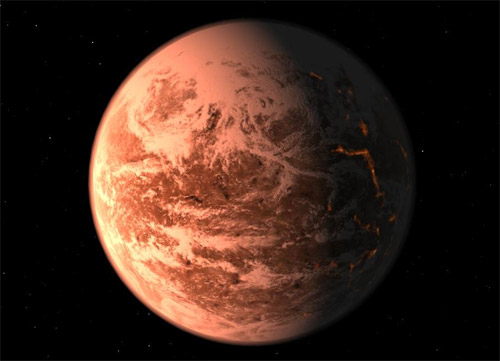
An artist's illustration of the
innermost planet, Gliese
876 d, depicting the planet as a hot,
volcanically active world that
is illuminated by red light from the star.
Artist
depiction of Gliese
876 d, a new Earth-like rocky planet discovered
in orbit around star M
dwarf Gliese 876 about 15 light years from
Earth. Date 13 June 2005(2005-06-13)
Source: National
Science
Foundation Author; Trent Schindler,
National Science Foundation
Gliese
876 is a red dwarf star approximately 15 light-years
away from Earth in the constellation of Aquarius. As
of 2010, it has been
confirmed that four extrasolar planets orbit the
star. Two of the middle
planets are similar to Jupiter, while the closest
planet is thought to
be similar to a small Neptune or a large terrestrial
planet, and the outer
planet has mass similar to Uranus. The orbits of all
but the closest planet
are locked in a rare three-body
Laplace resonance.
Distance and visibility Gliese 876 is located fairly close
to our solar system.
According to astrometric measurements made by the
Hipparcossatellite, the
star shows a parallax of 213.28 milliarcseconds,
which corresponds to
a distance of 4.69 parsecs (15.3 ly). Despite
being located so close to
Earth, the star is so faint that it is invisible
to the naked eye and can
only be seen using a telescope.
As a red dwarf
star, Gliese 876 is much less massive than
our Sun: estimates suggest it has only 32% of the
mass of our local star.
The surface temperature of Gliese 876 is cooler than
our Sun and the star
has a smaller radius. These factors combine to make
the star only 1.24%
as luminous as the Sun, and most of this is at
infraredwavelengths.
Estimating the age and metallicity of cool stars is difficult due to the formation of diatomic molecules in their atmospheres, which makes the spectrum extremely complex. By fitting the observed spectrum to model spectra, it is estimated that Gliese 876 has a slightly lower abundance of heavy elements compared to the Sun (around 75% the solar abundance of iron). Based on chromospheric activity the star is likely to be around 6.5 to 9.9 billion years old, depending on the theoretical model used. However, the low rotational period of the star as well as its membership among the young disk population suggest that the star is between 0.1–5 billion years old. Like many low-mass
stars, Gliese 876 is a variable
star. Its variable star designation is IL Aquarii
and it is classified
as a BY Draconis variable. Its brightness fluctuates
by around 0.04 magnitudes.
This type of variability is thought to be caused by
large starspots moving
in and out of view as the star rotates. Gliese 876
emits X-rays.
An
artist's impression
of the third planet, Gliese
876 b This is
an artist's concept of
a gas giant planet orbiting the cool, red
dwarf star Gliese 876, located
15 light-years away in the autumn
constellation Aquarius. Date 2006-03-09
Source NASA STScI-PRC2002-27 - Click image for
full size
Planetary system On June 23, 1998, an extrasolar planet was announced in orbit around Gliese 876 by two independent teams led by Geoffrey Marcy[6] and Xavier Delfosse. The planet was designated Gliese 876 b and was detected by making measurements of the star's radial velocity as the planet's gravity pulled it around. The planet, around twice the mass of Jupiter, revolves around its star in an orbit taking approximately 61 days to complete, at a distance of only 0.208 AU, less than the distance from the Sun to Mercury. On April 4, 2001,
a second planet was detected in the
system, inside the orbit of the
previously-discovered planet. The 0.62
Jupiter-mass planet, designated Gliese 876 c is in a
1:2 orbital resonance
with the outer planet, taking 30.340 days to orbit
the star. This relationship
between the orbital periods initially disguised the
planet's radial velocity
signature as an increased orbital eccentricity of
the outer planet. Eugenio
Rivera and J. Lissauer found that the two planets
undergo strong gravitational
interactions as they orbit the star, causing the
orbital elements to change
rapidly.[
Both of the system's Jupiter-mass planets are located in the 'traditional' habitable zone (HZ) of Gliese 876, which extends between 0.116 to 0.227 AU from the star.[ On June 13, 2005, further observations by a team led by Rivera revealed a third planet in the system, inside the orbits of the two Jupiter-size planets.[ The planet, designated Gliese 876 d, was estimated to have a minimum mass only 5.88 times that of the Earth and may be a terrestrial planet. In 2008, the system was used as a test case for the migration of 5 Earth-mass planets which had formed inside the orbit of the innermost gas giant of the system. If it formed at (in this test) 0.07 AU from the star, b's gravity would have pulled d into an eccentric orbit. That orbit then would have restabilished to its current location. In January 2009, the mutual inclination between planets b and c was determined using a combination of radial velocity and astrometric measurements. The planets were found to be almost coplanar, with an angle of only 5.0+3.9?2.3° between their orbital planes. It is the first planetary system around a normal star to have mutual inclination between planets measured (previously the mutual inclination of the planets orbiting the pulsar PSR B1257+12 had been determined by measuring their gravitational interactions). Later measurements reduced the value of the mutual inclination, and in the latest four-planet models the incorporation mutual inclinations does not result in significant improvements relative to coplanar solutions.
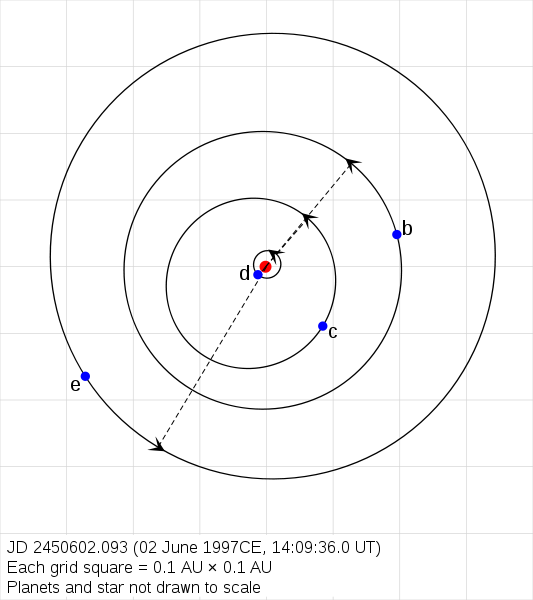
The orbits of the planets of
Gliese 876. Note that the strong gravitational
interactions between the
planets causes rapid orbital precession, so this
diagram is only valid
at the stated epoch.
On June 23, 2010, astronomers announced the discovery of a fourth planet (designated Gliese 876 e) in a 1:2:4 Laplace resonance with Gliese 876 b and c. This is the second known example of a Laplace resonance, the first being Jupiter's moons Ganymede, Europa and Io. This discovery better constrains the mass and orbital properties of the other three planets, including the high eccentricity of the innermost planet. Numerical integration indicates that the coplanar, four-planet system is stable for at least another billion years. This planetary system comes close to a triple conjunction between the three outer planets once per orbit of the outermost planet.
See also:
References:
 The Gliese 876 system
|
||||||||||||||||||||||||||||
|
Smallest Exoplanet Found ..
By Jeremy
McGovern
Although this exoplanet is the most earthlike extrasolar body yet detected, it is quite different from our home. In this artist's rendition, the newly discovered planet is shown as a hot, rocky, geologically-active world glowing in the deep red light of its nearby parent star, the M dwarf Gliese 876. Trent Schindler, National Science Foundation Astronomers have discovered more than 150 planets outside our solar system, ranging from 100 to 1,000 times Earth's mass. Today, astronomers announced the 155th exoplanet discovery. So far, this is the most earthlike planet found beyond the solar system. At the National Science Foundation's headquarters in Arlington, Virginia, an ecstatic team spoke about the serendipitous discovery today. While carefully examining two Jupiter-size planets with the Keck Telescope in Hawaii, the team noticed a wobble that could not be accounted for by the two-planet model they used. Doppler measurements revealed an inner planet. It orbits Gliese 876, an M dwarf star about one-third of the Sun's mass. "This planet answers an ancient question," says team leader Geoffrey Marcy. "Over 2,000 years ago, the Greek philosophers Aristotle and Epicurus argued about whether there were other earthlike planets. Now, for the first time, we have evidence for a rocky planet around a normal star." Little is known about the exoplanet, such as its chemical composition or terrain. Team members do recognize it possesses dissimilarities to Earth. First, it is larger than our home planet. Although astronomers believe it could be 6 to 9 times Earth's mass, the team estimates it is 7.5 times larger. Since previously discovered exoplanets are much larger — all bigger than Uranus, an ice-giant about 15 times Earth's mass — astronomers would place this body in an "earthlike class size." The exoplanet's orbit around its star is much shorter than Earth's orbit around the Sun. The body makes one trip around Gliese 876 in only 1.94 days. It is located about 2 million miles (3.2 million kilometers) from its star, compared to Earth's position about 93 million miles (150 million km) away. Furthermore, the exoplanet is much hotter than Earth — it's an oven, at 400º to 750º Fahrenheit (244º to 398º Celsius). While those who discovered the exoplanet believe these conditions could not support life, they have not ruled out the existence of water. The hot conditions also make it likely that the planet has not retained much gas, making the planet solid. "We keep pushing the limits of what we can detect, and we're getting closer and closer to finding Earths," says team member Steven Vogt. Team member Jack Lissauer admitted this exoplanet won't hold the title of "most earthlike" for long. Astronomers will study this model and search similar star-class systems for even smaller exoplanets. Scheduled for launch in 2007, NASA's Kepler mission is designed to detect earth-size exoplanets.. Source: Astronomy.com Found! Rocky world just like ours - Tuesday, 14 June 2005 |
||||||||||||||||||||||||||||
|
Gliese 876 b
is an extrasolar planet orbiting the red dwarf star
Gliese 876. It completes
one orbit in approximately 61 days. Discovered in
June 1998, Gliese 876
b was the first planet to be discovered orbiting a
red dwarf star.
Discovery
Gliese 876 c is an extrasolar planet orbiting the red dwarf star Gliese 876, taking about 30 days to complete an orbit. The planet was discovered in April 2001 and is the second planet in order of increasing distance from its star. Discovery
Gliese 876 d is an extrasolar planet approximately 15 light-years away in the constellation of Aquarius (the Water-bearer). The planet was the third planet discovered orbiting the red dwarf star Gliese 876. At the time of its discovery, the planet had the lowest mass of any known extrasolar planet apart from the pulsar planets orbiting PSR B1257+12. Due to this low mass, it can be categorized as a Super-Earth. Discovery Like the majority of
known extrasolar planets, Gliese
876 d was discovered by analysing changes in its
star's radial velocity
as a result of the planet's gravity. The radial
velocity measurements were
made by observing the Doppler shift in the star's
spectral lines. At the
time of discovery, Gliese 876 was known to host two
extrasolar planets,
designated Gliese 876 b and c, in a 2:1 orbital
resonance. After the two
planets were taken into account, the radial velocity
still showed another
period, at around two days. The planet, designated
Gliese 876 d, was announced
on June 13, 2005 by a team led by Eugenio Rivera and
was estimated to have
a mass approximately 7.5 times that of Earth.
Gliese 876 e is an extrasolar planet orbiting the star Gliese 876 in the constellation of Aquarius. It is in a 1:2:4 Laplace resonance with the planets Gliese 876 c and Gliese 876 b: for each orbit of planet e, planet b completes two orbits and planet c completes four. This configuration is the second known example of a Laplace resonance after Jupiter's moons Io, Europa and Ganymede. Gliese 876 e has a mass similar to
that of the planet
Uranus. Its orbit takes 124 days to complete, or
roughly one third of a
year. While the orbital period is longer than that
of Mercury around the
Sun, the lower mass of the host star relative to the
Sun means the planet's
orbit has a slightly smaller semimajor axis. Unlike
Mercury, Gliese 876
e has a nearly circular orbit with an eccentricity
of 0.055 ± 0.012.
|
||||||||||||||||||||||||||||
|
Home of J-Rod? .
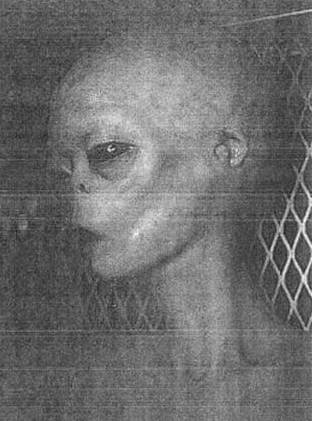
J-Rod: A class of EBE from the Zeta Reticulum area. The J-Rod assocated with Dr Burisch was housed in a pressurized hydrogen "Clean Sphere" at Level 5 of S4. He had a degenerative neurological condition. The J-Rod is similar in appearance to that of the "grey" aliens recovered from Roswell. P+52k-yr J-Rods (here after called 52's) note….they are from Gliese 876, halfway between Earth and Zeta Reticulum. P+45k-yr. J-Rods (hereafter called 45's) note…..they are from Reticulum and don't suffer the disease as do the 52's. Source: Danburisch.info The story behind the J-Rod image - Alleged photographs of ET beings: |
||||||||||||||||||||||||||||
| FAIR USE NOTICE: This page contains copyrighted material the use of which has not been specifically authorized by the copyright owner. Pegasus Research Consortium distributes this material without profit to those who have expressed a prior interest in receiving the included information for research and educational purposes. We believe this constitutes a fair use of any such copyrighted material as provided for in 17 U.S.C § 107. If you wish to use copyrighted material from this site for purposes of your own that go beyond fair use, you must obtain permission from the copyright owner. | ||||||||||||||||||||||||||||
|
|