ESO Press Release 12/05 - Full Web
Story
30 April 2005
Yes, it is the Image of an
Exoplanet
Astronomers Confirm the First Image of a Planet Outside
of Our Solar System
[1]
Among the most essential quests of modern astronomers,
taking direct images of planets outside of our solar system is certainly
up there among chart-toppers. Obtaining such images of a so-called exoplanet
would enable scientists to study in detail the physical nature of the object
and, in particular, to analyse the composition of its atmosphere. The astronomers'
ultimate goal is of course to perform such analysis for earth-sized planets,
in the hope of detecting a telltale signature of extraterrestrial life.
Such an ultimate objective is still at least decades
in the future, as earth-size and even Jupiter-size planets around stars
as old as the Sun are too faint to be detected by present-day technology.
Nevertheless, great progress can be achieved by taking
images of giant planets orbiting much younger objects. Because giant planets
a few tens of millions of years old are much hotter and brighter than their
older brethren, they can be much more easily detected. Moreover, as the
first tens of millions of years are considered to have been a critical
period in the formation of Earth and of our own solar system, the study
of nearby young planetary systems provides astronomers with invaluable
insight on our own origins, something that is difficult if not impossible
to decipher from investigation of old, mature planetary systems.
Several surveys are therefore currently in progress
that particularly aim at finding and taking direct images of sub-stellar
companions - brown dwarfs and exoplanets - close to very young objects.
Last year, an international team of astronomers [2]
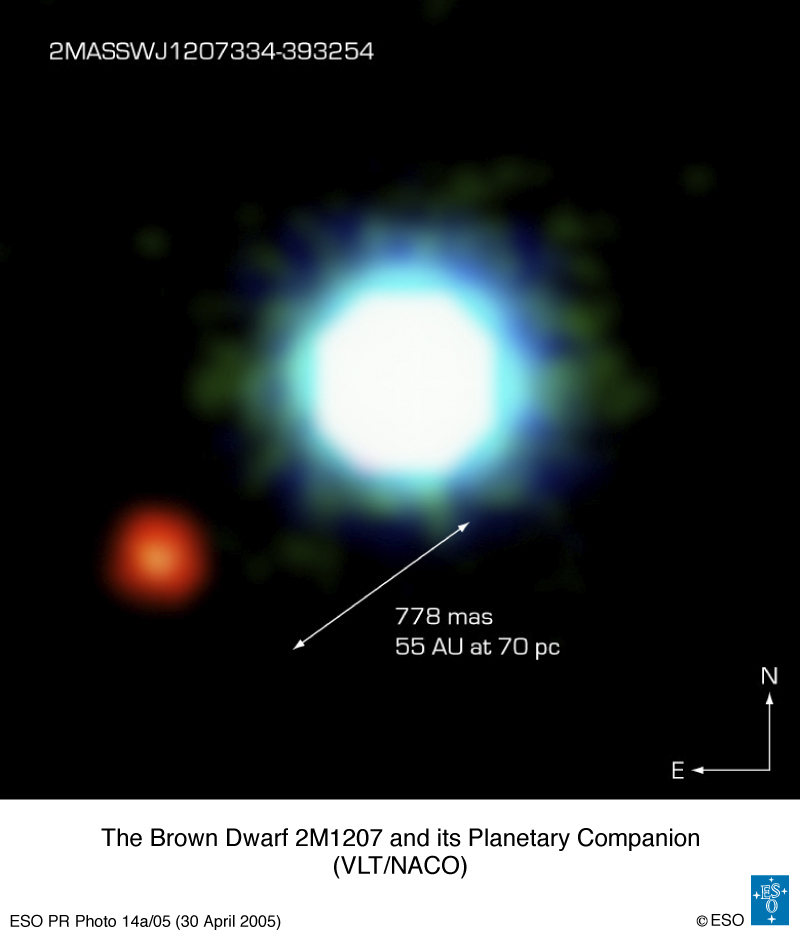
reported the first image of a Giant Planet Companion to 2M1207 (see ESO
PR 23/04). On NACO/VLT images obtained in April 2004, they detected a faint
reddish speck of light in the close vicinity of this young brown dwarf
member of the 8 million year old TW Hydrae Association. The feeble companion,
now called 2M1207b, is more than 100 times fainter than the brown dwarf,
2M1207A. The spectrum of the companion presents the strong signature of
water molecules. Based on the infrared colours and the spectral data, evolutionary
model calculations lead to the conclusion that 2M1207b is a 5 Jupiter-masses
planet [3]. Its mass can be estimated also by use
of a different method of analysis which focuses on the strength of its
gravitational field; this technique suggests that the mass might be even
less than 5 Jupiter mass.
In April 2004, the spectroscopic and photometric analysis
strongly indicated a planetary mass object close to the star. An alternative
explanation, that the faint detected object was a background source unrelated
to the young brown dwarf (such as an extragalactic object or a peculiar
cool star with unusual infrared colours), appeared very unlikely. Observations
with the Hubble Space Telescope, obtained in August 2004 (i.e. only 4 months
later), corroborated the VLT/NACO observations, even though they were obtained
too soon after the NACO ones to provide a definite answer. Additional observations
at a later epoch were required to prove beyond any doubt that the two objects,
2M1207A and 2M1207b, indeed move together in the sky and are therefore
gravitationally bound to each other.
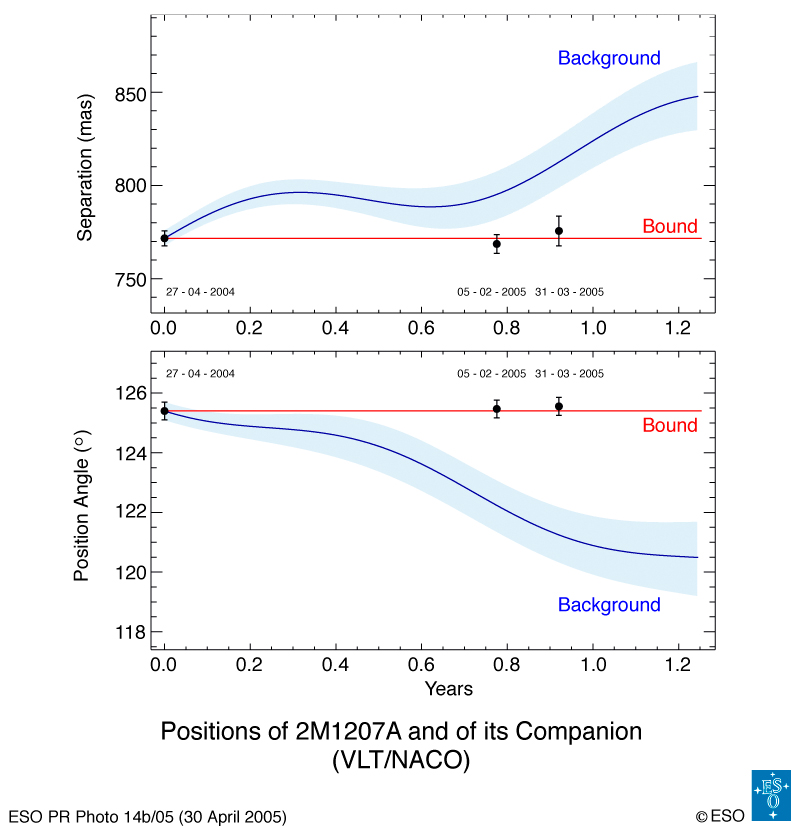
Caption: ESO PR Photo 14b/05 shows the relative position
of 2M1207b with respect to 2M1207a at three different epochs (April 2004,
February and March 2005). The top panel shows the separation between the
two objects in milli-arcseconds, while the lower one represents the relative
angle. The blue line shows the predicted change in position if the feeble
speck of light would have been a background object. It is clear however
that the data indicate that the two objects move together in the sky, hence
are bound (red line).
Such additional observations have now just been performed
by the same team of European and American astronomers. They used again
NACO on Yepun, the fourth 8.2-m Unit Telescope of ESO's Very Large Telescope
[4].
The team took new images in February and March 2005 and measured the apparent
motion on the sky of the young brown dwarf. For the three different epochs
(April 2004, February and March 2005), they then accurately determined
the relative position of the Giant Planet Companion with respect to the
brown dwarf.
These observations show, with high accuracy, that there
is no change in relative position between the two objects. This is exactly
what one expects over a time scale of one year if 2M1207b is gravitationally
bound to its host 2M1207A [5]. Over much longer time
spans, we should see the two objects orbiting around each other.
For Gael Chauvin, astronomer at ESO and leader
of the team of astronomers who conducted the study, "this new set of
NACO measurements unambiguously confirms that 2M1207b is a planetary mass
companion to the young brown dwarf 2M1207A. The image released last year
is thus truly the first image ever taken of a planet outside of our solar
system."
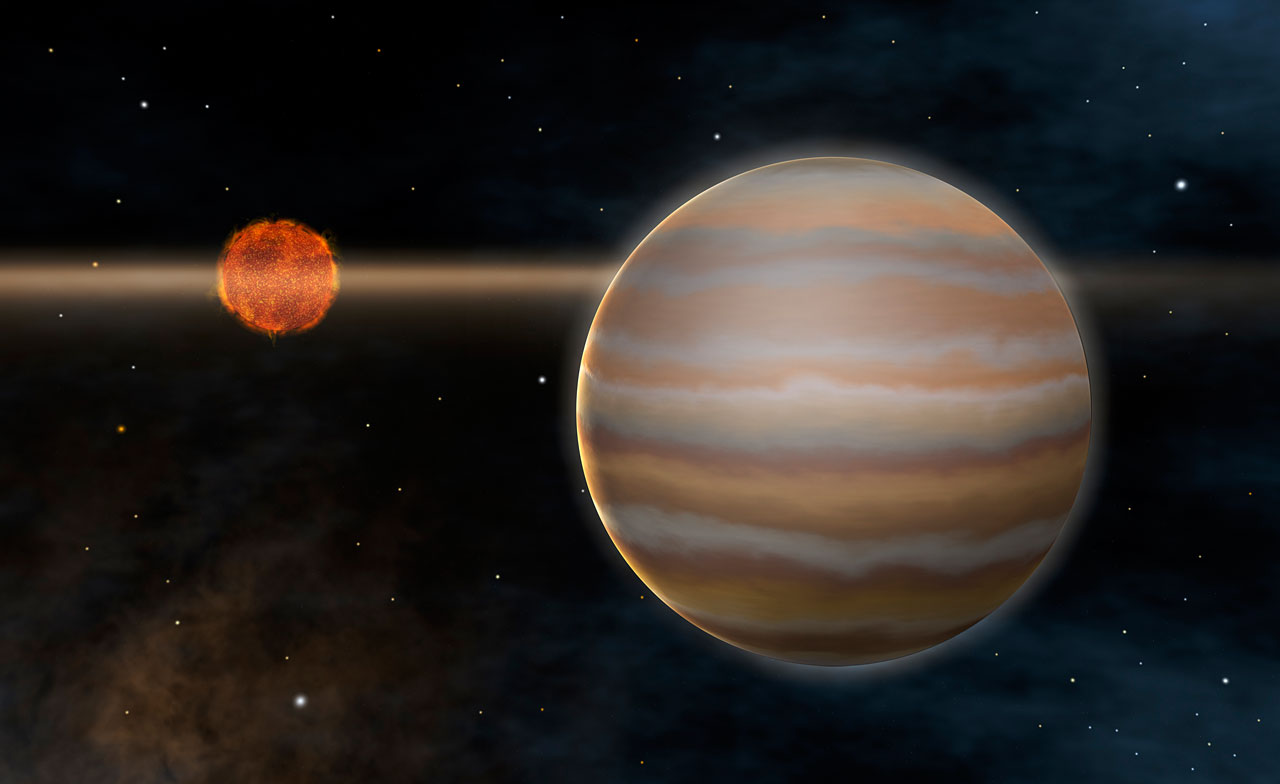
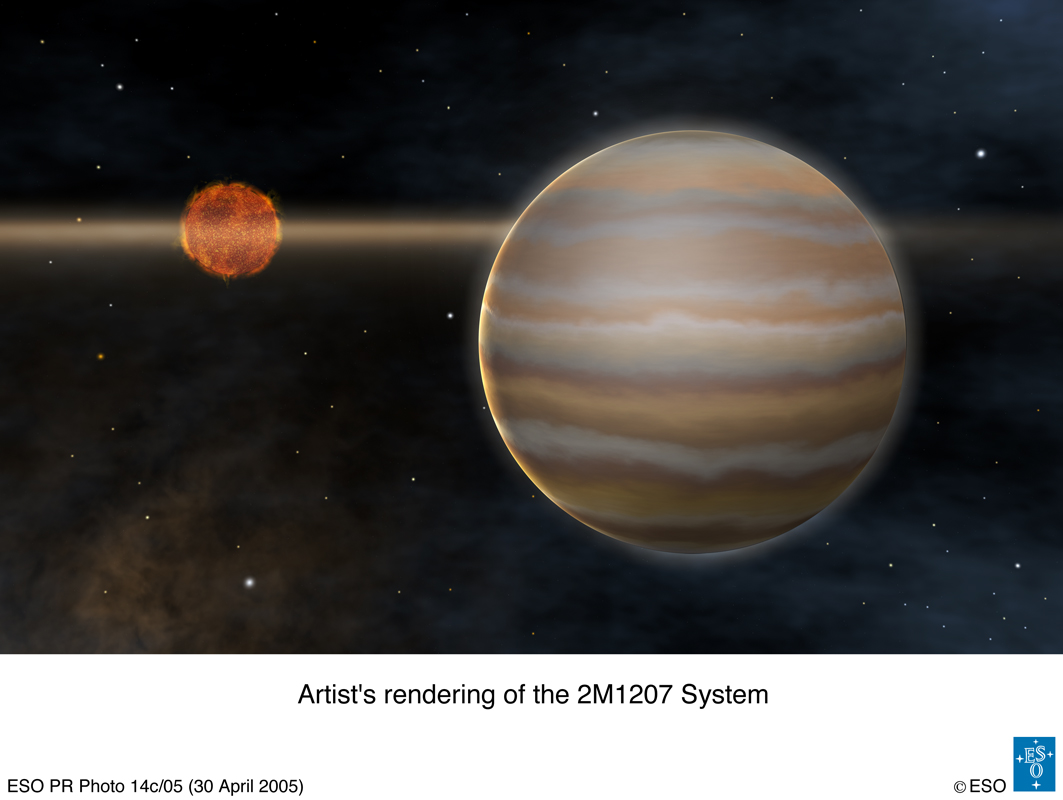
ESO PR Photo 14c/05 -
Artist's rendering of the 2M1207 System
Preview
- JPEG: 400 x 532 pix - 110k
Normal
- JPEG: 800 x 1063 pix - 284k
HiRes
- JPEG: 2257 x 3000 pix - 1.6M
HiRes
- TIF: 2257 x 3000 pix - 3.4M
ESO PR Video 02/05
The First Image of a Exoplanet Confirmed
QuickTime:
320 x 240 pix - 20Mb - 1:07 min
"The two objects - the giant planet and the young
brown dwarf - are moving together; we have observed them for a year, and
the new images essentially confirm our 2004 finding", says Benjamin
Zuckerman, UCLA professor of physics and astronomy, member of NASA's
Astrobiology Institute, and a member of the team. "I'm more than 99
percent confident. This would also be the first time that a planet outside
of our solar system has been detected far from a star or brown dwarf -
nearly twice as far as the distance between Neptune and the sun."
"Given the rather unusual properties of the 2M1207
system, the giant planet most probably did not form like the planets in
our solar system," says Gael Chauvin. "Instead it must have formed
the same way our Sun formed, by a one-step gravitational collapse of a
cloud of gas and dust.
..
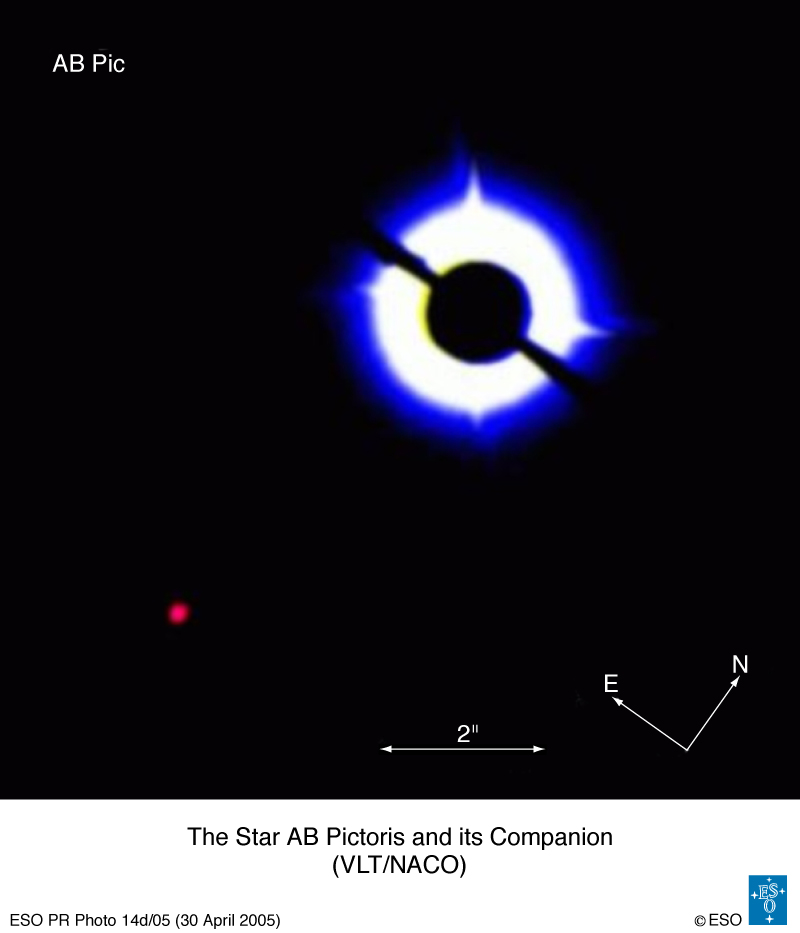
Caption: ESO PR Photo 14d/05
is a coronagraphic image of AB Pictoris showing its tiny companion (bottom
left). The data was obtained on 16 March 2003 with NACO on the VLT, using
a 1.4 arcsec occulting mask on top of AB Pictoris.
In the course of the same survey, the astronomers also
discovered an interesting companion to the young star AB Pictoris of the
30 million years old Tucana-Horlogium Association located about 150 light
years from Earth. This companion, imaged for the first time in March 2003,
has a near-infrared luminosity and spectrum which points to a light and
cool object.
Using the same strategy as for 2M1207b, the astronomers
observed the AB Pic system at different epochs over a time span of a year
and a half and confirmed that the companion is not a background object.
Evolutionary model calculations point to a 13 to 14 Jupiter masses object
with a temperature of ~1700 Kelvin. As the presently accepted separation
between a high mass planet and a low mass brown dwarf is at 13.6 Jupiter
masses [6], the newly discovered companion thus may
lie at the exact boundary between these two classes of sub-stellar objects.
It might therefore play the role of a unique "Rosetta stone" in the future.
Remarkably, this companion is located very far from its host star - about
9 times further from AB Pictoris than Neptune is from the Sun. Nothing
like this situation has ever been seen before in a planetary system.
Recently, a group of German astronomers presented evidence,
based on VLT/NACO data, for a sub-stellar companion to the 1 million year
old star GQ Lup (see ESO PR 09/05). However, the precise nature of this
sub-stellar companion is still unknown as the very young age of the system
makes comparison with theoretical models quite complicated. It was therefore
only possible to assess with certainty that the close companion to GQ Lup
has most probably a mass between 1 and 42 Jupiter-masses, and therefore
could be either an exoplanet or a brown dwarf.
The discovery of 2M1207b, AB Pic b and GQ Lup b/B,
all within a short period of time, bring evidence that new, carefully designed
surveys, using state-of-art instruments on the most advanced facilities,
can provide astronomers with images of planetary companions.
The first image of an exoplanet may now have been taken
and confirmed and there can be little doubt that others will follow soon.
The detailed study of a growing number of exoplanets with different masses
and orbital properties will provide insight on theoretical formation models
and afford a unique opportunity to learn more about how the solar system
formed, hence about our own origins.
Anne-Marie Lagrange, another member of the team
from the Grenoble Observatory (France), looks towards the future: "Our
discovery represents a first step towards one of the most important goals
of modern astrophysics: to characterize the physical structure and chemical
composition of giant and, eventually, terrestrial-like planets."
More information
Read the associated press release on [Page
1].
The result about 2M1207 presented in this ESO Press
Release is described in a Letter to the Editor accepted for publication
in Astronomy and Astrophysics ("Confirmation of a Giant Planet Companion
to the brown dwarf 2MASSWJ1207334-393254" by G. Chauvin et al.). The work
on AB Pictoris will also be published by Astronomy and Astrophysics ("A
light substellar companion to the star HIP 30034" by G. Chauvin et al.)
The papers are available prior to publication at astro-ph/0504658
and astro-ph/0504659.
Notes
[1]: This is a coordinated ESO/UCLA/CNRS
Press Release
[2]: The team consists of Gael
Chauvin and Christophe Dumas (ESO-Chile), Anne-Marie Lagrange and Jean-Luc
Beuzit (LAOG, Grenoble, France), Benjamin Zuckerman and Inseok Song (UCLA,
Los Angeles, USA), David Mouillet (LAOMP, Tarbes, France) and Patrick Lowrance
(IPAC, Pasadena, USA).
[3]: 2M1207A and its companion
belong to the TW Hydrae association and are therefore most probably 8 million
year old. Evolutionary model predictions are still uncertain at such young
ages and need to be calibrated, which could modify the nominal mass of
the planet. However, even an implausibly large error of a factor ten on
the predicted flux would still place 2M1207b within the planetary mass
regime.
[4]: NACO is an adaptive optics
instrument, which can compensate for the blurring effect of the atmosphere.
[5]: Due to the estimated period
of ~2500 years for 2M1207B, the orbital motion of the companion around
2M1207A is not expected to be detected with NACO over only one year. Several
decades will be indeed necessary with NACO. Moreover, due to the accuracy
of the VLT/NACO measurements and the looseness of the young association,
the fact that the two objects are so close and move together on the sky
can only mean they are gravitationally bound.
[6]: The International Astronomical
Union has recently adopted a definition to differentiate giant planets
and brown dwarf companions. The latter are objects with masses above the
minimum mass for deuterium burning (13.6 MJup). Based on this criterion,
2M1207B can be consider as a giant planet companion orbiting a young brown
dwarf.
Last Update: 18.04.07 ©ESO
http://www.eso.org/public/news/eso0515/