|
Enigmas in Our Solar System The Asteroids |
||
|
Rectangular Structure on Eros .
First posted by spacevisitor, A
member of ATS on April
29, 2007 at 10:38 GMT
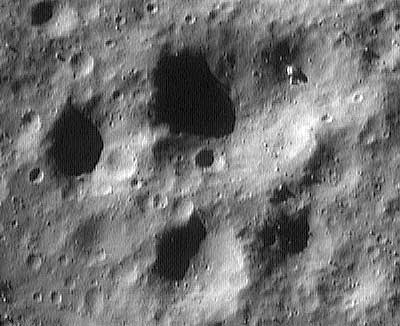
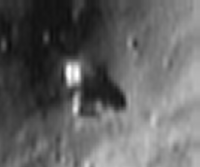
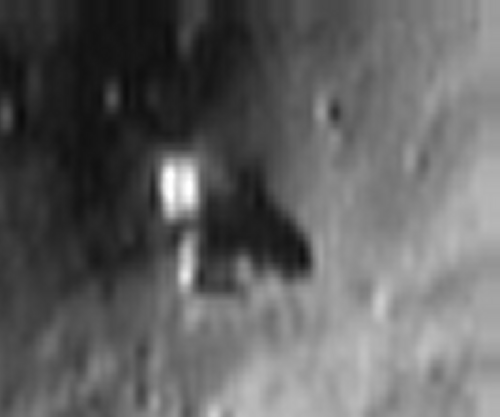
My question is, have you or anyone else see this photo before and what is your opinion of it? There is obvious something strange in this picture, at the right of the centre and it is on the bottom of a crater. It looks to me, as an object that not belongs there normally. When I saw this photo for the first time I always thought is was a picture of the Moon, but after some surfing on the net, I found the real meaning of it. This image of Eros, taken from the NEAR Shoemaker spacecraft on May 1, 2000, is among the first to be returned from "low orbit." Between May and August, the spacecraft will orbit at altitudes near 50 kilometers (31 miles) or less. This will be the prime period of activity for some of the spacecraft's science instruments. The X-ray / gamma-ray spectrometer will build up maps of chemical abundances, while the laser rangefinder measures the shape of Eros to within meters (a few feet). At the same time the magnetometer will watch for indications of Eros' magnetic field and the near-infrared spectrometer will map rock types. The imager will take pictures of the entire surface of Eros that capture features as small as 4 meters (13 feet) across. This particular image, taken from an orbital altitude of 53 kilometers (33 miles), shows a scene about 1.8 kilometers (1.1 miles) across. Numerous craters and boulders as small as 8 meters (26 feet) across dot the landscape. The large, rectangular boulder at the upper right is 45 meters (148 feet) across. Built and managed by The Johns Hopkins University Applied Physics Laboratory, Laurel, Maryland, NEAR-Shoemaker was the first spacecraft launched in NASA's Discovery Program of low-cost, small-scale planetary missions. SOURCE: Spaceflight Now |
||
|
NEAR image of the day for 2000 May 3 This image of Eros, taken from the NEAR Shoemaker spacecraft on May 1, 2000, is among the first to be returned from "low orbit." Between May and August, the spacecraft will orbit at altitudes near 50 kilometers (31 miles) or less. This will be the prime period of activity for some of the spacecraft's science instruments. The X-ray / gamma-ray spectrometer will build up maps of chemical abundances, while the laser rangefinder measures the shape of Eros to within meters (a few feet). At the same time the magnetometer will watch for indications of Eros' magnetic field and the near-infrared spectrometer will map rock types. The imager will take pictures of the entire surface of Eros that capture features as small as 4 meters (13 feet) across. This particular image, taken from an orbital altitude of 53 kilometers (33 miles), shows a scene about 1.8 kilometers (1.1 miles) across. Numerous craters and boulders as small as 8 meters (26 feet) across dot the landscape. The large, rectangular boulder at the upper right is 45 meters (148 feet) across. SOURCE: NEAR Image 0132577092 |
||
|
.
|
||
| NEAR Shoemaker
Near Earth Asteroid Rendezvous http://nssdc.gsfc.nasa.gov/planetary/near.html NEAR Eros Descent Images
NEAR Mission Completes Main Task,
Now Will Go Where
No Spacecraft Has Gone Before
Astronomy Picture of the Day
|
||
| The End of an
Asteroidal Adventure
NEAR Shoemaker Phones Home for the Last Time 28 February 2001 Tonight at 7 p.m. (EST) NASA's Deep Space Network antennas will pull down their last Near Earth Asteroid Rendezvous (NEAR) mission data, bringing to a close the first mission to extensively study an asteroid. NEAR, which was the first mission in NASA's Discovery Program of low-cost, scientifically focused space missions, and the first to land on an asteroid, has delighted astronomy neophytes and scientists alike. "NEAR has raised the bar," says Dr. Stamatios Krimigis, Space Department head at The Johns Hopkins University Applied Physics Laboratory in Laurel, Md., which built the spacecraft and managed the NEAR mission. "The Laboratory is very proud to have managed such a successful mission and worked with such a strong team of partners from industry, government and other universities. The team had no weak links and the result was an historic mission that surpassed everyone's expectations." "This mission has been successful far beyond what was in the original mission plan," says NEAR Mission Director Dr. Robert Farquhar of APL. "We got the first images of a C-class asteroid when we added a flyby of asteroid Mathilde in 1997; we added two low altitude series of passes over the ends of Eros this past October and January that gave us spectacular images from 2.7 kilometers above the surface; and we achieved the first landing of a spacecraft on an asteroid on Feb. 12. All this at no extra cost. When you talk about ' faster, cheaper, better,' this is what 'better' means." On Feb. 12 at 3:01:52 p.m. (EST), NEAR Shoemaker made a gentle, picture-perfect 3-point landing on the tips of two solar panels and the bottom edge of the spacecraft body. But the mission wasn't finished yet. Much to the amazement of the mission team and millions of observers around the world who were following the descent, the touchdown was so elegant that the craft was still operating and sending a signal back to Earth even after landing. Jumping at the chance to get "bonus science" from the spacecraft, which had already collected 10 times more data than originally planned, the mission team asked for and got a 10-day extension and then four more days of DSN antenna time, enabling NEAR Shoemaker to send back data through Feb. 28. The extension was granted to allow the gamma-ray spectrometer to collect data from an ideal vantage point about four inches from the surface. The spectrometer team quickly redesigned software and uploaded it to the spacecraft so they could begin collecting elemental composition readings. The results were spectacular. "This is the first gamma-ray experiment that has ever been done on the surface of a body other than Earth," says Dr. Jacob Trombka, of NASA's Goddard Space Flight Center, in Greenbelt, Md., who heads the gamma-ray spectrometer team. "In fact, we can say it's the first feasibility study of how to design an instrument to be used on a rover that could select samples from the surface, look for the presence of water, or map the surface for the purpose of future mining." The gamma-ray spectrometer team was able to retrieve data for a period of seven days after the spacecraft landed. "Right now we know we have good data with strong signatures," Trombka says. "But it will take months to scrutinize what we've collected. What we're looking for is information that will help us more precisely classify Eros and determine the relationship between the asteroid and meteorites that have fallen to Earth." NEAR Shoemaker now rests silently just to the south of the saddle-shaped feature Himeros as the asteroid twists more and more away from the sun with each rotation, moving the southern hemisphere into its winter season and temperatures as low as minus 238 degrees Fahrenheit (minus 150 centigrade). Project Scientist Dr. Andrew Cheng of APL, says the glamorous part of the mission is over but now scientists can get down to studying the data, including the more than 160,000 detailed images taken by the spacecraft. "We solved mysteries, we unveiled more mysteries. Now we're sharing the amazing amount of data that we collected with scientists all over the world, to sort through and debate and hopefully to help us discover facts about Eros and our solar system that no one knows today." Source: nssdc.gsfc.nasa.gov/ |
||
| For Immediate
Release
Feb. 12, 2001 NEAR Shoemaker Makes Historic Touchdown on Asteroid Eros Today, at 3:02:10 EST, NASA's NEAR Shoemaker spacecraft traveled its last mile, cruising to the surface of asteroid Eros at a gentle 4 mph (1.9 meters per second) - finally coming to rest after its 2-billion-mile journey. Cheers and congratulations filled the Mission Operations Center at the Johns Hopkins University Applied Physics Laboratory (APL) in Laurel, Md., which built the spacecraft and manages the mission for NASA, when NEAR Mission Director Robert Farquhar announced, "I'm happy to say the spacecraft is safely on the surface of Eros." The last image snapped by NEAR Shoemaker was a mere 394 feet (120 meters) from the asteroid's surface and covered a 20-foot (6-meter) area. As NEAR Shoemaker touched down it began sending a beacon, assuring the team that the small spacecraft had landed gently. The signal was identified by radar science data, and about an hour later was locked onto by NASA's Deep Space Network antennas, which will monitor the spacecraft until Feb. 14. NEAR Shoemaker's final descent started with an engine burn at 10:31 a.m. (EST) that nudged the spacecraft toward Eros from about 16 miles (26 kilometers) away. Then four braking maneuvers brought the spacecraft to rest on the asteroid's surface in an area just outside a saddle-shaped depression, Himeros. When it touched down, NEAR Shoemaker became the first spacecraft ever to land, or even attempt to land on an asteroid. The success was sweetened by the fact that NEAR Shoemaker was not designed as a lander. The spacecraft spent the last year in a close-orbit study of asteroid 433 Eros, a near-Earth asteroid that is currently 196 million miles (316 million kilometers) from Earth. During that time it collected 10 times more data than originally planned and completed all its science goals before attempting its descent to the asteroid. Details of NEAR Shoemaker's landing will be discussed at a post-landing press conference that will be held at APL's Kossiakoff Center at 1 p.m., Wednesday, Feb. 14. Panelists will be:
TelstarMedia wishing to follow the press conference on the Internet can contact NASA Hq. (202-358-1727) or APL Public Affairs (240-228-5113) for access instructions and passwords. To register for the press conference visit the NEAR Web site at http://near.jhuapl.edu and go to News Center - Upcoming Events. Images are also available on the Web site. Media Contact: Source: nssdc.gsfc.nasa.gov/ |
||
| FAIR USE NOTICE: This page contains copyrighted material the use of which has not been specifically authorized by the copyright owner. Pegasus Research Consortium distributes this material without profit to those who have expressed a prior interest in receiving the included information for research and educational purposes. We believe this constitutes a fair use of any such copyrighted material as provided for in 17 U.S.C § 107. If you wish to use copyrighted material from this site for purposes of your own that go beyond fair use, you must obtain permission from the copyright owner. | ||
|
|