Geminid Meteor Shower Defies
Explanation
Dec. 6,
2010:
The Geminid
meteor shower, which peaks this year on Dec.
13th and 14th, is the most intense meteor shower
of the year. It lasts for days, is rich in
fireballs, and can be seen from almost any point
on Earth.
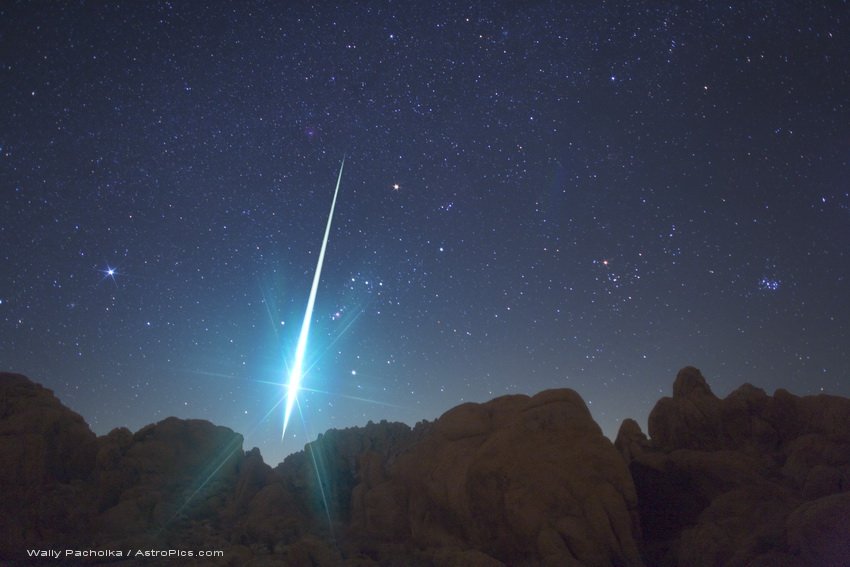
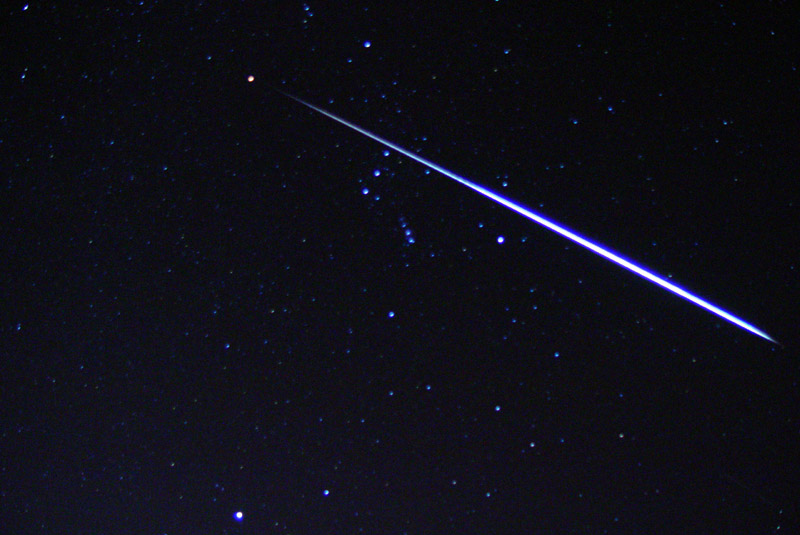
"It was a
monster fireball," says photographer Wally
Pacholka. "I caught it exploding over the
Hercules Finger rock formation near Victorville,
California, using a Canon 35 mm camera. This was
one of 1522 photographs I took "
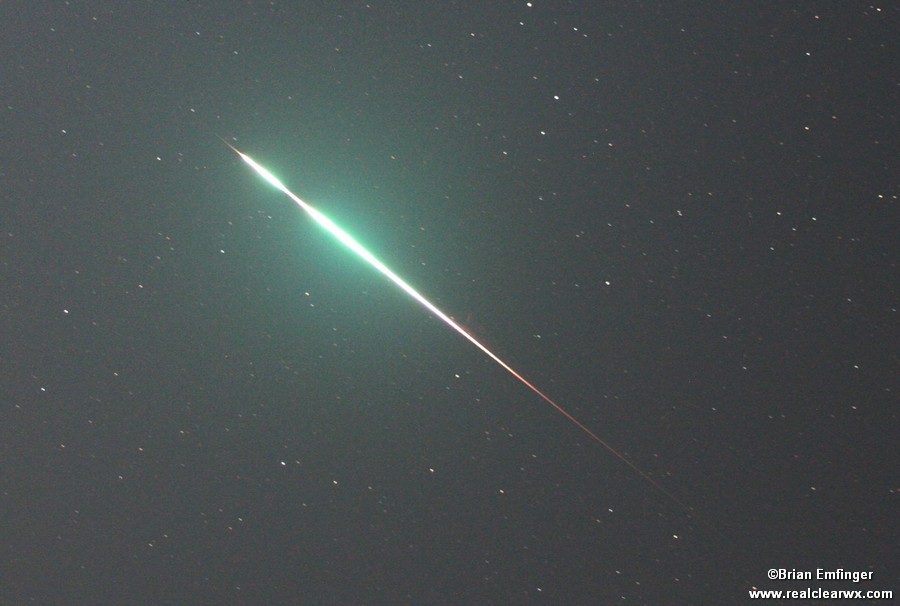
The fireball occurred during the Geminid meteor
shower, which peaked on Dec. 13th and 14th when
Earth passed through a stream of debris from
3200 Phaethon. In some places, people saw 200+
Geminids per hour. In the Mojave desert, one was
enough!
It's also NASA
astronomer Bill Cooke's favorite meteor
shower—but not for any of the reasons listed
above.
"The Geminids
are my favorite," he explains, "because they
defy explanation."
Most meteor
showers come from comets, which spew ample
meteoroids for a night of 'shooting stars.' The
Geminids are different. The parent is not a
comet but a weird rocky object named 3200
Phaethon that sheds very little dusty debris—not
nearly enough to explain the Geminids.
"Of all the
debris streams Earth passes through every year,
the Geminids' is by far the most massive," says
Cooke. "When we add up the amount of dust in the
Geminid stream, it outweighs other streams by
factors of 5 to 500."
This makes the
Geminids the 900-lb gorilla of meteor showers.
Yet 3200 Phaethon is more of a 98-lb weakling.
3200 Phaethon
was discovered in 1983 by NASA's IRAS satellite
and promptly classified as an asteroid. What
else could it be? It did not have a tail; its
orbit intersected the main asteroid belt; and
its colors strongly resembled that of other
asteroids. Indeed, 3200 Phaethon resembles main
belt asteroid Pallas so much, it might be a
5-kilometer chip off that 544 km block.
..
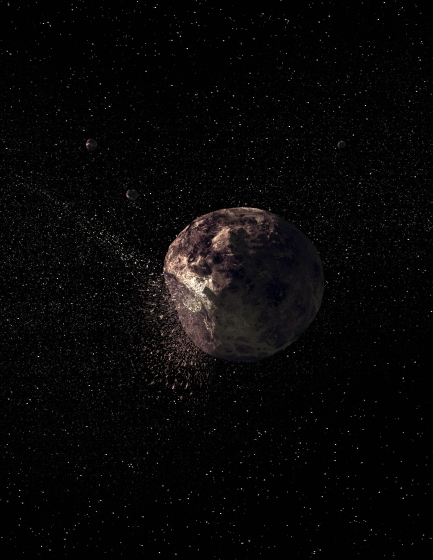
Credit:
An artist's concept of an impact event on
Pallas. Credit: B. E. Schmidt and S. C.
Radcliffe of UCLA.
"If 3200 Phaethon broke apart
from asteroid Pallas, as some researchers
believe, then Geminid meteoroids might be debris
from the breakup," speculates Cooke. "But that
doesn't agree with other things we know."
Researchers have looked
carefully at the orbits of Geminid meteoroids
and concluded that they were ejected from 3200
Phaethon when Phaethon was close to the sun—not
when it was out in the asteroid belt breaking up
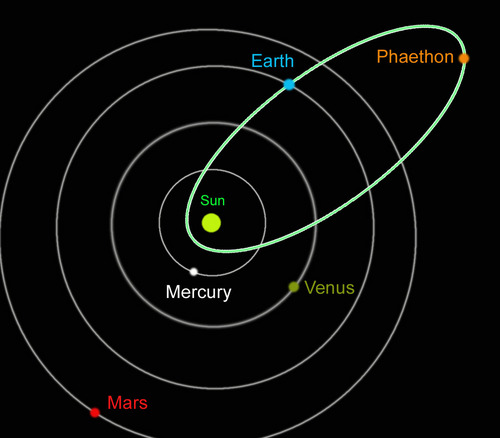
with Pallas. The eccentric orbit of 3200
Phaethon brings it well inside the orbit of
Mercury every 1.4 years. The rocky body thus
receives a regular blast of solar heating that
might boil jets of dust into the Geminid stream.
Could this
be the answer?
..
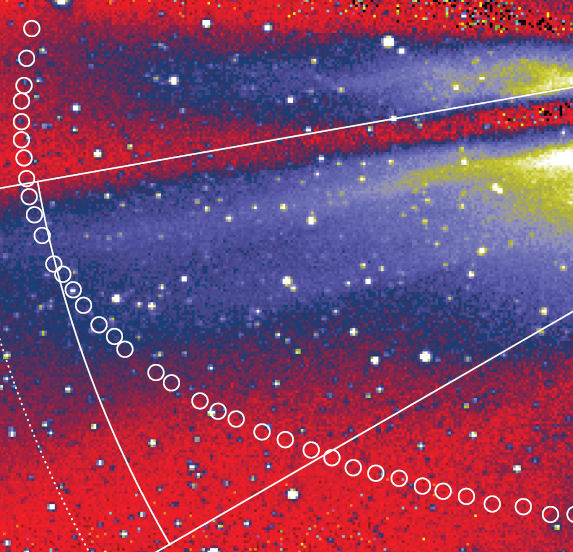
The path
of 3200 Phaethon through STEREO's HI-1A
coronagraph camera. False-color green and blue
streamers come from the sun.
To test the
hypothesis, researchers turned to NASA's twin
STEREO spacecraft, which are designed to study
solar activity. Coronagraphs onboard STEREO can
detect sungrazing asteroids and comets, and in
June 2009 they detected 3200 Phaethon only 15
solar diameters from the sun's surface.
What happened
next surprised UCLA planetary scientists David
Jewitt and Jing Li, who analyzed the data. "3200
Phaethon unexpectedly brightened by a factor of
two," they wrote. "The most likely explanation
is that Phaethon ejected dust, perhaps in
response to a break-down of surface rocks
(through thermal fracture and decomposition
cracking of hydrated minerals) in the intense
heat of the Sun."
Jewett and Li's
"rock comet" hypothesis is compelling, but they
point out a problem: The amount of dust 3200
Phaethon ejected during its 2009 sun-encounter
added a mere 0.01% to the mass of the Geminid
debris stream—not nearly enough to keep the
stream replenished over time. Perhaps the rock
comet was more active in the past …?
"We just don't
know," says Cooke. "Every new thing we learn
about the Geminids seems to deepen the mystery."
This month Earth
will pass through the Geminid debris stream,
producing as many as 120 meteors per hour over
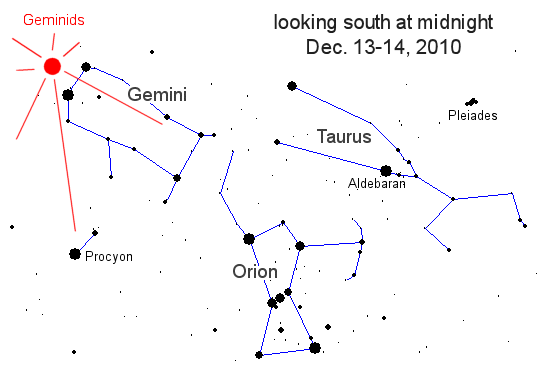
dark-sky sites. The best time to look is
probably between local midnight and sunrise on
Tuesday, Dec. 14th, when the Moon is low and the
constellation Gemini is high overhead, spitting
bright Geminids across a sparkling starry sky.
Bundle up, go outside, and savor
the mystery.
Author: Dr.
Tony
Phillips | Credit: Science@NASA
SOURCE: NASA
SCIENCE