|
Enigmas in Our Solar System New Planets Discovered |
|
|
Evidence for an Extended Scattered Disk? .
Orbit Determination of 2000 CR105 2000 CR105 is a transneptunain object (in our Solar System's Kuiper Belt beyond Neptune), discovered in Febuary 2000 during a Kuiper Belt survey by a team at Lowell Observatory. We tracked the object in March 2000 from the Canada-France-Hawaii telescope and showed that the object's orbit was larger than any other known Kuiper Belt object, and in particular the fact that it's pericenter was farther from Neptune than any other highly-eccentric object. Since then we have continued to follow the object and have proven that its orbit is only weakly affected by the giant planets. A paper has been submitted to the journal Icarus describing the implications of this fact. |
|
| Evidence for an extended scattered
disk
by B. Gladman, M. Holman, T. Grav, J. Kavelaars, P. Nicholson, K. Aksnes, and J-M. Petit. The paper has been accepted by
Icaurs, and is also
available via WWW download as
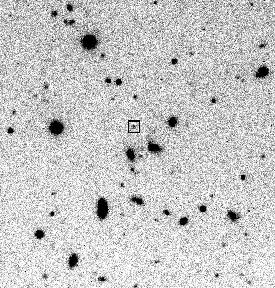
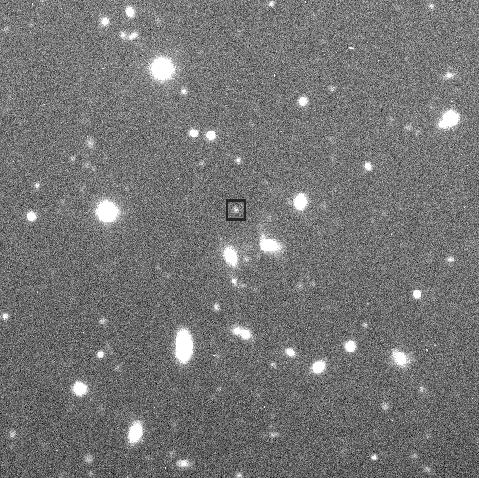
ImagesJPG images of 2000 CR105 in Normal black and white and Negative formats... 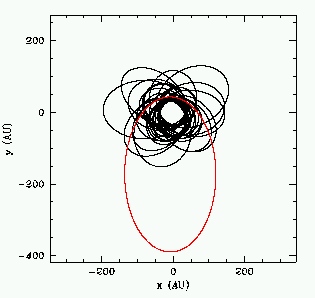
ORBIT OF SCATTERED DISK OBJECTS AND 2000 CR105 This figure compares the orbits of the other scattered disk objects with that we have estimated for 2000 CR105. This figure shows the orbits of all the known scattered disk objects (SDOs) as well as the much larger orbit of 2000 CR105 (in red). The SDOs are objects which are on large looping orbits; the most developedtheories for the creation of the scattered disk produce these orbits bygravitational scattering due to Neptune, which hurls them out to externalorbits which take hundreds of year to circulate around the Sun.Numerical calculations have shown that some of the objects can rest in this state for the 4.5-billion year lifetime of the Solar System. The first recognized SDO was 1996 TL66, discovered by Luu et al. in 1996 (reprint in pdf format available on the www). About two dozen such SDOs are now known, many of them have been discovered and tracked by C. Trujillo et al. The figure shows that 2000 CR105
journeys far from
the Sun, several times further than the other SDOs.
There are long-period
comets that journey much farther away towards the
Oort cloud. The interesting
facet of CR105's orbit is NOT its large size, but
rather the fact that
its perihelion (distance of closest approach to the
Sun) is larger than
any other known Solar System object.
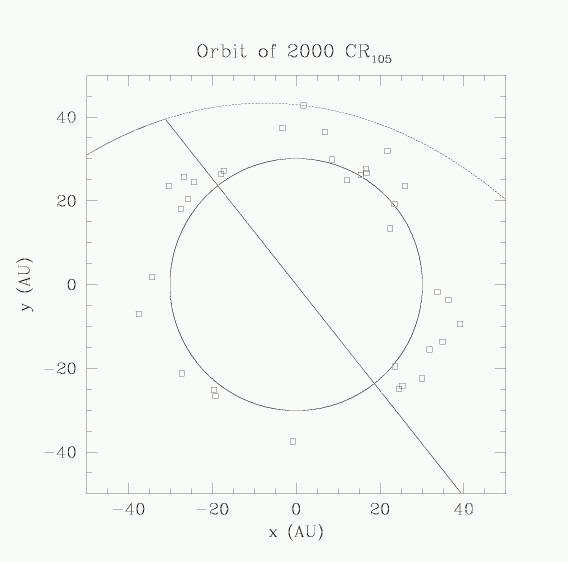 This figure shows a dot at the perihelion position of each of the SDOs plotted in the previous diagram, marking the point of closest solar approach. Only the orbit of 2000 CR105 is shown, and is dotted when the orbit is below the plane of the other planets and solid when above (2000 CR105's orbit is inclined about 20 degrees with respect to the plane of the solar system). The circle shows the orbit of Neptune, for reference. The straight solid line is the `line of nodes' of CR105, showing where its orbit intersects the plane of the planets. CR105 is currently past it's line of nodes and heading out farther into deep space to the top left of this plot. It is striking that this roughly 400-km object would be visible, even to the most powerful telescopes, for only a tiny fraction of its orbital period, while it is in the tiny portion near pericenter of its more than 3000-year orbital journey. Because the
perihelia of the SDOs are near Neptune,
it is thought that they are likely to be objects
that in the ancient past
had a close pass to Neptune and the planet's gravity
`sling-shotted' them
out onto large
The numerical simulations seem to show that it is possible for perihelia to eventually reach distances as far away as 40 AU. However, CR105's perihelion if 4.3 AU farther out than that (almost the distance from the Sun to Jupiter!) Therefore, the simulations do not seem to produce objects like this, and we believe that for the moment 2000 CR105 should NOT be classed as an SDO. In the preprint (available above) we discuss various scenarios which could have produced this fascinating object. Technical information All known astrometry of 2000 CR105 (MPC format, last update 31 Mar/2001) Page maintained by: |
|
| FAIR USE NOTICE: This page contains copyrighted material the use of which has not been specifically authorized by the copyright owner. Pegasus Research Consortium distributes this material without profit to those who have expressed a prior interest in receiving the included information for research and educational purposes. We believe this constitutes a fair use of any such copyrighted material as provided for in 17 U.S.C § 107. If you wish to use copyrighted material from this site for purposes of your own that go beyond fair use, you must obtain permission from the copyright owner. | |
|
|