|
The India ~ China Connection |
|
|
by Radha Banerji "It was the period which offered Buddhism favourable opportunities to spread far and wide beyond the geographical frontiers of India. King Kanishka and his successors who ruled during the early centuries of the Christian era and were eclectic in their religious outlook extended their patronage to all the religions that flourished in their kingdom. Among these religions Buddhism was the most prominent one. Kanishka was a great patron of Mahayana Buddhism. As a result of this, Buddhism in general and Mahayana Buddhism in special could spread without any obstacle in his vast kingdom comprising India, Afghanistan, Bactria and also certain parts of Xinjiang (Chinese Turkestan), viz. Kashgar, Yarkhand and Khotan. Kanishka’s reign was an active force for the dissemination of Buddhism in Afghanistan and Central Asia." Source
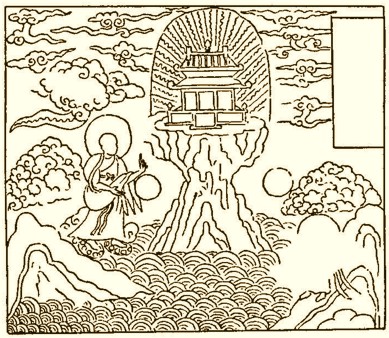
"In popular Indian cosmography Mt. Sumeru a magnificient mountain of gold and gems shaped like a cup or the seed vessel of the lotus, was believed to form the centre of the world, where all the planets revolved around it. On each face of this mountain a regent of the four quarters resided, and at the summit was the heaven of Brahma, and meeting place of the gods. This system was assimilated into Buddhism, where it later became part of the symbolic Triloka (three worlds) composing the Buddhist universe. The four regents were absorbed into the Buddhist pantheon to become important guardians of the faith. The fragments of the Bharhut railing dating around the middle of the 2nd B.C. indicate that their statue as Buddhist guardians was established at that time. The protectors of the Four regions appear there ivariably as warrior longs arravyed in gorgeous dress and armour and accompanied by supporters symbolising the hosts of Yaksa, or demons, over whom they rule according to Indian notion."
|
|
| Pyramids in
China - Great White Pyramid
The pyramids of China are approximately 100 ancient mounds, many of which were used for burial. Most of them are located within 100 kilometers of the city of Xi'an, around Xianyang, on the Qin Chuan Plains in the Shaanxi Province, central China. |
|
| FAIR USE NOTICE: This page contains copyrighted material the use of which has not been specifically authorized by the copyright owner. Pegasus Research Consortium distributes this material without profit to those who have expressed a prior interest in receiving the included information for research and educational purposes. We believe this constitutes a fair use of any such copyrighted material as provided for in 17 U.S.C § 107. If you wish to use copyrighted material from this site for purposes of your own that go beyond fair use, you must obtain permission from the copyright owner. | |
| ~ MENU ~ |