|
|
|
|
.
Fri Dec 8, 12:48 PM ET
The hazards of this hostile continent include ice, fire, wind and whiteout. And then there's the Crud. A debilitating ailment that can attack the nose, the throat, the chest or the gut, the Crud is a force to be reckoned with, especially for the highly skilled, highly pressured, highly motivated workers at McMurdo Station, the biggest U.S. science center in Antarctica. The garden-variety McMurdo Crud is "like what you'd call a cold back in the United States," said Dr. Harry Owens, the lead physician at the base hospital. Symptoms include stuffy nose, aching sinuses and ears and coughing. The problem is workers in Antarctica, often under pressure to accomplish much in a short stay, are reluctant to do what's needed to keep the Crud from infecting the entire population of 3000 or so: stay in bed, drink lots of fluids and wash hands before every meal and after every bathroom visit, Owens said. "Scientists and other grantees have more pressure to get things done -- the seals are only going to be out on the ice for so long -- but sometimes even they will say, 'Man, I can't budge,"' the doctor said. In one case, the South Pole station had to curtail operations a few years back because so many people there were down with the gastrointestinal version of the Crud, a particularly nasty strain featuring nausea, vomiting, diarrhea and prostration. Sufferers were simply too wiped out to move. Workers were too sick to unload planes that came to land. Those who were able made their own peanut-butter-and-jelly sandwiches to sustain themselves, since not enough kitchen staff were healthy. The prescription for this type of Crud is pure common sense, Owens said: "Go to bed, drink fluids and don't contaminate the galley." This means effective quarantine, with meals brought in by friends until the siege passes. So notices about the Crud are everywhere, and underlined in briefings for every new visitor. Hand-washing stations are in almost every hallway. For those who still forget to wash, jugs of waterless hand-sanitizing liquid are in the hallway leading to the main cafeteria. Other unexpected health hazards at McMurdo and elsewhere in Antarctica have to do with sleep deprivation, common for those unused to 24-hour-a-day sunlight. Again, Owens' advice is practical: try to darken sleeping rooms as much as possible, manage stress and keep a good attitude. Copyright © 2006 Reuters Limited. All rights reserved. Republication or redistribution of Reuters content is expressly prohibited without the prior written consent of Reuters. Reuters shall not be liable for any errors or delays in the content, or for any actions taken in reliance thereon. |
|
|
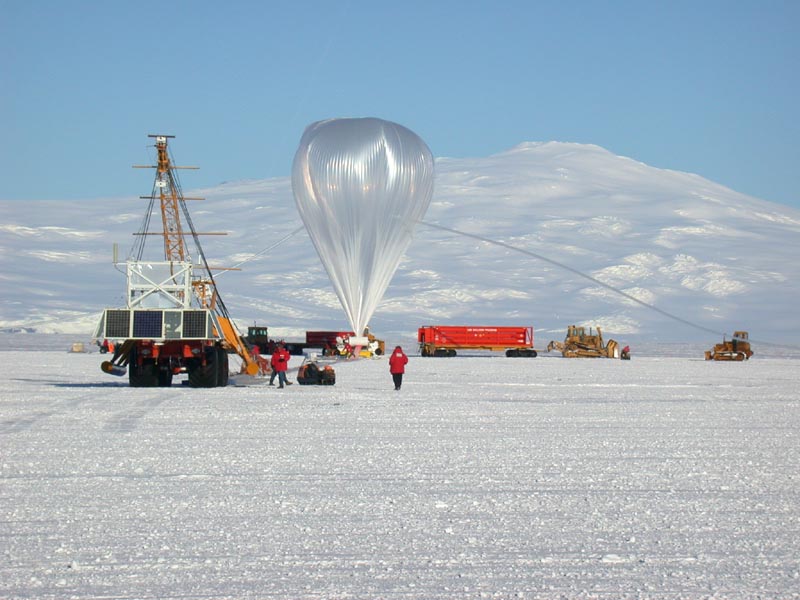
NASA has a presence in Antarctica TIGER launched from Antarctica's Mc Murdo base on December 16, 2003 (EST) and was brought down near Mawson base on January 4, 2004 after a successful 18 day flight. {See Photo top of Page} TIGER (Trans-Iron Galactic Element Recorder) is a balloon-borne NASA instrument that had three successful flights: one from Fort Sumner, NM (summer of 1997), and two from Antarctica (December 2001 - January 2002 and December 2003 - January 2004). The TIGER instrument measures the elemental composition of cosmic rays heavier than iron. |
|
| FAIR USE NOTICE: This page contains copyrighted material the use of which has not been specifically authorized by the copyright owner. Pegasus Research Consortium distributes this material without profit to those who have expressed a prior interest in receiving the included information for research and educational purposes. We believe this constitutes a fair use of any such copyrighted material as provided for in 17 U.S.C § 107. If you wish to use copyrighted material from this site for purposes of your own that go beyond fair use, you must obtain permission from the copyright owner. | |
| ~ MENU ~ |